I heard the story of Adolf Metzger when I was young – but it is only recently I encountered photographs of his bugle – discovered about 20 years after bugler Metzger wound up using it as his weapon at the Fetterman massacre (or, in Lakota terms, the battle of a hundred in the hand). I’ve read the story of Metzger’s death in histories, and heard the tale from Lakota – the versions have few discrepancies, though the Lakota version has more details.
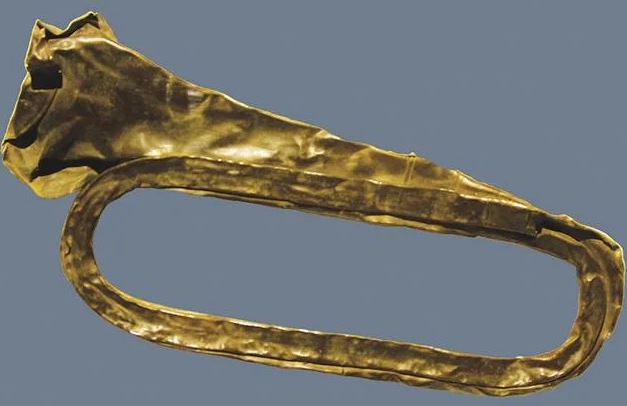
The Lakota story of the Fetterman fight describes Metzger riding in armed only with a “noisemaker” (his bugle) – and describes his role in the battle as seen through native eyes. His conduct was viewed as the only soldier who was there to essentially “count coup.” The story at Buffalo Bulletin includes
“The story of the bugle begins in November 1866, when 32-year-old Metzger traveled with the other members of Company C of the 2nd U.S. Calvary to the recently completed Fort Phil Kearny.
Tensions were high upon his arrival as U.S. troops and Native American forces had been fighting in the area for months.
On Dec. 21, a wood train going up to what is now Story was attacked by native forces. Those on the train signaled for reinforcements, which were sent out under the guidance of Captain William Fetterman.
Native American decoy riders lured the troops over the ridge just north of the fort. There they were met by more than 1,000 Cheyenne, Lakota and Arapaho warriors. The troops were out of sight of the fort and were quickly killed by native forces.
As the bugler, Metzger was responsible for directing troop movement after he was given a command.
“He would have, to all of our knowledge, been unarmed,” Bruner said. “It’s unfortunate that he wasn’t armed, but unless he could have afforded it on his own, he wouldn’t have been issued a weapon by the military.”
Legend has it that Metzger fought for survival using only his bugle. This courage in the face of staggering odds is likely what earned Metzger the respect of the Native Americans, Bruner said.
While Metzger and all 81 men under Fetterman’s command were killed during the fight, the bugle lived on – abandoned on the battlefield before being discovered by early Johnson County rancher Christian Hepp in 1887.
The bugle first joined the museum’s collection when it was given to museum namesake Jim Gatchell in the early 1950s. Whether Gatchell received the instrument from Hepp or some other mystery middleman is unknown although there is evidence of communications and transactions between Gatchell and Hepp.”
History Net offers these comments:
“In the wake of the Civil War, the federal government ignored a standing treaty with the Sioux—still a sovereign nation in 1866—and built three forts along the Bozeman Trail, which led to the Montana goldfields. In response, the Sioux, Northern Cheyennes and Arapahos besieged the forts. This was Red Cloud’s War—the only successful Indian campaign in the West, and the war in which Adolph Metzger became famous, however briefly, as the bravest of the brave.
Fort Phil Kearny, DakotaTerritory (in the part that would become Wyoming) was manned by a mixed detachment of the 18th U.S. Infantry and the 2nd Cavalry, including Metzger’s Company C. Commanding the post was Colonel Henry Carrington, a Yale graduate who had spent the Civil War as an administrative officer and had never seen combat. Among Carrington’s subordinates was Captain William Fetterman, a Civil War combat veteran who was unimpressed with the Lakotas, although he might not have actually said, “With 80 men, I could ride through the whole Sioux Nation.” On December 6, 1866, Lieutenant Horatio Bingham and Sergeant Gideon Bowers were killed when they pursued Lakota decoys into an ambush. The other troopers, including Metzger, barely escaped with their lives after Carrington encountered the self-possessed bugler and told him to blow recall.
Following this incident, the colonel apparently warned Fetterman never to pursue Indians out of sight of the fort. Then, around noon on December 21, Indians attacked a party of woodcutters not far from the fort. Fetterman set out with two other officers, 27 men of the 2nd Cavalry, 49 men of the 18th Infantry and two civilian scouts, James Wheatley and Isaac Fisher. The latter two had served in the Civil War and wanted to try out their new 16-shot Henry repeating rifles. As Fetterman’s foot soldiers followed his horsemen over Lodge Trail Ridge, at least 1,500 warriors rose from the snow-filled gullies and attacked.
Wheatley and Fisher with their repeaters and a half-dozen troopers with seven-shot Spencer carbines forted up in some rocks and hit an estimated 60 Indians or horses before being overwhelmed and literally cut to pieces. The 49 infantrymen died next. The Indians rushed in as soon as they saw the flashing ramrods of their single-shot Springfield muskets, and they clubbed or slashed the soldiers to death. Fetterman and his second-in-command, Captain Frederick Brown, did not place revolvers to one another’s temples and commit double suicide, though Brown might have shot himself. Many soldiers died cringing and piled in a heap while the Indians hacked at them.
Not Adolph Metzger. As the cavalrymen around him fell amid showers of arrows —40,000 according to one estimate— Metzger kept firing his seven-shot Spencer until he ran out of ammunition. As the Indians closed in, he used his bugle as a club, hitting several Indians over the head until the bugle was a twisted piece of brass. Wounded a dozen times, Metzger collapsed and died.The Sioux, instead of carving him up, cut a simple cross on his chest to indicate he had died facing the enemy and then covered his body in a buffalo robe as if he were sleeping. “His heroism had aroused the admiration of the savages,” Finn Burnett, a civilian at the post, said later. “They had covered his corpse with a buffalo robe as a symbol of extreme respect.”
At the time of the ambush, the Lakotas were mostly armed with bows and arrows and remained leery of the Army’s firepower. They had taken the precaution of having a hermaphrodite ritually curse the ambush site, zigzagging around with a black blanket over his/her head until envisioning 100 dead soldiers—and no survivors. Hermaphrodites, said to control life and death because they had two sets of genitals, garnered unwavering respect among the Lakotas. Nobody and nothing could be spared; the Indians even killed the soldiers’ pet dog, though one of them later said, “He looked so sweet.” The only survivor was Dapple Dave, an Army horse so badly wounded he had to be shot.
The Fetterman Fight was the worst defeat the Plains Indians handed the Army until Custer’s Last Stand, 10 years later. Metzger’s courage became frontier legend; it was later resurrected by Dee Brown in Fort Phil Kearny: An American Saga in 1962 and Evan S. Connell in Son of the Morning Star in 1984. In Lakota tradition, the German bugler remains among the bravest of the brave.”
My guess is that there was no hermaphrodite present – among the Lakota, a berdache was called a winkte, and those individuals had kind of a special spot. Still, the description is close enough that it almost fits the culture and the story. After all, it’s the west – and when the facts don’t match the legend, print the legend.
 Trego's Mountain Ear
Leave a comment