Watching the commentary on OceanGate’s submersible Titan brought back stories my father told. He had spent time as a diver during WWII and later – just how that fit in with his role as a Warrant Officer and Chief Boatswain never was quite clear to me, but damage control was his long suit.
One of his stories was the Squalus rescue – one of his shipmates from USS Hannibal had transferred to submarines, was on Squalus, and added a bit of personal interest to the story. It was 1939. Squalus was sunk in 240 feet of water. The story is here:
“On the morning of May 23, 1939, the submarine USS Squalus slipped beneath the storm-tossed surface of the Atlantic on a sea trial. Minutes into the maneuver, she began flooding uncontrollably. The Squalus sank to the ocean floor nine miles off the New Hampshire coast, trapping 59 men on board.
No submarine rescue had ever succeeded beyond 20 feet of water. The Squalus was down 240 feet. The Navy team had to use new methods that had existed only in theory before that day. They encountered problems that forced them to make decisions on the fly—each with life-or-death consequences. And they did it all with the world watching intently, captivated by the fate of the trapped men whose plight had been broadcast around the world at telegraph speed.”
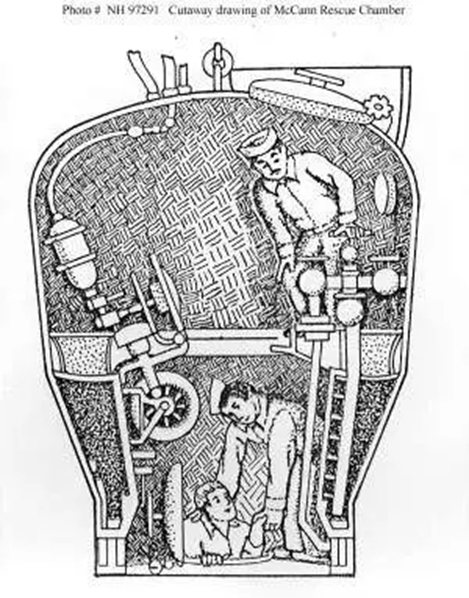
Squalus was 200 miles from the Momsen diving bell designed for submarine rescue. As you read the entire linked story, the luck factor keeps popping in – the sort of luck that happens to highly competent people. Still, losing even a few more hours would have changed the mission from rescue to recovery:
“It was only by luck that the rescuers knew where the Squalus went down.
Somehow, the exact coordinates of the dive had been garbled in transmission to the shipyard. So Sculpin went in the wrong direction to search for signs of Squalus.
One lookout, Lt. (jg) Ned Denby, happened to glance in the opposite direction and thought he saw a smudge of red smoke. He whipped out his binoculars and confirmed it was a distress signal just as the smoke disappeared. The Sculpin changed course and raced toward the spot.
At 12:55 p.m., Sculpin recovered the yellow telephone buoy and then dropped anchor. The trapped submariners’ spirits rose because they knew the propellers they heard came from their sister ship.
Sculpin’s commander, Lt. Warren Wilkin, got on the phone. “Hello, Squalus. This is Sculpin. What’s your trouble?”
Nichols, the lieutenant (jg.) who had sent up the marker buoy, responded: “High induction open, crew’s compartment, forward and after engine rooms flooded. Not sure about after torpedo room, but could not establish communication with that compartment. Hold the phone and I will put the captain on.”
Thirty seconds later, Naquin got on the line. “Hello, Wilkin,” said Naquin. Then the cable snapped.”
The Squalus was raised and recommissioned – this next excerpt comes from Naval History Magazine
“The Navy cleaned out the Squalus, repaired and recommissioned as the Sailfish in February 1940 She sank seven ships during World War II. Her conning tower now serves as a memorial to those who died at the Portsmouth Naval Shipyard.
Conning tower of SS-192 on display at Portsmouth Naval Shipyard, during a 2013 visit by Gen. Martin Dempsey, chairman of the Joint Chiefs of Staff.

 Trego's Mountain Ear
Leave a comment