The short definition would be a chemical other than glucose (sugar) that our taste buds interpret as “sweet”. These are the substances typically behind”diet” and “zero calorie” foods.
What are they? In the US, we’re likely to find those approved by the FDA:
- Aspartame
- Acesulfame potassium (Ace-K)
- Sucralose
- Neotame
- Advantame
- Saccharin
How do they work? (Or, to phrase it differently, how do they fool our tongues?)
To understand how artificial sweeteners work, we have to first consider how sugar (glucose) works. We have five basic tastes or, perhaps more accurately, five types of signals our tongue sends to our brain about the food we’re eating. Sugar is sweet because of how it bonds to our taste receptors.
Glucose is a popular molecule. The formula might be familiar from studies of photosynthesis or cellular respiration. It has 6 Carbons, 12 Hydrogen, and 6 Oxygen. It chemistry, arrangement is as important as formula. Flip a bond and glucose changes from a form we can digest into one we cannot.

It makes a degree of sense, then, that artificial sweeteners share some structural similarities with glucose. They are not equivalent to glucose in sweetness, however. Relative sweetness appears to be related to the ability to hydrogen bond with the taste receptors. Aspartame is probably at least a hundred times sweeter than glucose, and Saccharine is sweeter still.
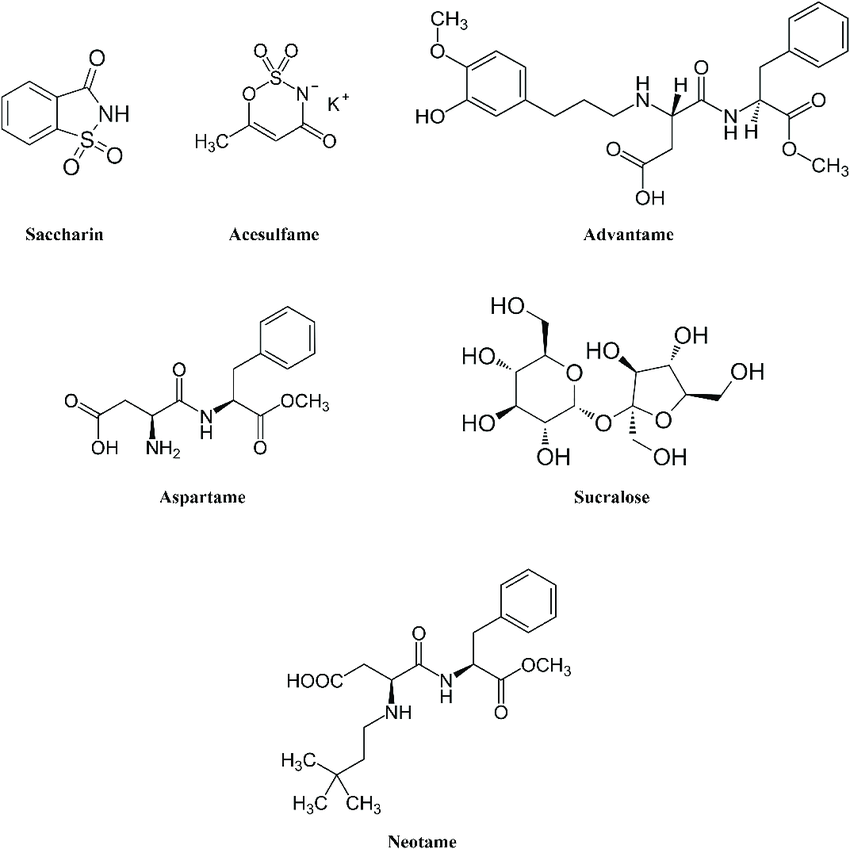
It’s of note that while this type of chemical drawing is generally easier to read, it often neglects to include some of the hydrogen in the structure (those familiar with the format are expected to know, from the structure, where they go). To someone familiar with the illustration style, it’s clear that these molecules all have areas with plenty of hydrogen.
For the most part, these are substances that our bodies are not able to break down for energy; Aspartame is an exception, and is not “zero calorie” but is generally used in smaller quantities.
One of the many interesting characteristics about artificial sweeteners, is that while they fool our taste buds, they do not fool our gut. Some studies with rats showed that even without taste buds, they were able to distinguish between sugar and saccharine (and preferred the real thing). Taste is not merely an artifact of the taste buds- but more on that system another time.
 Trego's Mountain Ear
Leave a comment