Again I have watched a fourth largest town in Lincoln County grow with tents as a field filled with firefighters. It isn’t a new thing – when an August fire hits in a dry year, it’s people in yellow shirts that come in and buy time until the shorter, cooler days of Fall can extinguish the fire. Sometimes those shorter, cooler days get close to the winter solstice.
I had a good view of the scoop planes flying over the house and field after they had filled up at Dickey Lake and were returning to the fire. My own fire training was in 1968 – as best I recall it emphasized using a Pulaski and a sharpened shovel. The concept was simple – dig a line around the fire and hold it.
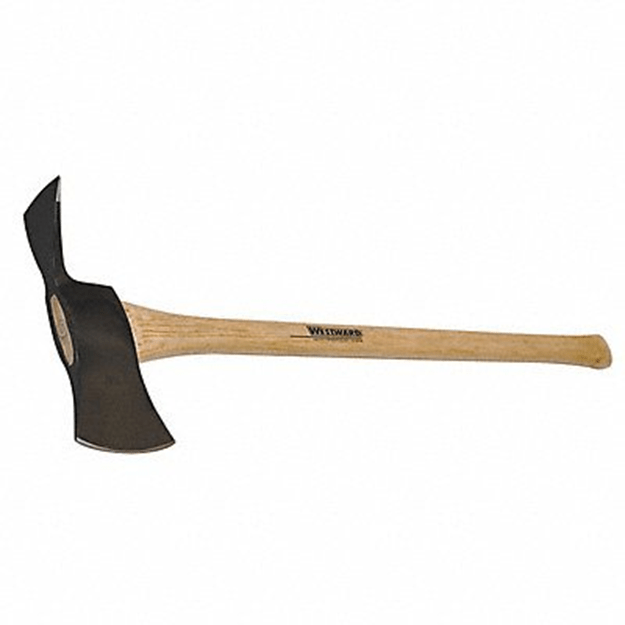
I learned that the Pulaski was invented by Ed Pulaski after the 1910 fires, and had been a firefighter’s tool of choice ever since. Pulaski’s own story of the 1910 fire is at Surrounded by Forest Fires It’s definitely worth a click and taking the time to read. Edward Pulaski tells more about the man, and the tool he developed.
Or maybe re-invented is a better description. The True Story of the Pulaski Fire Tool – Wildfire Today describes the story a bit differently than I learned it:
“The nickel-plated pulaski looks as good as new in its glass-fronted Collins Tool Company display case at the Smithsonian Museum of Arts and Industry in Washington, DC. Surrounded by equally shiny cutting tools of all description, the pulaski was first put on display at the Nation’s Centennial Exhibit in Philadelphia in 1876.
Conventional wisdom holds that the pulaski fire tool was invented by Edward C. “Big Ed” Pulaski in the second decade of the 20th century. Ed Pulaski, a descendant of American Revolution hero Casimir Pulaski, was a hero of the Great Idaho Fire of 1910, leading his crew to safety when they became imperiled. He was also one of a group of ranger tinkerers who struggled to solve the equipment problems of the budding forestry profession. However, the pulaski tool on display at the Smithsonian must have been made when Big Ed was no more than 6 years old!”
The article continues with the story:
“William G. Weigle, supervisor of the Coeur d’ Alene National Forest, thought of the idea-but not for firefighting (5). Rangers Ed Pulaski and Joe Halm worked under him (all three became heroes of the Great Idaho Fire) at Wallace, then headquarters for the Coeur d’Alene National Forest. At that time, plans were being made for some experimental reforestation, including the planting, pine seedlings. As Supervisor Weigle planned the job, he decided a new tool was needed to help with the planting as well as other forestry work. He decided on a combination of ax, mattock, and shovel. One day in late 1910 or 1911, Weigle sent Rangers Joe Halm and Ed Holcomb to Pulaski’s home blacksmith shop to tum out a combination tool that might replace the mattock that was then in common use for tree planting. Halm, with Holcomb helping, cut one blade off a double-bitted ax, then welded a mattock hoe on at right angles to the former blade position. He then drilled a hole in an old shovel and attached it to the ax-mattock piece by means of a wing bolt, placing it so the user could sink the shovel into the earth by applying foot pressure to the mattock blade.
The rather awkward device was not a success as a planting tool. Probably the whole idea would have been abandoned had not Ranger Pulaski been fascinated with the possibilities of the tool. He kept using it, experimenting with it, and improving it. He soon discovered that the bolted-on shovel was awkward and unsatisfactory. He abandoned the shovel part and also lengthened and reshaped the ax and mattock blades. It is too bad Pulaski did not know about the Collins Tool pulaski — it would have saved him a lot of time. Nevertheless, by 1913 Pulaski had succeeded in making a well-balanced tool with a sharp ax on one side and a mattock or grubbing blade on the other.
Pulaski use now spread throughout the Rocky Mountain region. However, it was used not for tree planting but for fire control. By 1920 the demand was so great that a commercial tool company was asked to handle production.”
I can’t bring myself to write great praise for the balance of a Pulaski – it builds a love-hate relationship when you dig line for 12 hours of night, then return to an open camp in a field to attempt sleep without shade through the heat of the day. Still, it must have been pure hell trying to beat forest fires before the Pulaski came into use.
 Trego's Mountain Ear
Leave a comment