In New Mexico, I see the governor issuing an executive order that bans carrying firearms in a single county. She issued that order because a couple of kids were shot – I’d tend to use the word murdered. She found a simple solution that doesn’t address the problem, but affects a lot of people and violates both her state constitution and the US constitution.
There are right turn lanes from highway 93 to each exit for Trego from the north – but no left turn lanes from the south. Right turn lanes were simple to add – the complexity of highway design made including left-turn lanes a project that required more thought and planning. I don’t like making the left into Trego when I have cars making 75 mph on my tail – and I remember a highway department employee telling me that “a couple of people are going to have to die before you get a left turn lane.”
Trego, Stryker, Fortine and Rexford have had part-time post offices for quite a while. Now, I read that UPS will be cutting down to 3 days a week of delivery. It’s a simple solution – but I’m not sure that it directly affects the problem – remoteness.

The simple solution to messy, misused garbage transfer sites – our green boxes – is to reduce the number of sites and reduce access. Another solution is “Narc on your Neighbor” – turn in the folks who violate policy. Clear, simple, and wrong.
If we carry that Einstein quote out a little farther, perhaps another interpretation is that the problems we encounter in complex societies require more complex thinking rather than less. Every increase in complexity has been incorporated as a simple solution . . . and has generally led to another problem that was solved by increasing complexity.
Gibbons wrote of the rise and fall of the Roman Empire. Six volumes, and he gave Christianity credit for being the fall. He may have been right – but Rome was basically a pirate empire – supported by taking wealth from the neighboring folks they conquered. As they ran out of neighbors, the wealth stream grew smaller . . . in the year 383, Rome abandoned northern and western Britain. Around 409, Rome completed their Brexit. About 641, Rome was out of Egypt, as a new concept – the religious state, following the Koran, proved stronger than the pirate empire. When the old ways couldn’t continue successfully, nobody changed the paradigm.
As taxation, security, transportation and declining crop yields combined to make farming unprofitable at the edges of the empire, Rome’s solution was to declare that, if you were born a farmer, you couldn’t change professions . . . small wonder the barbarians on the edges of the Roman empire looked better to those agriculturists away from the capital. I suspect that those folks at the fringes of the empire were reduced to the equivalent of part-time post offices and three-day UPS deliveries long before the empire’s official fall in 476.
We live in a complex society – even an activity that is as mundane as garbage disposal is stressed. The same thinking that created a problem seems, and is, incapable of providing a solution. In 1910, faced with the problem of disposal of kitchen trash at the Tobacco Lumber dam in Trego, the cook hauled the empty cans to a stumphole on the adjacent place. Less than a century later, the solution was to haul those empty cans to the greenboxes.
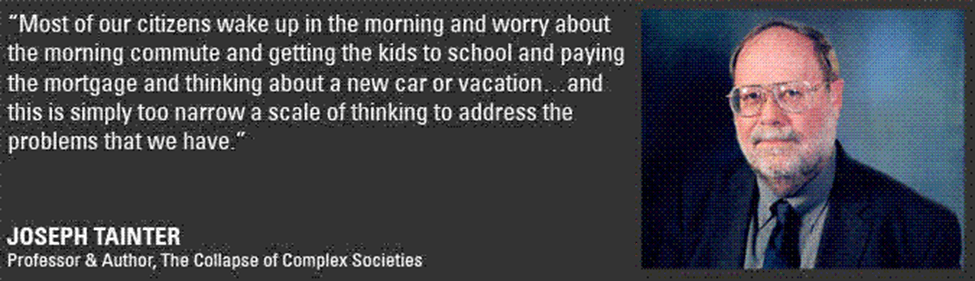
Joseph Tainter’s book on The Collapse of Complex Societies is expensive – worth reading, but expensive. A PDF is available at Princeton that you can access online: The collapse of complex societies . It’s relevant to understanding our greenboxes and reduced deliveries.
“in the evolution of a society, continued investment in complexity as a problem-solving strategy yields a declining marginal return.”

 Trego's Mountain Ear
Leave a comment