A phobia is, by definition, intense, persistent and irrational. Glancing at the historical record, it’s difficult to claim that a fear of Islam is irrational. The Rise of Islamic Geography in the Middle Ages provides this description of Islamic expansion:
“The Islamic empire began to expand beyond the Arabian Peninsula after the death of the prophet and founder of Islam, Mohammed, in 632 CE. Islamic leaders conquered Iran in 641 and in 642, Egypt was under Islamic control. In the eighth century, all of northern Africa, the Iberian Peninsula (Spain and Portugal), India, and Indonesia became Islamic lands. The Muslims were stopped from further expansion into Europe by their defeat at the Battle of Tours in France in 732. Nonetheless, Islamic rule continued on the Iberian Peninsula for nearly nine centuries.”
When we talk about the west, or western civilization, we’re referring to what was the western quarter of Christendom – Europe. Prior to the Islamic expansion, Egypt was Christian. Syria was Christian. The Byzantines were Christian. A century after Mohammed’s death, three fourths of the Christian world was under Islamic rule – The First Crusade didn’t occur until 1096. Spain – then Andalusia – had been under Islamic rule for over 350 years when the first Crusade set out for Jerusalem.
Still, having a quarter of the territory left was pretty good compared to Zoroastrianism –
“Zoroastrianism is an ancient Persian religion that may have originated as early as 4,000 years ago. Arguably the world’s first monotheistic faith, it’s one of the oldest religions still in existence. Zoroastrianism was the state religion of three Persian dynasties, until the Muslim conquest of Persia in the seventh century A.D. Zoroastrian refugees, called Parsis, escaped Muslim persecution in Iran by emigrating to India. Zoroastrianism now has an estimated 100,000 to 200,000 worshipers worldwide, and is practiced today as a minority religion in parts of Iran and India.”
“The Muslim conquest of Persia between A.D. 633 and 651 led to the fall of the Sassanian Persian Empire and the decline of the Zoroastrian religion in Iran.
The Arab invaders charged Zoroastrians living in Persia taxes for retaining their religious practices and implemented laws to make life difficult for them. Over time, most Iranian Zoroastrians converted to Islam.”
“Having failed to take Vienna in the siege of 1529, the Turks prepared a second attempt in 1683. Under the leadership of the Grand Vizier, Pasha Kara Mustafa, and with their Tatar and Malaysian allies, they made their preparations and fought their way towards the capital, overrunning Austrian villages and smaller cities in their path and taking many captives. As the Muslim hordes approached Vienna, King Leopold fled west with most of the citizens, leaving a garrison of about 11,000 soldiers and 5,000 citizen volunteers to hold the city against the Turks. The Viennese razed buildings in the area around the city walls in order to deny the enemy cover, and brought livestock and provender into the city to prepare for a siege.
On July 16th, 1683, the second siege of Vienna began. The tiny garrison in the city was no match for Kara Mustafa’s army of 140,000, but the Grand Vizier decided to starve the city into submission rather than attempt a frontal assault on its defenses.
All of these squabbling political entities were Catholic, and theoretically united under the leadership of Rome. Pope Innocent XI recognized the danger posed by the Ottomans, and, in the name of God and the Church, called on all the rulers of Central Europe to unite against the common foe and save Vienna.
Louis XIV declined to obey his pontiff, and continued his scheming.
Jan Sobieski, on the other hand, was ready to answer the Pope’s call. However, in order to go to war, Polish law required him to get the unanimous approval of the Polish Diet. The French king’s ambassador plied members of the Diet with massive bribes to induce them to vote against Sobieski’s venture. Through most of the summer it seemed that Sobieski would be unable to ride to Vienna.
Fortunately for the Austrians, and for Christendom, Pope Innocent authorized the papal nuncio in Kraków to use the full resources of the Vatican. The nuncio was able to outbid Louis in bribery, but only barely. In the end the Diet reached unanimity and authorized their King to ride to the relief of Vienna.
When the King of Poland set off for Vienna in early September, the Viennese garrison was in desperate straits. The people of the city were starving, and the city had suffered serious damage from the Turkish bombardment.
The Ottoman armies’ artillery pieces were of inferior design, and were unable to reduce the city walls, so the Turks had taken to tunneling. They had ample gunpowder, and their engineers dug mines under the walls and set off a number of charges that did serious damage and opened gaps in the walls. The Viennese rallied to build barriers in the gaps, and managed to keep the Turks out, but it was only a matter of time until Kara Mustafa succeeded. The Viennese garrison prepared for a last-ditch defense within the city walls.
It was then, at the last possible moment on the evening of September 11th, that Jan Sobieski arrived at a hill north of the city, leading a force of 40,000 Poles and their German and Austrian allies. The battle began soon afterwards, in the early morning hours of September 12th.
The Austrians and Germans attacked the Turks first at the center and on the left flank. The Turks counterattacked, but held back a significant portion of their forces in anticipation of entering the city through a breach in the wall. That very morning the Grand Vizier had prepared a second and more powerful charge to be set off under the Löbel bastion, one that would throw the city open to the Turkish forces once and for all.
Unfortunately for Kara Mustafa, the Austrians within the city had mounted a counter-tunneling operation. The Austrian “moles” detected the Turkish mine, found the charge, and defused it.
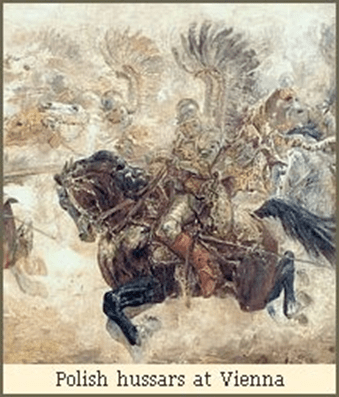
At about the same time the King of Poland, in the van with the fearsome Winged Hussars and with 20,000 men behind him, led a cavalry charge down the hill into the right flank of the Ottoman army. The Hussars were one of the most formidable fighting forces of the time, and the sound of the wind through the feathers of their artificial wings was said to unnerve the enemies’ horses and drive superstitious soldiers into a panic.
The battle was over in three hours. The King drove through the Turkish lines, and, seeing his success, the Vienna garrison sallied forth from the city and hit the Turks from the rear. Demoralized by these attacks and their failure to breach the wall, the Turks fled eastwards in haste, abandoning their tents, weapons, battle standards, provisions, and slaves.
The siege was broken and city was saved. Jan III Sobieski was received as the hero of Vienna. Though it was not evident at the time, the Ottoman tide had turned at the Gates of Vienna and was about to recede, beginning its long withdrawal through the Balkans and Greece into Asia Minor over the next two centuries.
Looking at history – even ancient history – suggests that Islamophobia may not qualify as irrational.

 Trego's Mountain Ear
Leave a comment