I’m pretty sure I misspelled the word in my undergrad notes – but the notes are long gone, so I’m taking the definition from the net, not from Professor Carmichael: Miriam Webster says
“völkerwanderungen -ŋən
: the migration of nations
especially : the movement into southern and western Europe of the Teutonic peoples, Huns, and Slavs from the 2d century a.d. to about the 11th century reaching the peak in the 5th and 6th centuries and closing with the settling of Norsemen in England and France”
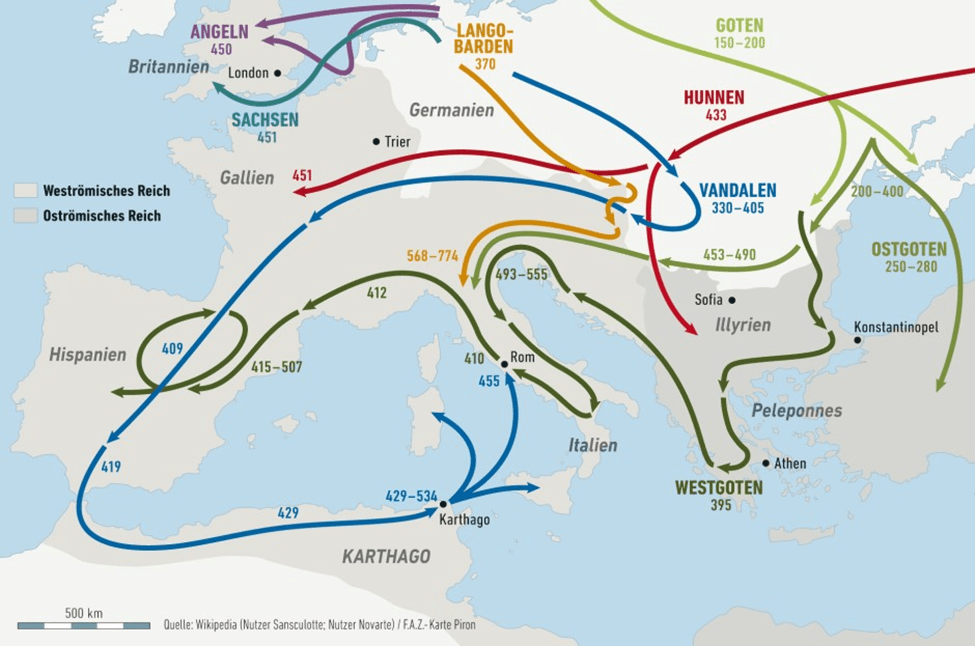
I’m looking at this historical migration of nations and thinking about the immigration crisis along our southern border, and the photographs of jam-packed boats crossing the Mediterranean from Africa to Europe. Sure, the immigrants we see are mostly young men . . . but that may have been the case in the first years of the volkerwanderungen. The rule may be women and children first in lifeboats, but in folk migrations, the tendency runs single men first, then married couples with no kids.
Crossing the Rio Grande is a simple decision – Mexico looks better than Venezuela or Honduras – but the US is still the land of the big PX. I’ve relocated for better jobs and opportunities several times. Never had to leave the US for employment, but I have considered it, and know people who have. In my own limited way, I understand the motivation of migrants.
Southern Europe must look a lot better than the nations these folks have left behind – and the photo suggests that the vast majority of these migrants are young men. As I think of American history, I recollect that the Lewis & Clark expedition was also composed of young, single men – until they added Sacajawea.
Folks have been crossing the southern border for over a century, with or without papers. It’s a more mature folk-wandering than Europe – complete with women and children.
The original Volkswanderung occurred as the Roman Empire went into full decline – I can’t say if there was a causal relationship or not. Still, historians tend to give a lot of credit to Rome losing battles with the barbarians – 8 Reasons Why Rome Fell | HISTORY :
“The most straightforward theory for Western Rome’s collapse pins the fall on a string of military losses sustained against outside forces. Rome had tangled with Germanic tribes for centuries, but by the 300s “barbarian” groups like the Goths had encroached beyond the Empire’s borders. The Romans weathered a Germanic uprising in the late fourth century, but in 410 the Visigoth King Alaric successfully sacked the city of Rome.
The Empire spent the next several decades under constant threat before “the Eternal City” was raided again in 455, this time by the Vandals. Finally, in 476, the Germanic leader Odoacer staged a revolt and deposed Emperor Romulus Augustulus. From then on, no Roman emperor would ever again rule from a post in Italy, leading many to cite 476 as the year the Western Empire suffered its death blow.”
The Barbarian attacks on Rome partially stemmed from a mass migration caused by the Huns’ invasion of Europe in the late fourth century. When these Eurasian warriors rampaged through northern Europe, they drove many Germanic tribes to the borders of the Roman Empire. The Romans grudgingly allowed members of the Visigoth tribe to cross south of the Danube and into the safety of Roman territory, but they treated them with extreme cruelty.
According to the historian Ammianus Marcellinus, Roman officials even forced the starving Goths to trade their children into slavery in exchange for dog meat. In brutalizing the Goths, the Romans created a dangerous enemy within their own borders. When the oppression became too much to bear, the Goths rose up in revolt and eventually routed a Roman army and killed the Eastern Emperor Valens during the Battle of Adrianople in A.D. 378. The shocked Romans negotiated a flimsy peace with the barbarians, but the truce unraveled in 410, when the Goth King Alaric moved west and sacked Rome. With the Western Empire weakened, Germanic tribes like the Vandals and the Saxons were able to surge across its borders and occupy Britain, Spain and North Africa.”
Just conjecture, and recalling a lecture from over 50 years ago – but the articles at the links may be worth reading.
 Trego's Mountain Ear
Leave a comment