My mother-in-law was a refugee. She lived through the Russian Revolution, the Holodomor, and did a long stretch in Hitler’s camps. She came to the United States in 1947 – Stalin’s decree would have put her doing a tour in Siberia for practicing medicine in those German camps. She was a refugee – her next-door neighbors were a Jewish family who had fled Germany, and the couple across the street were refugees from Poland. But that refugee status belonged to a single generation. Their kids were Americans of the Baby Boom.
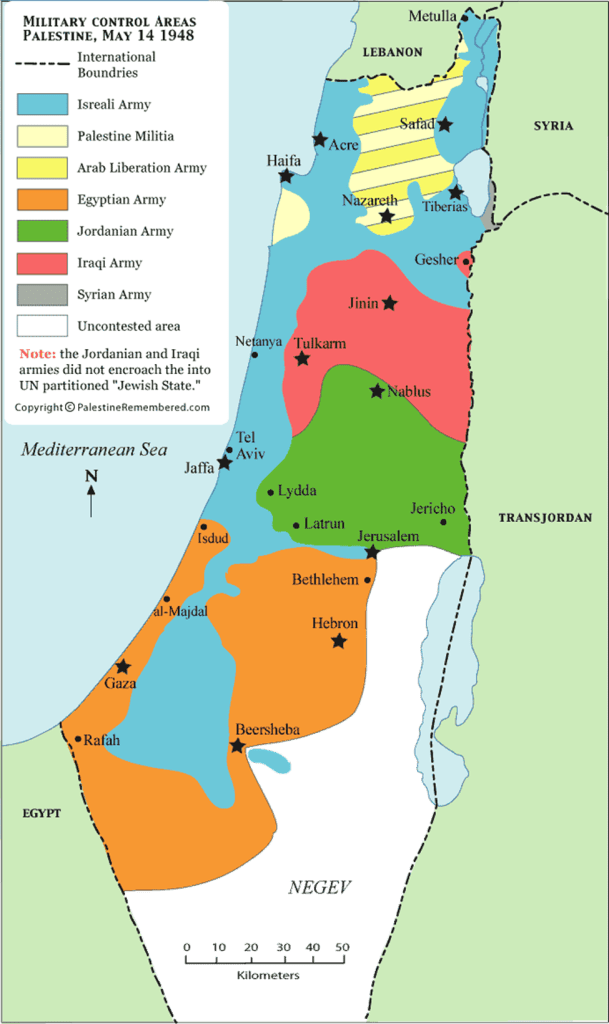
Israel declared independence on May 14, 1948. The next day, armies from Egypt, Iraq, Jordan and Syria invaded Israel. The war went on for the next 13 months. The number of refugees from that conflict: 804,766. A 2000 census shows the survivors of that original group of refugees and their descendants number 5,248,185. The Mid-East Monitor shows the number at 6.4 million in 2022. In Jordan, most of the Palestinian refugees are Jordanian citizens. This is not the case in other nations.
Latest Population Statistics for Israel shows:
The Jewish population is 7,181,000 (73.3%), and 2,065,000 (21.1%) are Arabs.
In 2022, the population by religion was roughly 18% Muslim (1,728,000), 2% (184,400) Christian, and 2% Druze (149,400).
From those numbers, my guess is that over 6 million Palestinian refugees were born refugees – never living in the area we call Israel. The dates show that the oldest of those born with refugee status are around 75 years old. One of the horrors of being stateless is the inability to emigrate to a nation where you can build a home.
In 1947, the decolonization movement succeeded in splitting Pakistan and India away from British Rule. Victims of History: The Untold Story of Pakistani Hindu Refugees in India At that time, roughly a quarter of Pakistan was Hindu. Today, that’s 2% and shrinking. India now has over 100,000 Pakistani Hindu refugees. Contrast that with 6 million Palestinian refugees.
I don’t have refugee experience – I remember Willi explaining to me that Americans don’t have an understanding of what it is like to flee with only what you can stuff into your pockets. I recall hearing a European refugee explain the wonderful thing about Canada: “There is always enough to eat.”
The Arab nations have not, in general, been willing to absorb the Palestinian refugees – I think back to Yassar Arafat – born in Cairo, Egypt, yet head of the Palestinian Liberation Organization. I recall Palestinian students in the mid-eighties, telling that their families still kept the keys to the houses they had locked and abandoned in 1948 . . . as if, 40 years later they would still be standing.
Finding a place that will accept Palestinians was difficult in 1950 – so they were left in camps, and the population increased. Now, the world needs a location for over 6 million Palestinians . . . and if that number were instantly moved into Israel and granted citizenship, Israel would instantly tip to a Muslim majority country. I can understand why Israelis tend to regard that as an unsatisfactory solution.
Jordan accepted Palestinians as citizens – and Black September is the name for the Jordanian Civil War between the Hashemite forces of King Hussein and Yassar Arafat’s Palestinian Liberation Organization. Fifty Years after “Black September” in Jordan provides an explanation of just how close the balance was for that nation – which makes the reluctance of other Arab states to accept Palestinians fairly understandable.
I can see that letting a problem grow for 75 years leaves future generations with an unsatisfactory solution to a situation none of the present generation created. That thought isn’t original to me – I heard it in slightly different form from a Pakistani economist years ago. I am reasonably sure that there are rational Palestinians and Israelis who would prefer a peaceful solution. I am also reasonably certain that the rational people aren’t in charge – and that continues the unsatisfactory solution of generational refugees.
 Trego's Mountain Ear
Leave a comment