Louis Pasteur is credited with the observation that “Fortune favors the prepared mind.” I suppose I started preparing to identify Lonesome Charley Reynolds’ Sharps rifle before I was 10. I read my grandmother’s book Frontier and Indian Life by Joseph Henry Taylor, and the section on Lonesome Charley began “One day in the early summer of 1870, there appeared at the lower Painted Woods, of then Territory of Dakota, a young man about twenty-four years of age, singing a Sharps 44 calibre, 80 grain charge, rifle over his shoulder and leading a pony in pack. He ostentatiously gave his name as Charley Reynolds, and his occupation that of a professional huntsman.”
Taylor, in 1870, was a hunter and trapper living at the Painted Woods. As he grew older, he became a printer in Washburn, ND, and employed my then teen-aged or younger grandfather as his ‘printer’s devil’ – a phrase describing the job of a juvenile assistant.
When I taught at Trinidad State, I took advantage of the wonderfully complete gunsmithing library to learn more: that 44 calibre Sharps had to be an 1869 cartridge – technically, the 45-77 Sharps was a Remington cartridge first. The two-piece cartridge, part iron, part brass was designed to be cleaned and reloaded easily.
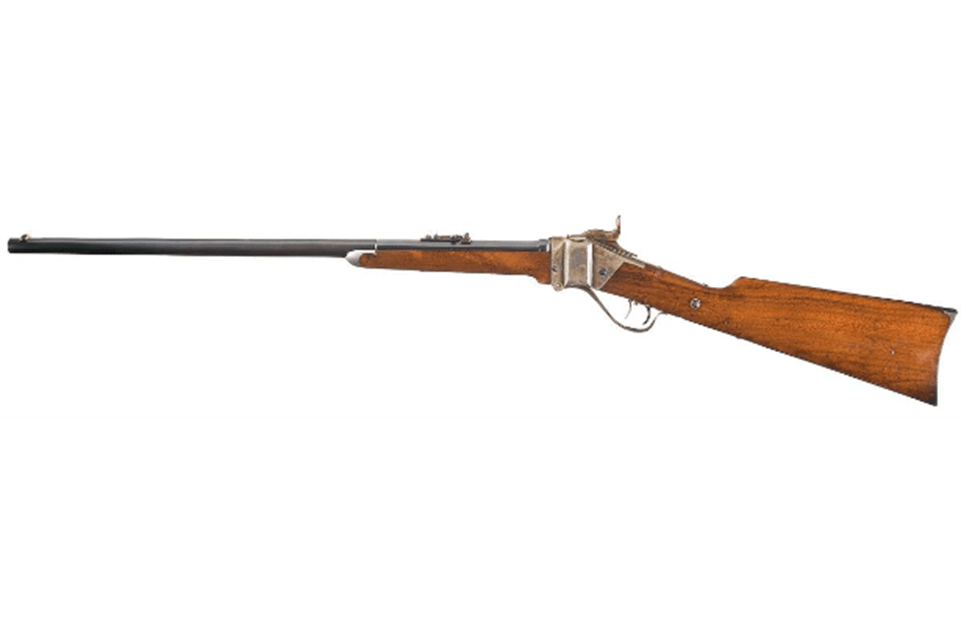
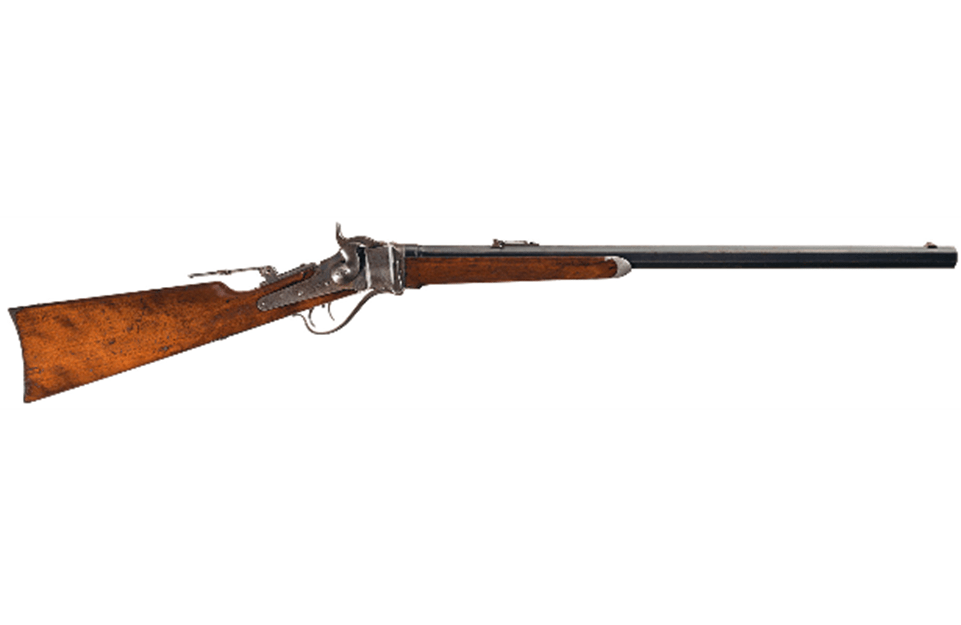
This rifle, sold in 2010 at auction, probably is very similar to the rifle Lonesome Charley carried on that day in 1870 when he met Joe Taylor – and probably similar in appearance before Lonesome Charley’s rifle had it’s stock smashed and barrel bent before being abandoned on the Reno attack section of the Little Bighorn Battlefield:
We ran across Lonesome Charlie’s rifle at the privately owned museum at Garryowen – not far from the spot where Lonesome Charley died at the Little Bighorn. The barrel has been bent, probably by Cavalry troopers who recognized the problem of finding cartridges for it, but didn’t want it left for that fortunate Lakota marksman who might find some.
This 1869 Sporting rifle, sold in 2018, included a factory letter that explained only 50 were made:
“Richard J. Labowskie notes that this rifle is “among the finest of the known examples of Model 1869 Sporting Rifles. . .” Only 50 of these New Model 1869 Sporting Rifles were manufactured in 1869-1872 according to Sharps firearms expert Frank Sellers in his book “Sharps Firearms.”
Lonesome Charley was Custer’s chief of scouts in both the Black Hills expedition and in Custer’s final chapter. Joseph Taylor described their last visit – “Through Reynolds influence with Custer, the writer of these sketches was tendered the position of assistant guide and Reynolds visited the Turtle Valley Ranch where I was then stopping. Holding some regard for the just rights of the Indians in the premises, and fearing a repetition of Chivington’s work at Sand Creek, or of Baker’s butchery of the Piegan small pox victims in Montana, or that of the General himself in the destruction of Black Kettle’s camp of southern Cheyenne’s, the flattering offer was respectfully declined.
In this interview at the Turtle valley – which so far as we two were concerned was destined to be our last – he said while Custer and his officers were of the opinion, basing it upon the attitude of these Indians during the invasion of their hunting grounds about the Black Hills and the various taunting military reconnaissance made from time to time in the Sioux country, that these refractory Sioux under Sitting Bull and Crazy Horse would not make much disturbance or resistance when confronted by military power.
Reynolds seemed of a different opinion. He had been making observations, he said, and he believed the Sioux would fight, and fight hard. He had noticed them quietly preparing for a long time – supplying themselves with plenty of ammunition and the best of Winchester rifles, and every move they were making meant fight, and while he did not believe the Sioux had the dashing courage of a Cheyenne or the stubbornness of a Modoc, there was fight in them and they would show it at the proper time. They expected to fight and he thought that summer would witness the greatest Indian battle ever fought on the continent.
The event of July 25th, of that year marked the chief guide’s prophecy as being nearly correct.”
This studio photograph is the picture of Charley Reynolds in Joseph Taylor’s book.

Reading Joseph Taylor’s book left me prepared for the more modern view of Custer – and learning the rarity of his rifle gives me confidence that the bent Sharps in the museum deserved a more prominent place in the museum – with only 50 made, probability is on my side.
 Trego's Mountain Ear
Leave a comment