As the last hatch of goslings began their flight training, we noticed that two are being left behind. A bit more observation showed that one is a bit older than the other, but both show enough wing problems in the last joint to qualify them as angel wing. The Poultry Feed provides a description of the condition: “Angel Wing, also known as slipped wing or carpal deformity, is a wing condition that affects the flight feathers of geese. The condition is characterized by the outward twisting or “S” shape of the last joint of the wing, making the feathers point away from the body. This results in an inability for the goose to fold its wings properly, affecting its flight capabilities.”
The site includes this photo, which may be worth the proverbial thousand words in describing the condition:
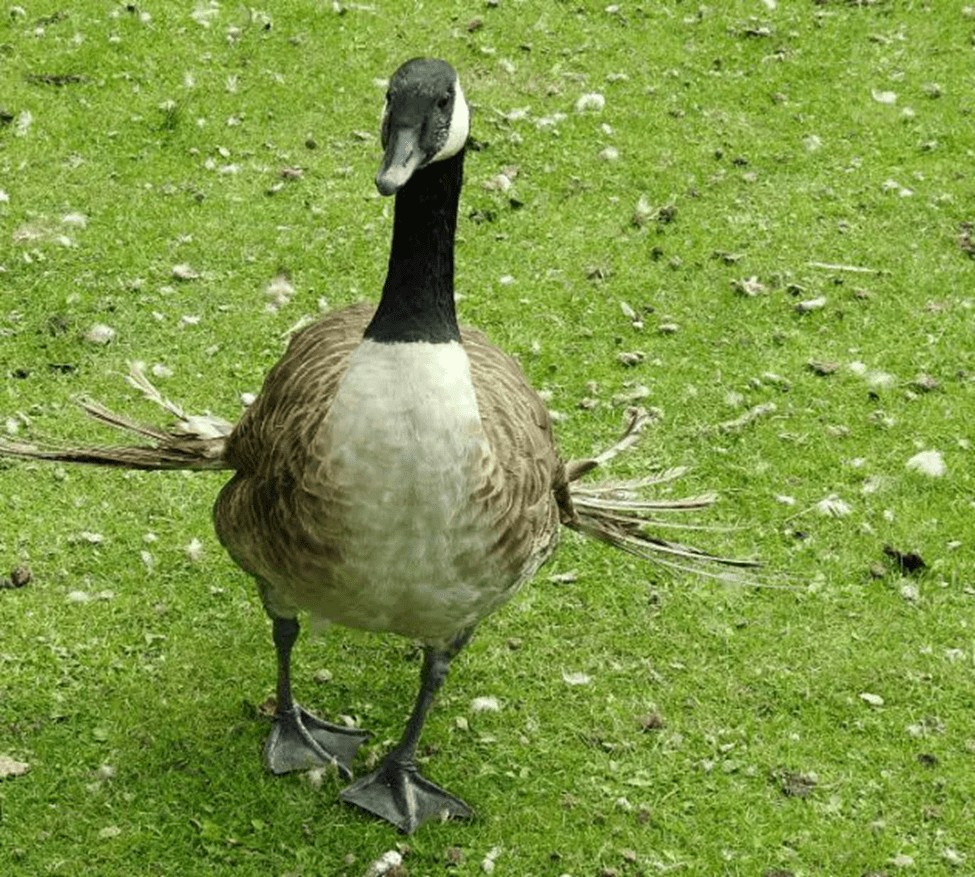
The two young geese on our pond aren’t nearly so extreme – but a goose who can barely fly is a goose who has to be left behind in the Fall. I’ve been impressed with how long the parents work to try get that last goose airborne, but the end is always the same – the family flies south, and the goose with the wing deformity is left on the same pond where it hatched.
It’s been several years since we encountered the first case of Angel Wing on the pond – the goose could almost fly, and worked hard at it. I kept an aerator on through the winter to keep a bit of open water, and the crippled goose almost made it to Spring – when the Golden Eagle got it. Last year, one with a crippled wing just stayed in the field – easy prey for the Bald Eagle. A goose that can’t fly has problems, and a solitary goose has more problems. This time we’re seeing two crippled geese as Fall approaches. I prefer a world where no goose is left behind – but that isn’t going to be the case this Fall. So I’ll keep an aerator on as Winter sets in – a goose on the water isn’t a real safe target for the eagle. I’ll stick a couple of bales of hay close to the open water – and I’ll feel a bit of sadness when the eagle does harvest the cripple. I’ve never had a pair of crippled geese left behind – in some ways it seems kinder, since a goose without a flock seems pathetically lonesome
 Trego's Mountain Ear
Leave a comment