To tell the truth, I can’t tell you which phrase fits. I’ve probably built both – long before some anti-gun politician or activist came up with the two phrases.
As I understand it – and my understanding of how guns work is a lot better than my understanding of anti-gun folks – a ghost gun is a gun built on a receiver that I built or finished at home, while a zombie gun is a gun that had its original receiver destroyed, and all the parts were recycled and built back into a gun on a new receiver.
Time was that a lot of second-hand parts for model 1911’s were available -and an outfit in California was selling complete aluminum receivers (with serial numbers) for $29.95 plus shipping. I think that when I put all the pieces together, that qualified as the zombie gun. In those pre-neuropathy days, to me it was just the cheapest way to get a 45 auto.
If I wanted a pistol that grouped better, I’d usually start with a steel frame, and include some parts that never saw government service. Accuracy in a 1911 correlates with hand work – and fewer recycled parts meant that it was going to take more time to get the 1911 working reliably. Those old government surplus parts often had a lot of wear on them.
This is a photo of one of those fed ord frames – not one that I built on, but only the serial number is different:

Now a ghost gun is built on a less-finished (80% complete) receiver like this one. You can order it through the mail, and finish it at home – you’ll notice that it needs the slots milled for the slide rails, and then moved to the drill press to get a few holes drilled. It has no serial number – but adding a serial number is a fairly easy task. It just requires a stamp set and a hammer.

Frankly, it’s a lot less work to buy the completed frame – and the 80% receiver isn’t that much cheaper. Either way, I think I was putting zombie guns together. The couple of 80% receivers I did finish probably qualified as ghost zombie guns. Or maybe Zombie ghost guns. I don’t know. I’m not a hoplophobe.
Time was when folks were buying 80% receivers for AR-15s, then having a weekend party with someone who had a milling machine, and carrying a complete AR-15 home, lacking only the serial number. Before completion, it looks like this:

I never found going the 80% route worthwhile. Anderson receivers were available at Cabelas, cost the same, were a lot less work, and could be purchased with points.
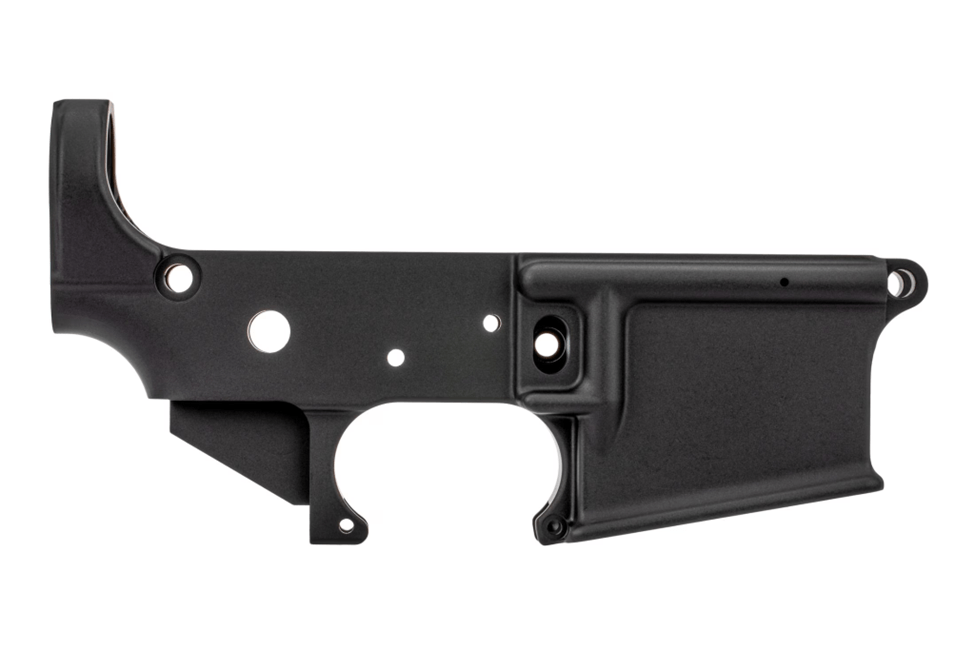
Generally speaking, it’s cheaper to get new parts for an AR, so the zombie option isn’t there. And the ghost gun option is just more work than it’s worth.
Still, there are a lot of parts kits available, for AK’s, CETME’s, old submachine guns, etc. For some, an 80% receiver is an option, where a new commercial receiver isn’t available. For others, a piece of metal tubing, a welder, and a dremel allow you to build a replacement receiver. There are molds available so you can cast your own plastic receiver for Glock parts.
The Supreme Court heard arguments in Garland v VanDerStok this past week – and probably we’ll learn next year if the 80% receivers remain legal.
 Trego's Mountain Ear
Leave a comment