I ran across a new website last week – well, new to me anyway. Just Facts Daily
The article I looked at explained why the FBI data on murder is low. I had always figured that murder data had to be the best data . . . except for Jimmy Hoffa, whose body was reportedly found in 2006 and in 2015, but is still missing. But most murders have bodies to go with them.
According to the article “death certificates provide “more accurate homicide trends at the national level than” FBI data because:
- the reporting of death certificates is “mandatory,” while the FBI relies on “voluntary” reports “from individual law enforcement agencies that are compiled monthly by state-level agencies.”
- death certificates include homicides that “occur in federal jurisdictions,” while the FBI rarely counts “homicides occurring in federal prisons, on military bases, and on Indian reservations.”
- death certificates include homicides caused by the deliberate “crashing of a motor vehicle, but this category generally accounts for less than 100 deaths per year.”
However, death certificates tend to overcount murders because they include:
- justifiable homicides by civilians acting in self-defense, which are not murders.
- some justifiable homicides by police, even though these are supposed to be coded as “legal intervention deaths,” not as homicides.
Time was when I regarded the FBI statistics as the gold standard – but as I have aged, I have learned that the reported statistics aren’t always that good.
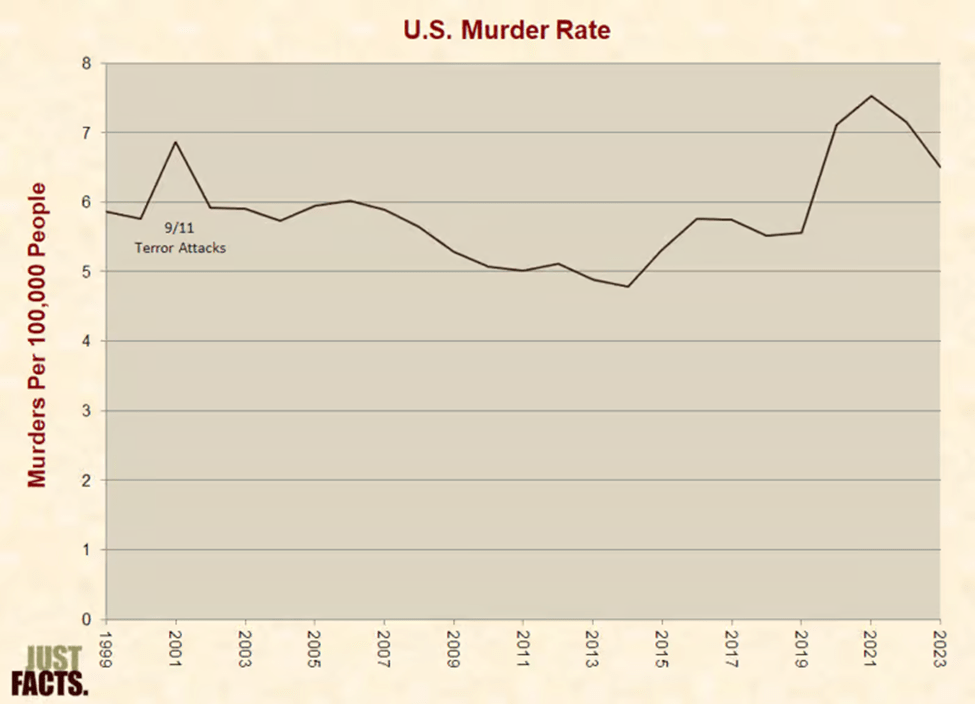
The graph shows that our murder rates – at least during this century have been fairly consistent – save for the bump on 9/11 2001 and another bump during covid.
This article matches data that I dug out before I retired: Illegal Immigrants Are Far More Likely to Commit Serious Crimes Than the U.S. Public – Just Facts Daily
The article includes these observations:
“First, U.S. Census data from 2011 to 2015 shows that noncitizens are 7% more likely than the U.S. population to be incarcerated in adult correctional facilities. This alone debunks the common media narrative, but it only scratches the surface of serious criminality by illegal immigrants.
Second, Department of Justice data reveals that in the decade ending in 2015, the U.S. deported at least 1.5 million noncitizens who were convicted of committing crimes in the U.S. (Table 41). This amounts to 10 times the number of noncitizens in U.S. adult correctional facilities during 2015.
Third, Department of Justice data shows that convicts released from prison have an average of 3.9 prior convictions, not including convictions that led to their imprisonment (Table 5). This means that people in prison are often repeat offenders—but as shown by the previous fact, masses of convicted criminals have been deported, making it hard for them to reoffend and end up in a U.S. prison.
In other words, even after deporting 10 times more noncitizens convicted of crimes than are in U.S. prisons and jails, they are still 7% more likely to be incarcerated than the general public.”
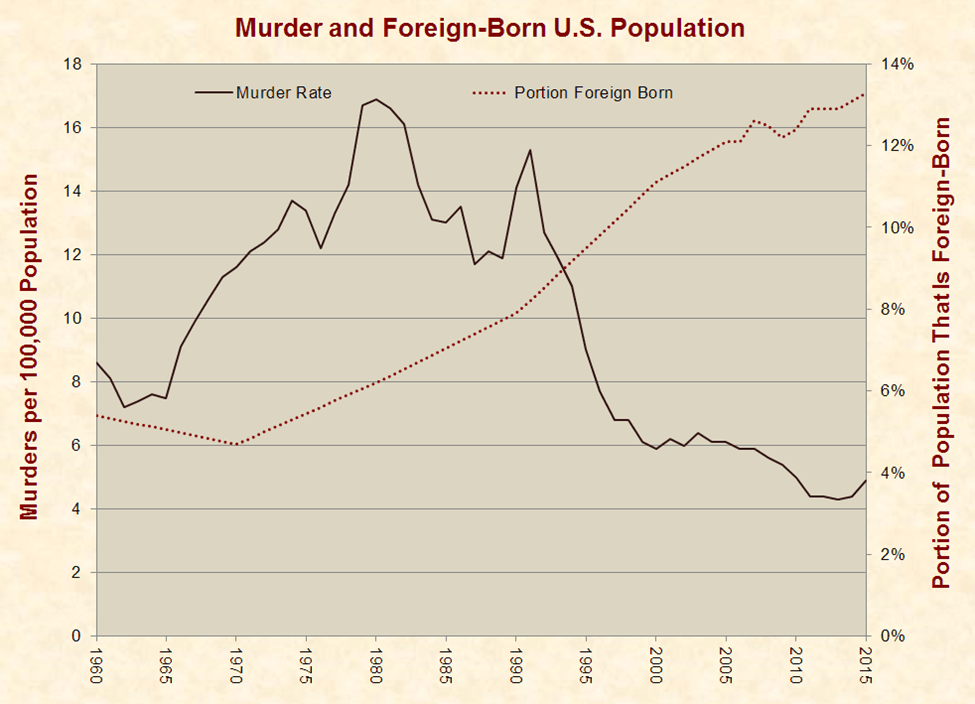
Their explanations for the data they offer seem pretty decent. I think I’ll read a few more of their articles.
 Trego's Mountain Ear
Leave a comment