The term “midwit” is described by its originator at The Coining of the Term: Midwit – Vox Popoli. The most pertinent phrase is “ A midwit has an IQ in the 105 to 120 range. The very need for the term is derived from the observation that the individual so described possesses a level of intelligence that is sufficiently above average to inspire him to overrate himself. “
To turn that description into useful numbers, the IQ Percentile and Rarity Chart is a useful tool. It lets us know how many people have to be in the room where the midwit is the smartest kid in the room. The problem with being the smartest kid in the room is that there are always times when you wind up in a larger room. Here’s where the Bell Curve kicks in:

An IQ of 105 is, by definition, above average. Has to be – the average IQ is defined at 100. (I will admit having some amusement when a classmate had bragged about his IQ score of 93 – but the fact that he completed his master’s degree long before I got mine does keep me a bit humble)
That flight of memory aside, the guy with an IQ of 93 can still be the smartest kid in the room if he’s the only one in the room. The guy with the 105 IQ has tested higher than 63% of the population. He’s technically above average, but not significantly above average – you have to score over 115 to be above the average or normal range.
At 107, he/she has scored above 67% of the population – so if the room holds 3 people (and is filled in a way that matches probability), he/she is the smartest kid in the room. 110 is above 75% of the population, so gets a 4 person room.
A score of 113 is above 80% of the population, so gets a 5 person room. 115 tests at 84% and is at the top of the hypothetical 6 person room. At 117, we reach the 87% level and get to the top of an 8 person room. At 120, the percentage is 91% and the room size is 11.
And that takes care of explaining midwits – and there is nothing wrong with scoring in the 105 to 120 range. I suspect it may be a happier area than either of the extremes.
Mensa’s cutoff is 130 – basically, to get into Mensa, you need to score higher than 98% of the population. Sounds like a big deal – but the room only has 50 people in it . . . well, actually 44, but 131 is 98.06% and has 52 people in the room. That 130 is close to the line for the second standard deviation above the average, and each point up from there really gets a bigger room. Basically, to be a member of Mensa you have to score in the top 2% on the test and pay $79 a year dues.
The third standard deviation comes in around 145 – and that score beats 99.87% of the population – the chart shows that individual is the top scorer of 741 people. The room is getting larger – but even that score won’t be the top in the county. Five more points – 150 – is one out of 2,330 – we’re talking a large room here. That one in a million score is somewhere between 170 and 171.
Incidentally, some IQ tests have a standard deviation of 15, some have 16. The numbers I’m throwing out are all based on the 15 SD.
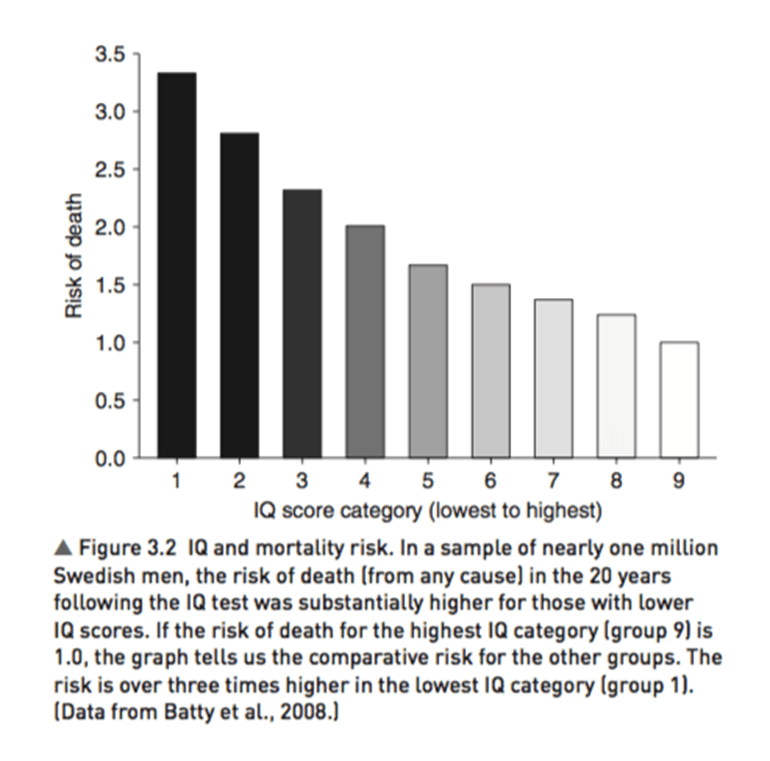
IQ isn’t fair. This graph, taken from IQ, explained in 9 charts | Vox shows the inverse correlation between IQ and risk of death.
On the other hand, an extremely high IQ doesn’t always bring success – articles like Chris Langan: The Bouncer, Rancher, And Conspiracy Theorist Who Might Be The World’s Smartest Man and William James Sidis: The Tragic Story Of The World’s Smartest Person show where it might be a lot more pleasant to go through life as a midwit.
 Trego's Mountain Ear
Leave a comment