In the US, the Supreme Court ruled secession illegal in Texas v White (1869). Admitted, this occurred after the Justice Department dropped the treason case against Jefferson Davis – for fear that a Virginia jury would have supported the idea that once Mississippi seceded, Davis was no longer a citizen of the United States, and could not have committed Treason.
Despite the 1869 Supreme Court decision, there’s something to be said for believing the secession issue was resolved by US Grant and the Union army.
In Canada, it’s more recent – the decision was made in 1998. The document is at Reference re Secession of Quebec, 1998 CanLII 793 (SCC), [1998] 2 SCR 217 I think that the conclusion at the end of this document says that secession is legal in Canada, but once the province has voted to secede, there’s a whole lot of negotiation required. Remember, I’m not a lawyer, and sure as hell, not an international lawyer – and the only family experience with secession didn’t work out all that well. Here’s what I think is relevant:
“151 Quebec could not, despite a clear referendum result, purport to invoke a right of self-determination to dictate the terms of a proposed secession to the other parties to the federation. The democratic vote, by however strong a majority, would have no legal effect on its own and could not push aside the principles of federalism and the rule of law, the rights of individuals and minorities, or the operation of democracy in the other provinces or in Canada as a whole. Democratic rights under the Constitution cannot be divorced from constitutional obligations. Nor, however, can the reverse proposition be accepted. The continued existence and operation of the Canadian constitutional order could not be indifferent to a clear expression of a clear majority of Quebecers that they no longer wish to remain in Canada. The other provinces and the federal government would have no basis to deny the right of the government of Quebec to pursue secession, should a clear majority of the people of Quebec choose that goal, so long as in doing so, Quebec respects the rights of others. The negotiations that followed such a vote would address the potential act of secession as well as its possible terms should in fact secession proceed. There would be no conclusions predetermined by law on any issue. Negotiations would need to address the interests of the other provinces, the federal government, Quebec and indeed the rights of all Canadians both within and outside Quebec, and specifically the rights of minorities. No one suggests that it would be an easy set of negotiations.”
This cartoon came from the Canadian Blog Small Dead Animals – with a 1915 date, I’m fairly sure it’s in the public domain. It does suggest that the idea that Alberta is being ripped off by Quebec and Ontario isn’t a particularly new one.
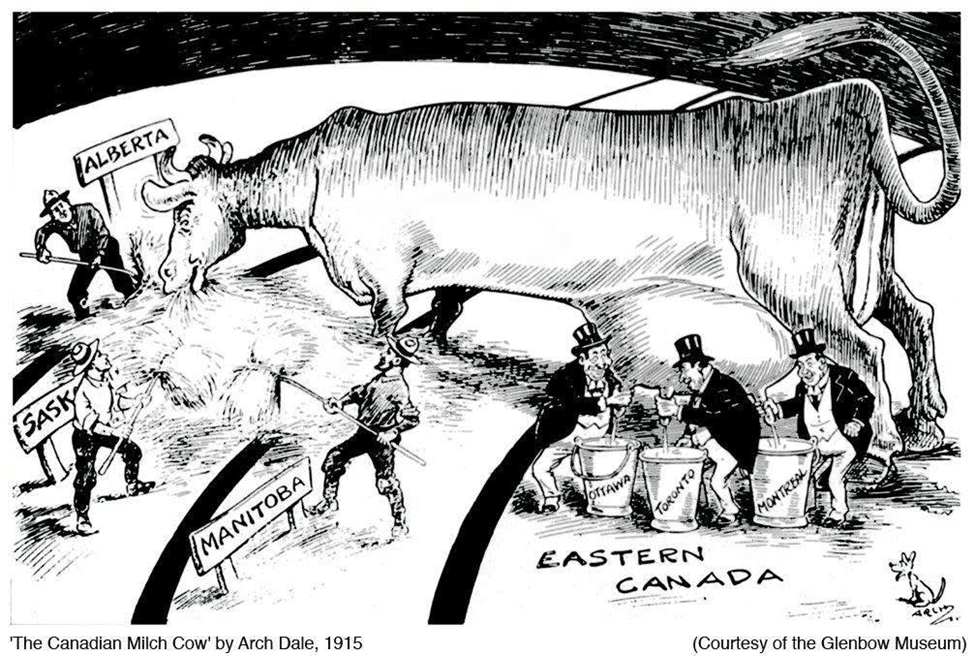
The article headed by this cartoon includes this observation: “British Columbia has 19 border crossings with the United States, Alberta has 6, Saskatchewan has 12, and Manitoba has 16. There is just 1 narrow 2 lane road through 1,000 miles of wilderness connecting all of Western Canada with Ontario, Quebec and the Atlantic provinces, yet the East rules the lives of Western Canada?” To read the whole thing, complete with links, click Western Canada Secession: Why Does the West stay in Canada?
Click the links and read – you’ll probably understand secession in Canada better than the average American.
 Trego's Mountain Ear
Leave a comment