Time ran out on us this Memorial Day weekend, we didn’t get quite everything we’d hoped accomplished. All the same, progress was still made, and a good time had. Here’s hoping the long weekend treated you folks with as much kindness.
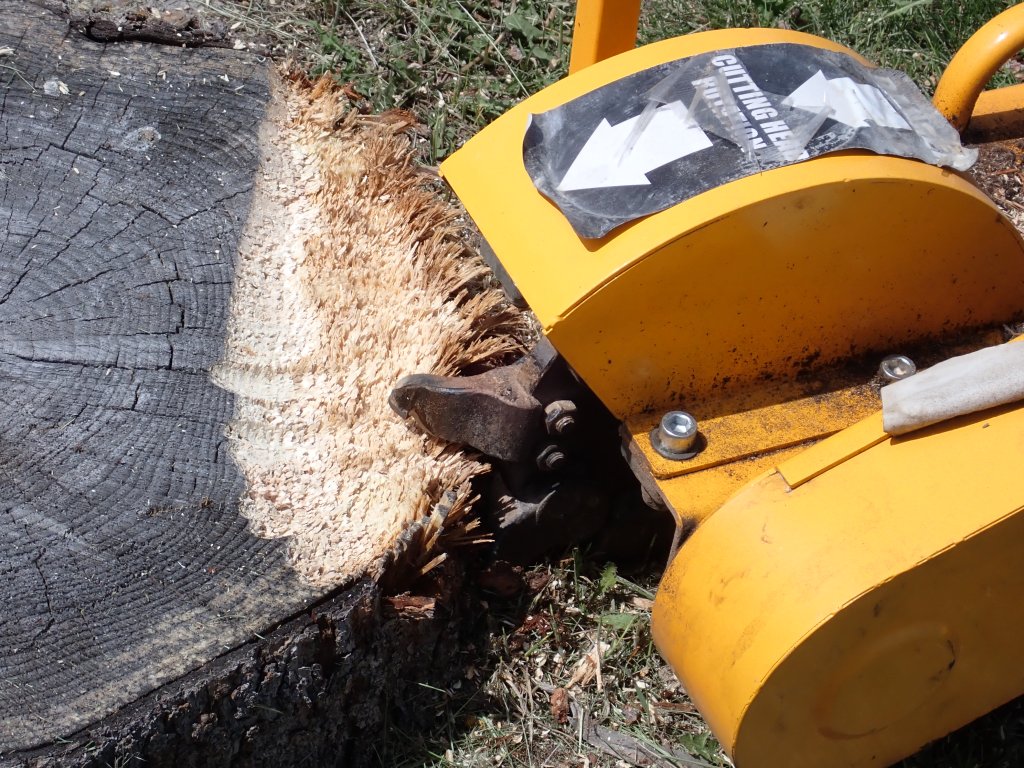
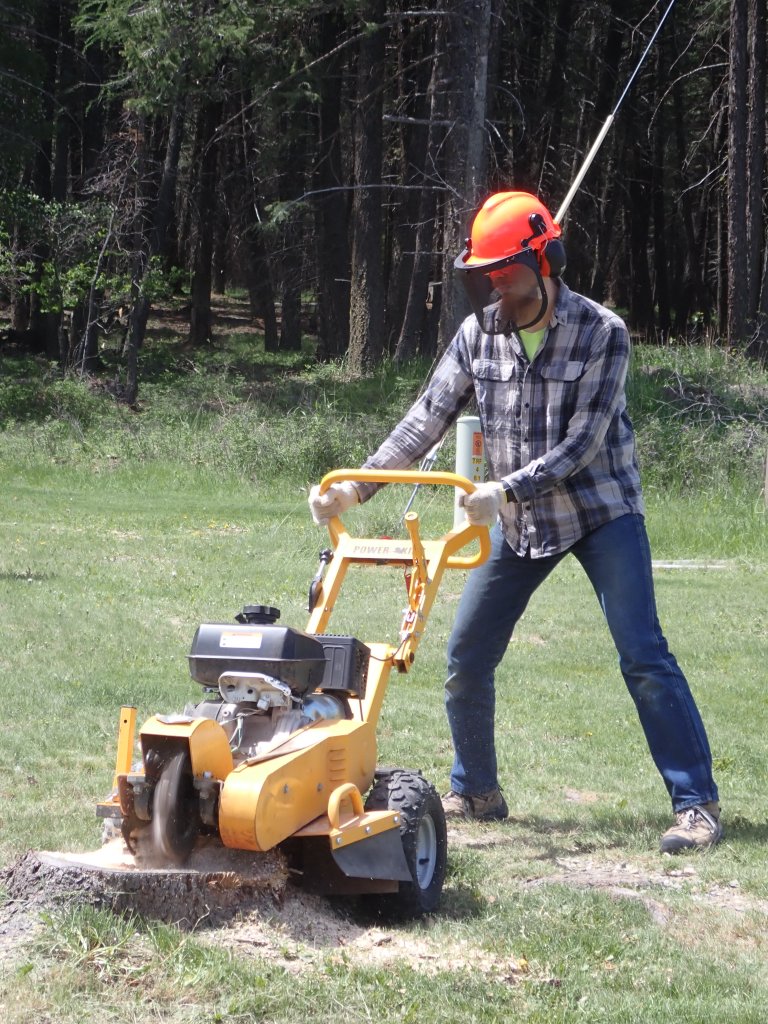
I became more proficient with the stump grinder, waging war against some spruce stumps that Lincoln Electric’s line-clearing contractors left us. Thankfully they had the courtesy to cut them close to the ground, lessening our task.
It was a good learning experience – spruce are among the softer-wooded conifers we have in these parts, and tend to have fewer knots than pine or fir. All the same, one has to be careful.
Always try to cut with the forward part of the tool, lest something be pulled to the back and jam the cutting wheel and burn out the belt. Constantly shift side-to-side, to wear the stump down uniformly, and lessen the chance of getting caught in a rut. I’m sure the stumpgrinder still has many tricks to teach me, pending user error.
In the words of Horace, the great Roman poet “Dulce et decorum est pro patria mori”. “Sweet it is, and proper, to die for one’s fatherland”. Noble thoughts, but Horace himself fled battle, abandoning his shield. Living another day can be a tempting proposition.
Sometimes it’s good to be able to rejoin battle at a later date – I know the projects will be waiting there for me come next Sunday, as will another couple of stumps.
This past week, some folks in our community Facebook page wanted to know if something was a tick or a spider. The comments section got a bit heated, and the offending post seems to have been censored. There were differing opinions, as there often are on such things, and opinions held with no shortage of confidence.
Here’s how you can actually tell the two critters apart.
Both spiders and ticks are arachnids, and have two body regions – the “cephalothorax” (a combination of old Greek words for “head” and “chest”) and the “abdomen” (same as in English).
In arachnids, the cephalothorax is what all the limbs are attached to, and where the mouthparts and muscles are. The abdomen holds most of the non-muscular organs, and is where breathing and digestion take place.
In spiders, there is a strong pinch between these two body regions – it looks like you could cut the abdomen off with a lasso of dental floss. In ticks and mites, however, these same two body regions are “completely fused” or “broadly joined”. Functionally, this means it’s hard to see when one part begins and the other ends, much less separate the two.
This is pretty much all you really need to tell the two apart, but there are a few more differences. Mouthparts: Spiders have paired fangs (chelicerae, pronounced “Kelly-Sir-Ee”) to pinch their prey and inject venom. Ticks and mites have mouthparts like hypodermic needles, and their chelicerae have saw-like teeth to help them cut their way through your hide before injecting chemicals to keep your blood from clotting. Legs: Spiders (well, uninjured spiders) all have eight legs, even when they are newly hatched. Ticks, however, start out as larvae with six legs. They gain another pair of legs after their first molt.
Medical Importance (are these dangerous?)
Spiders: In our area, northwest Montana, we have only one spider of medical significance. That’s the western black widow. Personally, I’ve always found Western Black Widows to be very docile – I’ve known quite a few kids to keep females as pets, even ones with eggsacs. Next time you’re at a rodeo and there are crates as extra seating, flip one over – the odds of finding a black widow are decent.
While we have Hobo spiders (aka “the aggressive house spider”) up here, their venom isn’t anything to get worried about. They move quickly – that’s about the only reason for their bad reputation. They need to move quickly, though – they don’t have much at all in the way of venom, and they don’t make sticky webs, so they rely on speed to catch their prey. If you want to control them, I’d recommend using sticky traps.
Ticks: There’s a lot more to be concerned about with ticks – while their feeding itself isn’t generally harmful in our neck of the woods, they can transmit harmful diseases in other locations. Southern Montana is home to several tick-borne diseases you should be aware of. The American Midwest and East are where you’re most likely to catch Lyme disease. Some west-coast deerticks in coastal regions of Washington and Oregon, can spread it, too.
True to schedule, the mayflies have returned. Of course, the mayflies didn’t wait for May proper… they’ve been with us for the past month at least.
Here’s the shed skin of one I watched emerging this past week. Note the three tail filaments – this is how you can tell it is a mayfly skin.
It’s hard to get an ID from a cast skin – I’ll be keeping my eyes peeled for an adult to photograph.
Our pond tends to have the smaller species of mayflies in good abundance – primarily genus Callibaetis. Here are some higher-quality photographs of other mayfly nymphs, so you can get a sense of the variety.
All mayflies belong to Order “Ephemeroptera”, which is Greek for “ephemeral things with wings”. While their winged life-stages may be here today and gone tomorrow, their aquatic young live much longer – a year or more below the surface before taking to the skies.
Mayflies are of an ancient lineage – they were around before creatures with backbones colonized the land. In those early days, the skies were relatively free of predators, far safer than below the water. Far different from the world they inhabit now.
Today, mayflies are a staple food for many creatures – fish, birds, and bats (as well as many insects)… All eat prodigious amounts of mayflies. Fly-fishers are well aware of fish’s dependence on mayflies. Many fly-fishers tend to be insect-watchers, and tailor their flies to match the most abundant mayflies are in their location and season.
We can anticipate our mayflies staying around far longer than the month of May – new adults will emerge all summer long, and can be found well into October, depending on the weather. Their presence can also be used to assess how healthy a body of water is – mayflies don’t do well in polluted areas.
A question we received last month – our apologies for the delay in answering.
Thank you to Sandra Elster for prompting this piece.
Our mound-building ants in this part of the country are Western Thatching Ants, Formica obscuripes. 5′ by 5′ is quite an impressive mound! I suspect it had quite a few active queens in it at one time… These ants are rather special because they generally have multiple active queens in a single colony – the young queens often help out and reproduce at home, instead of founding their own new colonies.
While Thatching Ant queens can live about a decade, they will eventually die. And when they do so, if there aren’t other queens waiting in the wings, the whole colony will go down with them. I’m guessing this is what happened at your daughter’s place.
Workers at the entrance of a Western Thatching Ant nest near my home. Busy despite the overcast day.
This species is most interesting to me when it sets about starting new colonies… You see, Western Thatching Ants often start out as social parasites! Queens of the red-colored wood ants, including our species of Thatch Ant, don’t start from scratch… They use others ants’ labor to get started.
The Queen is dead, long live the queen!”
A young queen of the Western Thatch Ant, instead of going to the backbreaking work of digging and founding a new colony all by herself, will tend to infiltrate nests of related ant species. Once inside, the young queen kills the old queen, acquires her smell, and steps into her role.
Over time, the new queen’s offspring will far outnumber those of the old queen, and the nest will eventually be a single species again. Fancy folks call this “temporary social parasitism“.
If the colony is very successful, it may divide into smaller colonies – a way new colonies sometimes form without using social parasitism. If a colony gets sufficiently large, daughter queens may take control of certain sections of it, forming a “satellite colony” instead of leaving to form an entirely separate one. Many linked colonies form a “supercolony”. The largest I’ve heard for this species is 210 linked colonies in eastern Oregon.
I wrote about wasp control not too long ago… Well, ants are your number one natural means of keeping wasps, and most other pest insects, in check. If a wasp colony is under stress, ants will often invade and carry away the baby wasps to be food for the colony. Controlling your Thatch Ants may lead to you having more wasp problems.
That said, if you want to exterminate your Western Thatch Ant colony, Washington State University Extension has some advice.
When they emerge, I’ll address Carpenter Ants & how to control them.
This past Friday evening (March 26, 2021), the Trego Civic Center had its annual meeting and membership drive.
Attendees received an update on the raffle, new board members were appointed, and the bylaws were amended to change the requirements for membership, opening it up to a much wider area. Now, anyone living in the TFS Fire District can become a member. Previously, membership had been restricted to residents of Montana School District 53 – Trego and Stryker.
There was a proposal from the North Valley Foodbank to use the Civic Center to achieve more efficient food distribution. Then, there was a discussion on maintenance of the hall. Finally, the evening concluded with suggestions for activities and fundraising that could take place at the hall.
New Board Members:
Two Positions were up for vote: those held by Lindy Smith and Donna Todd Lowery. Todd Swan (of the Trego Pub & General Store) and Erica Ness were voted in as their replacements.
Amended Bylaws:
*** Current Bylaws, under the membership eligibility section, state that to be a member you must live in or own property in Trego. *** We would like to amend that to state that to be a member you live in or own property in the TFS (Trego, Fortine, Stryker) fire district.”
The sheet handed out to attendees, stating the meeting agenda.
North Valley Foodbank:
Lauren Jarrold from North Valley Foodbank arrived to discuss a proposal to use the Civic Center as a satellite food pantry. Biweekly food distributions from the mobile food pantry at Trego have served an average of twice as many families than at Eureka. (Trego has an average of 100 families, peaking at 160 last fall. Eureka averages 50).
Having the Civic Center as a place where food could be stored, boxed, etc. could potentially increase the number of distribution times a month. It would also mean that someone with a sudden need for food assistance could call and get food, even if it wasn’t a set distribution day, without having to make a trip down to the Flathead.
Lauren also briefly spoke about the BackPack program, which North Valley Foodbank is assisting with, noting that the mobile pantry will be bringing the food up, and that the program is fully reimbursed by the state. She mentioned the possibility of continuing the program on into the summer months.
Maintenance Needs:
Repair of recent damage. (Upon further inspection, this appears to have been done by a raised vehicle. Yes, county vehicles parked nearby have been considered. Snow plows have not yet been examined). Ken Smith has volunteered to do the repairs.
Replacement of the current wood stove with a propane heater on hand. (This would substantially lower insurance costs, which are high due to the fire risk inherent in wood heating).
Hooking up a wonderful commercial propane stove that was donated.
Suggestions:
Later, talked turned to the future of the Civic Center, the need for fundraisers, and how to better serve the community. The consensus seemed to be that more events were needed, but that to make that happen, more volunteers would be needed as well.
Speaking of volunteers, that’s one way to earn membership. Like-kind service is acceptable instead of the membership fee; Otherwise, it’s a $25 fee per household.
Some suggestions for activities and fundraisers were:
Bringing back the Fireman’s Ball (this was mentioned at the TFS Fire Department Meeting as well)
T-shirts, mugs, and other little reminders of the Civic Center
Public Educational Talks by community members.
Science Fair (open to all kids, both public and home-schooled)
While winter isn’t quite done with us yet, we’ve had a good period of warmth recently. Wasps, as well as bears, are waking from their winter hibernation. I’ve seen a few queen paper wasps scouting for new nesting sites.
With this in mind, if you want to control wasps in or around your property, the time to start is now. If you can catch and kill the wasp version of a queen, you’ll stop her whole colony from bothering you the rest of the summer.
(A wasp queen is called a “gyne”, which means “woman” in ancient Greek. Gynes are quite large – perhaps twice the size of a standard wasp. Gynes are the wasps most likely to not die in hibernation.)
While most paper wasps will try to hibernate through the winter (the reason we see them moving indoors in fall), most are unsuccessful. Most wasp queens have to start anew in spring, building their new colonies (and sometimes their nests) from scratch.
Raising kids can be hard work, as any parent can tell you. It’s no different for wasps. As gynes start building their new nest, and laying their first eggs of the season, they spend most of their time looking for food for their young.
(A gyne’s first eight or so children are called “haplogynes” meaning “half-women” – these are about half as large again as a standard wasp. These haplogynes take over caring for their little siblings, leaving the gyne free to lay more eggs and expand the nest.)
Developing wasp larvae, just like developing human children, need diets rich in protein to grow and build muscle tissue. As such, a gyne caring for her first batch of larvae will spend much of her time looking for meat to feed them with. Later in the year, wasp larvae will often be fed caterpillars. But early on, carrion forms much of the available meat.
If you want to control your wasp problem before it starts, consider setting a wasp trap and baiting it with a bit of leftover meat and letting it spoil. If you manage to catch and kill a gyne, or her crew of haplogynes, you’ll have won a war before giving it a chance to start.
(Bear in mind, we do live in an area with bears, who are also beginning to leave hibernation. Be bear aware, and cautious in your use of meat to bait wasp traps.)



 Trego's Mountain Ear