Trego's Mountain Ear

"Serving North Lincoln County"

Author: EntomologistJed

  • TFS Volunteer Fire Department Held Annual Meeting

    TFS Volunteer Fire Department Held Annual Meeting

    This past Wednesday night (24 March 2021), the TFS Volunteer Fire Department had its much-delayed annual meeting at the Trego Civic Center. The evening included a discussion of the expenses of the fire department, the activity of the department, appointment of new board members, a bylaw change, and a mention of a proposed fee increase that will be taken to the commissioners. The meeting ended with a reminder to everyone to take bread home with them.

    A much delayed meeting:

    The annual meeting requires at least 20 members to attend. Conventionally, the annual meeting is held in November, however there were not enough people in attendance to hold November’s meeting. Members of the department expressed their disappointment at poor attendance. Twenty-one members attended Wednesday’s meeting, making a full quorum.

    Liz Williams discusses the qualifications to be a voting member of the TFS VFD corporation.

    Expenses:

    • Purchased Fire Station Software Program for Record Keeping (c. $1,300 initial cost, and $200 in yearly upkeep).
    • Upgraded the electricity to the Trego Station (the lights flickered and occasionally went out when the wind blew).
    • Purchased 4 new SCBA (Self Contained Breathing Apparatus) packs without bottles. Each SCBA pack cost about $4000, a considerable savings without new $1000 bottles. This brings the department to a total of 12 full packs and 4 spare bottles.
    • Acquired a 2008 F-550 type 6 fire engine on lifetime loan from the DNRC

    Department Activity:

    The department attended a greater number of calls, since the ambulance was attending fewer (due to fear of exposing the ambulance crew to Covid). From November of 2019 to November of 2020 the department had a total of 36 calls. Seven were aid calls, one of which was actually a cat in a tree.

    The department set up WEX cards for tax-exempt fuel purchasing, ran first-aid and CPR classes, and taught emergency drills. They also passed pump testing on all three engines with no issues – to some acclaim from their testers.

    Raffle:

    The department’s raffle was postponed due to Covid. The firearm being raffled is a Henry 45-70. The business and firefighter to sell the most tickets will each receive a Henry 47 HMR. The department will be selling tickets at Rendezvous Days.

    New Board Members:

    Of the current board, three positions were up for election. Those held by: Wayne Nowacki (representing the area at large), Josh Helgert (representing Trego) and John Menke (representing Fortine): John Menke and Josh Helgert were reappointed and Dan Schenkram of Trego replaced Wayne Nowacki.

    All three alternate board members positions were up for election (terms are yearly). Jacob Chrestensen of Stryker, Matthew Kelley, Justin Menke, were nominated to the at-large, Trego, and Fortine positions, respectively.

    By-law Change:

    Section 2. Qualifications of Members. Any person shall be qualified to be a member of the corporation if A. he or she is (1) over 18 years old, (2) is assessed a fee by Lincoln County for fire protection within the TFS Fire Service Area, and (3) is not a member of any other fire department.

    TFS Volunteer Fire Department By-laws, as amended.

    The amendment, which was approved, removed part 3 of the membership qualifications, so that residents of TFS Fire District that are part of Eureka’s fire department can still be voting members of TFS Volunteer Fire Department.

    Proposed Fee Increase:

    With the departmental budget rather tight, fee proposals are being discussed. At this stage, it’s discussion only. Later, they’ll go to the commissioners, and folks will have a chance to vote.

    Currently, the department collects about $45,000 annually. The proposal is to double the fire protection fees. The current fee is 50$ for homeowners (it was raised from $25 to $50 in 2010), businesses pay more. Another suggestion was that the fee be based on taxable value, so that folks with larger houses and outbuildings would pay more for fire protection.

    Get Involved:

    The public is welcome to attend training nights, as well as the TFS VFD’s monthly board meetings.

    Trainings happen on Monday nights at 7 PM at the Fortine Fire Hall, between the Fortine Mercantile and the greenboxes on Highway 93.

    Meetings are held the Second Tuesday of each Month, at 7 PM, also at the Fortine Fire Hall.

  • Tick diseases in Montana

    Tick diseases in Montana

    Spring has sprung, and our first ticks are out and about.
    When folks start talking about illnesses transmitted by ticks, the first to come up almost always seems to be Lyme Disease. While Lyme Disease is the most common tick-borne disease among Montanans, you don’t need to worry about picking it up around here – it tends to be something folks pick up on vacation.

    The Black-Legged Tick, also known as the deer tick, is the primary culprit responsible for transmitting Lyme Disease. Black-legged ticks are not found in Montana – they are, however, found all across the eastern half of North America. A related tick on the west coast, the Western Black-Legged Tick, is a less-effective vector of Lyme Disease.

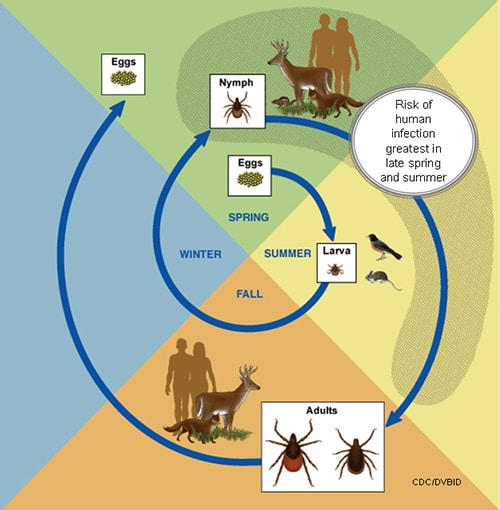
    A black-legged tick feeding on you isn’t a guarantee of disease – to transmit the disease, the tick first needs to feed on a small mammal (usually a White-Footed Deer Mouse) which is infected with the bacterial agent responsible for the disease… Because these ticks eat blood meals only once per life stage (once each as a larva, nymph, and an adult), you’re most likely to get the disease from a black-legged tick nymph. The adults prefer deer to us humans, anyways.

    The lifecycle of the Black-Legged Tick, sometimes known as the Deer Tick.
The common hosts for each life stage are pictured as well.
    The CDC’s helpful graphic on the black-legged tick lifecycle.

    Our northwestern corner of Montana is untroubled by tick-vectored disease. That said, if you venture into the southern portions of the state, we do have four tick-borne illnesses you could contract.

    Rocky Mountain Spotted Fever
    -About 6 cases reported in MT per year.
    -This disease is potentially deadly, moreso than Lyme Disease. Symptoms include achiness and fatigue, as well as a distinctive mottled rash.
    -This disease is vectored by larger ticks, the Rocky Mountain Wood Tick and the American Dog Tick, both of which should be easier to spot.

    Tularemia
    -About 4 cases reported in MT per year.
    -Sudden high fever, swollen lymph nodes, and pervasive weakness.
    -Tularemia can be vectored by the same two ticks that transmit Rocky Mountain Spotted Fever. However, more people catch it from contact with blood from infected rodents and especially rabbits. Something to keep in mind if you’re fond of skinning.

    Colorado Tick Fever
    -1 to 2 cases reported in MT per year.
    -This feels much like flu – aching, fever, chills, fatigue – which makes sense, as flu and Colorado Tick Fever are both are caused by viruses. Not too dangerous, usually goes away after 1-3 days.
    -Like the previous two diseases, this one is transmitted by both the Rocky Mountain Wood Tick and the American Dog Tick.

    Tick-Borne Relapsing Fever
    -Extremely rare, but it does occur in MT.
    -Fever rapidly develops after the initial infection, but then subsides, and reocurs in cycles about four days long.
    -Transmitted by soft-bodied ticks that specialize on chipmunks and pine squirrels – avoid contact with small woodland mammals and sleeping in dilapidated cabins and you should be okay.

    I would strongly advocate wearing clothes treated with permethrin if you’ll be in good tick habitat for a while – especially if you’re someplace with more interesting tick-borne diseases, like Red Meat Allergy, in the American southeast.

    The ticks you’re most likely to find here in Montana are these two… but if you come across something odd, there’s the CDC’s tick ID page, and beyond that I’d be more than happy to take a look at any bugs you might have for me!

    A poster from the MT Department of Health & Human Services
    Communicable Disease Epidemiology Program
  • Litter vs Artifacts?

    Litter vs Artifacts?

    If you leave trash sitting around long enough (about 50 years), something mysterious happens and it stops being litter (punishable by a $200 fine) and becomes an archaeological resource which if you remove from federal land could lead to a $500 fine and six moths in jail.

    What’s the difference?

    Litter is, according to the Lincoln County Ordinance:

    “Litter” means any quantity of uncontained or openly stored materials which may be classified as trash, debris, rubbish, refuse, garbage or junk, including but not limited to:
    a) any worn out or discarded material that is ready for destruction or has been collected or stored for recycling or salvage;
    b) old or scrap metals, wire, rope, batteries, paper, tires, cardboard, plastic, cans, wood, concrete, glass, crockery, or rubber;
    c) dead domestic animals;
    d) animal and vegetable wastes from the handling, preparation, cooking, and the consumption of food that is not incorporated into a properly maintained compost system;
    e) discarded, broken, or unusable furniture, fencing, or building materials,
    f) discarded, broken, or non-functioning appliances, campers, mobile homes, junk vehicles, machinery, fixtures, or any component parts thereof, that are serving no apparent purpose, or will not be made to function within a reasonable time;”

    Ordinance 2018-02 – Litter Control

    It’s probably worth noting that Lincoln County’s litter ordinance doesn’t just apply to roadsides: “It is unlawful for an owner, lessee, or occupant of private property to allow litter to accumulate on his or her property.” As with the community decay ordinance, there appears to be some potential for overlap between “yard art” and “illegal”.

    Archaeological resources are broadly defined by federal law, and include trash over 50 years in age (though only if it is of archaeological interest– that is, “capable of providing scientific or humanistic understanding of past human behavior, cultural adaptation, and related topics…”) Archaeological resources are covered by 36 CFR 261.9 (theft of government property, penalty of up to 500$ and/or up to 6 months imprisonment), which means that they are illegal to remove from federal lands.

    So, 50+ year old trash? If it’s on federal ground, leaving it is the safer bet. On private property, while explaining it was an artifact rather than litter might make for an interesting argument, that $200 (each day) fine might also prove persuasive.

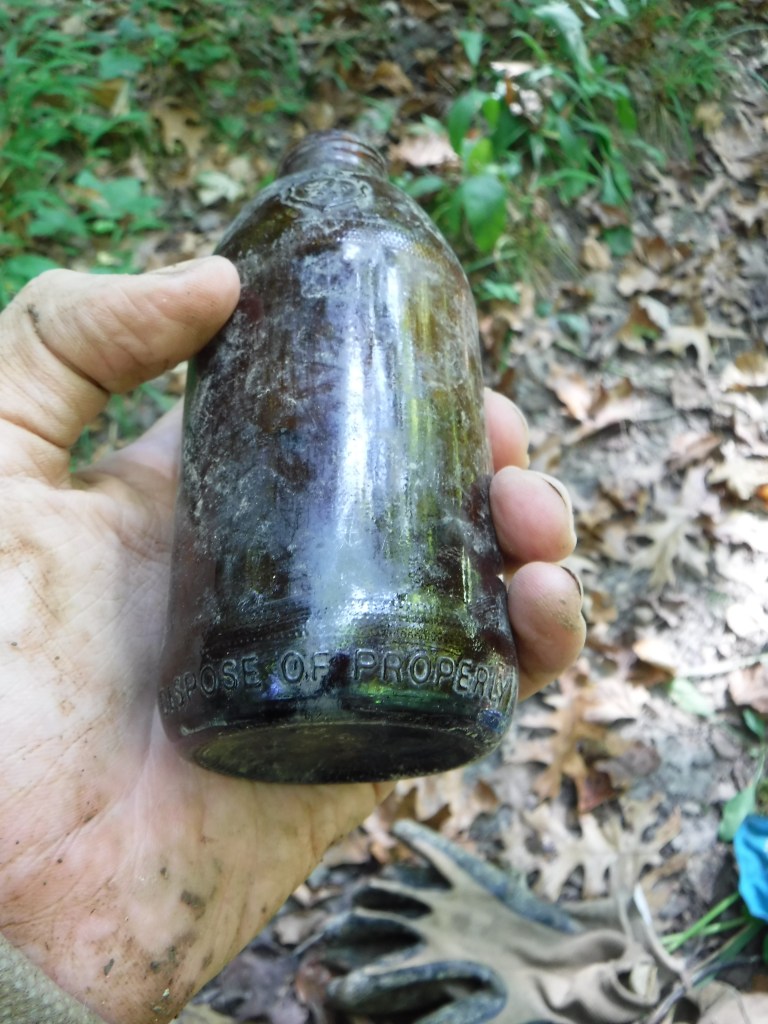
    Litter, to be removed? Or an artifact to remain? Sometimes labels provided clues, allowing the item to be dated, and making the determination easier.

  • Weird Words: Emoluments

    Perhaps we should call this “ask the etymologist”…

    Emolument comes to us by way of Latin – specifically, ēmŏlŭmentum literally means “something that is produced from work”. Different forms of the Latin word “emolument” meant striving for success and achieving success, but it also referred to profits, gains, or benefits. “Emolument” can be dissected into a couple of word roots to help us remember the meaning of “emolument”.

    “Ex-“ or “E-“ means “out/out of” in both Greek and Latin. Think of organ removal surgeries – an appendectomy is when an appendix is taken out, likewise a hysterectomy is when one’s uterus is removed. Alternatively, some Christians believe in creation “ex nihilo”, God’s creation of the universe “out of nothing”.

    “Melere” means “to grind” in Latin. This word root has a fine and storied history, older by far than Latin, going all the way back to Proto-Indo-European. Think of all the words we have that come from this today! Our grinding teeth are called “molars”, certain hammer-related crushing tools are called “mauls”, a “miller” crushes things in a “mill” and the resultant “meal” is what has been crushed.

    So, if we mash those two word roots together ex-melere → e-melere emolument would roughly translate as “the outcome of grinding” (money, if you’re the miller).

    This word appears prominently in the Foreign Emoluments Clause in the U.S. Constitution. This clause was put in place to limit the amount of governmental corruption, particularly by outside money… A worthy goal, if hard to achieve.

    The idea is that we don’t want our officials, either elected or appointed, using their positions to achieve personal gain. Most organizations, whether community, state, or national-level have safeguards to prevent emoluments. One doesn’t want an employee giving preferential treatment to certain people because of secret bargains. It’s also a common word to see in Nepotism laws.

  • Ask The Entomologist: What’s this bug in my breakfast?

    Ask The Entomologist: What’s this bug in my breakfast?

    “This guy and its buddy were both about 5 mm (1/5 inch) long, in my Malt-O-Meal.”

    Excellent question, and an attractive little fellow it is.
    This furry worm-like beastie is a larder beetle larva, a member of family Dermestidae.

    If you’ve ever watched a criminal mystery program on television, you’ve probably seen these insects’ relatives make an appearance with forensic entomologists. Dermestid beetles are often used to clean meat off bones, whether for criminal investigations or by folks who prepare skull mounts. They’re better than chemical treatments, as they leave no markings on the bones themselves, and can be stopped before they destroy the connective tissues holding the creature together.

    While entomologists call these things dermestid beetles, there’s a variety of names for them, depending on the species and what they like to eat. Often the bone-cleaning ones are called hide beetles” or “skin beetles The household stored-product pest names you might be familiar with are larder beetles or carpet beetles. As these names imply, there’s quite a bit of variation in what these insects eat.

    These insects are survivors. Many species of dermestid beetle occupy some of the worst, least-tasty carcasses out there… These beetles tend to come late to bodies, after most of the good juicy bits have been eaten or have spoiled. I’ve found dermestid larvae between dry ocean fish vertebrae, inside a variety of mammal skulls, as well as in the dried out bodies of little things like mice, songbirds and lizards.

    While some species can be helpful at times, most can become pests, especially to taxidermists or fur preparers. It’s an absolute nightmare trying to get dermestid beetles out of museum collections – they’re happy to eat just about anything dry and once living – aged fabrics and hide clothing, pressed plant specimens in herbariums, as well as taxidermied animals (skins as well as hairs or feathers). They don’t discriminate between vertebrates and invertebrates either – dermestid beetles are quite happy to eat pinned insect collections, too.

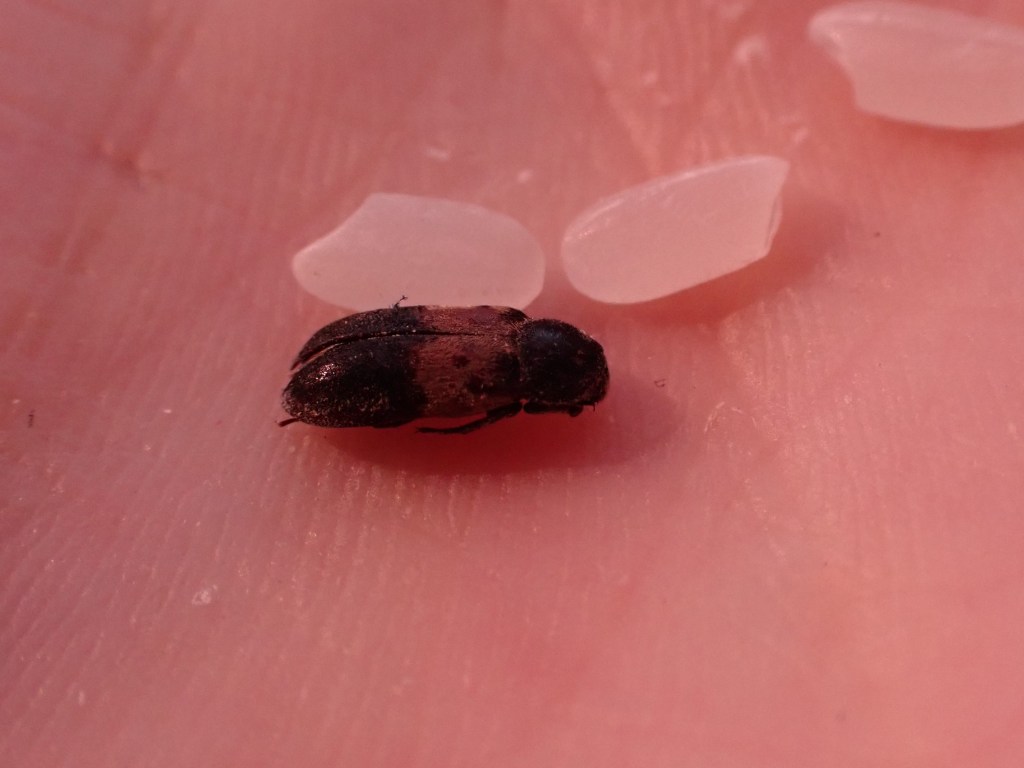
    This three-color band pattern is very common in dermestid beetles.
    This particular individual is a true larder beetle, found in my sack of short-grain sticky rice.

    Some dermestids have found that sacks of grain are to their liking as well. Here’s a stowaway I found in one of my sacks of rice recently – a diet much more similar to that of your malt-o-meal beetle. It stands to reason, of course – they’re the same species, Dermestes lardarius.

    Should you have problems with these in your own home, both Colorado State University and The Ohio State University have made nice informational sheets on how to control larder beetles and other dermestids.
    CSU’s dermestid info & control sheet & OSU’s dermestid info & control sheet.
    If they should get into your emergency food cache, though, don’t worry. They’re good eating.

    And a closeup – this adult larder beetle is just a little bit bigger than the larva in the ID request photo.
    Just over 1/4th inch, as opposed to 1/5th of an inch.

  • Ask the Entomologist: Ladybugs – which types bite?

    Ask the Entomologist: Ladybugs – which types bite?

    First off, this is an excellent question.
    All ladybeetles have jaws and the ability to bite, but some certainly seem to do so more often.

    I’m fond of this question for more than that, though.
    I got my start in entomology as a highschooler in South Dakota. Dr. Louis Hesler, a USDA lab scientist who specialized on ladybeetles took me under his wing, and helped me learn to identify them. I specialized in dissecting and identifying tiny ladybeetle species, often less than 1/10th of an inch long. That was the first time in my life that I felt I was doing work that couldn’t be easily replaced, and it was an addictive feeling.

    If you have ladybeetles in your home, and have been bitten by them, I’d expect them to be Multicolored Asian Ladybeetles. Other ladybeetles are quite capable of biting, too, even if they don’t do so terribly often.
    It’s more a question of what kind of ladybeetles we regularly encounter in our homes.

    This past autumn I saw just over a dozen species of ladybeetles around our place… and I wasn’t searching for them. For comparison, South Dakota is currently known to have 80 species of ladybeetles. Chances are good that Montana has a similar or higher number. Despite all the ladybeetle species we had outdoors this summer, the only species I’ve seen in our home this winter is the Multicolored Asian Ladybeetle.

    Why are these beetles in our homes? To avoid the cold weather.
    While most ladybeetles need to avoid freezing to survive winter, not all do so in the same way.

    European ladybeetles, such as the Seven-Spotted Ladybird Beetle (now common in North America as well) often overwinter in leaf litter. New World ladybeetles, such as the Convergent Ladybeetle, tend to overwinter inside rotting trees, much like Cluster Flies further from human structures do. Smaller ladybeetles are known to overwinter inside ant burrows, feeding on their larvae through the winter.

    The Multicolored Asian Ladybeetle, has a different history, though. This species has lived alongside soybean farming for ages – the soybean was domesticated in the 11th Century BC. The Asian Ladybeetle’s ancestors overwintered in barns after the soybean harvests, and its descendants seek out shelter in human-made structures as well… It is this behavior that brings them into conflict with humans more than other species of ladybeetle.

    Not all entomologists think that Asian Ladybeetles are likely to bite.
    This write-up found that only about 1/4 of Asian Ladybeetles bit the author when given the opportunity… When not removed from his hands after they began biting, the Asian Ladybeetles happily feed on him for about a half hour. I suspect few people besides entomologists have personally experienced this phenomenon, however. One can see how similar behavior on fruits can quickly make these into pests.

    How can I prevent the Asian Ladybeetles from invading my home in the winter?
    Well, I can tell you what doesn’t work, and what ostensibly should work.

    Putting up “Ladybug Houses” will not work at all. These beetles aren’t stupid – they can tell it’s warmer in your home than in the ladybug house, so your home will be their clear preference for winter quarters.

    It’s theoretically possible to caulk your house so well that insects won’t be able to get inside. In practice, I don’t think this is viable at all. Good luck getting all those 1/16th inch cracks closed! There will always be a few tiny gaps that you miss, and the insects will invite themselves in to the warmth.

    If you feel the need to remove your ladybeetle infestation, I’d suggest vacuuming. With a good suction attachment, you’ll be able to remove the Asian Ladybeetles without smushing them and making stains. I’d suggest emptying the vacuum bag promptly, or they’ll crawl out and continue on their merry way. Purdue Extension advocates using socks when vacuuming bugs.

    Vacuuming them up can also be a wise idea if you’ve got a dog who likes to eat ladybeetles. Consuming sufficiently large quantities of ladybeetles, regardless of the species, can make your pets sick. But, as Paracelsus said, “The dose makes the poison”. It takes a special dog to eat one ladybeetle and decide to follow it up with fifteen more. I suspect your beasties may be a bit more discerning.

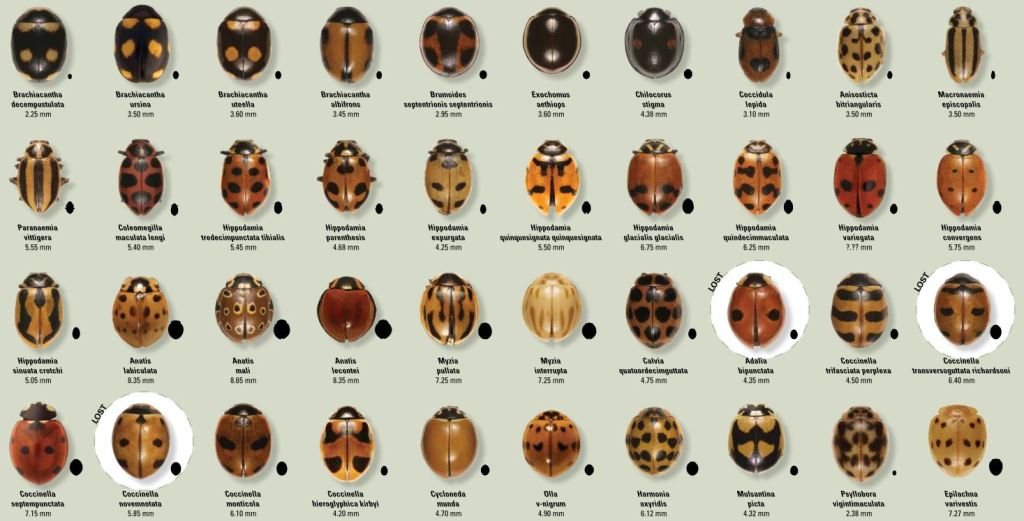
    An excerpt from my mentor’s poster of the Ladybeetles of South Dakota.
    I’ve observed many of these species here in Montana as well.