Trego's Mountain Ear

"Serving North Lincoln County"

Author: EntomologistJed

  • Are there bugs in your mail?

    Are there bugs in your mail?

    I recently started working for the United States Postal Service, and, while I’ve been seeing quite a few bugs lately, few are the kind I like. While I’m not terribly fond of them, the sheer numbers these bugs occur in has been very impressive.

    Mercifully, with elections past, there’s been a sizeable reduction in the numbers of incoming bugs in our P.O. boxes.

    I’m talking about union bugs, specifically printers’ union bugs. These minuscule beasties seem to be on well more than half of our political junk mail this season! Here’s some fine examples of the species:

    These strange ink-based critters colonize almost all publications that come out of unionized printing presses.

    If you’ll notice, there’s a certain bias in the political affiliation of these bugs. At present, almost all Democrat-leaning political flyers are published in unionized print shops. Republican-leaning political flyers, on the other hand, are seldom published in unionized print shops, and most lack union bugs.

    Republican flyer, lacking the Union Bug

    This trend doesn’t necessarily hold constant across the country, though. Nor has it held constant over time – unions used to be strongly supported by the right, as a way that capitalism led to better worker conditions. And, alas, the presence of the union bug is no longer as indicative of an entirely union-made product as it once was…

    Due to prevalent local political sentiments, certain political flyers have been disguising themselves to sneak their messages into new homes. Take a look at this piece of political mail – at first glance, you’d assume that LR-130 is opposed to the Second Amendment.

    But look closer!
    A union bug. This indicates a union press was used, and the flyer in question was most likely published by a left-leaning group. When we examine the bones of this legislation, LR-130 is actually in favor of the Second Amendment.

    Cleverly camouflaged flyers and a fair bit of funding led to a surprisingly close vote on LR-130. It’s important to be well-informed on what the issues we’re voting on actually are – legislation and flyers rarely aim to be straightforward.

    Mercifully, while pests of a sort, political flyers do not reproduce, unlike invasive insects. Personally, I’m rather grateful that we only have to deal with this volume of political propaganda once every four years.

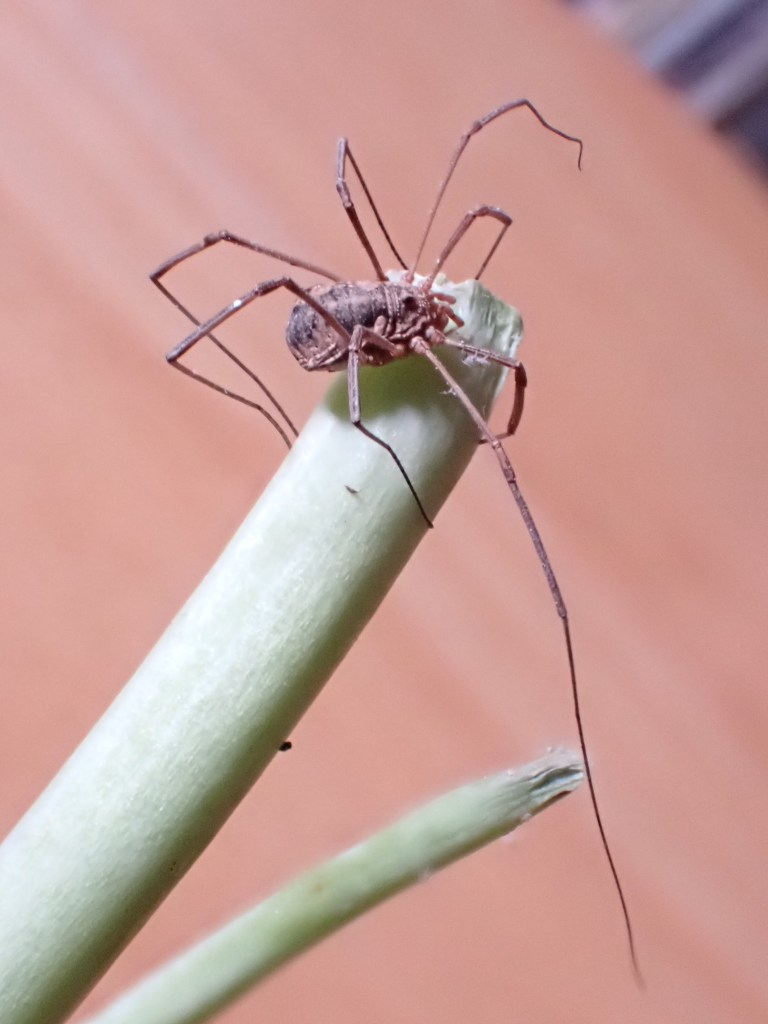
  • Harvestmen, or Daddy-Long-Legs

    Harvestmen, or Daddy-Long-Legs

    Earlier this week, I met a Harvestman while making supper. It had stowed away on some kale from the garden, and was still walking about on it… even after a week or so in the refrigerator.

    The refrigerated Harvestman was promptly photographed and released in our garden’s cold frames.

    Harvestmen have a rather well-known urban legend. Perhaps you’ve heard people say that “they’re the most venomous spiders in the world, but are harmless to humans because their fangs are too small to puncture our skin.”This myth is mostly untrue. While Harvestmen are harmless to humans, they are NOT spiders – they’re closer kin to scorpions and mites. Additionally, they don’t have venom, though they do have some chemical weapons and chemical defenses. Some species, however, rely more on physical armor than chemicals.

    This Ecuadorian Harvestman sees no reason to limit itself:
    it has spiny armor and is putting chemicals on an arm, which it will then use as a whip!

    While many people call Harvestmen “Daddy-Long-Legs”, this common name is rather vague, and I try not to use it. It can also refer to Crane Flies and Cellar Spiders, and I prefer being specific. Incidentally, the harvestmen myth is equally untrue for those two organisms as well.

    Unlike most other arachnids, Harvestmen aren’t primarily hunters. Actually, many Harvestmen prefer to eat things that are already dead… They’re great scavengers, happy to eat dead vertebrates, dead invertebrates, and even droppings. One European species has been claimed to hang about bee hives, eating the dead worker bees that worker bees on the custodial shift are tossing out.

    Harvestmen are beneficial for our gardens though, because they can and do hunt small insect pests such as springtails. They use their tiny little pinchers and fancy chemical glue to catch their prey. If you’d like to see their feeding behavior yourself, I’d suggest waiting by a porchlight at night – I’ve found that they like to ambush and eat little moths. If you’re a bit more hands-on, Harvestmen are easy to keep in captivity, and could make a great science project (drop me an email if interested in more details).

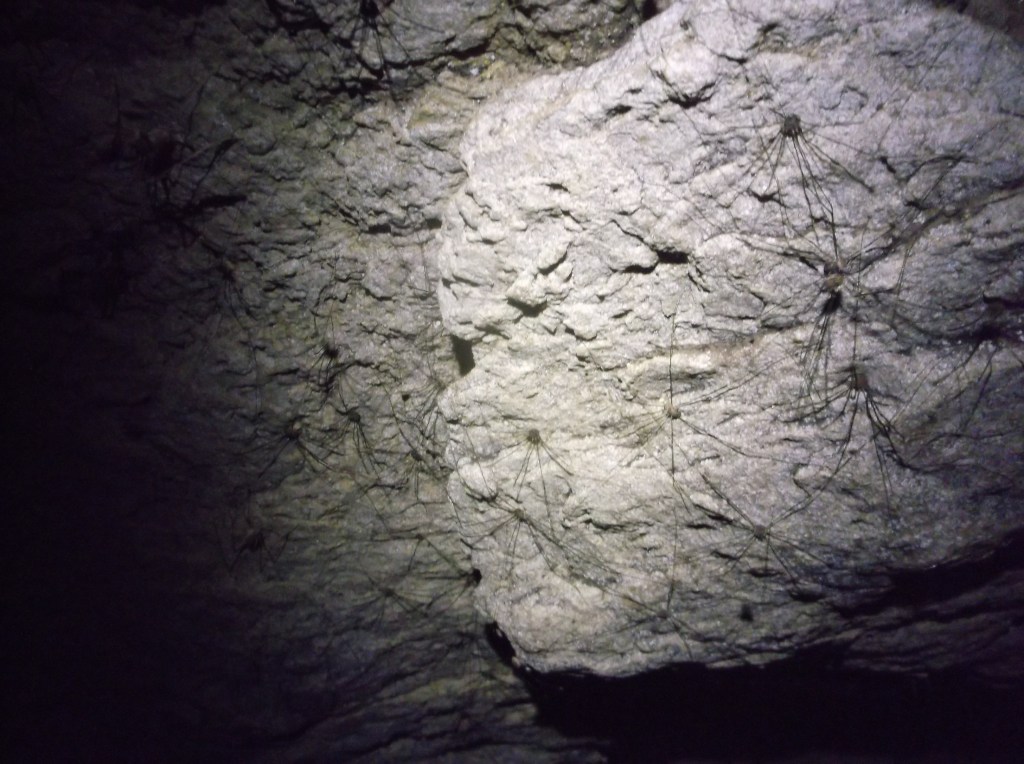
    As for why my Harvestmen was still alive in the refrigerator, these invertebrates tend to be Cold-Tolerant and Freeze-Avoidant. They’d prefer to be warm, increasing their odds of survival, so in autumn one can find large aggregations of Harvestmen. Sharing warmth, sheltering from the elements, and trying to survive the winter. This overwintering behavior frequently happens in caves, though in eastern North America, Harvestmen also overwinter in leaf litter.

    A disturbed aggregation of overwintering Harvestmen from a cave in Northern Tennessee.

    What have you observed Harvestmen doing?
    Hunting? Mating? Overwintering?

  • Ichneumonid wasps, imposing allies

    Ichneumonid wasps, imposing allies

    Last Thursday I saw this lovely Ichneumonid wasp (pronounced ICK-new-mon-id, from Greek “Ιχνευμων” which means “Tracker”). Most of the time I see Ichneumonids, they’re on the sides of trees, ovipositing (laying eggs) in boring insect larvae. This one’s behavior was very odd indeed.

    An Ichneumonid wasp, Pimpla pedalis, oviposits into a newly split piece of Douglas Fir.

    As you can see, this particular Ichneumonid wasp was laying her eggs inside a freshly split piece of Douglas Fir … or rather, inside a boring insect inside the Douglas Fir. Curious to see what insect she was laying her eggs inside, I peeled away layer after thin layer of wood …

    Uncovering the beetle grub (at left, mid-height) the wasp laid her eggs in.

    … And after an inch and a half of wood was removed, exposed a boring beetle grub. This is a Jewel Beetle grub, a member of family Buprestidae. These beetles can be lumber pests, though they’re unlikely to damage treated wood. While none of our Montanan Jewel Beetles are quite as bad, the Emerald Ash Borer has been devastating to ash trees throughout eastern North America.

    There it is, a Buprestid beetle grub, just to the left of the burrow it gnawed in the wood.

    I have very fond childhood memories of Giant Ichneumonid wasps. Most Sundays, my family would go to the arboretum of South Dakota State University’s then-public gardens. Among my favorite things there were some large multi-trunked cedars, which, in autumn, attracted some very large wasps. Presumably, the cedars also had very large wood-boring larvae that the Ichneumonids were parasitizing. Despite being a typical small human, making noise, climbing trees, and being generally bothersome, the Ichneumonid wasps never showed any sign of interest in me.

    While their large stingers and stinger sheaths look quite formidable, Ichneumonid wasps very rarely sting mammals or other large animals. Unlike typical colony-living wasps and bees, Ichneumonid stingers are almost exclusively used for laying eggs inside of host insects. Eventually the eggs hatch, and the baby wasps eat the host insect from the inside out. Parasites that always kill their hosts are called parasitoids (think of the Xenomorphs from the Alien movies).

    Fortunately for us, in addition to not stinging us or our pets, Ichneumonid wasps are also great at controlling garden pests. They take out a variety of garden pests (tomato hornworms, cabbage worms, etc.) as well as lumber pests (long-horned beetles, jewel beetles, bark beetles, etc.).

    All in all, they’re neighbors I’m quite glad to have.

  • Louse flies

    Louse flies

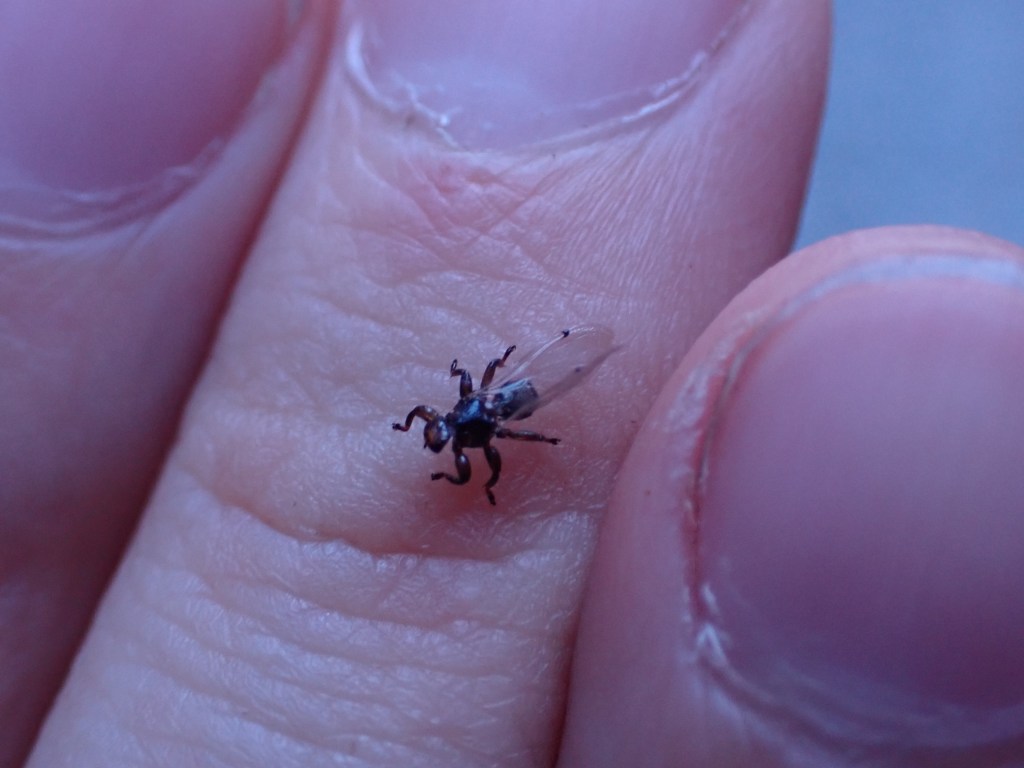
    It’s autumn. Among the many little signs of this are the appearance of Western Deer Keds, or louse flies, as they’re often called. As I was walking in the woods this past week, a number of them flew about me, a couple landed on my hand and ran up and down my arms. A poor life choice for them, as they were swiftly collected.

    Louse flies are members of family Hippoboscidae, and are best known for their very odd reproduction. They have their young one at a time, much like us humans. Females fertilize a single egg from stored sperm, the egg then hatches inside the mother fly’s reproductive tract. The resulting maggot nurses from a “milk” gland and molts several times inside the uterus. After about a week of this, the mother fly gives birth to a large late-stage maggot. In the case of the Western Deer Ked, the mother generally does this where the deer beds down for the night.

    Liptoptena depressa, a deer ked, courtesy of my in-laws’ dog (an unsuitable host).

    The late-stage maggot pupates immediately. After emerging from its pupal case as an adult in the fall, the new adult louse fly will take off in search of a suitable host. Once it finds a host, it will start feeding on blood, shed its wings, and will remain on the host until its dying day. Western Deer Keds can survive on Mule Deer, White Tailed Deer, Elk, and Moose. They may try to feed on other species – they can certainly bite. But they won’t be able to survive for long off of their proper hosts.

    Keds are best known as livestock pests – sheep keds are somewhat famous for the economic damages they can inflict. Native to Europe, sheep keds immigrated with humans, and are present across almost all of North America and much of South America, as well as parts of Africa, Asia, and Australia. While sheep keds have been reported, there is not good evidence that they can survive long on Bighorn Sheep or Mountain Goats.

    If you hunt turkey, and have tried for the “Grand Slam” you might have encountered turkey keds in the American southeast as well. There’s several species of turkey keds, but to the best of my knowledge, none have made it west of the Rocky Mountains yet.

    Have you met louse flies before? When, and on what?

  • Ask the Entomologist: Massive spider

    Ask the Entomologist: Massive spider

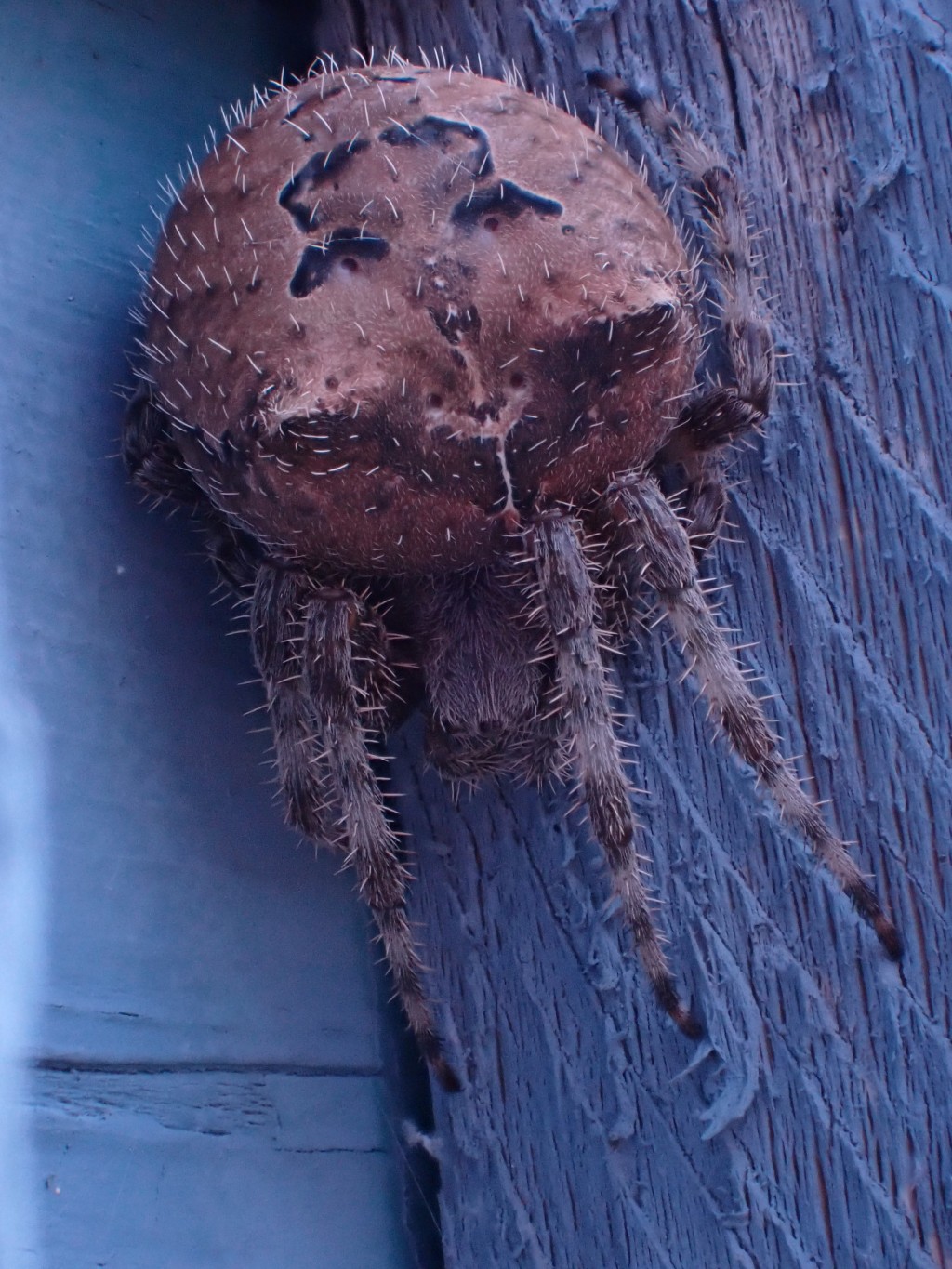
    This past week I had an identification request from a bit closer to home. This giant spider was perched right below one of our windows and my wife wanted to know what it was.

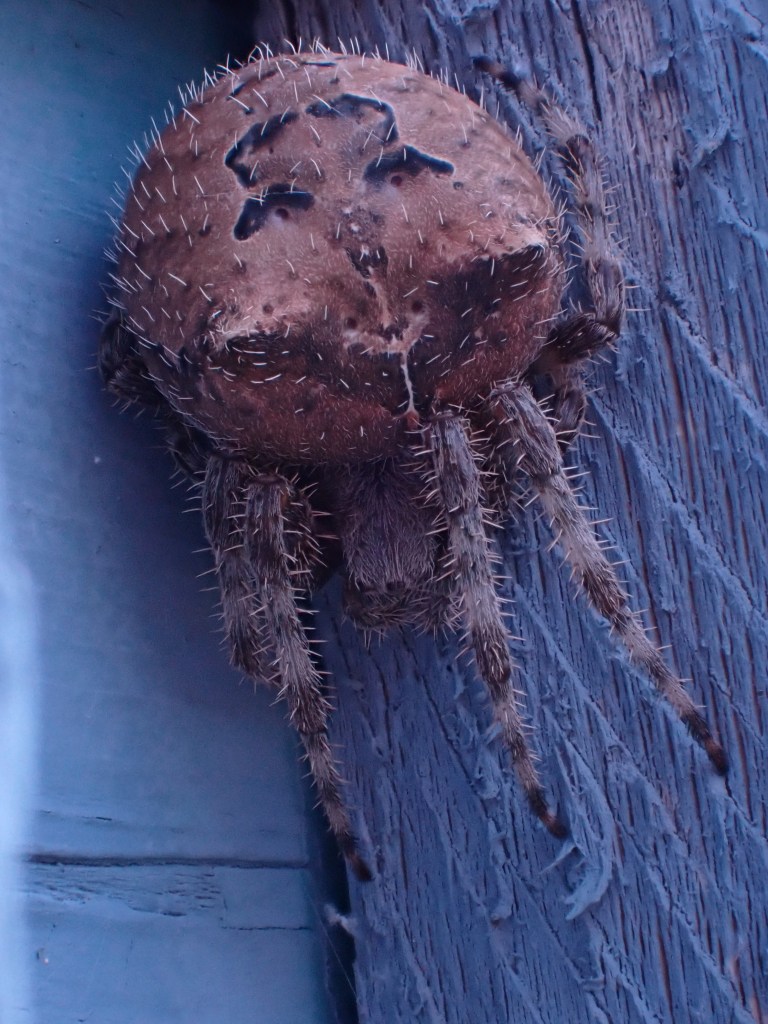
    Araneus gemma, the Gem-Shaped or Cat-Faced Spider.

    While I’d seen and admired her webs before, this was the first time I met the web’s weaver. She must have spent most days hidden behind the window AC unit. Revealed now that we’d removed it, now that fire season and the heat of summer seem to be past.

    As an entomologist, I have to say that I’ve met larger spiders, but this is the largest one I’ve seen up here in Trego. She’s an Orb-Weaver, a spider in family Araneidae. These are classic storybook spiders, straight out of Charlotte’s Web. When you see those beautiful wheel-shaped webs, big and round, full of droplets from the morning’s dew, these are the spiders responsible.

    I rather like Orb-Weavers – these spiders have pronounced sexual dimorphism. Females are often far larger than males – routinely twice the size, sometimes up to four times as large. Our A. gemma was quite large for her species, a 2/3 inches across the abdomen, and over an inch in length if we measure from the tip of her abdomen to her outstretched legs.

    At over an inch in length, she’s one of the largest spiders I’ve met here.

    As far as medical importance is concerned, the Gem-Shaped Spider’s bite is harmless to healthy humans. Additionally, I’ve handled many related Argiope orb weavers, and have never been bitten by them, so I don’t think receiving a bite from one of these is likely. However, if you or your loved ones are immunocompromised, elderly, or very young, more caution may be merited.

    Which common name do you prefer – the Gem-Shaped Spider or the Cat-Faced Spider?

  • Refugees from the cold

    Refugees from the cold

    As the year goes by and we feel the weather shifting towards winter, we find more and more insects in our homes. By and large, these insects are trying to get out of the cold, and find our homes just as good an answer as cracks in treestumps, downed wood, or burrows beneath the frostline.

    There are two main types of animal adaptation to cold. Freeze-Tolerance and Freeze-Avoidance.

    Freeze-Tolerant organisms can survive their bodies being frozen – they’ll thaw and wake up in the spring, none the worse for wear. Perhaps with a bit of amnesia, but physically unharmed. Many woodboring lumber pest species do this, as do some frogs (e.g. our Columbia Spotted Frog). Their trick is that they expel most of the water from their body before freezing (i.e. empty out their digestive tract) so that they have as little ice forming inside their body as possible. Additionally, they make special “ice-nucleating agents” that help them freeze at higher temperatures. If you have to freeze to survive the winter, it’s best to do so on your own terms.

    A Leaf-Footed Bug, a freeze-avoidant insect. Many of these have since joined us indoors.

    Freeze-Avoidant (Cold-Tolerant, Freeze-Susceptible) organisms can avoid freezing solid, even when in temperatures far below 32 F. However, if it gets cold enough to freeze them solid, freeze-resistant organisms will die. Stink Bugs and Leaf-Footed Bugs are good examples of this. Many freeze-resistant creatures produce a sugary antifreeze-like compound called “glycerol” in their blood, lowering their freezing point, and thus avoiding freezing. This isn’t just an insect thing – some fish use glycerol, too. Thanks to this adaptation, you can find Leaf-Footed Bugs active in some pretty cold places.

    All aquatic insects, as well as fish, are Freeze-Avoidant. This is especially important for aquatic creatures, as contact with ice could otherwise spontaneously freeze them. Some deep-sea arctic fish freeze solid upon contact with ice (link with picture), despite having antifreeze compounds in their blood.

    Most of the insects you’ll see invading your homes will be Freeze-Avoidant. Even though they can survive cold temperatures, they’d rather be someplace warmer, someplace with less risk of death.

    What insects are beginning to immigrate to your home?