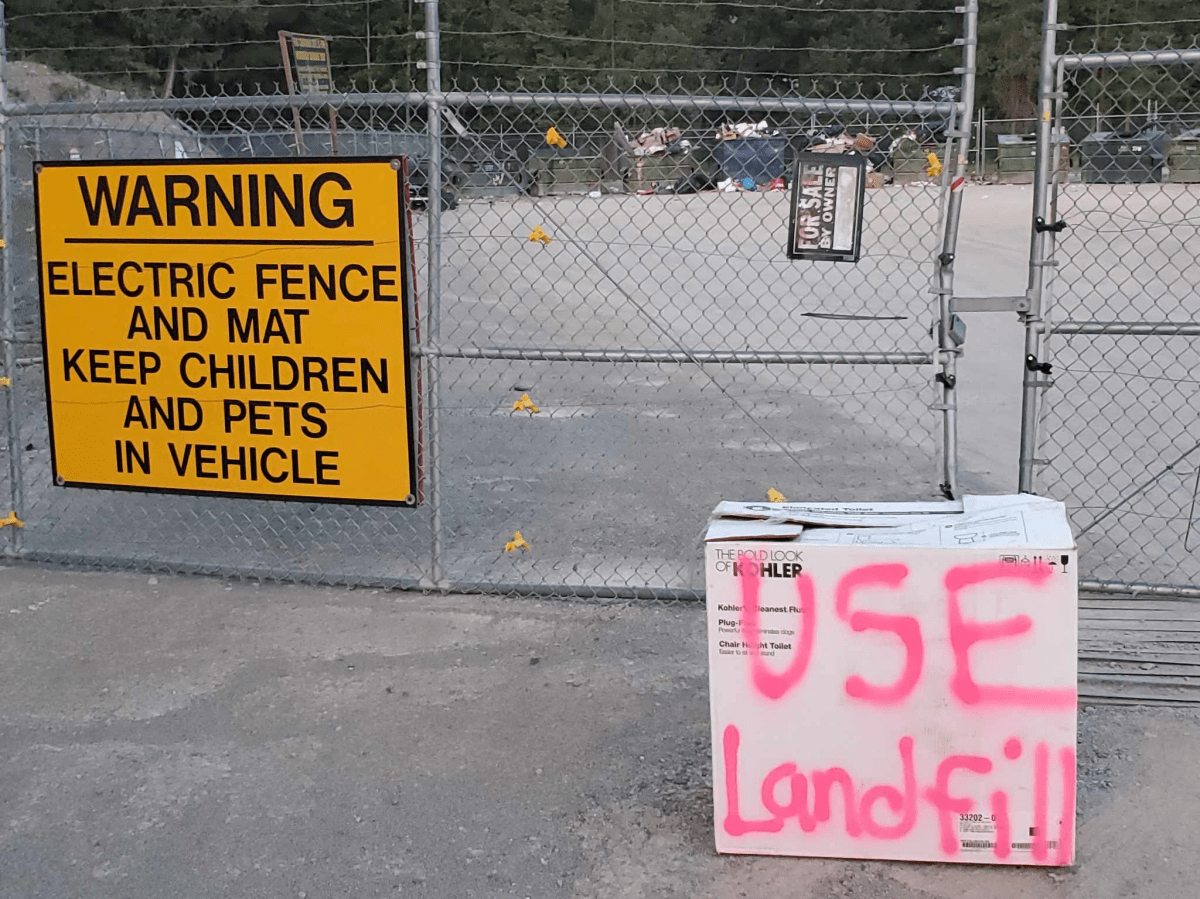
With the recent county commissioner’s meeting (and the wonderful job the TV news has done on reporting on the issue), it seems like it’s time to talk about trash again.
The green box issue – cutting down access to garbage removal services – in Lincoln County has me thinking about garbage. Basically simple facts about garbage over a lifetime – there have been a lot of changes since 1960. In 1960 there was a dump on Forest Service Land for Trego residents – less than a mile from where the green boxes are now. It had the collateral advantage of being the place to find bears. It was, fundamentally, trashy – but the old open dumps were cheap and accessible. A half-century earlier, when Tobacco Lumber had managed the dam…
One of the questions worth asking is ‘how do you start a waste-management/trash hauling company? Well, under current law, you’ll need a “Class D Motor Carrier Certificate Of Public Convenience And Necessity”. To get that, you must apply with the public service commision. The guidance for that is here.
The commission will advertise your application in the local newspaper and bill you for it. Then, they’ll have you pay a $500 application fee.
You are required to prove that existing service providers can’t or won’t do the job. There is a good chance that your application will include a formal hearing (if anyone, anyone at all, complains about your application. Even if they later withdraw the complaint). The commission is required to make a decision within 180 days.
Now, if you’re reading through that guidance- you’ll notice this additional turn of phrase: “For purposes of a Class D certificate (transportation of garbage), in addition to consideration of standards 1-4, a determination of public convenience and necessity may include a consideration of competition.”
Historically, independent voters, and voters for minor third parties, do not get a large percentage of votes. Often, they’re considered “spoiler” candidates, who lose the election for someone by dra4wing critical support away during a close race. Or their thought of as simply “protest candidates” with no chance of winning.
In Montana, for the presidential race and senate race, there were very small percentages (0-2%) for third party candidates. But further down on the ticket, libertarians often carried 3-4% of the vote.
And there were some interesting exceptions. In the race for public service commissioner of district four, the contest was between a republican and an independent. The independent carried 45% of the vote.
This year, in the races for state senate, there were more contested elections than not. In the one race that had three parties (District 45- Mineral County), the independent carried 8%.
State representative races were less consistently contested. Thirteen were uncontested, all republican. There were two instances of three party races, and one contest between a libertarian and a major party. In Yellowstone County, the Libertarian running against a republican carried 42% of the vote.
As for Lincoln county, we had a higher percentage of votes for libertarian candidates at the state level, and a 28% vote for the independent public service commissioner of district four (significantly less than the 45% she carried across the district, but higher than the percentage usually won in our county by democrats in equivalent races).
Interestingly, in the race for county commissioner, the democrat candidate took 14% of the vote, while the libertarian carried 20%. Noel Duram, republican, carried only 66% of the vote. A majority, but a substantially smaller one than republicans have typically enjoyed.
This year, only three of our county positions were uncontested: Clerk of District Court, Clerk and Recorder, County Superintendent of Schools. Unfortunately, this is still a tremendous percentage considering how few county positions were up for election. These were the only partisan county elections, other than the race for county commissioner and state representatives.
Editor’s Note: Sometimes it is necessary to state, research, and publish the obvious. In this case, the obvious is that having a cannabis dispensary near a school is not a great thing. Unless there are more of them than google wants to admit to, the nearest one to Eureka Elementary is about half a mile.
I’ll suggest anyone still feeling 100% comfortable with marijuana consider reading about marijuana induced psychosis and the differences between marijuana now and what it used to be.
As more states legalize marijuana, researchers are examining the effects of legalization on society. Angus Kittelman, an assistant professor of special education at the University of Missouri-Columbia, and Gulcan Cil, a senior statistician at Oregon Health & Science University, decided to look at the effects of cannabis dispensaries being located near schools. They discuss their research in the following Q&A with education editor Jamaal Abdul-Alim.
Is it bad when a school is located near a dispensary?
Yes, it’s not good for a couple of reasons. When cannabis dispensaries are near middle schools, students are more likely to receive office discipline referrals for substance use. When students get sent to the office, they lose valuable instructional time in the classroom.
Adolescent cannabis use is also associated with many negative health effects, such as poorer cognitive functioning and increased risks for developing mental health or substance use disorders. Students who use cannabis are also less likely to complete high school or go to college.
With the legalization of recreational cannabis sales in many U.S. states, there are more cannabis outlets and greater access, which can be concerning for families and schools. In our recent study, for example, we found that the number of office discipline referrals for substance use increased in middle schools after legalization of recreational cannabis in the state of Oregon in 2015. But this increase was only when there were recreational outlets within a 1-mile radius of the schools.
Middle school students receiving an office discipline referral for substance use is relatively rare. An average middle school had three to four referrals of substance use per year. But those near an outlet experienced a 44% increase after legalization and had one to two additional referrals on average each year.
What’s causing the increase in referrals?
Great question. We analyzed student substance referrals after excluding referrals for tobacco and alcohol. We observed increases in substance referrals in Oregon schools after the statewide legalization of cannabis in 2015, compared with the trends in similar states with no legal cannabis at the time. We then examined whether having a cannabis dispensary within a 1-mile radius was associated with an increase in referrals.
We cannot say with certainty that the increase in all substance use referrals were from cannabis use. However, we know that cannabis is among the most common substances adolescents reported using. In a nationwide survey, for example, 8.3% of eighth graders reported using cannabis. That’s compared with 12% for vaping nicotine/tobacco and 15.2% for alcohol.
Besides potentially providing easier access to the product, when there are more legal cannabis stores in certain neighborhoods – and increases in signs and flyers advertising for it – it may make kids ignore or downplay the health risks. Increases in exposure to cannabis marketing is associated with adolescents being more likely to use cannabis.
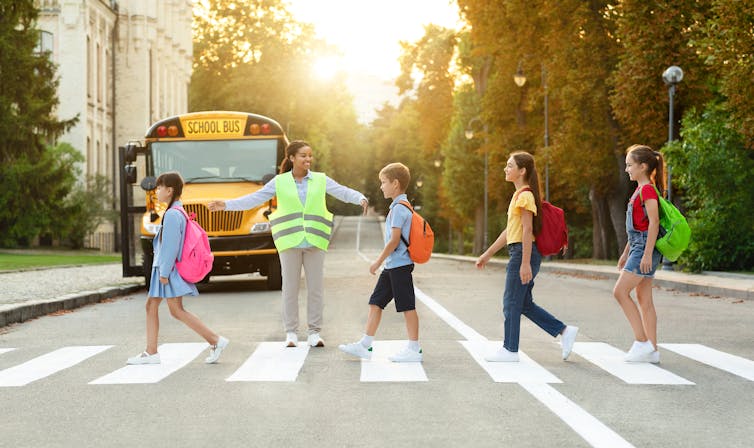
Students often travel a mile or two to get to school. And those in middle schools are more likely to walk to school compared with students in elementary or high school. Therefore, even though adolescents are too young to legally buy cannabis themselves, having a cannabis outlet nearby makes it easier for them to obtain it from a friend or purchase it from a stranger.
What can be done?
Isn’t a 1-mile radius a rather large area?
We recommend that school staff look for patterns in student discipline referrals for substance use. If the substance use is occurring in certain school locations, such as playgrounds, hallways or bathrooms, staff can then supervise these areas better.
Schools may consider implementing proactive and preventive strategies to support students engaging in substance use. These can include having school counselors provide drug resistance skills training programs or programs that teach students how to manage emotions and to resist stressful situations.
Editor’s note: With recent events making waste disposal more interesting, I thought it worth reminding people of the ordinance the county health department enforces with regards to waste management.
One could be forgiven for assuming that community decay ordinances were the business of rather fussy municipalities in places other than here. One would, as it happens, be wrong on two counts. Lincoln County, Montana, has one.
Back in December of 2018 the Lincoln County Board of Commissioners adopted Ordinance 2018-05 “An Ordinance to Control Community Decay Within Lincoln County and to Establish Procedures for its Enforcement”.
So, this leaves us with several pressing questions:
What exactly is community decay?
Who does this apply to?
Enforcement?
None of these have short answers, so I’ll discuss each in depth in later posts. For now, the quick summary:
Community Decay
“Anything that is injurious to health, indecent, offensive to the senses, or an obstructive of the free use of property so as to interfere with the comfortable enjoyment of life or property...” that affects multiple people. Unless it’s agricultural- then, it’s okay.
Who does this apply to?
Renters/Landowners on property in the county adjacent to a public roadway (We’ll discuss what exactly a public roadway is, for these purposes, at a later date)
Enforcement
Misdemeanor: Fine up to $500 and/or 6 months imprisonment (Each day of violation is a separate violation…)
Eureka Community Players will present The Apple Tree (sponsored by Interbel). The Apple Tree is a series of short plays, based each on short stories. The first act is based on Extracts from Adam’s Diary by Mark Twain, while act two is based on The Lady and the Tiger by Frank Stockton.
You can view the play at Timbers Event Center Friday night, Saturday night, or Sunday afternoon.


 Trego's Mountain Ear