Hello! My name is Chelsea Wertenberger and I’m 14 years old. I’ve always been passionate about writing, so I started my own monthly newspaper called “Small Town Vibes”. My main goal is to give local teenagers an open and accepting place to have their opinions published for the community to read. If you’re interested in reading the newest paper, find me on Facebook at “Small Town Vibes” or if you’d prefer a hard copy, I stock them in the Eureka Library, Montana market, Trego Pub, and the Trego Post office. I absolutely love hearing opinions and encouragement from the community. Feel free to contact me using the email below with questions and ideas for the next edition. If you would like to enter an advertisement, I’m charging a fee of $15 for a 3-month term. For articles, I’m currently searching for more opinionated and controversial pieces. If you are thirteen to eighteen and would like to submit an article, art, or photography to be published contact me by email at juniper4368@gmail.com
As we approach fall, the Eureka Community Players are gearing up for their Fall Play (the Apple Tree), and the annual tour of the Eureka Cemetary.
As in the past actors will be positioned throughout the cemetery, in period garb, to represent a sampling of the dead and tell about their lives. Guides will accompany each tour and offer information about the cemetery itself and the symbolism to be found upon the gravestones and around the cemetery.
The cemetery tour will take place on Sunday, October 13th. Unlike previous years, the tours will be beginning in the early afternoon.
Actors have a fairly minimal commitment. One dress rehearsal and one performance, with no obligation to memorize their lines (reading from the script is perfectly acceptable).
If you have an interest in acting, driving a golf cart (tours will have the option for those who would have difficulty walking around the cemetery), guiding tours, or helping with setup, please contact the Eureka Community Players.
Rural electric cooperatives have a history dating back to Franklin Delano Roosevelt and the New Deal. Congressional action fueled by federal loans and grants enabled membership cooperatives to connect the “last mile” and bring electricity to almost all of rural American within the early years of their organization. The goals and principles of the cooperatives were idealistic, high-minded, and membership-based.
More than 75 years later, rural electric cooperatives in many areas where they operate are often a significant economic presence and employer with assets and sales throughout the South of billions dollars annually. The U.S. Department of Agriculture … sees the cooperatives as primary intermediaries for economic development and social services, and continues to invest loans and grants in the cooperatives accordingly as a fundamental component of the U.S. policy and program for rural Americans.
A look at the cooperatives today in the 12-state region of the South offers another picture entirely. There is too much evidence of democracy lost and discrimination found. Transparency is rare and too many rules and procedures are designed to maintain a status quo that seems more frozen in the 1950s before the advent of the civil rights and women’s rights’ movements in the South and nationally, than equipped to fairly service and deliver progress to all members of the cooperatives equitably.
The Rural Power Project, a joint project of Labor Neighbor Research and Training Center and ACORN International, examined all available records on all 313 cooperatives in the South. The project found that of the 3,051 supposedly democratically elected board members, 2,754 are men or 90.3% while 297 members are women or 9.7%. This figure is in spite of the fact that the gender distribution in South is 48.9% men and 51.1% women. Examining participation by African-Americans in the governing process of the cooperatives where information was available and verifiable, we found that 1,946 of the members were white or 95.3% throughout the South, while only 90 or 4.4% of the members were black. Of the more than 2,000 governing positions for which we had information, only six were Hispanic or 0.3% of the total. These figures compare to the fact that throughout the 12 Southern states, only 69.23% are white, while 22.32% are black, and 10.19% identify as Hispanic.
Half of the states (Arkansas, Florida, Kentucky, Louisiana, Mississippi, and Tennessee) had three or fewer African-American members with Louisiana and Kentucky having only one and Arkansas, Mississippi, and Tennessee having only two. Despite the fact that Florida counts almost one-quarter (24.1%) of its population as Hispanic and Texas has more than one-third (38.6%) of its population who are Hispanic, there was only one Hispanic board member in Florida and five in the entire state of Texas.
It matters. Not only because such undemocratic procedures and lack of representation invariably disempowers the very people who should be empowered by the cooperatives, but also because it raises questions about whether such radically unrepresentative leadership can possibly deliver jobs, loans, scholarships, and other opportunities equally without regard to race, gender, ethnicity and other reasons, when the leadership has been so committed to the opposite practice in the rules and procedures governing their own affairs and elections.
As the report shows, it also matters if members are elected who are willing to embrace energy conservation and move away from the predominant reliance on coal generation to supply rural electric cooperatives which continues to be the case.
Efforts over and over again throughout the history of the cooperatives in the South have tried to challenge these practices and lack of diversity but whether temporarily successful or soundly defeated, the record indicates that permanent reform has not been achieved or sustained. Meanwhile most cooperatives are allowed to be self-regulated without sufficient due diligence practiced by the USDA and its Rural Utilities Service arm, the Internal Revenue Service, or, for the most part, state utility regulators. The fiction of membership-control is overriding the facts of membership disempowerment.
The federal government needs to stop providing loans or grants without guarantees of full transparency and equal representation in both rules and reality for consumer-members in every Southern service area. States need to pass legislation like Colorado has done to guarantee transparency, end proxy voting, and provide access for participation to members. Congress and state legislators need to resist lobbyists and trade associations and protect cooperative members.
Our Sun drives a constant outward flow of plasma, or ionized gas, called the solar wind, which envelops our solar system. Outside of Earth’s protective magnetosphere, the fastest solar wind rushes by at speeds of over 310 miles (500 kilometers) per second. But researchers haven’t been able to figure out how the wind gets enough energy to achieve that speed – until now.
Parker’s work suggested that this extreme temperature could create an outward thermal pressure strong enough to overcome gravity and cause the outer layer of the Sun’s atmosphere to escape.
Gaps in solar wind science quickly arose, however, as researchers took more and more detailed measurements of the solar wind near Earth. In particular, they found two problems with the fastest portion of the solar wind.
For one, the solar wind continued to heat up after leaving the hot corona without explanation. And even with this added heat, the fastest wind still didn’t have enough energy for scientists to explain how it was able to accelerate to such high speeds.
Both these observations meant that some extra energy source had to exist beyond Parker’s models.
The Sun and its solar wind are plasmas. Plasmas are like gases, but all the particles in plasmas have a charge and respond to magnetic fields.
Similar to how sound waves travel through the air and transport energy on Earth, plasmas have what are called Alfvén waves moving through them. For decades, Alfvén waves had been predicted to affect the solar wind’s dynamics and play an important role in transporting energy in the solar wind.
However, scientists couldn’t tell whether these waves were actually interacting with the solar wind directly or if they generated enough energy to power it. To answer these questions, they’d have to measure the solar wind very close to the Sun.
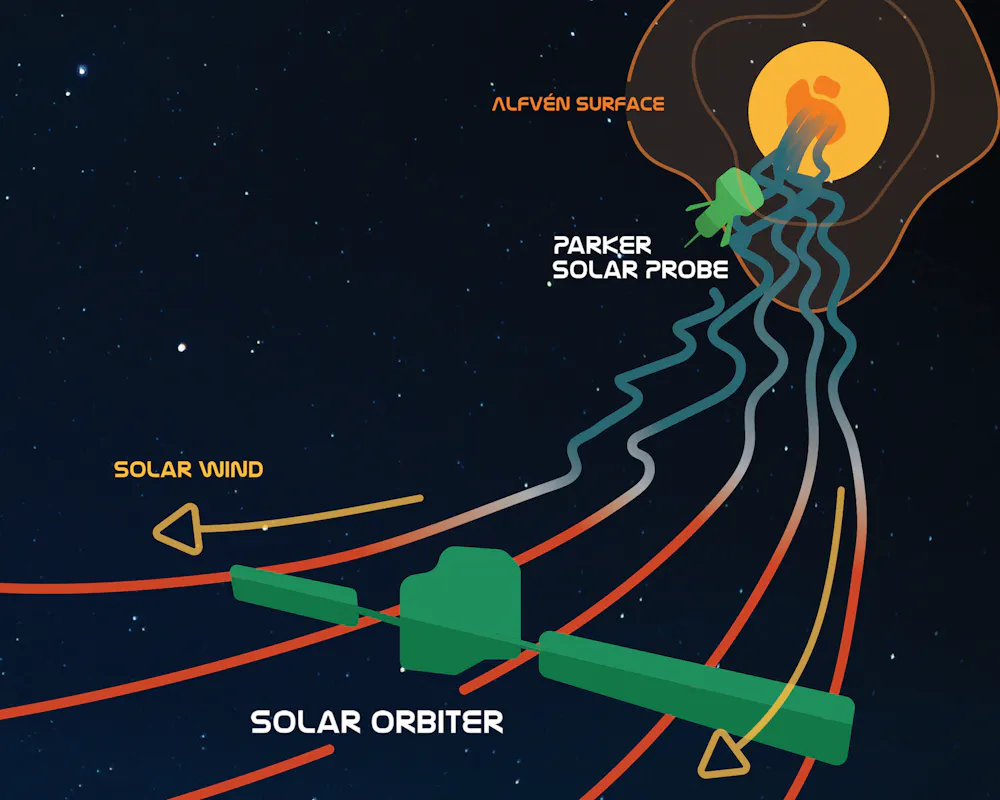
The Solar Orbiter ventures between 1 astronomical unit, where the Earth is, and 0.3 astronomical units, a little closer to the Sun than Mercury. The Parker Solar Probe dives much deeper. It gets as close as five solar diameters from the Sun, within the outer edges of the corona. Each solar diameter is about 865,000 miles (1,400,000 kilometers).
NASA’s Parker Solar Probe and ESA’s Solar Orbiter missions measured the same stream of plasma flowing away from the Sun at different distances. Parker measured lots of magnetic waves near the edge of the corona – called the Alfvén surface – while Solar Orbiter, located past the orbit of Venus, observed that the waves had disappeared and that their energy had been used to heat and accelerate the plasma. Arya De Francesco
With both these missions operating together, not only can researchers like us examine the solar wind close to the Sun, but we can also study how it changes between the point where Parker sees it and the point where the Solar Orbiter sees it.
Scientists used Parker to measure the solar wind’s magnetic field. At some points they noticed the field lines – or lines of magnetic force – waved at such high amplitudes that they briefly reversed direction. Scientists called these phenomena magnetic switchbacks. With Parker, they observed these energy-containing plasma fluctuations everywhere in the near-Sun solar wind. https://www.youtube.com/embed/plabpsKpydE?wmode=transparent&start=0 Magnetic switchbacks are brief reversals in the solar wind’s magnetic field.
Our research team wanted to figure out whether these switchbacks contained enough power to accelerate and heat the solar wind as it traveled away from the Sun. We also wanted to examine how the solar wind changed as these switchbacks gave up their energy. That would help us determine whether the switchbacks’ energy was going into heating the wind, accelerating it or both.
To answer these questions, we identified a unique spacecraft configuration where both spacecraft crossed the same portion of solar wind, but at different distances from the Sun.
The switchbacks’ secret
Parker, close to the Sun, observed that about 10% of the solar wind energy was residing in magnetic switchbacks, while Solar Orbiter measured it as less than 1%. This difference means that between Parker and the Solar Orbiter, this wave energy was transferred to other energy forms.
By comparing both datasets and the models, we could see specifically that this energy contributed to both acceleration and heating. We knew it contributed to acceleration because the wind was faster at Solar Orbiter than Parker. And we knew it contributed to heating, as the wind was hotter at Solar Orbiter than it would have been if the waves weren’t present.
These measurements told us that the energy from the switchbacks was both necessary and sufficient to explain the solar wind’s evolution as it travels away from the Sun.
Not only does our measurement tell scientists about the physics of the solar wind and how the Sun can affect the Earth, but it also may have implications throughout the universe.
Many other stars have stellar winds that carry their material out into space. Understanding the physics of our local star’s solar wind also helps us understand stellar wind in other systems. Learning about stellar wind could tell researchers more about the habitability of exoplanets.
by Donna Kallner, The Daily Yonder August 23, 2024
Affordable rural housing stock is almost as scarce as large animal veterinarians these days. We happen to know one of that rare breed (we call her the Cow Whisperer), and she recently found a house to buy. The price was reasonable for a starter home because it needs some work. It’s not a “Let’s restore a Victorian painted lady” fixer upper, but it needs more than a fresh coat of paint. She knows what to expect.
But if you’ve lived in or tried to renovate an old farmhouse, you can understand the temptation to put a match to it and walk away. There’s a point at which it seems pointless to continue battling mice, jerry-rigged plumbing, and bird and rodent nests near wiring that wouldn’t pass any building code inspection. The shed snake skin I found nestled among my canning jars drove me closer to arson than any of our many domestic encounters with bats.
When we were younger, visitors knew to prepare for nights in our unheated, uninsulated upstairs bedrooms like a winter camping adventure. It’s just the way it was. Then I was in a serious motor vehicle accident. Maneuvering on crutches was hard enough. But the dark, narrow passage from the kitchen to the miniscule bathroom (better than an outhouse but not much)? That really tested my mettle. And that’s after my husband duct-taped open the accordion door so I didn’t have to wrestle it open and closed.
It became clear that aging in place would require big changes. So we did the math on what it would cost to rewire, insulate, and build an addition for a bath/laundry/kitchen that could be plumbed without venting the soil pipe through a kitchen cupboard. The cost was enough that it made more sense to choose new construction on the same property.
But that left us with the question of what to do about the old house – or as my husband called it, the one that was paid for. We had no interest in dividing the property to sell part, or in renting out the house: Either would have required difficult and costly choices about our well, septic system and electrical service. We didn’t know anyone willing to take on the expense of moving a structure that would need so much work. Or anyone willing to dismantle it and haul away everything, not just the limited materials that could be reused. Letting it stand wasn’t an option for tax, insurance and other reasons: Empty structures can attract meth cookers and people who strip out copper and other materials, and we could still be liable if anyone was injured on our property.
In the end, we did burn it – as a training exercise for local volunteer fire departments. But a lot went into the preparation for that controlled burn in May of 2002.
As a member of my local volunteer fire department, I’ve been on a number of calls where building materials were intentionally burned without that control. In some cases, the responsible party was genuinely surprised that anyone would call 911, and that people can’t just burn or bury anything they want to on their own property in the country. After all, that was a common practice at one time, so they may have known people who did just that and got away with it. But nowadays it takes an Oscar-caliber performance to achieve forgiveness when you didn’t first get permission to burn or bury demolition waste.
That’s because there are health and safety risks associated with disposal of construction and demolition (C&D) materials, and state laws that regulate their disposal. In Wisconsin, you can face fines and penalties if you burn a structure or if there is documented environmental damage caused by waste disposed of on your land. And you may be held liable for environmental cleanup. Burying C&D waste on your land could significantly reduce your property value and make you liable to future landowners. Reduced property value or fulfilling the contingency requirements for cleanup could cost more than simply managing the waste properly to begin with.
For the controlled burn of our old farmhouse in 2002, the first step was a conversation with our volunteer fire chief. He directed us to the Department of Natural Resources for guidelines on our responsibilities.
We had to have a state-certified inspector come out to examine the structure. He took samples of shingles, siding and ceiling materials, and examined the interior for flooring that might have contained asbestos. Lab results indicated no asbestos, so we were not required to do asbestos abatement. We received a letter attesting to inspection results to give to our fire chief so he could proceed with planning for the burn.
We did not have to remove asphalt shingles, which is required “unless they are considered necessary to the fire practice” (roof venting was one of the training evolutions). We did have to remove furniture, appliances and household items, even if we hadn’t needed them in the new house. I think many people don’t know how much toxic smoke and gas can be released by burning the foams, plastics, adhesives and petroleum products in furnishings.
Our fire chief developed plans for the training and the demolition burn. We identified hazards like the creepy open cistern in the basement. Advance preparations included nailing sheets of OSB over upstairs windows to help minimize airflow during training exercises. We also covered the large picture windows downstairs to help manage flames and heat radiating toward other exposures during the burn.
In a rural area like ours, there are no nearby fire hydrants, so water is often moved to the scene by what is called a tender relay. On the day of the burn, our local volunteer fire department was joined by several neighboring departments to participate in the training exercises and to assist with the burn. They set up a portable pump in the river by the fire station, less than two miles away, and used three tenders to move water from that fill site to our location.
First up that day was a roof venting training exercise. Firefighters worked from a roof ladder hooked to the peak, using a specialized saw to cut through roofing materials and rafters.
The plan was to start the controlled burn in the single-story kitchen addition. Once that burned, the two-story main structure could collapse toward that and away from the new house. (Photo by Donna Kallner)
The other training evolutions were conducted in upstairs bedrooms. As is true in many old farmhouses, the stairs to those bedrooms were steep and narrow, with irregular step heights and tread depths. Imagine navigating those in full bunker gear, breathing apparatus and face shields while managing a firehouse pressurized from the engine and ready to deliver water to a fire. Now imagine doing that with smoke filling the space.
After putting out several training fires upstairs, the chief called a break for volunteers to eat the lunch my mom and I had prepared for them. During that time, the wind started to pick up. The chief elected to cut a final planned training evolution and conduct the burn before the wind could increase or shift toward our new house.
Even though you’re not trying to put out a structure fire, it takes a lot of firefighters for a controlled burn. There were firefighters working a hose line to cool the siding on the new house so it wouldn’t be damaged. They set up water curtains to protect our liquid propane tank and another small structure. There was an engine operator pumping water, another on a backup engine, and a fill site boss working with the tender relay drivers. We shouldhave had a few more people on the highway to manage traffic before every Looky-Lou passerby pulled off on the shoulder to watch the fire, thereby blocking access to the driveway for those tender drivers so that we almost ran out of water.
The chief had a plan to burn the old house starting with the single-story kitchen addition on the far side away from the new house. Once that burned, the two-story main structure could collapse toward that and away from our new house. And that’s exactly what happened. Eventually. While I was quietly freaking out at how quickly our bedroom was fully engulfed in flame, others were marveling at how long it took for the walls and central chimney to come down.
And that’s not all. Without suppression measures, the fire got so hot it melted the glass in those picture windows. There were a couple of floor joists that didn’t burn. But with so much heat and so much air, there was little left by the time the fire was done.
Before that, things got a little exciting when embers from the structure ignited and started a grass fire. Firefighters fought that and kept a minor crown fire in a red pine tree from blowing up. By the end of that day, I was grateful beyond measure to every one of the volunteers who contributed to a successful training and to a successful demolition burn.
Our fire department regularly gets inquiries from people interested in donating a structure for a training burn. Sometimes we don’t hear from them again after they learn it’s not as simple as just tossing a match. But when we do, we get valuable live fire training and a chance to help our community remove a structure that has outlived its usefulness.
Donna Kallner writes from Langlade County in rural northern Wisconsin.
This article first appeared on The Daily Yonder and is republished here under a Creative Commons license.
The land exchange proposed in July has been withdrawn by landowner Mark Kok. The proposal included the TFS Community Hall board granting a 30-foot easement to Kok in exchange for a .8 acre parcel of land north of the TFS Community Hall. Previously, the TFS Community Hall board has sought to buy the land north of the hall to expand the TFS Community Hall’s kitchen and bathrooms.
The hall board is moving forward to develop plans to renovate the kitchen and make the bathrooms ADA compliant without a building expansion.
Trego Heritage Days
The TFS Community Hall board is sponsoring Trego Heritage Days as THE major fund raiser for the TFS Community Hall. The goal is to raise $10,000 to cover a year of the hall’s expenses. Part of the money has been raised through sponsorships. The remainer of the funding will be raised by selling parking passes and music tickets. Parking passes are available at thehalltfs.com website for $10 per car. Music tickets and parking passes will be available the day of the event. Music tickets are separate from parking passes and are $10 per person with children 12 and under free. The goal is to sell over 500 parking passes and/or music tickets. Much of the promotional advertising is occurring in the Flathead valley.
The majority of the heritage events occur Saturday, September 7th. The TFS fireman’s breakfast is Sunday at the hall. On Saturday, a parking pass is required to park on the grounds adjacent to the hall (Mee field) or at Blarney Ranch. There will be food vendors, a beer garden, talks about local history, and music at the TFS community hall. Music is expected to start at 2:30 and continue to 8 pm.
The Trego pub is hosting educations and local agencies information booths as well as fiber demostrations and a MLA logging simulator. Around noon Two Bears Rescue Helicopter is expected to land at the Trego pub. Much of the day’s activities will be at Blarney Ranch including “Coffe with Cows”. Blarney Ranch is hosting ranching, logging, and farming demonstations. There will be a petting zoo (from Poverty Flats), a bouncy house, 3 legged races, sack races, and a pie eating contest for the kids. The ranch will have a vendor village (with local artists), food trucks and beer garden.
Volunteers for the event will receive free parking passes and tickets for the music event. Parking passes will be given out to food bank recipients before the event. With the large crowd expected, come early.




 Trego's Mountain Ear