Trego's Mountain Ear

"Serving North Lincoln County"

Author: Sam

  • Q&A: Can the Farm Bill Promote Racial Justice?

    by Olivia Weeks, The Daily Yonder
    April 5, 2024

    Editor’s Note: This interview first appeared in Path Finders, an email newsletter from the Daily Yonder. Each week, Path Finders features a Q&A with a rural thinker, creator, or doer. Like what you see here? You can join the mailing list at the bottom of this article and receive more conversations like this in your inbox each week.


    New research from American University and the Federation of Southern Cooperatives/Land Assistance Fund says the currently stalled farm bill is an avenue for reversing historic discrimination against farmers of color by the U.S. Department of Agriculture. 

    I spoke with Sara Clarke Kaplan, executive director of American’s Antiracist Research and Policy Center, to learn more about their new toolkit – “Pointing the Farm Bill Toward Racial Justice.”

    Enjoy our conversation about the current state of the farm bill, and Kaplan’s hopes for its future, below.

    Black farmers gather at Farm Aid 1999. (Photo courtesy of the Federation of Southern Cooperatives/Land Assistance Fund)

    What’s the current state of the farm bill? Or, in other words, what’s the occasion for this toolkit? 

    The farm bill is reauthorized every five years; reauthorization is always a big deal because there’s a tremendous amount of money involved for issues ranging from sustainable agriculture to farm extension programs to nutritional assistance programs. This reauthorization was especially high stakes because of the infusion of money from the Inflation Reduction Act into conservation programs. In 2023, ARPC, The Federation of Southern Cooperatives/Land Assistance Fund, UC Berkeley’s Food Institute, and AU’s Center for Environment, Community, and Equity convened a national summit on racial justice and the farm bill when Congress was in the process of deliberating a new Bill. Unfortunately, Congress kicked the farm bill reauthorization into 2024 and we still don’t have a new farm bill. That means that the goal of building in policy changes that would increase racial justice is still a critical issue right now.  

    That said, this work – and this toolkit – isn’t just about a single reauthorization: it’s part of a longstanding and ongoing collaboration of grassroots agricultural organizations and food justice scholars that has produced a strong, lasting coalition of farmers, advocates, researchers, and workers who are seeking to infuse questions of racial equity into food, climate, and agricultural justice. The toolkit reflects that coalitional thinking, with the goal of carrying it forward into ongoing efforts for this eventual farm bill reauthorization and beyond. 

    Why is the farm bill a good target for justice-oriented demands?  

    It’s important to remember that the farm bill is a huge omnibus bill, and the primary Congressional vehicle for setting U.S. agricultural and food policy. As such, it’s an instrument for distributing huge amounts of money and for setting multi-year political priorities. It’s not just farm subsidies, it’s the provision of rural broadband, the mediation of food insecurity, the decision of who has access to the treasury of germplasm. These funds are already slated to be spent on agriculture, so the question becomes where these resources will go? How can we ensure that the farm bill’s policies and allocation of resources address the needs, interests, and long term sustainability and wellbeing of all of the diverse people who are impacted by its 12 titles? And if you look carefully, some of the most important racial justice issues of our time are present in the farm bill. Researchers of mass incarceration have traced how when small farmers lose their farms, it opens that land up to prison development; reproductive justice organizers have pointed out that the ability to have and raise children requires secure access to healthy, affordable food; there are so many ways in which the farm bill is a critical site for interventions by people and organizations committed to intersectional racial justice. 

    This research is based on years of listening sessions and symposia with Black farmers. What were the most surprising findings from those community-based conversations? 

    Our colleagues at the Federation of Southern Cooperatives/Land Assistance Fund, conducted two years of extensive listening sessions with their many Black farmer and landowner members in the South. These were led by their former Director of Land Retention and Advocacy, Dãnia Davy, who is now continuing this important work at Oxfam. The results of these unprecedented listening sessions were distilled and presented at the summit, where we continued to discuss them with farmers, researchers, and other allied grassroots organizations. While I can speak to those summit presentations and conversations, our Federation colleagues are really the experts on this.

    One point that Federation speakers emphasized was that despite provisions in the previous farm bill for “socially disadvantaged farmers and ranchers” many programs and sources of funding are still not reaching Black farmers. At the summit, we discussed various ideas for making the language in policy more specific about the needs of Black farmers, Indigenous farmers, and other farmers of color.

    Our colleagues at the Federation – and Dãnia in particular – also called attention to the intersecting challenges that Black farmers and landowners face that make it even more difficult for them to work the land: lack of broadband internet, the dearth of child and elder care in the communities, etc. It goes without saying that these are issues of racial, social, and economic justice.  

    Sara Clarke Kaplan is an associate professor of literature and the executive director of American University’s Antiracist Research and Policy Center. (Photo provided by Kaplan)

    The toolkit’s central tenet is “Climate Justice = Racial Justice = Food Justice = Farm Justice.” Can you elaborate on that idea?  

    I can imagine that at first glance, this equation might seem cryptic, but it’s crafted to clarify matters by making implicit connections explicit. All too often, discussions of agricultural policy marginalize questions of racial equity and justice, and far too little is known in the broader racial justice movement about the long history and ongoing role that farming and farmers have played in racial liberation struggles in the U.S. and globally. I consider myself as having been part of that problem. I’m relatively new to Farm Justice, with a long history in racial and gender justice movements, but largely in urban settings. Yet the more I learn about central issues in Farm Justice work, the more I see how inextricably these issues and movements are entwined.  

    Of course, rural participants in grassroots racial justice movements have always known this. Take, for example, projects like Fannie Lou Hamer’s Freedom Farm Cooperative, which enabled Black farmers and sharecroppers who had been excluded, exploited, and terrorized by white landowners to exercise self-determination while providing a source of much-needed food to the hundreds of poor Black families who worked that land. Or take the BIPOC farmers who are innovating new approaches to regenerative agriculture and the building of sustainable, resilient rural communities, who are at the frontlines experiencing the effects of climate change. As long as the vast majority of recent investments in conservation and climate-smart agriculture are directed to white farmers, existing racial disparities will increase, and we will all lose out on opportunities to benefit from the climate-forward work of these small BIPOC farmers.  

    What’s the connection between American University and this Farm Justice work? 

    It’s so important to remember the historical relationship between institutions of higher education in the United States and agriculture. There are over 100 land grant universities in the U.S., from large, well-known universities like Cornell or the University of California, Berkeley to small HBCUs like the University of the District of Columbia. Not only did those land-grant institutions’ original emphasis on agriculture, science, and engineering, create an idea of postsecondary education and research as a resource for everyone, not just elites, but it was through the land grant system that the HBCU system and Tribal College system as we know them now first came into being. In fact, several of our collaborators on the summit and the toolkit came from land-grant universities: April Love from Alcorn State’s Socially Disadvantaged Farmers and Ranchers Policy Research Center, Sakeenah Shabazz from The Berkeley Food Institute at UC Berkeley, Mchezaji Axum from the College of Agriculture, Urban Sustainability and Environmental Sciences at the University of the District of Columbia. Of course, that’s not a history that American University shares. But AU faculty like Garrett Graddy-Lovelace, for example, have been working in collaboration with community partners like the Federation, Rural Coalition, Alianza Nacional de Campesinas, for years – in some cases, over a decade – to build a coalition that connects grassroots movements, farmers and farmworkers, and researchers and scholars. And that’s where the Antiracist Research and Policy Center comes in. From summit to toolkit to our forthcoming online research hub, the “Pointing the farm bill Toward Racial Justice” project is an example of what we believe is the best way toward future social justice: the creation of transformative, scholarship through reciprocal, equitable, and sustainable collaborations among scholars, organizers, and policymakers, presented in ways that are accessible to everyone, including the people most impacted by the issues we address. Not only does it touch on all of our core focus areas – that is, not just climate, land, and environmental justice, but race and reproduction, educational access and equity, and even carceral politics – but it’s an important opportunity for us to remind people that race issues aren’t just urban issues – race is a huge part of the fabric of rural and agricultural American life, and needs to be addressed as such.


    This article first appeared on The Daily Yonder and is republished here under a Creative Commons license.

  • Never Commit To A Living Politician

    Over 50 years ago, I switched  from a candidate I had endorsed to his opponent (Bob Brown,  if anyone cares) two days before the election.  Bob and I have remained friends  for a long time, and part of the reason is that  we both know that my support for any politician is conditional.  So long as a politician breathes, he or she has the ability to do something to shaft me, or to stomp the hell out of something I believe in.  Ignore the dangling preposition – it’s bad enough that the internet is kicking on and off as I write.  I don’t need the ghost of Mrs. Sherman getting new allies in teaching me grammar.

    So long as a politician lives, he or she can, and probably will do something reprehensible and let you down.  I imagine that Jefferson Davis wasn’t a damned bit surprised when Lincoln introduced the Income Tax – but I suspect that more than a few abolitionist Republicans were absolutely gobsmacked.  Just a hunch, you understand.

    I’ve had some folks (dedicated democrats) call me a trumpkin.  I’ve had MAGA supporters classify me as a libtard.  It’s pretty simple – Trump went against my beliefs with the rent controls during the Covid thing.  Biden did the same.  No taxpayer dares sleep while a politician of whatever side yet breathes.  The only politician who can’t roll over and shaft you is a dead one.

    Bob is Montana’s closest thing to a good, reliable living politician.  He’s retired from that life, so can’t harm anyone.  Admitted, we won’t vote the same – he despised Trump more than Hillary, I despised Hillary more than Trump – but that’s really the second stage of responsible voting.

    The first stage of responsible voting is voting against the politician who shafted you.  I’ll be doing that on Neil Durum.  Neil did worse than just shaft Trego taxpayers.  He set it up so I will have to vote to raise taxes on my neighbors.  He has an opponent – of whom I know nothing – but his opponent has not put me in a spot where I will have to raise taxes for the school because of his vote.  Zoey Zephyr voted against the bill – but Neil Durum, who had the opportunity to vote in Trego’s favor chose to vote the other way.  Did he even think about what his vote would do, or did he just thoughtlessly vote party line?  I don’t know – but responsible voting is voting against a politician – of whatever party – who has voted against you.  I’m voting responsibly.  I have no problem voting Democrat when a Republican votes against my interests.

    Another responsible thought is term limits.  Our legislation on term limits can be simplified and improved at the same time.  It should be: One term in office, one term in prison.  Simple.  Elegant.  Hell, I even have New York liberals supporting this concept.  Admittedly, they only support it if the politician is Donald Trump, but you have to start somewhere.

    Vote for the least harmful candidate running – and vote against the candidate who has done you harm.  An earlier age used tar and feathers to express disapproval – but that seems a bit messy.  For now.  

  • The Late Hatches

    We’re still watching the latest hatch of geese – five goslings and two parents that haven’t gone into the flight training stage.  Very different from the old gander, who brings his (second) mate north, and makes certain the nest site is clear and ready before the ice goes out and the island becomes the safest place to nest.  He’s been mostly gone for over a month, taking his goslings and grand-goslings on flights to lakes and fields in the area.  The last time he stopped by there were 43 geese landing.  We expect an even larger entourage when he makes the final fall landing, impressing the concept of his home field on all of his followers.

    Today, Saturday the 17th, the lone turkey hen showed up at lunch-time, accompanied by six day-old hatchlings.  She had lost her original three hatchlings – although we have good habitat for little birds, that habitat is also good for predators.  Probably the worst predator from the turkey perspective is the nest of ravens – but the coyote, the eagle, even the occasional feral cat all look for the smallest turkeys.  Hopefully, she’ll be successful with this late lot.

    We’re getting ready to put the sign on the driveway.  We’ve had it a little less than 40 years, back when Renata won the gift certificate at some raffle, for Dave Clark to chainsaw carve a sign.  It moved to Libby with us, then to SDSU and home when we retired.  I’ve touched up the paint and varnish, and planned to use aluminum nails to put it on a tree next to the gate – under the theory that a sign that reads “Mike and Renata” essentially says the same thing as “Private Drive” but a whole lot more politely.

    I got in the habit of using aluminum nails in trees when I surveyed for Cadastral – and getting my own mill has increased my bias against iron and steel in trees – my last encounter was in a blowdown alongside the old Fortine Creek Road where one of the insulators for the phone line between Ant Flat and the old dam had been placed.  Nearly a century of growth had well concealed the iron after the insulator and line were gone, and naturally it was an almost new band I ran into it.

    So I went shopping for long aluminum nails.  Failed in Eureka.  Failed in Kalispell.  Got on the internet.  Found them at a hardware store in Ohio.  $9.00 gets me 10 5-inch aluminum nails delivered in about ten days.  Hopefully we’ll have the project up by the first of September.  As I approach 75, protecting the sign from the element seems increasingly less significant.

  • Almost a Rifle

    In the early seventies, a glance at GCA 68 showed how far the anti gun forces  had moved legislatively in my college years.  As percussion guns weren’t (and still aren’t) classified as firearms, I looked for a version of a revolving rifle to give me a repeater that I could carry if the gunbanners got even more legislation passed.

    There was a carbine based on the Remington New Model Army revolver – an appealing little rifle, but limited by the capacity of the small cylinder.  I still like the looks, but it seems a bit underpowered for deer.   This photo is in the Midway Arms catalog, and they’re asking $609.99 for one today (and out of stock, to boot).

    So, having rejected the Remington Replica, I opted for a variant of the Colt Third Model Dragoon.  Colt had developed the Dragoon to replace the Walker, mostly because the Walker’s cylinders kept blowing up with 60 grains of black powder loaded.  The Dragoon cylinders had held together for 40 grain loads through 3 variants.   This photo, and description is taken from an ad at guns international:

    “Armi San Marco produced this 1851 3rd Model Dragoon with an 18″ Barrel. It was marketed by both Navy Arms and EMF. It originally came with a steel hardware shoulder stock and holster. There were around 5000 produced. The production of the steel hardware shoulder stocks ceased in around 1974-75 The Dragoon stocks are very rare with either the brass or steel hardware. The last steel hardware STOCK sold was in April, 2013, for $1000. The Dragoon brass hardware stocks are in the $800+ range.”

    Mine, with a 4200 range serial number supports this advertising story – it must have been one of the last made with a steel hardware stock.  I will admit, I never figured that it would be worth $1,500.  I bought it figuring it would be roughly equivalent to a model 1873 Winchester in 44-40.  It definitely is far outclassed by the old 30-30.  It has Express sights with 3 settings, but is probably, at best, a 50 yard hunting rifle.  I’ve only used it on paper – and in the 50 years since I bought it, the gun banners have continued to lose in their attempts to ban handguns and rifles.  It’s fun to shoot, and reasonably accurate.

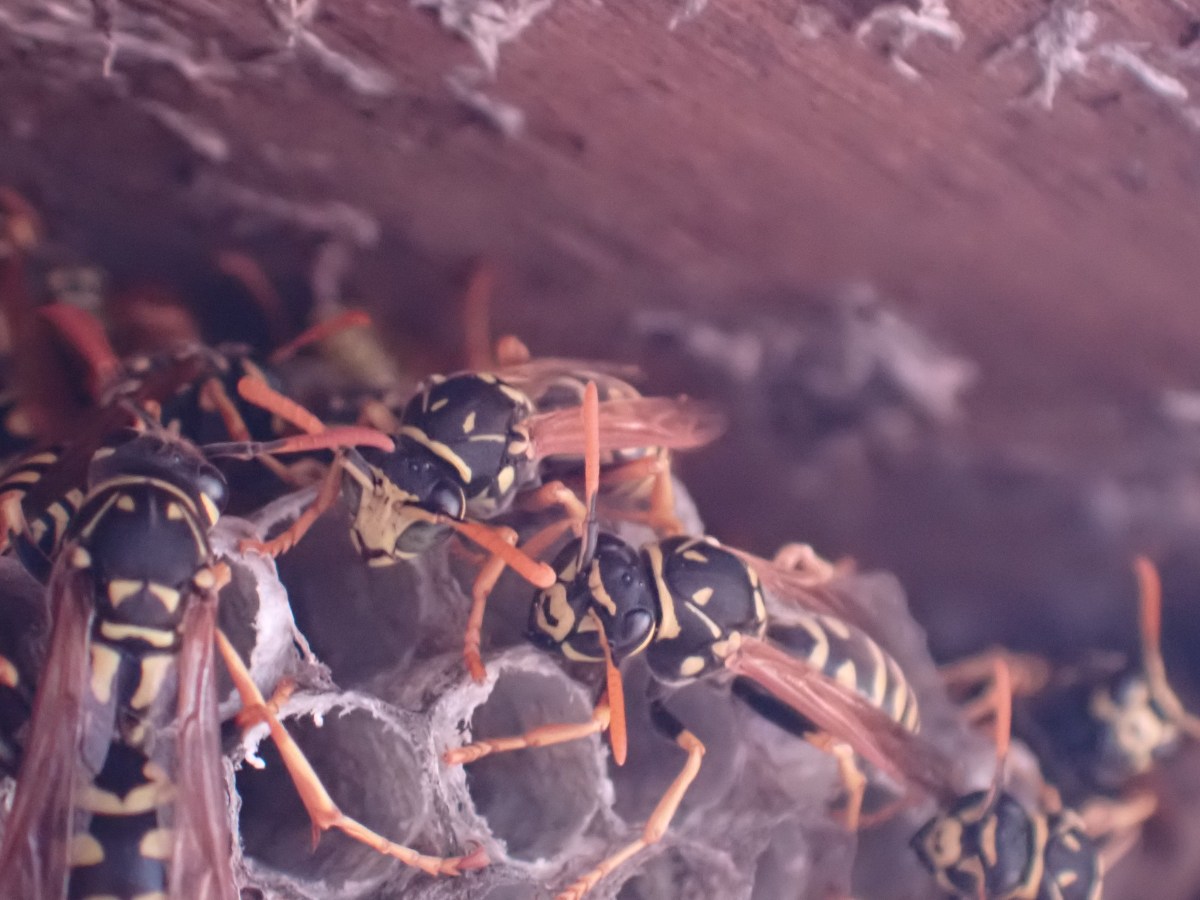
  • Rerun: Wasps

    Facebook would seem to indicate that everyone else is getting stung, bitten and otherwise mobbed by flying insects. Here’s the usual reminders:

    ‘Tis the Season for Wasps

    With the weather warming and the insects coming out in force, it’s time to start thinking about wasps (and what to do about them)

    Wasp control

    I’d wanted to talk about how to read wasp body language this week, but that’ll be postponed. I couldn’t persuade any individuals to do threat displays this week – all live wasps were well-mannered, despite extreme invasion of their personal space. Most of the wasps I’ve seen around Trego are Polistes paper wasps. We have…

    The time to start trapping wasps is now.

    While winter isn’t quite done with us yet, we’ve had a good period of warmth recently. Wasps, as well as bears, are waking from their winter hibernation. I’ve seen a few queen paper wasps scouting for new nesting sites. With this in mind, if you want to control wasps in or around your property, the…

    Wasps… they’re not always out to get us.

    What says midsummer better than unexpected wasp nests? Buzzing uncomfortably overhead, nests full to bursting with developing young. Dreadful things, right? What would you say if I told you that aggressive wasps (think of your stereotypical Bald Faced Hornets) aren’t the only kind out there? Even within a single species, there are a wide variety…

    Paper Wasp Body Language

    If you know what signs to look for when you meet a wasp, it’s easy to avoid being stung. Have you ever been buzzed by a bee or a paper wasp? They dive bomb you, fly close to your face, even collide with you, but without stinging? Those were probably sentries for a nest, trying…

  • Not Simply Open Range

    “Montana is an open range state” is a common response to folks complaining about cattle in places they’d rather cows were not. However, that simple statement is an oversimplification. Montana is not just an open range state.

    Rather, our range laws stem from the need to address two separate issues. The first was addressing the needs of folks moving large herds of cattle across the plains. The second was addressing grain shortages made worse by damaged crops. Both issues can be solved by fencing, in one form or another, but how to find the balance?

    In Montana, it’s a choice. We are not an open range state, not exactly. Rather, Montana is piecemeal, patches of open range nested among patches of “herd districts”.

    In an open range district, cattle must be fenced out. In a herd district, cattle must be fenced in. What determines which an area is? Local choice. Specifically, landowner petition to the county commissioners. There’s a bit more detail to it- but go check Montana Code Annotated for the rest, and remember that sometimes the simple truisms aren’t quite true.