Editor’s Note: This was originally published about a year ago (last March), but we’re publishing it again because the bill is coming due. We won’t know the amount until the school year is up and every school in the state has to figure out how much to bill other districts for, but permissive levy notices have gone out and tax payers are learning how this will impact their bill.
One of the ‘Things Our Government Has Been Up To’ is House Bill HB203, which passed into law. It’s marketed as a bill about school choice, although Montana was already a state that allowed for out of district enrollments.
One of the things it does, is that it makes it harder for schools to say no to out of district enrollment. “Perhaps the most compelling and direct impact of HB203 is that Montana public school districts will no longer have absolute discretion to deny applications for out-of-district attendance.” There are very limited circumstances in which the law will allow districts to reject out of district enrollment.
More choice for parents? Not here. Our local schools have already been accepting out of district enrollments when they’ve been able to do so and meet the needs of the students. Less choice for school boards? Definitely. And for taxpayers…?
The taxpayers of the district accepting students aren’t on the hook for funding those students (and really weren’t before, since the state distributes school funding based on enrollment anyway), but the donating school district can expect to contribute over a thousand dollars of tuition per leaving student.
Will this impact district taxes and levies? Probably, especially in smaller districts where budgets run tight.
Did it increase our choices for where to send our kids to school? No. Not here. Not for us. Did it turn our kids into dollar signs for other school districts? They already were, due to the state’s method of redistributing funds. But it’s increased the number that goes with the dollar sign.
What did our local senator and representative vote? Yea.
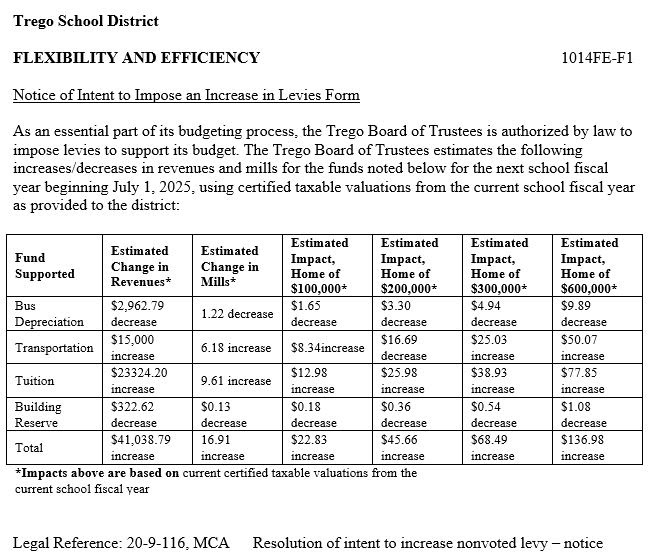
With taxable valuations now tentatively available, schools are publishing estimates of changes in the levies that no one other than the school board gets to vote on. Just in time for school board elections (Election Day: May 6th).
It’s notable that these are estimates. They are not set in stone, and will not be finalized until the school budget meetings are held. What this means is that taxpayers with concerns have time to vote their wallets with regards to the upcoming school board election, and also to make their thoughts known to the board well in advance of the budget meeting.
Also notable is that none of these “permissive” levies are in the general fund. The uses of these funds are all very specifically defined by state law. For example, the transportation levy cannot be used to pay a classroom teacher- it can’t even be used for field trips. It is explicitly for expenses associated with transporting students to and from school.
The Sun periodically ejects huge bubbles of plasma from its surface that contain an intense magnetic field. These events are called coronal mass ejections, or CMEs. When two of these ejections collide, they can generate powerful geomagnetic storms that can lead to beautiful auroras but may disrupt satellites and GPS back on Earth.
The northern lights, as seen here from Michigan in May 2024, are caused by geomagnetic storms in the atmosphere. Shirsh Lata Soni
Two merging CMEs triggered the largest geomagnetic storm in two decades, which manifested in brightly colored auroras visible across the sky.
I’m a solar physicist. My colleagues and I aim to track and better understand colliding CMEs with the goal of improving space weather forecasts. In the modern era, where technological systems are increasingly vulnerable to space weather disruptions, understanding how CMEs interact with each other has never been more crucial.
Coronal mass ejections
CMEs are long and twisted – kind of like ropes – and how often they happen varies with an 11-year cycle. At the solar minimum, researchers observe about one a week, but near the solar maximum, they can observe, on average, two or three per day.
During the solar maximum, solar flares and coronal mass ejections are more common.
When two or more CMEs interact, they generate massive clouds of charged particles and magnetic fields that may compress, merge or reconnect with each other during the collision. These interactions can amplify the impact of the CMEs on Earth’s magnetic field, sometimes creating geomagnetic storms.
In my research team’s study, published in May 2024, we found that CMEs that do interact or collide with each other are much more likely to cause a geomagnetic storm – two times more likely than an individual CME. The mix of strong magnetic fields and high pressure in these CME collisions is likely what causes them to generate storms.
During solar maxima, when there can be more than 10 CMEs per day, the likelihood of CMEs interacting with each other increases. But researchers aren’t sure whether they become more likely to generate a geomagnetic storm during these periods.
Scientists can study interacting CMEs as they move through space and watch them contribute to geomagnetic storms using observations from space- and ground-based observatories.
In this study, we looked at three CMEs that interacted with each other as they traveled through space using the space-based observatory STEREO. We validated these observations with three-dimensional simulations.
The CME interactions we studied generated a complex magnetic field and a compressed plasma sheath, which is a layer of charged particles that, once they reach the upper atmosphere of Earth from space, interacts with its magnetic field.
When this complex structure encountered Earth’s magnetosphere, it compressed the magnetosphere and triggered an intense geomagnetic storm.
Four images show three interacting CMEs, based on observations from the STEREO telescope. In images C and D, you can see the northeast flank of CME-1 and CME-2 that interact with the southwest part of CME-3. Shirsh Lata Soni
This same process generated the geomagnetic storm from May 2024.
Between May 8-9, multiple Earth-directed CMEs erupted from the Sun. When these CMEs merged, they formed a massive, combined structure that arrived at Earth late on May 10, 2024. This structure triggered the extraordinary geomagnetic storm many people observed. People even in parts of the southern U.S. were able to see the northern lights in the sky that night.
These resources, coupled with advanced modeling capabilities, provide timely and effective ways to investigate how CMEs cause geomagnetic storms. The Sun will reach its solar maximum in the years 2024 and 2025. So, with more complex CMEs coming from the Sun in the next few years and an increasing reliance on space-based infrastructure for communication, navigation and scientific exploration, monitoring these events is more important than ever.
Integrating the observational data from space-based missions such as Wind and ACE and data from ground-based facilities such as the e-Callisto network and radio observatories with state-of-the-art simulation tools allows researchers to analyze the data in real time. That way, they can quickly make predictions about what the CMEs are doing.
These advancements are important for keeping infrastructure safe and preparing for the next solar maximum. Addressing these challenges today ensures resilience against future space weather.
This article was updated to clarify how a compressed plasma sheath interacts with the Earth’s upper atmosphere and magnetic field.
There’s a balance to be struck between the hard facts of a textbook and the beguiling prose of historical fiction. That said, modern textbooks are increasingly less “dry”, and more conversational.
Some of that may be an acknowledgement to the attention span of modern readers (Not, actually, shorter than the average goldfish, as it happens. But research does suggest a possible decrease, beyond the anecdotal commentary of previous generations), but another aspect is the human fascination with stories.
We are better at learning stories than lists of facts- so much so, that “create a story out of it” is a memorization tool taught to teachers and students alike. It makes sense that we would be; stories have been with us a long time, much longer than the written word, and there’s an argument to be made that modern humans evolved with them.
Regardless, general observation would tend to indicate that children, and people in general, are more interested in stories than they are in dry lists of facts and summaries of theory.
Thus, literature-based curriculum. Once, the guidance would have been to supplement the dry textbook with related reading. Take Radium Girls as an example: include it as a suggested addition to a lesson on radioactive decay. Or perhaps tell the story of Thomas Midgley, an engineer with a greater inadvertent negative environmental impact than most could aspire to accomplish deliberately, as part of a lesson on toxins.
Literature-based curriculum takes this a step further. Start with the story. Then, teach the concepts, the facts, the details as part of that story. Because the parts of a story matter; the names for the various layers of the atmosphere…mostly don’t, unless you have a good reason to think they should.
This has the additional advantage of encouraging literacy, especially important when it’s an area that students struggle in.
Trego School has recently shifted to literacy-based curriculum, especially for the younger students, and benefited from a grant from the Montana Masonic Foundation to help support this. This March, the school received $1,500 towards expanding the literature available to support their literacy-based program. The additional books will allow for more customization to student interests and reading levels.
In 1990, George Franklin was convicted of murder and sentenced to life in prison based on the testimony of his 28-year-old daughter Eileen. She described seeing him rape her best friend and then smash her skull with a rock.
When Eileen testified at her father’s trial, her memory of the murder was relatively fresh. It was less than a year old. Yet the murder happened 20 years earlier, when she was 8 years old.
How can you have a one-year-old memory of something that happened 20 years ago? According to the prosecution, Eileen repressed her memory of the murder. Then much later she recovered it in complete detail.
Can a memory of something so harrowing disappear for two decades and then resurface in a reliable form?
This controversy is not merely an academic one. Real people’s lives have been shattered by newly recollected traumatic experiences from childhood. I’ve seen this firsthand as a memory expert who consults on legal cases involving defendants accused of crimes they allegedly committed years or even decades ago. Often the only evidence linking the defendant to the crime is a recovered memory.
Nineteenth-century psychoanalytic theorist Sigmund Freud developed the concept of repression. He considered it a defense mechanism people use to protect themselves from traumatic experiences that become too overwhelming.
The idea is that repression buries memories of trauma in your unconscious, where they – unlike other memories – reside unknown to you. They remain hidden, in a pristine, fixed form.
In Freud’s view, repressed memories make themselves known by leaking out in mental and physical symptoms – symptoms that can be relieved only through recovering the traumatic memory in a safe psychological environment.
In the 1980s, increasing numbers of therapists became concerned about the prevalence of child sexual abuse and the historical tendencies to dismiss or hide the maltreatment of children. This shift gave new life to the concept of repression.
Rise of repressed memory recovery
Therapists in this camp told clients that their symptoms, such as anxiety, depression or eating disorders, were the result of repressed memories of childhood sexual abuse that needed to be remembered to heal. To recover these memories, therapists used a range of techniques such as hypnosis, suggestive questioning, repeated imagining, bodywork and group sessions.
Did recovered-memory therapy work? Many people who entered therapy for common mental health issues did come out with new and unexpected memories of childhood sexual abuse and other trauma, without physical evidence or corroboration from others.
But were these memories real?
The notion of repressed memories runs counter to decades of scientific evidence demonstrating that traumatic events tend to be very well remembered over long intervals of time. Many victims of documented trauma, ranging from the Holocaust to combat exposure, torture and natural disasters, do not appear to be able to block out their memories.
There are times when victims of trauma may not remember what happened. But this doesn’t necessarily mean the memory has been repressed. There are a range of alternative explanations for not remembering traumatic experiences.
Trauma, like anything you experience, can be forgotten as the result of memory decay. Details fade with time, and retrieving the right remnants of experience becomes increasingly difficult if not impossible.
There also are biological causes of forgetting such as brain injury and substance abuse.
Trauma also can interfere with the making of a memory in the first place. When stress becomes too big or too prolonged, attention can shift from the experience itself to attempts to regulate emotion, endure what’s happening or even survive. This narrow focus can result in little to no memory of what happened.
If science rejects the notion of repressed memories, there’s still one question to confront: Where do newly recollected trauma memories, such as those triggered in recovered-memory therapy, come from?
All memories are subject to distortions when you mistakenly incorporate expectations, assumptions or information from others that was not part of the original event.
Memory researchers contend that memory recovery techniques might actually create false memories of things that never happened rather than resurrect existing memories of real experiences.
To study this possibility, researchers asked participants to elaborate on events that never happened using the same sorts of suggestive questioning techniques used by recovered-memory therapists.
What they found was startling. They were able to induce richly detailed false memories of a wide range of childhood traumatic experiences, such as choking, hospitalization and being a victim of a serious animal attack, in almost one-third of participants.
These researchers were intentionally planting false memories. But I don’t think intention would be necessary on the part of a sympathetic therapist working with a suffering client.
Are the memory wars over?
The belief in repressed memories remains well entrenched among the general public and mental health professionals. More than half believe that traumatic experiences can become repressed in the unconscious, where they lurk, waiting to be uncovered.
This remains the case even though in his later work, Freud revised his original concept of repression to argue that it doesn’t work on actual memories of experiences, but rather involves the inhibition of certain impulses, desires and fantasies. This revision rarely makes it into popular conceptions of repression.
As evidence of the current widespread belief in repressed memories, in the past few years several U.S. statesand European countries have extended or abolished the statute of limitations for the prosecution of sexual crimes, which allows for testimony based on allegedly recovered memories of long-ago crimes.
Given the ease with which researchers can create false childhood memories, one of the unforeseen consequences of these changes is that falsely recovered memories of abuse might find their way into court – potentially leading to unfounded accusations and wrongful convictions.
The Eureka Community Players undertook the challenge of writing plays and is presenting their new play on Sunday, March 23rd. Done in an anthology format, “Seasons on the Farm” – An Afternoon of 10-minutes Scenes Written by Local Writers, begins at 3:00 p.m. at the Timbers Event Center.
This is the second year that the Players have hosted a writers’ group. The group began with a workshop in October. In the workshop, we set certain parameters: 10-12 minutes with 2-3 actors all set in a mutually agreed upon space: a farm. The writers met every two weeks with the final script done in January. Auditions were held in February for actors and directors.
Last year’s play “The Waiting Room” was the Players first attempt at writing a play. “Seasons on the Farm” is our second and slightly different. The Waiting Room’s scenes each stood alone, only similar in that they were set in a waiting room. The Seasons on the Farm’s scenes are tied together by the Narrator / Farm Wife, beginning and ending with her moving away from the farm; and sharing friends and neighbors’ stories in between. The Narrator is played by Loree Campbell. Besides narrating the play, she is also the Grandmother in two of the scenes.
Act I includes “Memories or Grandma Magpie” by Sharon LaBonty; “Sunflower Seeds” by Noelle Nichols; “Who Can Work on a Farm” by Becky Gray; and “Farm Olympics: The Grains of Glory” by Adrian Miller. “Never Trust a Girl in a Hay Loft” by Mike Workman; “All in a Day’s Work” by Judy Russell; and “Fun on the Farm” by John LaBonty make up Act II. The afternoon ends with a talk-back / question and answer session with the writers.
People new to the ECP Writers Group this year were Noelle Nichols, Becky Gray, Mike Workman and Judy Russell. We also use this play as an opportunity for people interested in directing to try it out in a 10-minute format. New directors this year are Madeline Richards and Nancy Haugan. Returning directors are John and Sharon LaBonty, Adrian Miller, Lisa Priller, Kelley Comstock, and Rachel Lautaret Clear.
Many of Eureka’s favorite actors are bringing these original scenes to life. The actors include Alan Guderjahn, Danica Cate, Hugo “Four” Granados, John Priller, Judy Russell, Ethel White, Nancy Haugan, Emily Benge, and Rachel Clear. New faces on stage are Carolyne Snipes, Amy Currie, Devin Braaten, and Daniel and Isaac Lane.
The Players hope to continue this anthology writing as an annual event. The Eureka Community Players invite anyone that is interested to join us. As Sharon LaBonty, Coordinator, said, “Working together, supporting each other, has been fun!”. Just talk to Sharon or call/text her at 406 / 263-9208 for more information.





 Trego's Mountain Ear