House Bill 567 has passed the house and awaits senate review. The bill is designed to incentivize increased cooperation between school districts at the county level.
Multi-District Agreements between districts take many forms: Curriculum cooperatives and special education cooperatives are a common means of resource sharing.
This bill increases the quality educator payment that districts receive in order for participating in a county level multi-district agreement. However, all of the districts in the county must participate for this to be the case. Quality Educator Payment is awarded based on the number of teachers, so this provides a larger fiscal incentive to larger school districts.
Essentially, the way the bill is worded, any of the little rural districts could refuse to participate and deny the rest of the schools in the county the payment increase.
Additionally, this isn’t designed to facilitate small agreements addressing single things:
The programs of the participating districts that are mutually administered must 15 include, at a minimum: (A) administration functions, including budgeting, payroll, human resources, elections, and services provided in support of the board of trustees; (B) custodial services; (C) instructional services and support, including remote instruction, selection of textbooks, library and media services and curriculum development and implementation; (D) K-12 career and vocational/technical education and work-based learning; E) school food services; (F) software licensing and other information technology; (G) extracurricular activities; (H) special education programs; and (I) transportation for instruction and school activities.
Some of these make a great deal of sense for school districts to cooperate on. It’s often a better deal, financially, to bulk purchase software. Special education has so many requirements for various specialists that small districts essentially have to join cooperatives, and extracurricular activities might benefit from resource sharing.
But one has to ask; How exactly is sharing lunch programs and custodial services going to be beneficial, across county schools? Can we simply send our staff to the same trainings, or does it need to be more complicated?
If this does get signed into law, I’ll run the numbers for how much it would increase the general fund budget of each of the local school districts. For now, however, it’s still “wait and see”
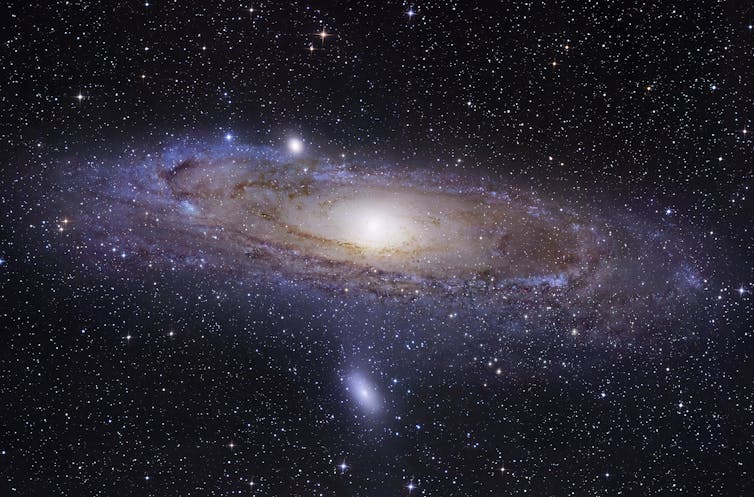
A hundred years ago, astronomer Edwin Hubble dramatically expanded the size of the known universe. At a meeting of the American Astronomical Society in January 1925, a paper read by one of his colleagues on his behalf reported that the Andromeda nebula, also called M31, was nearly a million light years away – too remote to be a part of the Milky Way.
Hubble’s work opened the door to the study of the universe beyond our galaxy. In the century since Hubble’s pioneering work, astronomers like me have learned that the universe is vast and contains trillions of galaxies.
Nature of the nebulae
In 1610, astronomer Galileo Galilei used the newly invented telescope to show that the Milky Way was composed of a huge number of faint stars. For the next 300 years, astronomers assumed that the Milky Way was the entire universe.
Charles Messier also produced a catalog of over 100 prominent nebulae in 1781. Messier was interested in comets, so his list was a set of fuzzy objects that might be mistaken for comets. He intended for comet hunters to avoid them since they did not move across the sky.
As more data piled up, 19th century astronomers started to see that the nebulae were a mixed bag. Some were gaseous, star-forming regions, such as the Orion nebula, or M42 – the 42nd object in Messier’s catalog – while others were star clusters such as the Pleiades, or M45.
A third category – nebulae with spiral structure – particularly intrigued astronomers. The Andromeda nebula, M31, was a prominent example. It’s visible to the naked eye from a dark site.
Astronomers as far back as the mid-18th century had speculated that some nebulae might be remote systems of stars or “island universes,” but there was no data to support this hypothesis. Island universes referred to the idea that there could be enormous stellar systems outside the Milky Way – but astronomers now just call these systems galaxies.
In 1920, astronomers Harlow Shapley and Heber Curtis held a Great Debate. Shapley argued that the spiral nebulae were small and in the Milky Way, while Curtis took a more radical position that they were independent galaxies, extremely large and distant.
At the time, the debate was inconclusive. Astronomers now know that galaxies are isolated systems of stars, much smaller than the space between them.
Hubble makes his mark
Edwin Hubble was young and ambitious. At the of age 30, he arrived at Mount Wilson Observatory in Southern California just in time to use the new Hooker 100-inch telescope, at the time the largest in the world.
He began taking photographic plates of the spiral nebulae. These glass plates recorded images of the night sky using a light-sensitive emulsion covering their surface. The telescope’s size let it make images of very faint objects, and its high-quality mirror allowed it to distinguish individual stars in some of the nebulae.
Estimating distances in astronomy is challenging. Think of how hard it is to estimate the distance of someone pointing a flashlight at you on a dark night. Galaxies come in a very wide range of sizes and masses. Measuring a galaxy’s brightness or apparent size is not a good guide to its distance.
Hubble leveraged a discovery made by Henrietta Swan Leavitt 10 years earlier. She worked at the Harvard College Observatory as a “human computer,” laboriously measuring the positions and brightness of thousands of stars on photographic plates.
She was particularly interested in Cepheid variables, which are stars whose brightness pulses regularly, so they get brighter and dimmer with a particular period. She found a relationship between their variation period, or pulse, and their intrinsic brightness or luminosity.
Once you measure a Cepheid’s period, you can calculate its distance from how bright it appears using the inverse square law. The more distant the star is, the fainter it appears.
Hubble worked hard, taking images of spiral nebulae every clear night and looking for the telltale variations of Cepheid variables. By the end of 1924, he had found 12 Cepheids in M31. He calculated M31’s distance as a prodigious 900,000 light years away, though he underestimated its true distance – about 2.5 million light years – by not realizing there were two different types of Cepheid variables.
His measurements marked the end of the Great Debate about the Milky Way’s size and the nature of the nebulae. Hubble wrote about his discovery to Harlow Shapley, who had argued that the Milky Way encompassed the entire universe.
“Here is the letter that destroyed my universe,” Shapley remarked.
Always eager for publicity, Hubble leaked his discovery to The New York Times five weeks before a colleague presented his paper at the astronomers’ annual meeting in Washington, D.C.
An expanding universe of galaxies
But Hubble wasn’t done. His second major discovery also transformed astronomers’ understanding of the universe. As he dispersed the light from dozens of galaxies into a spectrum, which recorded the amount of light at each wavelength, he noticed that the light was always shifted to longer or redder wavelengths.
Light from the galaxy passes through a prism or reflects off a diffraction grating in a telescope, which captures the intensity of light from blue to red.
It seemed that these redshifted galaxies were all moving away from the Milky Way.
Hubble’s results suggested the farther away a galaxy was, the faster it was moving away from Earth. Hubble got the lion’s share of the credit for this discovery, but Lowell Observatory astronomer Vesto Slipher, who noticed the same phenomenon but didn’t publish his data, also anticipated that result.
Hubble referred to galaxies having recession velocities, or speeds of moving away from the Earth, but he never figured out that they were moving away from Earth because the universe is getting bigger.
Belgian cosmologist and Catholic priest Georges Lemaitre made that connection by realizing that the theory of general relativity described an expanding universe. He recognized that space expanding in between the galaxies could cause the redshifts, making it seem like they were moving farther away from each other and from Earth.
Lemaitre was the first to argue that the expansion must have begun during the big bang.
Edwin Hubble is the namesake for NASA’s Hubble Space Telescope, which has spent decades observing faraway galaxies. NASA via AP
NASA named its flagship space observatory after Hubble, and it has been used to study galaxies for 35 years. Astronomers routinely observe galaxies that are thousands of times fainter and more distant than galaxies observed in the 1920s. The James Webb Space Telescope has pushed the envelope even farther.
The current record holder is a galaxy a staggering 34 billion light years away, seen just 200 million years after the big bang, when the universe was 20 times smaller than it is now. Edwin Hubble would be amazed to see such progress.
There’s a saying that you need to take an interest in government, because it will certainly take an interest in you. I’m not sure how active that interest is, but it’s certainly willing to step in and change your life in inconvenient ways without consulting you.
HB814 is another example of that. Last legislative session left us with a tuition bill forcing all of the local school districts, which had previously had a choice on whether or not to charge tuition for out of district enrollments, to charge tuition regardless of school board and community wishes.
HB814 is even worse for ignoring the preferences of local voters. HB814 would force the merger of all elementary districts with their associated high school districts. Now, the thing is, consolidation has always been an option. Our district has voted on it (not recently)- Trego opposed the abolishment of LCHS and merger with Eureka Elementary into a unified school district. The vote passed elsewhere, as it happens, and that’s more or less why the high school board is the Eureka Elementary Board with add-ons.
Trego and Fortine could put a merger on the ballot whenever- all it takes is both school boards asking the county superintendent, or a petition of voters in both districts- not a huge petition, either. The option already exists.
HB814? Some condescending person elected into Helena has decided that it just doesn’t make sense for these little schools to be separate. So, they’re going to take that choice away from us. And Fortine. And Yak. And McCormick. And every other sufficiently rural community with a school in the state.
Can you ignore your government? Trust that your elected senator and representative won’t vote for something you believe is blatantly stupid, likely to negatively impact your community, or reduce freedom of choice for the population? You could. But if last legislative’s sessions tuition bill (which is going to increase school taxes all over the state, via permissive levies that you don’t get to vote on) is any indication, you probably shouldn’t.
With the whole family catching one of the plethora of illnesses being passed around, the toddler’s gotten a bit more movie time than usual, and I’ve had a chance to evaluate more movies for the faceblind.
The good dinosaur checks a lot of boxes:
Small Cast
Very distinctive characters (especially distinct body language)
No laundry (The clothes never change. They should be members of the cast in their own right)
Color Coding (Star trek does this quite well)
Frequent use of names
Subtitles
Cartoons/Animals
There’s a small cast, predominantly composed of animate dinosaurs, which are very easily distinguished by size/shape/color. Absolutely no laundry. I didn’t even need subtitles.
The only thing on the list really missing is frequent use of names, as one of the major characters doesn’t have a name for a significant portion of the movie. That said, it more than makes up for it in clarity elsewhere. It’s a very easy to follow film.
It’s also toddler approved; He likes dinosaurs, and The Good Dinosaur is about the developing friendship between a lost young dinosaur an an orphaned human boy. The boy’s young, often moving about in a crouch, non-verbal and pretty much feral. Naturally, my toddler has a new hero.
I found the sad little one explaining his lack of a family to be pretty heart-wrenching, but Remi’s insisted quite happily that we need to watch the film repeatedly.
Fortunately, there are solutions. Based on my professional research on emergency preparedness – and my experience working in educational settings – I’ve identified several strategies that may help.
Rural schools have unique disaster challenges
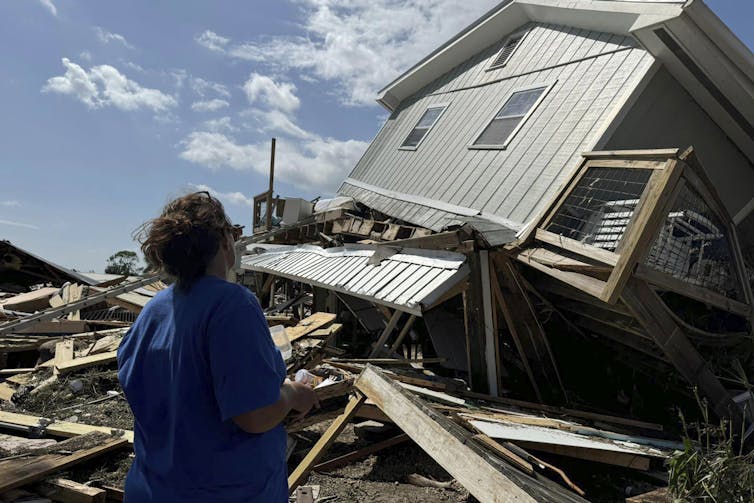
Unlike urban areas, rural districts often have little access to the recreation centers, cultural institutions, university campuses and other structures that could provide temporary sites for classes after a disaster.
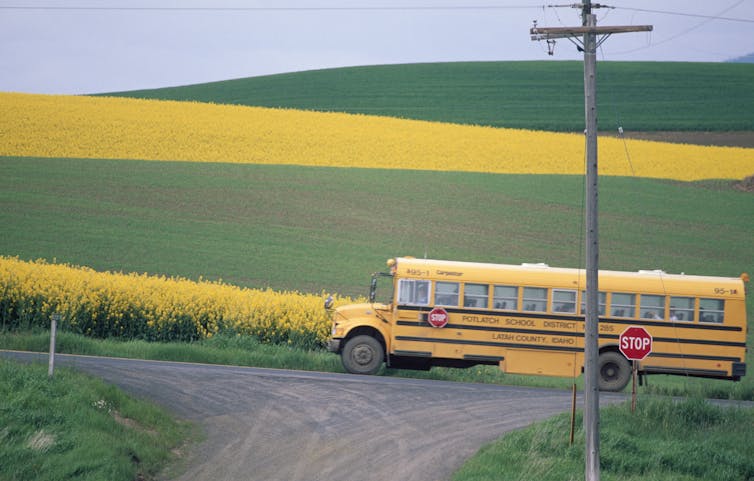
In many rural communities, students rely on school buses to get to and from school. When natural disasters damage roads or disrupt transportation networks, students may be unable to attend school in person for extended periods.
Urban schools, with more reliable power and internet and better access to digital resources, are able to pivot quickly to online or hybrid learning when buildings are suddenly closed.
Due to the challenges already facing rural schools, I believe preparing for a disaster in a rural area should occur earlier and take into account the specific needs of the community.
Although it may seem intuitive, one key solution to school closures is developing learning materials that do not require internet access. I have found that many teachers focus on electronic resources, such as smartphones and Apple watches, and overlook the use of old-fashioned methods.
Instructional materials, such as workbooks and textbooks, should be available and used before a disaster occurs. This is to ensure that students can continue with their studies when they are cut off from school. These materials, which can be supplemented after a disaster, can include projects that students can work on independently or with their families.
Use mobile technology
Another approach incorporates mobile technology, such as smartphones. If service is available, students and teachers can communicate by phone.
When internet access is unavailable, schools can use mobile learning hubs. These are vehicles equipped with Wi-Fi, computers and other educational tools. These mobile hubs can travel to rural areas to provide students with access to digital resources. They serve as temporary classrooms or internet access points, bringing education directly to students.
During the COVID-19 pandemic, for example, I worked with a community college in Tennessee that provided mobile hubs at public libraries, school parking lots and on campus. Students were able to use these resources at all hours, day and night.
Create a flexible learning environment
Schools can give students more flexibility in when and how they learn during the academic year. For example, schools can allow students to make up missed work at their own pace. Or schools can provide alternative learning hours to students who may need to help their families with recovery efforts.
After Hurricane Helene downed power lines and closed roads in Beaufort County, South Carolina, students who were without power or internet were given five days to complete their work and other considerations.
Making rural school systems more resilient when disasters occur is essential to ensuring that students can continue learning.
Advance planning, flexible learning options and partnerships with families, community support services and local and federal government programs can help. But I believe the underlying issues of the lack of resources, transportation challenges and the digital divide should also be addressed to reduce the long-term impact of crises on rural education.
Having just received plenty of snow, we’re now due for a thaw. Forecast indicates that we can expect freezing rain and ice; warm, slightly rainy days of melting followed by freezing evenings in which all of that water turns into a sheet of ice to greet us for our morning commutes.
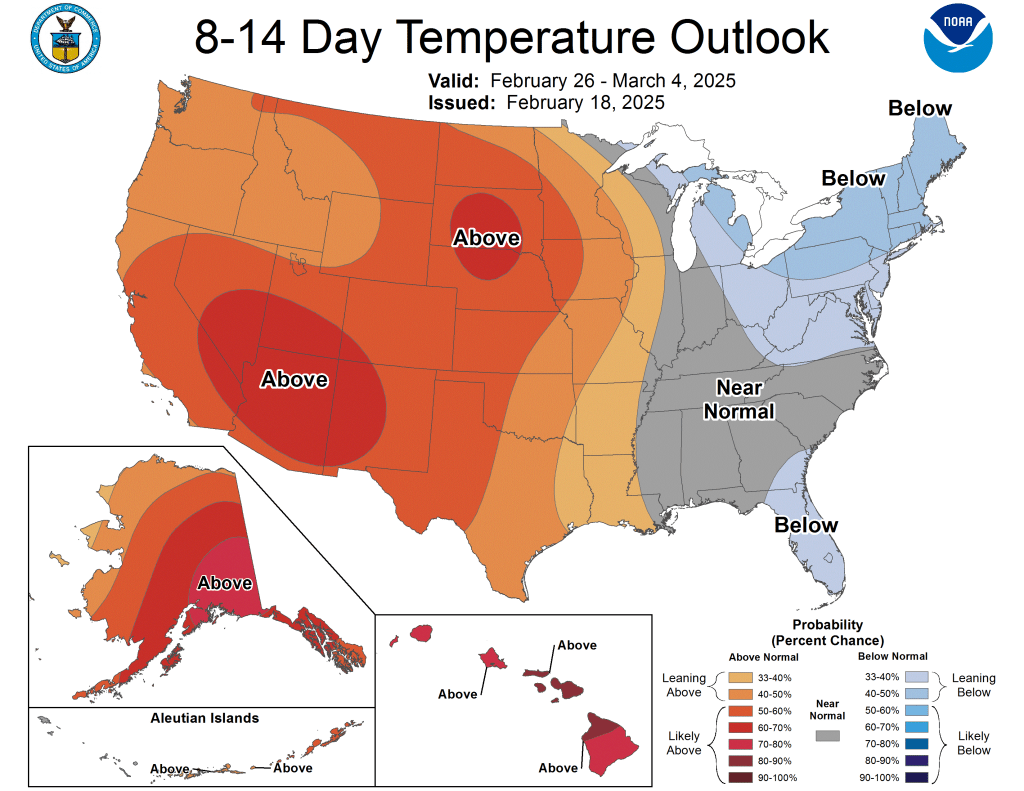
After a few days of that, we can anticipate water, water everywhere, as even night temperatures start to remain above freezing. For the forecast- visit weather.gov which is predicting above average temperatures for the next two weeks, accompanied by above average precipitation for most of the state.


 Trego's Mountain Ear