The Eureka Community Players’ Writers Group 10-minutes scenes. Have you ever thought about acting or directing but don’t want to make a major commitment? This is your opportunity to try it.
“Seasons on the Farm” was written by local writers (interested in playwriting? Watch for the next ‘writer’s workshop’) and will consist of 10 minute scenes sharing the theme of ‘Seasons on the Farm’.
Auditions will be held Tueaday February 18th at 6:00 p.m., at Timbers Event Center. There are parts for men, women, youth – ages 8 to 80.
Everyone will have an opportunity to read parts and choose which scenes appeal to them. Script pages will be provided for review prior to the readings.
For More Information: call Sharon LaBonty at 406 / 263-9208
This Sunday, folks braved the snow to gather at Timbers Event Center to enjoy Eureka’s Got Talent and donate to the Shelly Moen scholarship fund. The Eureka Community Players have a yearly fundraiser for the scholarship and provide one student of the arts with a $1,000 scholarship per year.
Despite the cold and snow outside, folks stayed warm with coffee and cider, while they bid on items in the silent auction, purchased mystery gift cards in the “grub grab”, or mystery jewelry in the mystery box activity.
Between performances, the audience played heads or tails, a simple gambling game with a 1 dollar buy-in. Each participant picks heads or tails and remains in the pool of potential winners if their choice matches the results of the coin toss. This continues until a single winner remains and wins the item.
It was a warm event on a cool afternoon for an excellent cause. There were plenty of donations for the silent auction, grub grab, and heads/tails game from local artists and businesses.
Testosterone (which, for the sake of simplicity, we treat as if it’s a single thing and not a category word like ‘hawk’ or ‘cake’ with many subcategories) is a precursor molecule for estrogen (another category word, as it happens).
What does that mean? When students learn about chemical reactions, they are taught them as if they occur in a single step, react completely, and in only one direction. All of this is a vast oversimplification. The degree of oversimplification becomes even greater for organic chemistry, where the molecules involved are increasingly complex.
The short version: Making estrogen is a multi-step process, and testosterone is an important step along the way. All estrogens start out as testosterones.
The enzyme generally responsible for this conversion is aromatase. Interestingly, this is a biological pathway that pretty much runs in one direction. Testosterone convers into estrogen, but the reverse doesn’t occur.
What are the consequences? Among other things, this means that both men and women with low testosterone are also likely to show symptoms of low estrogen as well.
More interesting trivia, is that while artificially increasing testosterone levels can increase estrogen, it doesn’t necessarily always do so to a clinically significant amount. This implies there’s a mechanism at play determining the rate of conversion between testosterone and estrogen, but details on that don’t seem especially well studied. In general, the body will inhibit enzymes to downregulated their activity, so it’s probable that’s what going on in that instance.
Why is water different colors in different places? – Gina T., age 12, Portland, Maine
What do you picture when you think of water? An icy, refreshing drink? A crystal-blue ocean stretching to the horizon? A lake reflecting majestic mountains? Or a small pond that looks dark and murky?
You would probably be more excited to swim in some of these waters than in others. And the ones that seem cleanest would probably be the most appealing. Whether or not you realize it, you are applying concepts in physics, biology and chemistry to decide whether you should leap in.
The color of water offers information about what’s in it. As an engineer who studies water resources, I think about how I can use the color of water to help people understand how polluted lakes and beaches are, and whether they are safe for swimming and fishing.
Light and the color of water
Drinking water normally looks clear, but ponds, rivers and oceans are filled with floating particles. They may be tiny fragments of dirt, rock, plant material or other substances.
These particles are often carried into the water during storms. Any rainfall that hits the ground and doesn’t go into the soil becomes runoff, flowing downhill until it reaches an open body of water and picking up loose materials along the way.
Particles in water interact with radiation from the Sun shining on the water’s surface. The particles can either absorb this radiation or reflect it in a different direction – a process known as scattering. What we see with our eyes is the fraction of radiation that is scattered back out of the water’s surface. It strongly affects how water looks to us, including its color.
Visible light forms just a small part of the electromagnetic spectrum, which includes all types of electromagnetic radiation. Within the visible range, different wavelengths of light produce different colors. Ali Damouh/Science Photo Library, via Getty Images
Depending on the properties of the particles in our water sample, they will absorb and scatter radiation at different wavelengths. The light’s wavelength determines the color we see with our eyes.
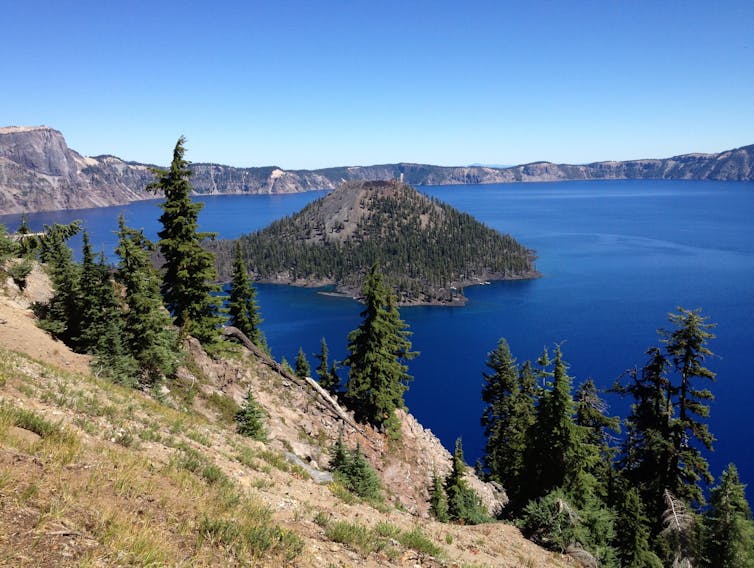
Cleaner, more pure water backscatters light in the blue range, which makes it look blue. One famous example is Crater Lake in Oregon, which lies in a volcanic crater and is fed by rain and snow, without any streams to carry sediment into it.
Deep waters like Crater Lake look dark blue, but shallow waters that are very clear, such as those around many Caribbean islands, can appear light blue or turquoise. This happens because light reflects off the white, sandy bottom.
When water contains a lot of plant material, chlorophyll – a pigment plants make in their leaves – will absorb blue light and backscatter green light. This often happens in water bodies that receive a lot of runoff from highly developed areas, such as Lake Okeechobee in Florida. The runoff contains fertilizer from farms and lawns, which is made of nutrients that cause plant growth in the water.
Finally, some water contains a lot of material called color-dissolved organic matter – often from decomposing organisms and plants, and also human or animal waste. This can happen in forested areas with lots of animal life, or in heavily populated areas that release wastewater into streams and rivers. This material mostly absorbs radiation and backscatters very little light across the spectrum, so it makes the water look very dark.
Bad blooms
Scientists expect water in nature to contains sediments, chlorophyll and organic matter. These substances help to sustain all living organisms in the water, from tiny microbes to fish that we eat. But too much of a good thing can become a problem.
For example, when water contains a lot of nutrients and heats up on bright sunny days, plant growth in the water can get out of control. Sometimes it causes harmful algal blooms – plumes of toxic algae that can make people very sick if they swim in the water or eat fish that came from it.
When water bodies become so polluted that they threaten fish and plants, or humans who drink the water, state and federal laws require governments to clean them up. The color of water can help guide these efforts. https://www.youtube.com/embed/SaGX0dzAuo4?wmode=transparent&start=0 Engineering professor Courtney Di Vittorio and her students collect water samples from High Rock Lake in North Carolina to assess its water quality.
My students and I collect water samples at High Rock Lake, a popular spot for swimming, boating and fishing in central North Carolina. Because of high chlorophyll levels, algal blooms are occurring there more often. Residents and visitors are worried that these blooms will become harmful.
Using satellite photos of the lake and our sampling data, we can produce water quality maps. State officials use the maps to track chlorophyll levels and see how they change in space and time. This information can help them warn the public when there are algal blooms and develop new rules to make the water cleaner.
Hello, curious kids! Do you have a question you’d like an expert to answer? Ask an adult to send your question to CuriousKidsUS@theconversation.com. Please tell us your name, age and the city where you live.
And since curiosity has no age limit – adults, let us know what you’re wondering, too. We won’t be able to answer every question, but we will do our best.
Hello, I would like to share my concerns about the formation of a library district, and another increase in my taxes. As you are aware our property appraisals went up 43%. That translates to quite an increase in our taxes. I am on a fixed income; I assure you no entity raised my income by 43%. In addition to this, I understand we will be paying more taxes for schools in May because of an undercollection by the county. I also understand that we are very likely to start paying road taxes. And when will Eureka decide it…
Forest Service warns of budget cuts ahead of a risky wildfire season – what that means for safety Camille Stevens-Rumann, Colorado State University and Jude Bayham, Colorado State University A wet winter and spring followed by a hot, dry summer can be a dangerous combination in the Western U.S. The rain fuels bountiful vegetation growth, and when summer heat dries out that vegetation, it can leave grasses and shrubs ready to burn. In years like this, controlled burns and prescribed fire treatments are crucial to help protect communities against wildfires. Well-staffed fire crews ready to respond to blazes…
The historical accounts pretty much say the Great Depression sucked, and some reading of Montana’s history will suggest that it started sucking out west before the “dirty thirties”. So, things sucked, people were poor- but what was the exact cause of homelessness that drove the spread of “hoovervilles”? What exactly was it people couldn’t pay? Rent, Mortgages, and Property Taxes (these are in a sense, much the same thing, with a mortgage being a lot like rent paid to the bank, and property taxes being a lot like rent paid to the government). Rent has been increasing-…
I spotted this photo, from 1962 – in Lincoln County, as in Wittenoom, Australia, the sixties were happy days, when the hazards of asbestos exposure weren’t particularly understood. “Wittenoom was officially removed from the Western Australian maps in 2007 and legislation was introduced to forcibly remove the last three residents in 2015. This ghost town located at the mouth of the Wittenoom Gorge is the home of Australia’s greatest industrial disaster. However, being in the Hamersley Range, it can lay claim to being located in one of the most beautiful areas of the Pilbara.” https://www.aussietowns.com.au/town/wittenoom-wa This article…
During the Cold War, a heated debate arose over the role of economic planning. Did the “planned” economy of the USSR or the “free market” economy of the U.S. allocate resources more productively?
The Soviet Union’s collapse seemed to relegate the economic planning concept to the dustbin of history. But issues raised in those debates are still relevant today.
For these companies, planning – particularly the coordination of activities across global supply chains – represents a significant strategic focus. Americans rarely think about the importance of planning, but it plays a crucial role not only in the availability of consumer products but the economy overall.
Supply chain planning refers to the set of iterative, interconnected decisions aimed at continuously aligning company capacity, inventory and other assets to maximize profits. It integrates a range of decisions across different time horizons, from longer-term optimization of global supply networks to near-term scheduling of deliveries.
Planners also decide how much product to make or buy based on shifting consumer demand. And perhaps most importantly, they manage the time required to ensure that products arrive at the right time, in the right place and in the right form. They do this not just once but across thousands of products and millions of transactions each day.
Consider a typical Walmart store, which offers roughly 120,000 different products – technically known as stock-keeping units, or SKUs – at any given time. These products must be made available in over 10,000 stores worldwide – as well as online and at homes – 24 hours a day, seven days a week.
And they must be made available in an assortment that changes continuously, sometimes dramatically, based on consumer preferences and outside events. Products must be competitively priced, fueling a relentless search for lower input costs. Planners attempt to coordinate this vast network of people, products and places to profitably match supply and demand.
The best-laid plans
Sometimes plans work; sometimes they don’t. The most obvious signs of planning dysfunction are empty shelves and long wait times. Less obvious are billions of dollars in excess inventories. And even more deeply hidden are innovation delays and massive waste across the supply chain.
These dysfunctions are pervasive in most companies. But it took the COVID-19 pandemic to expose what many planners already knew: Dated planning technologies, gaps in talent and overstretched supply chains keep companies from delivering the goods.
What’s more, companies often use dozens – sometimes hundreds – of different systems to manage workflows and databases. As a result, planners must cobble together incomplete information from multiple sources to determine dynamic supply-and-demand requirements.
Automation’s potential
Automation, especially when it incorporates learning algorithms, has enormous potential for overcoming technological challenges. But the data requirements are daunting.
Those of us with a pantry full of toothpaste because we subscribed to a set-it-and-forget-it delivery service will appreciate the dangers of automating decisions based on a forecast. Solving that problem for a global supply chain requires extremely high-quality data coupled with sophisticated analytics. Most companies aren’t there yet.
And even if the systems are available, it isn’t clear that the people needed to operate those systems are ready. Businesses are increasingly turning to planners to direct supply chain processes.
The need for planning talent comes at a time when labor shortages and training issues plague the supply chain. While innovative educational programs have emerged, it will take time to develop the needed talent.
Challenges and solutions for supply chain management
Finally, the global scope of today’s supply chains creates daily challenges for planning. Even assuming a company has the systems and people to optimize inventories for future demand, it still needs to move that inventory around the world.
So, in addition to solving a complex demand-supply matching problem, planners must execute that solution with planes, trains, trucks and ships. Even a passing glance at the headlines will give you a sense of how difficult that can be. Risks include global conflicts and infrastructure breakdown.
Companies are slowly shifting their supply chains to lower-risk places and establishing more regional networks. But creating new facilities and adding business partners takes time. It also takes systems and talent, because it’s planners who will make these decisions.
A brave new-ish world
The challenges facing companies today mirror the economic planning debates of the Cold War, with many of the same issues returning. There are clear differences with Soviet-style centralized planning. But an increasingly consolidated set of companies plan huge swaths of the U.S. economy.
For individual companies, planning failures can easily lead to business failure. And at the economy level, planning dysfunctions produce both excess and scarcity. That means too much stuff, but not the right stuff people need to improve their lives.
As the U.S. economic system faces its own challenges, the question may be whether it’s possible to plan our way to prosperity.


 Trego's Mountain Ear