All else being equal, it seems likely that people would prefer too keep more of their cash and have the money they do spend get the best results possible.
When shopping, we try to get the best deal for our value, whatever that happens to mean for us. Some people will put more weight on items being ‘organic’ and ‘pesticide free’, while others will value ‘fair trade’ highly. So that “best value” will look different for different people. But, regardless, people generally try for efficiency in spending.
Should we apply the same principle to government? The problem there is that it’s no longer any of us as individuals at the grocery store, weighing what to purchase against the price and considering our priorities.
The what of ‘what to purchase?’ has been decided, not by any of us as individuals, but by the amalgamation known as government. And in that case, do we as individuals really value efficiency?
Efficiency is all well and good when it’s my money being spent on something I want. It’s less good when it’s on something I’d rather I not have in the first place. No matter how good the sale on orange trees is, planting them in my yard is still going to be a terrible idea. All else being equal, if I have to have orange trees planted in my yard in Trego, I might prefer fewer of them.
Do we actually want government efficiency? That depends on what it’s doing, doesn’t it?
If what the government is doing is generating regulations, well, how are we defining efficiency? Because if it’s text produced per hour, we have a problem. There are already more regulations than any of us have time to read.
Any conversation about improving government efficiency needs to start with consideration to what the role of government should be. What do we want it to be efficient at? Until then, inefficiency may be the only thing keeping us from drowning in reams of regulatory paperwork.
For accompanying thematic music- I’ll refer to Leslie Fish: “The Paper Sea”
The Eureka Community Players announce auditions for “Seasons on the Farm”. The Players sponsors a writers group that has been meeting to write 10-minute scenes. Now, these nine scenes have been combined into an afternoon on the farm. Each scene is set somewhere on the farm: the hayloft, kitchen table, front porch, or in the field. Each scene has 2-3 people and is 10-minutes long. The scenes take a look at a “season” of life and is narrated by the old farm wife.
Auditions for “Seasons on the Farm” is scheduled for February 18th at 6:00 p.m. at the Timbers Event Center. There are parts for up to 21 people, ages 8 to 80, men, women and youth. Everyone will have an opportunity to read parts and choose which scenes appeal to them. Script pages will be provided for review prior to the readings.
Individuals who have thought about directing also have an opportunity to try their hand at this, in a limited commitment as the Player will also be asking for volunteer directors.
This is the second year that the writers group has worked together to produce a play. Some of the writers are new to the group, such as Mike Workman and Noelle Nicholas; returning writers include Adrian Miller and John LaBonty.
Rehearsals of “Seasons on the Farm” scenes will be set by the director and actors. “Seasons on the Farm” will be presented Sunday, March 23rd.
For more information about auditioning, contact Sharon LaBonty at 406/263-9208.
The U.S. Supreme Court will test how flexible the EPA and states can be in regulating water pollution under the Clean Water Act when it hears oral argument in City and County of San Francisco v. Environmental Protection Agency on Oct. 16, 2024. This case asks the court to decide whether federal regulators can issue permits that are effectively broad orders not to violate water quality standards, or instead may only specify the concentrations of individual pollutants that permit holders can release into water bodies.
My research focuses on water issues, including the Clean Water Act. This case involves both federal and state authority to issuing permits, and it will be interesting to see where the court focuses. While justices have been willing to limit the EPA’s authority under the act, they traditionally have allowed states broad authority to protect water quality. Thus, while some fear that this case is yet another occasion for the court to limit the EPA’s authority, California’s involvement may have exactly the opposite effect.
Standards for treating sewage
The 1972 Clean Water Act prohibits any “discharge of a pollutant” without a permit into water bodies such as rivers, lakes and bays that are subject to federal regulation. San Francisco has a combined sewage treatment plant and stormwater control system, the Oceanside plant, which discharges treated sewage and stormwater into the Pacific Ocean through eight pipes, or “outfalls.”
San Francisco’s Oceanside water treatment plant is built into a hollowed-out hill in the southwest corner of the city and discharges to the Pacific Ocean. Pi.1415926535/Wikimedia, CC BY-SA
The California State Water Resources Control Board is in charge of seven outfalls that release treated water close to shore, in state waters. But the facility’s main pipe discharges in federal waters more than 3 miles out to sea, so it is regulated by the EPA.
To comply with the law, polluters must obtain permits through the National Pollutant Discharge Elimination System. The city and county of San Francisco have held a permit for the Oceanside facility since 1997.
Discharge permit requirements can be both quantitative and qualitative. For example, the EPA establishes standard effluent limitations that dictate how clean the discharger’s waste stream must be. The agency sets these technology-based limitations according to the methods available in the relevant industry to clean up polluted wastewater.
Numeric targets tell the discharger clearly how to comply with the law. For example, sewage treatment plants must keep the pH value of their wastewater discharges between 6.0 and 9.0. As long as the plant meets that standard and other effluent limitations, it is in compliance.
San Francisco monitors beach water quality year-round and issues alerts when bacteria levels make water contact unsafe. This can happen after the city’s water treatment system is overwhelmed during major storms. San Francisco Public Utilities Commission
What counts as ‘clean’?
A second approach focuses not on the specific content of the discharge but rather on setting standards for what counts as a “clean” water body.
Under the Clean Water Act, Congress gives states authority to establish water quality standards for each water body within their territory. First, the state identifies the uses it wants the ocean, river, lake or bay to support, such as swimming, providing habitat for fish or supplying drinking water.
Next, state regulators determine what characteristics the water has to have to support those uses. For example, to support cold-water fish such as perch and pike, the water may need to remain below a certain temperature. These characteristics become the water quality criteria for that water body.
Sometimes technology-based effluent limitations in a polluter’s permit aren’t stringent enough to ensure that a water body meets its water quality standards. When that happens, the Clean Water Act requires the permitting agency to adjust its permit requirements to ensure that water quality standards are met.
That’s what happened with the Oceanside plant. During rainstorms, runoff sometimes overwhelms the plant’s sewage treatment system, dumping a mixture of sewage and storm runoff directly into the Pacific Ocean – an event known as a combined sewer overflow. These episodes can cause violations of water quality standards. Area beaches sometimes are closed to swimming when bacterial counts in the water are high.
In combined sewer systems, during dry weather and small storms, all flows are handled by the publicly owned treatment works. During large storms, the relief structure allows some of the combined stormwater and sewage to be discharged untreated to an adjacent water body. USEPA
These aren’t small-scale releases. In a separate legal action, the federal government and the state of California are suing San Francisco for discharging more than 1.8 billion gallons of sewage on average every year since 2016 into creeks, San Francisco Bay and the Pacific Ocean.
The complaint asserts that San Francisco has not significantly upgraded its combined sewer overflow system in the past 25 years, and that the system is failing to meet standards in the city’s and county’s Clean Water Act permits.
When the EPA and California issued the Oceanside plant’s current permit in 2019, they included two general standards. The first requires that Oceanside’s “[d]ischarge shall not cause or contribute to a violation of any applicable water quality standard.” The second states that “[n]either the treatment nor the discharge of pollutants shall create pollution, contamination, or nuisance” as defined under California law.
The city and county of San Francisco argue that their permit terms aren’t fair because they can’t tell how to comply. Their petition to the court asserts that Clean Water Act permits should function like recipes that restrict specific ingredients in a dish, rather than telling cooks not to make the dish “too salty.”
The Supreme Court will decide whether such narrative permit terms are legal. https://www.youtube.com/embed/UBhmfP_AzIM?wmode=transparent&start=0 The Environmental Protection Agency and California water officials are suing San Francisco, accusing the city of allowing its sewer systems to fall into disrepair.
What’s legal, what’s fair
In its brief, the EPA invokes Section 1311(b)(1)(C) of the Clean Water Act, which allows permit writers to insert “any more stringent limitation, including those necessary to meet water quality standards,” into the permit. The agency argues that this phrase allows for narrative permit terms – a position that was upheld by the U.S. Court of Appeals for the 9th Circuit.
The city and county argue that “any more stringent limitation” still has to be a numeric, end-of-the-pipe requirement. They also contend that the very general requirements in the Oceanside plant’s discharge permit fail to give notice of what’s actually required for compliance, leaving the city vulnerable to penalties and lawsuits.
The key question, then, is how much flexibility regulators and regulated entities get. If state environmental agencies and the EPA have to translate every water quality criterion into a numeric effluent limitation, permit writers could be overwhelmed. Or, as the EPA warns in its brief, they could impose very stringent requirements to ensure that the discharge won’t violate water quality standards.
For example, some sewage treatment plants can and do treat sewage to drinking water standards. Requiring San Francisco to do this would ensure that discharges from the Oceanside plant did not make waters offshore unusable. It also would make clear how to comply with the law. However, it would require expensive upgrades to the plant.
It’s unusual to see a liberal, pro-environment city such as San Francisco challenge the EPA, with support from trade groups such as the National Mining Association that also see the EPA’s approach as too vague. Conversely, all 14 states that joined one of the two state amicus briefs filed in this case are on the agency’s side – a sign that state environmental regulators want flexibility in setting targets for polluters.
If the justices are content to merely interpret what Congress meant by allowing “any more stringent limitation” in permits, then the EPA has the stronger case. If they focus on fairness, however, San Francisco has a good argument – especially before a court that has already issued multiple decisionscurbing federal regulatory power.
Our cultural touchstones series looks at influential books.
The late David Graeber was an American professor of anthropology at the London School of Economics. His best-known writings challenged views in liberal economics about the origins of money, attempting to reconceive the historical relationship between debt and social institutions. He was also known for his political activism, notably as one of the original organisers of the Occupy Wall Street movement.
In 2013 Graeber wrote an article for obscure left-wing magazine Strike! entitled “On the Phenomenon of Bullshit Jobs”. He had no inkling it was about to cause something of a minor sensation.
The response from readers was unlike any he had experienced, prompting him to expand his ideas into a book, Bullshit Jobs: A Theory, first published in 2018.
A “bullshit job”, according to Graeber, is a job where even the person doing it secretly believes the job shouldn’t exist. But part of their conditions of employment is to pretend it’s not as pointless as they know it to be.
Bullshit jobbers, he writes, can include “box tickers”, “flunkies”, “goons” and “taskmasters” (more on them later). Such roles are prevalent in areas such as finance, admin, law, marketing and human resources. The book has been translated into many languages and while it has been criticised for some rather broad generalisations, he clearly struck a chord.
In the 1930s, economist John Maynard Keynes had suggested we were fast approaching a time where our new “labour-saving technology” meant we’d have to confront the issue of “technological unemployment”. Due to the prodigious gains in productivity, wrote Keynes, we’d soon be working half as much – or less. By the postwar period this had become a widely held belief.
Keynes, writes Graeber, was right. But rather than embrace more leisure time for workers, our response was “to make up a raft of new jobs ” resulting in “huge swathes of people, in Europe and North America in particular”, spending “their entire working lives performing tasks they secretly believe[d]” did not really need to be performed.
The “proliferation” of these “bullshit jobs”, Graeber suggests, is a significant part of the reason we don’t have a 20 – or even 15-hour work week.
Bullshit jobs, he argues, have bloomed in professions like finance (financial services); law (corporate law); administration (academic and health administration); as well as marketing, public relations, and human resources.
People in these jobs are often well paid, given a great deal of respect, and regularly viewed by family members as “the person who most made something of themselves”.
Graeber also analyses the “bullshitisation” of “real jobs”, such as in education, where new cultures of neoliberal “managerialism” have seen teachers and academics doing increasing amounts of administrative work, taking up more and more of the time that, most agree, would be better spent doing actual teaching or research.
Graeber’s book is conversational in style, drawing on history, literature, sociology, anthropology and pop culture to support his arguments.
Full of interesting observations and suggestions, the generalisations come thick and fast (with varying degrees of evidence to support them). It is more “groundwork” for a theory than a fully worked out one, and is America-centric, making some of its generalisations, at times, questionable.
Graeber’s article, and subsequent book, were criticised by some economic journalists – and resentful employers – for having an inadequate understanding of capitalist economies or contemporary firms. In the book, Graeber draws on “over 250” “firsthand testimonies” from the workers themselves. They, he argues, are the ones actually doing the work and, therefore the best placed to really know what’s going on.
These testimonies are informative descriptions of peoples’ experiences, expressed in their natural voices.
Some had me laughing out loud at the sheer absurdity of the individual’s predicament. The situation of “Eric”, for instance, farcically escalates like a P.G. Wodehouse story as he becomes more and more reckless in a bid to break the vocational pointlessness and absurdity of it all by getting himself fired … only to keep being offered more money!
We have usually associated “bullshit jobs” or “make-work”, writes Graeber, with the old Soviet Union and its “full employment ideology”. The current prevailing view is that market competition means such “inefficiencies” are not supposed to happen in a capitalist economy: a private firm would never hire and spend good money on someone they don’t need.
However a significant number of contemporary workers, he writes, firmly believe their employers do just this. Yet, somehow, this has not been seen as a significant social problem.
Box tickers, duct tapers
Graeber offers a humorous basic taxonomy of types in Bullshit Jobs.
“Box tickers” (such as survey administrators, corporate compliance officers, in-house magazine journalists), are meant to make a firm appear to be doing something it’s not actually doing.
“Betsy”, for example, was hired to “coordinate leisure activities in a care home”. She conducts elaborate surveys of the residents, asking what sorts of entertainment they would like. The surveys take up so much time she doesn’t have any left to actually entertain anybody.
“Flunkies” (receptionists, administrative assistants, door attendants, store greeters) serve to make their superiors feel important but don’t have much in the way of actual tasks to perform. For example, Graeber describes a small publishing firm that doesn’t really need a receptionist (“the phone rang maybe once a day”). But it hired one to be perceived as a “real company”.
“Duct tapers” are hired to manage the problems that ensue as a result of not fixing real problems. (They might include IT workers repairing shoddily written code, or coordinating badly chosen, poorly integrated software programs).
“Taskmasters” (such as some middle managers or leadership professionals) are people who supervise people who don’t need supervision. Certain middle managers complained to Graeber of being in the strange position of needing to either make up “box-ticking rituals” for their subordinates or to try and allocate more actual work for themselves on the sly.
“Goons” work in industries that don’t really need to exist, according to most that work in them. (They include PR specialists, telemarketers, lobbyists and corporate lawyers). They are goon-like in their aggressive and often deceptive or harmful practices. Basically, Graeber says, many companies feel they need such services because other companies have them.
The cult of work
Graeber roundly critiques the process of bureaucratisation in contemporary capitalism, suggesting a type of “managerial feudalism” has developed. Corporate managers are always downsizing blue collar or salaried workers on the grounds of poor productivity and maximising efficiency.
However, engaged in internal company power struggles, they also, like feudal lords, hire a “retinue” of “flunkies”. This inflates their own position, as their status, and often their pay, are connected to how many staff are under them.
He also explores the role of “supply-side economics” (the idea that tax cuts for the wealthy will increase savings and investment capacity, which “trickle down” to the overall economy), and the “financialisaton of the economy” (the large increase in size and importance of a country’s financial sector relative to its overall economy). The social and economic conditions created by these phenomena, Graeber argues, have contributed to the proliferation of BS jobs.
Why, he asks, do we as a society, not object to this growth in pointless employment?
A key part of the answer is the contemporary cult of work, where people “boast” about “how overworked they are”. Graeber traces this back to moral conceptions rooted in the puritan work ethic.
We see work as intimately bound up with our self-worth, tied to a conception of labour as a type of virtuous suffering. This explains why we haven’t advocated for reduced work simply because it is “good in itself” – it would be nicer to work less!
Spiritual violence
The “spiritual violence” caused by BS jobs is perhaps the core of the book. It is commonly assumed people would be happy to have such jobs – they would surely welcome such a “skive”. But while a small number of people Graeber spoke to were happy to put in the least amount of effort into their jobs, a far greater number report being “miserable”.
Interestingly, their misery is compounded by the fact that they don’t feel justified in being miserable and, so, become confused and disoriented. They report anxiety and depression. The fact that these folks can’t understand why their situation is upsetting them so much seems to further compound the problem.
Some report being haunted by the knowledge that if their job didn’t exist it wouldn’t matter – or that the world might even be better for it.
Graeber argues that by not being able to properly exercise their capacity to have effects in the world – to contribute to the world in a meaningful way – people in BS jobs have their basic “sense of self” undermined.
They feel guilt about others who are working harder, and fear how others view them. Might co-workers, for instance, attribute these work arrangements to personal scheming rather than structural issues? They fear being found out by higher ups and feeling like a fraud to co-workers – and those who praise them for being “high achievers”.
Graeber is very good at provoking the reader to reconsider many articles of faith of orthodox economic theory, such as inherited notions of “human nature”, “value” and the effects of “free market reforms”.
Traditional models of the market economy, he writes, are centred on the “production” of material goods and their “consumption”. But most “labour” is not actually about producing, he argues. As the role of manufacturing has declined, most workers are involved in “care-giving labour” – working at an essential task that enables others to thrive, whether assisting or taking care of people or taking care of animals, plants or machines.
According to Graeber, care-giving work involves any essential task that helps others thrive. Simon L/unsplash
Our common conception of a care-giving job, such as nursing or early childhood education, is unjustifiably narrow, he argues, due to the dominance of production-centred models in economic theory. Even in the days of Marx and Dickens, he writes, the majority of workers were engaged in labour that took care of those around them, attending to the everyday essentials that keep the world running.
Thus, for Graeber, care-giving work also includes classic blue-collar working-class jobs. This allows him to talk of a possible “revolt of the caring classes” – those who do the necessary and important jobs yet are rewarded with low pay and cultural and political narratives that devalue them. He also suggests a Universal Basic Income is the best way to lower inequality while avoiding an increase in BS jobs.
Graeber died suddenly in Italy in 2020, aged 59. Some of his arguments in Bullshit Jobs may ultimately be “enjoyably overstated”, as one reviewer aptly put it. However, his thought-provoking ideas are timely and important, addressing questions as relevant today as when first raised.
I read that they are at the edge of developing PhD level artificial intelligence. It sounds like a great accomplishment – but I have met some folks who hold a Ph.D. who aren’t necessarily all that bright.
My Ph.D. says that I can be trained. It says that, with a bit of guidance and supervision I can perform original research and write up an acceptable report on that research. It’s called a dissertation and some of them are downright lengthy. In the old days they were shorter – but computers have made it easy to produce more pages. If I remember correctly, Einstein’s dissertation was 20 pages. Mine was 111 pages. Alfred Kroeber’s was 28 pages, and the first dissertation in anthropology at Columbia. More pages does not translate to better. Like Kroeber and Einstein, my best research was completed after the dissertation. Kroeber’s daughter (Ursula K Le Guin) wrote a lot more pages than he did – and if I recall correctly, he had over 500 publications.
It’s kind of like the term ‘masterpiece’ – originally, a masterpiece was the piece of work a journeyman did to show he was a master of his art. It wasn’t the finest piece of work he ever did . . . as a master, he was expected to be able to regularly perform at that level. Going back to Einstein – his dissertation was on a method of using Brownian motion to calculate Avogadro’s number, as I recall. I suspect relativity was his finest work, but he might not have agreed. Kroeber’s dissertation dealt with Arapaho ornamentation – and that is definitely not his greatest accomplishment.
Basically, a Master’s thesis can show either original research, or, more frequently, can replicate research that has already been published. Again, under guidance and supervision. My most significant research was conducted as a Master’s thesis advisor.
I recollect a woman who explained “If you want to know about X, you should read my dissertation.” She didn’t realize that the completed dissertation just formally recognizes the first step as a research scientist.
As I think of the advantage Artificial Intelligence has over my bio-chemical brain, I think of the ability to input information. I was blessed with the ability to read about 1200 words per minute. With decent comprehension. I’ve always suspected that the reason I got high scores on placement tests like the ACT, SAT and GRE was because I read faster – three or four times faster – than the average college graduate. That gave me more time to answer the test questions, and return to the ones that needed more thought. The Artificial Intelligence program may well just be able to input and process data faster – but it may be like the lady who thought her dissertation was the definitive work on personality disorders.
My Ph.D. says that I am trainable. So is a Border Collie. It looks like Artificial Intelligence programs are joining me and my dog.
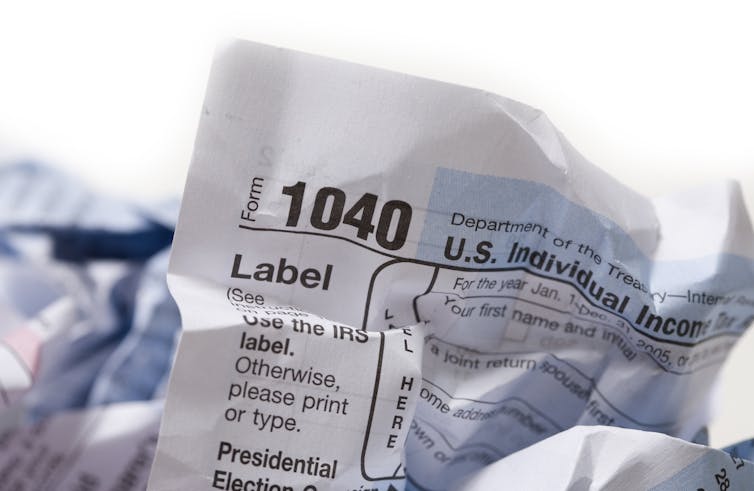
But to me this raises an important question: Why should taxpayers have to navigate the tedious, costly tax filing system at all?
The case for a ‘simple return’
In 1985, President Ronald Reagan promised a “return-free” tax system in which half of all Americans would never fill out a tax return again. Under the framework, taxpayers with simple returns would automatically receive a refund or a letter detailing any tax owed. Taxpayers with more complicated returns would use the system in place today.
In 2006, Austan Goolsbee, who later went on to serve as President Barack Obama’s chief economist, suggested a “simple return,” in which taxpayers would receive already completed tax forms for their review or correction. Goolsbee estimated his system would save taxpayers more than US$2 billion a year in tax preparation fees.
As an expert on the U.S. tax system, I see America’s costly and time-consuming tax reporting system as a consequence of its relationship with the commercial tax preparation industry, which lobbies Congress to maintain the status quo.
Furthermore, 95% of American taxpayers receive at least one of more than 30 types of information returns that let the government know their exact income. These information returns give the government everything it needs to fill out most taxpayers’ returns.
Maybe you’re wondering whether Congress is just behind the times, unaware that it can release us from tax preparation? Not true.
Commercial tax preparation
About two decades ago, Congress directed the IRS to provide low-income taxpayers with free tax preparation. The agency responded in 2002 with “Free File,” a public-private partnership between the government and the tax-preparation industry. As part of the deal, the IRS agreed not to compete with the private sector in the free tax preparation market.
In 2007, the House of Representatives rejected legislation to provide free government tax preparation for all taxpayers. And in 2019, Congress tried to legally bar the IRS from ever providing free online tax preparation services.
The public part of Free File consists of the IRS herding taxpayers to commercial tax -preparation websites. The private part consists of those commercial entities diverting taxpayers toward costly alternatives.
According to the Treasury Inspector General for Tax Administration, which oversees IRS activities, private partners use computer code to hide the free websites and take unsuspecting taxpayers to paid sites.
Should a taxpayer discover a free preparation alternative, the private preparers impose various restrictions such as income or the use of various forms as an excuse to kick taxpayers back to paid preparation.
Perhaps you are guessing that there are valid policy justifications for avoiding government and empowering the private sector. Judge those arguments yourself.
One argument from commercial tax preparers is that taxpayers will miss out on valuable tax savings if they rely on free government preparation.
In fact, the government software would reflect the same laws used by the paid preparers with the same access to tax saving deductions or credits. Further, tax preparers like H&R Block promise to pay all taxes and interest resulting from a failed audit. As a result, these services have every incentive to take conservative, pro-government tax positions.
A second argument is that government-prepared tax returns encourage tax evasion.
In a no-return system, the government reveals its knowledge of the taxpayer’s income before the taxpayer files. Thus, the argument goes, the taxpayer knows if the government has missed something and has reason to let the mistake stand.
But taxpayers already know what information forms the government has because they receive duplicates of those forms. The incentive to lie does not increase because the taxpayer avoids weeks of tax preparation.
Bolstering the anti-taxers
Finally, there is the anti-tax argument for onerous tax preparation: Keep tax preparation unpleasant to fuel anti-tax sentiment.
Exasperating tax preparation, according to this argument, helps keep the anti-tax fever high. And that fuels public hate for government and the tax system.
Unfortunately, the anti-tax contingent’s desire to force Americans to spend time and money on tax preparation dovetails with the tax preparation industry’s desire to collect billions of dollars in fees.
Tax preparation companies lobby Congress to keep tax preparation costly and complicated. Indeed, Intuit, maker of TurboTax, the tax preparation software, has listed government tax preparation as a threat to its business model. ProPublica reported in 2019 on the company’s 20-year fight to prevent the government from making tax filing simple and free for most citizens.
I believe only public outcry can change the system.
This article was corrected to clarify how tax preparation companies have lobbied Congress and to clarify the timing of Austan Goolsbee’s service as chief economist to President Obama. It is an updated version of an article originally published on March 22, 2021.






 Trego's Mountain Ear

