Trego's Mountain Ear

"Serving North Lincoln County"

Author: Sam

  • 20+ Career/Tech Standards for 3rd Grade?

    School districts are expected to adopt standards for education, but they’re essentially required to adopt those published by the office of public instruction, and then allowed to add extras. At any rate, this does mean that ‘what every student is required by law, to learn’ is publicly available.

    I occasionally find myself looking through the standards for work, and I generally come away a bit surprised. For example, if we count the various sub-standards, there are twenty-one career and technical education standards for third graders. I repeat, twenty-one.

    This isn’t necessarily a critique of the standards themselves; it’s that the average teacher in a rural school is expected to be familiar with the standards for every subject they teach; and that isn’t just english/math/science/social studies. And that best practices are to be familiar with all of the standards leading up to the grades you teach. For example, an 8th grade science teacher ought to be familiar with the science standards from K-7, as well. The sheer bulk of standards is enough to make this task daunting, even within a single subject area.

    “utilize critical thinking to make sense of problems and persevere in solving them” is, I believe, a generally good thing to want students to be able to do. “employ valid and reliable research strategies by representing data in multiple
    formats” also seems like a good thought.

    Even good ideas can be implemented badly. The overflow of standards means that explicitly tying assignments and instructions to standards, which is how teacher’s are supposed to ensure that they’re teaching what they should be, takes huge amounts of time.

    Additionally, not all standards are created equally. Another 3rd grade standard is “work productively in teams while using cultural/global competence by recognizing and understanding barriers to productive communication”, which at best is going to require most of us to find a definition of cultural/global competence.

    This standard: “demonstrate creativity and innovation by exploring the design cycle” sounds nice, too, but how’s the state defining the design cycle? There are resources for this, videos, summary documents, but all of it takes time.

    Editor’s note: I’m not sure whether I should be classifying this as an article about education, or something about government over-reach, along the lines of ‘you need a license for what?’.

  • Repost: Community Decay: Part 3

    At long last, what exactly is community decay?

    Community decay “may include, but is not limited to any discarded substance, item, or material, such as cardboard, paper, pallets, tires, iron, or metal; demolition waste; construction or building material, such as bricks, concrete, or wood; junk vehicles; ruined or unusable boats, trailers, campers, or mobile homes, vehicle or machine parts; dead animals or animal parts; appliances; furniture; branches, logs, yard trimmings, or garden waste; or any other similar materials, items, waste, parts, or substances.”

    So, what is, and what isn’t community decay? I’ll offer some examples and consider whether they might potentially be community decay.

    • That old car your neighbor is working on. It’s blocked up and he’s been making repairs on it after he gets home from work

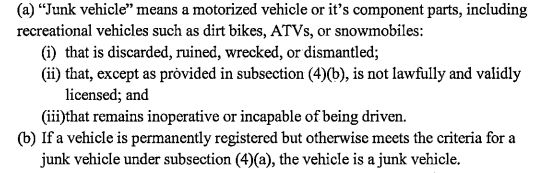
    Is that old car community decay? Looking at the definition of junk vehicles…

    That car could be described as dismantled, and it’s definitely not capable of being driven at this precise moment. So, junk vehicle? Based on this definition, it may well be one. Is it community decay? To meet the definition of community decay, the car would have to be “discarded”, so probably not. The more interesting question is how long can the project car sit, while the owner is busy with other things, before it is considered “Discarded”, and thus, community decay?

    The community decay ordinance fails to provide a definition for discarded, but one suspects it’s a word with gradations of meaning. After all, my “I’ll get to this project again someday” pile looks an awful lot like abandoned clutter until I get back to the project.

    Community Decay…Part 1

    One could be forgiven for assuming that community decay ordinances were the business of rather fussy municipalities in places other than here. One would, as it happens, be wrong on two counts. Lincoln County, Montana, has one. Back in December of 2018 the Lincoln County Board of Commissioners adopted Ordinance 2018-05 “An Ordinance to Control Community Decay Within Lincoln County and to Establish Procedures for its Enforcement”. So, this leaves us with several pressing questions: What exactly is community decay? Who does this apply to? Enforcement? None of these have short answers, so I’ll discuss each in depth in later…

    Community Decay… Part 2

    What exactly is community decay? Who does this apply to? The Community Decay Ordinance for Lincoln County (2018-05) reads “It is unlawful for any person to maintain conditions that contribute to community decay on property owned, occupied, or controlled by him or her on or adjacent to any public roadway within the county.” At this point, one might breath a sigh of relief. “On or adjacent to any public roadway”- that can’t apply to very much of the county, right? Ah, but this ordinance begins with definitions. Adjacent: “beside, next to, contiguous or nearby. Properties adjacent to any public roadway…

  • Astronauts on NASA’s Artemis mission to the Moon will need better boots − here’s why

    The lunar south pole’s terrain is rugged, and it can reach extreme temperatures. Michael Karrer/Flickr, CC BY-NC

    Jesse Rhoades, University of North Dakota and Rebecca Rhoades, University of North Dakota

    The U.S.’s return to the Moon with NASA’s Artemis program will not be a mere stroll in the park. Instead it will be a perilous journey to a lunar location representing one of the most extreme environments in the solar system.

    For the Artemis program astronauts, walking on the Moon will require new ways of thinking, the latest technology and innovative approaches to improve boot and spacesuit design.

    The Apollo program’s journeys to the Moon 50 years ago were all to the milder, equatorial regions of the lunar surface, where the coolest temperatures reached -9 degrees Fahrenheit (-23 degrees Celsius).

    In contrast, the Artemis missions are designed to take astronauts to the Moon’s extreme polar regions, where temperatures can reach -369 degrees Fahrenheit (-223 degrees Celsius). Apollo-era equipment designed for short-term stays in a moderate zone will not be enough for extended stays in this new, more hostile region.

    At the University of North Dakota we focus on biomechanics, the study of human movement. Our research explores the effects of extreme environments on human movement patterns and gait, and our lab conducts research that we hope will one day help astronauts explore the Moon while protecting their body.

    New boots for the Moon

    Of all the equipment astronauts need to explore the Moon, one of the most critical pieces is the boots they’ll use for extravehicular activity – when they step outside their spacecraft and bounce across the lunar landscape. These boots have to hold up to the harsh environmental conditions unique to the lunar south pole.

    A photo, shown from above, of an astronaut's boot and boot print on the lunar surface.
    The Apollo program represents the last time humans stepped onto the lunar surface. Edwin ‘Buzz’ Aldrin/NASA via AP

    Since the lunar poles are much colder than other lunar regions, the boots will need to retain heat effectively. The current iteration of the lunar boot uses a rigid thermal plate, which is typically integrated into the sole of the boot. The plate is solid and does not bend or flex. These plates were not used during the earlier Apollo missions.

    While it’s necessary to keep astronauts’ feet warm, this addition to the boot prevents the footwear from flexing. The stiff sole restricts the foot’s natural movement, specifically the joint at the big toe, called the the metatarsophalangeal, or MTP, joint. The MTP joint bends and flexes to facilitate normal walking and running gait patterns.

    The windlass mechanism

    As you walk, the MTP joint allows your big toe to extend forward. Extension of the big toe triggers a mechanism in the foot that converts the flexible landing foot to a ridged pushing foot when you’re about to push forward to step. This mechanism allows the foot to become rigid and support your body weight through your step. Kinesiologists call this mechanism the windlass mechanism. https://www.youtube.com/embed/0eVcnXcunss?wmode=transparent&start=0 The windlass mechanism helps propel your foot forward while walking.

    The windlass mechanism isn’t well studied – particularly under lunar gravity. If this mechanism is vital for walking around on the Moon, it could be a problem that the boots keep an astronaut’s feet from bending.

    There are a million little details that have to go right for a Moon mission to succeed – how much flex is in the sole of the boots explorers use is just one that could ultimately influence their health on the Moon.

    While an astronaut should be fine over the short term – days or weeks – once astronauts are staying on the Moon for months, they could develop a foot injury that might affect other parts of the body.

    Kinesiologists like to examine the human body as a kinetic chain. This is to say, if you hurt part of your lower body, your upper body takes on the load of many of its functions. An issue that begins in the foot may affect the way a person walks and stands, causing further injury up the kinetic chain, through compensatory mechanisms.

    So, the kinetic chain describes how an injury in the lower body could cause chronic injury in several other joints further up the body.

    As NASA works on sending astronauts back to the Moon, researchers will need to learn more about lunar gait to understand how the foot reacts while moving around under lunar gravity. What they learn will aid designers as they continue to perfect spacesuit designs.

    Jesse Rhoades, Associate Professor of Education, Heath & Behavior, University of North Dakota and Rebecca Rhoades, Researcher in Education, Health & Behavior, University of North Dakota

    This article is republished from The Conversation under a Creative Commons license. Read the original article.

  • Eureka Community Players Annual Meeting

    The Eureka Community Players are having their annual meeting at Glacier Bank, Tuesday January 14th at 6pm.

    The meeting agenda is as follows:

    INTRODUCTION:

    1. Sign-in
    2. Minutes – November 5th
    3. Financial Report – Sam
    4. Bills

    COMMITTEE REPORTS:

    1. Membership Committee – Ethel, Chair; Krysten, Kelley
    2. Grant Committee – Margaret, Chair; Sharon, Sam
    3. Theatre Committee – ___________, Chair; Adrian, Jim, Jessie
    4. Publicity Committee – Sharon, Chair; Danica, Heather, Elianne, Margaret, Sam
    5. Fund-Raising Committee – Rachel, Chair; John, Sharon, Lisa

    SPECIAL COMMITTEE REPORTS:

    1. Cultural Treasure Project – Lori
    2. Cemetery Tours – Shianne
    3. Scholarship – Lisa
    4. Workshops / Writers Group – Sharon
    5. Chorus – Margaret
    6. Art Show – William

    OLD BUSINESS:

    1. Fall Play – Adrian and Margaret

    NEW BUSINESS:

    1. Fund-Raiser
    2. Review of Year’s Events
    3. Ad Sales Start in March
    4. Writers’ Group Play – March 23

    ANNUAL MEETING:

    1. Election of Officers / Appointment of Committee Chairmen
    2. Set Calendar / Events
    3. Adopt Annual Budget

    CLOSING:

    1. Next Meeting:  February
    2. Adjournment

  • Trash Meeting Sunday

    In case you missed the community meeting, this past Sunday at the TFS Community Hall, Diane Carlton who arranged for the meeting, has handily provided a summary document as well:

    Notes from the first, quarterly Trego, Fortine and Stryker
    Community Town Hall Meeting. January 12, 2025. 3:00 – 5:00 pm


    Many thanks to Terry Groesbeck for providing the synopsis notes. I’ve
    done a bit of tidying where needful but she did such an excellent job, I’ve
    left the notes largely as is. I have thoughts and noodles of my own but this
    is such a large document as is, I might post those in a separate post. The
    meeting went well but there are some concerns.

    Also, as noted in the presentation notes, the attendees voted to hold a
    regular town hall meeting at a quarterly interval, for the members of the
    Trego, Fortine and Stryker community. Other county communities are
    encouraged to do something similar and while we will not ask noncommunity members to leave so long as we have enough room in the hall
    for our community members, I will only advertise the meeting on our
    community BB and the TFS Community Hall site.

    The Meeting Synopsis:
    The agenda and then a presentation was given by Diane Hackett Carlton.
    (see the end of this document for the agenda and presentation.)

    Then Noel Duram, our new District 3 Commissioner was given time to
    speak. Here are notes on his information:

    County Commissioner Noel Duram introduced. (3:30p)
    ND: 50-60 years ago we dumped our trash in the woods or burned it; what’s still left is glass and cans; more plastic is being dumped today (which doesn’t decompose).

    Eureka is a transfer station, not a landfill.

    Libby has an expansion going on which must follow DEQ rules. Cost is $2.1 Mil to operate both the Libby and Eureka landfills (before associated costs).

    Taxes pay for $1.9 mil of that cost ($150 per household).

    Some of the missing money is provided for from the Lincoln County budget.

    There is concern about corporate entities taking over our disposal needs.

    In order to keep trash amounts to a minimum, we need to encourage recycling and not dumping so much cardboard.

    Our container needs have increased (i.e. Trego from 8 to 12 units); we have growing pains as local populations are increasing.

    Don’t dump things that can’t be compacted! Cardboard must be flattened.

    Too difficult for Evergreen to assess what they will be picking up.

    Our County site attendant is picking up the overflow and excess debris that Evergreen is responsible for. A breach of contract ND claims there is nothing we can do anything about out of concern Evergreen will simply walk away and not provide any services.

    West Kootenai is open 7 days/week and gets hauled 2x/week. This is true for the Upper Yakk site.


    All Evergreen trucks come up from Libby and return to Libby. (We are not able to dump at Kalispell as it is in a different county.)

    ND said there is a $35/month curbside service that is available “in town.”

    Even with curbside service there will still be a possibility of having wildlife problems.

    ND advised us that we were very close to not having ANY green box service as of 11/09 if Evergreen didn’t agree to the new contract.

    Evergreen is the only available provider because of MTPSC (Montana Public Service Commission) restrictions.

    ND claims that there is no way to force our will on the system; that we need to work with them over the next two years.

    We can’t hold Evergreen for breach of contract as they will probably back out. (Tell us to “pound sand”) Waste Management company covers the rest of the State.

    In the meantime, we need to come up with a long term solution. We need another service available and in place if we force our hand on Evergreen.

    Noel has said that he will be in support of the County attendants and will not allow them to be abused.

    He’s seen violators dumping construction debris and appliances. This is illegal dumping and while Evergreen, per the contract, is allowed to pick those things up, likely they will not. We need to help discourage our neighbors from this activity. He is for the reporting of illegal dumping to Noel Duram. There will be a sign at the green boxes with his contact information.

    Evergreen can’t dump an overflowing container. Don’t overflow the containers! Apparently equipment can no longer dump into the trucks trash that is overflowing the containers or is not compactable, and the drivers are forbidden to do so.

    If there is no room to dump your trash in the containers on the day you go to do so, Noel Duram tells us we should take our trash back home and try another day.
    Sometimes the gates don’t open exactly on time but give them a break if they don’t open/close on time. Even if it’s inconvenient to you.

    Overall, solid waste is a growing problem in the county. One idea is to get an incinerator but we can’t compromise air quality. Noel is checking out other countries’ methods and trying to implement them here.
    The floor was then open to questions and comments. All asked of or directed to Noel
    Duram.
    Name? :

    Why is cardboard filling up landfill? Who is handling?
    $2.1 million seems excessive. Need to explain “growing pains”; haven’t we had green boxes for 11 years?


    ND: This is year 1 of contract; not year 11 It’s 11 years we have had the Trego site. (Note: This is incorrect. It states quite clearly in the contract that this is a 2-year extension of the old, 10-year contract and that this year, 2024-2025, is year 11 and that the second year, year 12 is 2025-2026. We have had 10 years to know what kind of trash we are tossing and how much.)

    One truck died in Eureka on Friday so it affected the schedule.

    We have paid separately for cardboard recycling.

    Noel reviewed and presented the balance sheet amounts for landfill for last year.

    Our old green boxes that we owned have been amortized (those that were not salvageable) or acquired by Evergreen (2 and which are at the Libby Landll for carcass deposits by hunters.)

    Kelvin Stinger: We need time to adjust to the new system. (comment only)

    Lee Egebratten: Should we maybe consolidate Trego and Fortine sites?
    ND: If Evergreen doesn’t agree we can’t ….?? Doesn’t know if closing one of sites will help but probably won’t happen until 2-year contract is up.

    Sharon Wood: We have tried to reduce our waste; we don’t want to store garbage so why can’t we take it to the green boxes 7 days a week and have it picked up 3 days/week? Are we being punished? We still create the same amount of trash that we did before the contract changed.
    ND: There will still be problems if gates are open 7 days/week and we only pick up 3 days/week. Noel claims that the boxes will ll in between hauling dates and would leave citizens with an inability to dump trash once that occurred. (There is some disagreement with that comment.)

    Doreen Mee: Maybe we should have transfer boxes instead of 4-yard dump trucks.
    ND: Thinks that is a good idea and is looking into it. However, we still need to build a site to accommodate transfer boxes so we don’t handle our trash multiple times.

    Name?: Can we change the dates? What do we do if it’s overowing? What to do with cardboard
    ND: Break down your cardboard; call someone when they’re overowing; or go to Fortine or Eureka if necessary (DO NOT put on ground and do not put on top). Or take the trash back home.

    Erwin Dreissen: Was the $150/year fee meant to cover the hauling?
    ND: It’s more of an average because there are sometimes no households and sometimes multiple households on one property tax bill. You need to get involved with your commissioners and vote for who you want to make the change. (This was an obscure comment and didn’t really answer the question.)

    Jim Carlton: Talked to Letcher about $150/year being inadequate. Keeping garbage at your home can be dangerous and there are potential liability issues if someone is mauled by a bear because you can’t haul. We can address a bond issue and not deal with contract issues. (The bond idea was never acknowledged by Noel Duram but should be discussed.)
    ND: Noel claims that other counties don’t have the same problems as we do. 75% of Lincoln County is Federally owned; our taxes are based on 8% of land area. Noel (personally) has been managing his trash but there are more people and more bears. We are stuck with the current contract so we need to reduce and manage our waste.

    Nancy Wilkins: Auditors say DOR is not updating property tax information. (Quoted some references. I have a document she provided and will try to get that uploaded, later.)
    ND: No one wants to have taxes updated after they build something; we know some records are incorrect but are working on correcting that.

    Rob __?: Cardboard issue – is cardboard being recycled or just transferred?
    ND: Bundled and transferred to Libby.

    Todd Swan: Fire Dept has been provided the DOR information and there is a way to find out who is not paying for services. It will take some volunteers to go over the data sheets as DOR apparently will not assign anyone to do that.

    Andrew (TFS FD): Worried about summer influx and people who can’t get to dumpsters will burn trash and start forest res or just toss the trash anywhere or over the fences when gates are closed. Suggested a 4-day service (Fri-Mon).
    ND: May not be able to amend contract; can present to Evergreen and ask but probably won’t happen until November. (This means we are in for a hellish summer resident/tourist season in the meantime. The current schedule and boxes cannot possibly manage the increase in trash during that time frame. This was an honest observation that seems to have been brushed
    aside.)

    Name (Eureka)?: Has seen what Canada does and they seem to be managing ne. (It seems to be a type of transfer truck or station (?) that has openings in which one puts one’s trash. It gets compacted and then hauled off at intervals.)
    ND: Agreed with that and said we need to look into that.

    L. Hoffman: Did Evergreen give solutions for when pickup falls on a Holiday?
    ND: Contract dictates how they will adjust for holidays; call Noel if you have a problem. He mentioned he would be willing to open gates on holidays since the attendant would have those
    days off.

    Diane: Can we have a volunteer sign up for open/close of site?
    ND: No, but you can help attendant pick up trash around dumpsters any time you wish.

    Tillie: Thanks for being our Commissioner; works for Friends of TFS Fire Dept.; knows that lots
    of people are not paying their fair share.
    ND: As he nds violators on the tax issue, he calls them on it.

    Karen (Food Bank): Are we losing one day of pick up at the dumpsters? Please ll dumpsters responsibly. (Others who do this community outreach are pointing out that there is trash that needs to be dumped on those days and there is no place to store that trash unless it is left at the TFS Community Hall. Where would it be left? Who will come dump it on Sat?)
    ND: We have asked questions and will be finding out answers.

    Diane Carlton (wrap-up): 4:55p Would like to do Town Hall meeting every other month or every quarter with agenda items that need to be addressed by local politicians. Per show of hands; should be quarterly.
    Adjourned at 5:00pm.

  • The Value of Anger

    Anger is like pain. It’s unpleasant, but informative. If you’re in pain, the logical course of action is to figure out why, and decide whether or not you can do something about it in the future. It’s a stimulus that demands a response.

    Anger is very similar. If you’re angry, the question to ask is ‘why’, and ‘can I do something about this situation?’. Like pain, anger often indicates that something is wrong. Like pain, it isn’t something to be wholly avoided, nor taken as an injunction for action without thinking. But it bears consideration.

    Feeling angry tells us things. It tells us that something in the world is not as we would like it to be. More than that, though, anger often tells us that we feel we are being treated badly or unfairly.

    If you’re angry about the situation around the green box site, for example, it’s worth considering the reason. Are their people in our community who simply cannot make the designated drop-off days? Almost certainly.

    Are there one-off reasons for more of us to be in that situation? Absolutely. Holidays reduce available days, bad weather, car trouble, simple life events can occupy further days.

    Are you angry because the situation is unfair? Maybe so. Maybe being forced to risk increased conflict with bears because of arbitrary trash days that you had no input in deciding is a reason to be angry.

    Or perhaps you feel you, and your neighbors are being talked down to? Patronized by people who feel that they, not the community, must make the decisions that are best for us and for our families.

    If you’re angry, it’s worth considering the reason.

    But that’s only the first step. Anger can be a call to action. It’s true that sometimes the action must be internal, to accept that which cannot be changed. But it isn’t always.

    By all means, be angry. Be angry at politics. At politicians. At government bureaucrats insulated from any consequences from the harm their bad decisions cause.

    Be angry. And then do something.