Trego's Mountain Ear

"Serving North Lincoln County"

Author: Sam

  • Why does a rocket have to go 25,000 mph to escape Earth?

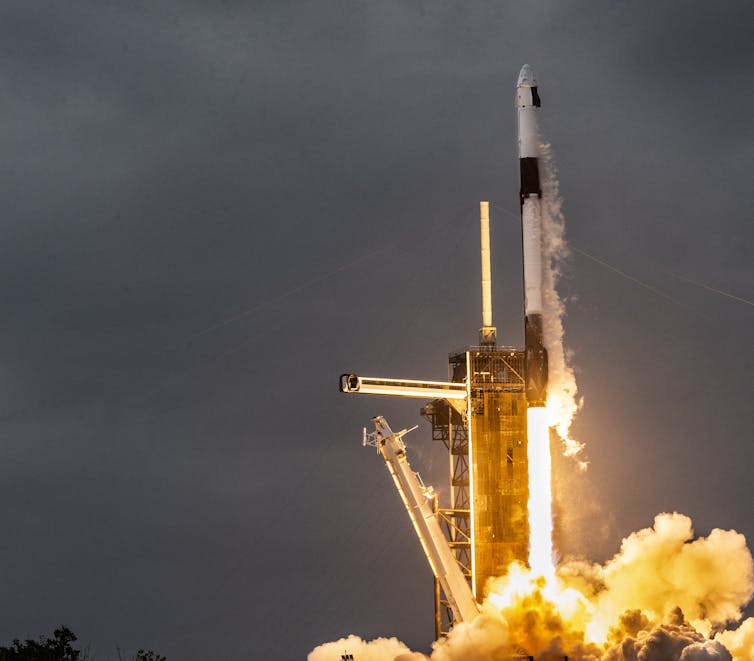
    A SpaceX Falcon 9 rocket with its Crew Dragon capsule launches from Cape Canaveral, Fla., in January 2024. Chandan Khanna/AFP via Getty Images

    Benjamin L. Emerson, Georgia Institute of Technology

    Curious Kids is a series for children of all ages. If you have a question you’d like an expert to answer, send it to curiouskidsus@theconversation.com.


    Why does a rocket have to go 25,000 mph (about 40,000 kilometers per hour) to escape Earth? – Bo H., age 10, Durham, New Hampshire


    There’s a reason why a rocket has to go so fast to escape Earth. It’s about gravity – something all of us experience every moment of every day.

    Gravity is the force that pulls you toward the ground. And that’s a good thing. Gravity keeps you on Earth; otherwise, you would float away into space.

    But gravity also makes it difficult to leave Earth if you’re a rocket heading for space. Escaping our planet’s gravitational pull is hard – not only is gravity strong, but it also extends far away from Earth.

    Like a balloon

    As a rocket scientist, one of the things I do is teach students how rockets overcome gravity. Here’s how it works:

    Essentially, the rocket has to make thrust – that is, create force – by burning propellant to make hot gases. Then it shoots those hot gases out of a nozzle. It’s sort of like blowing up a balloon, letting go of it and watching it fly away as the air rushes out.

    A bird's eye view of a rocket blasting off.
    On July 16, 1969, a Saturn V rocket sent Apollo 11 and three American astronauts on their way to the Moon. Heritage Images/Hulton Archive via Getty Images

    More specifically, the rocket propellant consists of both fuel and oxidizer. The fuel is typically something flammable, usually hydrogen, methane or kerosene. The oxidizer is usually liquid oxygen, which reacts with the fuel and allows it to burn.

    When going into space and escaping from Earth, rockets need lots of force, so they consume propellant very quickly. That’s a problem, because the rocket can’t carry enough propellant to keep thrusting forever; the amount of propellant needed would make the rocket too heavy to get off the ground.

    So what happens when the propellant runs out? The thrust stops, and gravity slows the rocket down until it gradually begins to fall back to Earth.
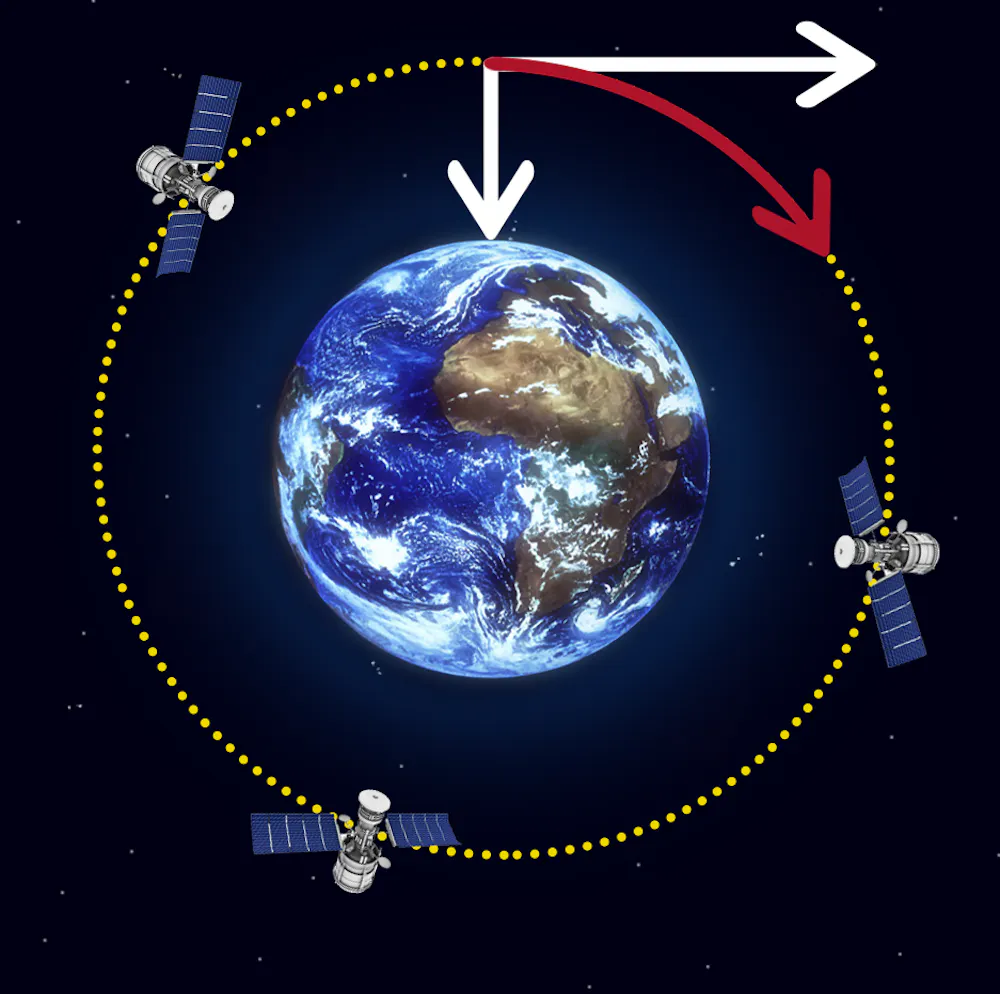
    A diagram that shows a satellite orbiting the Earth.
    A rocket provides the spacecraft with a sideways push (right arrow), gravity pulls it toward Earth (down arrow), and the resulting motion (red arrow) puts the spacecraft into orbit (yellow path). ESA/ L. Boldt-Christmas

    Fortunately, scientists can launch the rocket with some sideways momentum so that it misses the Earth when it returns. They can even do this so it continuously falls around the Earth forever. In other words, it goes into orbit, and begins to circle the planet.

    Many launches intentionally don’t completely leave Earth behind. Thousands of satellites are orbiting our planet right now, and they help phones and TVs work, display weather patterns for meteorologists, and even let you use a credit card to pay for things at the store or gas at the pump. You can sometimes see these satellites in the night sky, including the International Space Station.

    Escaping Earth

    But suppose the goal is to let the rocket escape from Earth’s gravity forever so it can fly off into the depths of space. That’s when scientists do a neat trick called staging. They launch with a big rocket, and then, once in space, discard it to use a smaller rocket. That way, the journey can continue without the weight of the bigger rocket, and less propellant is needed.
    Against a blue sky, a rocket shoots off into space.
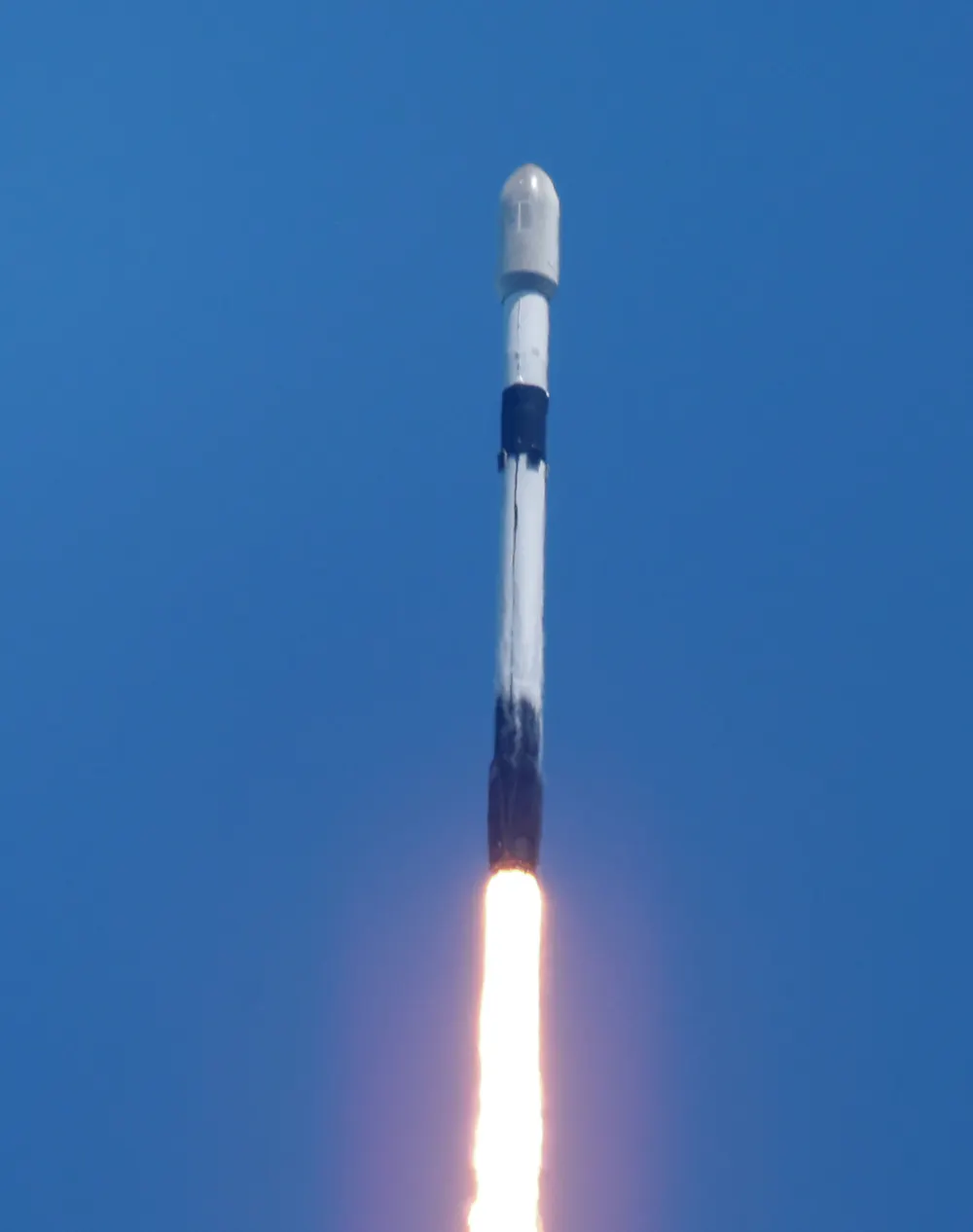
    The launch of a SpaceX Falcon 9 rocket from Cape Canaveral, Fla., in May 2024. The rocket carried 23 Starlink satellites into low Earth orbit. Joe Raedle via Getty Images

    But even staging is not enough; eventually the rocket will run out of propellant. But if the rocket goes fast enough, it can run out of propellant and still continue to coast away from Earth forever, without gravity pulling it back. It’s like riding a bike: build up enough speed and eventually you can coast up a hill without pedaling.

    And just like there’s a minimum speed required to coast the bike, there’s a minimum speed a rocket needs to coast away into space: 25,020 mph (about 40,000 kilometers per hour).

    Scientists call that speed the escape velocity. A rocket needs to go that fast so that the momentum propelling it away from Earth is stronger than the force of gravity pulling it back. Any slower, and you’ll go into an orbit of Earth.

    Escaping Jupiter

    Bigger, or more massive, objects have stronger gravitational pull. A rocket launching from a planet bigger than Earth would need to achieve a higher escape speed.

    For example, Jupiter is the most massive planet in our solar system. It’s so big, it could swallow 1,000 Earths. So it requires a very high escape speed: 133,100 mph (about 214,000 kilometers per hour), more than five times the escape speed of Earth.

    But the extreme example is a black hole, an object so massive that its escape speed is extraordinarily high. So high, in fact, that even light – which has a speed of 370 million mph (about 600 million kilometers per hour) – is not fast enough to escape. That’s why it’s called a black hole.


    Hello, curious kids! Do you have a question you’d like an expert to answer? Ask an adult to send your question to CuriousKidsUS@theconversation.com. Please tell us your name, age and the city where you live.

    And since curiosity has no age limit – adults, let us know what you’re wondering, too. We won’t be able to answer every question, but we will do our best.

    Benjamin L. Emerson, Principal Research Engineer, School of Aerospace Engineering, Georgia Institute of Technology

    This article is republished from The Conversation under a Creative Commons license. Read the original article.
  • NASA’s micro-mission Lunar Trailblazer will make macro-measurements of the lunar surface in 2025

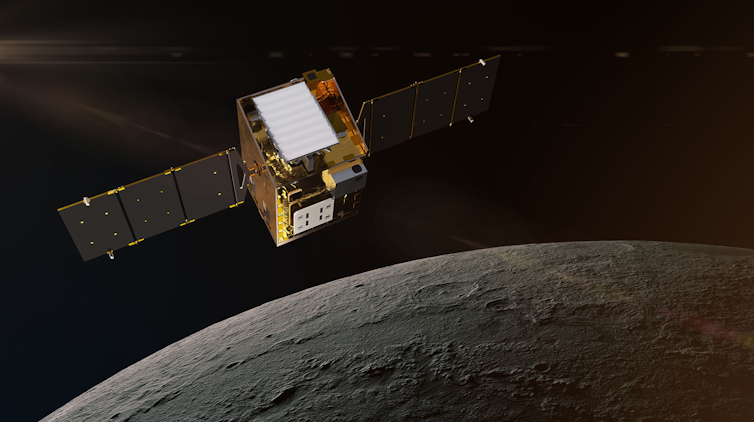
    Lunar Trailblazer is planned to launch in early 2025. Lockheed Martin Space

    César León Jr., Washington University in St. Louis

    NASA’s upcoming Artemis II mission is slated to return astronauts to the Moon no sooner than April 2026. Astronauts were last on the Moon in 1972 during the Apollo 17 mission.

    Artemis II will utilize NASA’s Space Launch System, which is an extremely powerful rocket that will enable human space exploration beyond Earth’s atmosphere. The crew of four will travel in an Orion spacecraft, which the agency launched around the Moon and successfully returned during the Artemis I mission.

    But before Artemis II, NASA will send two missions to scout the surface of the lunar south pole for resources that could sustain human space travel and enable new scientific discoveries.

    Planetary geologists like me are interested in data from Lunar Trailblazer, one of these two scouting missions. The data from this mission will help us understand how water forms and behaves on rocky planets and moons.

    Starting with scientific exploration

    PRIME-1, or the Polar Resources Ice Mining Experiment, will be mounted on a lunar lander. It’s scheduled for launch in January 2025.

    Aboard the lander are two instruments: The Regolith and Ice Drill for Exploring New Terrain, TRIDENT, and the Mass Spectrometer for Observing Lunar Operations, MSOLO. TRIDENT will dig down up to 3 feet (1 meter) and extract samples of lunar soil, and MSOLO will evaluate the soil’s chemical composition and water content.

    Joining the lunar mining experiment is Lunar Trailblazer, a satellite launching on the same Falcon 9 rocket.

    Think of this setup as a multimillion-dollar satellite Uber pool, or a rideshare where multiple missions share a rocket and minimize fuel usage while escaping Earth’s gravitational pull.

    Bethany Ehlmann, a planetary scientist, is the principal investigator of Lunar Trailblazer and is leading an operating team of scientists and students from Caltech’s campus. Trailblazer is a NASA Small, Innovative Mission for PLanetary Exploration, or SIMPLEx.

    These missions intend to provide practical operations experience at a lower cost. Each SIMPLEx mission is capped at a budget of US$55 million – Trailblazer is slightly over budget at $80 million. Even over budget, this mission will cost around a quarter of a typical robotic mission from NASA’s Discovery Program. Discovery Program missions typically cost around $300 million, with a maximum budget of $500 million.

    Building small but mighty satellites

    Decades of research and development into small satellites, or SmallSats, opened the possibility for Trailblazer. SmallSats take highly specific measurements and complement data sourced from other instruments.

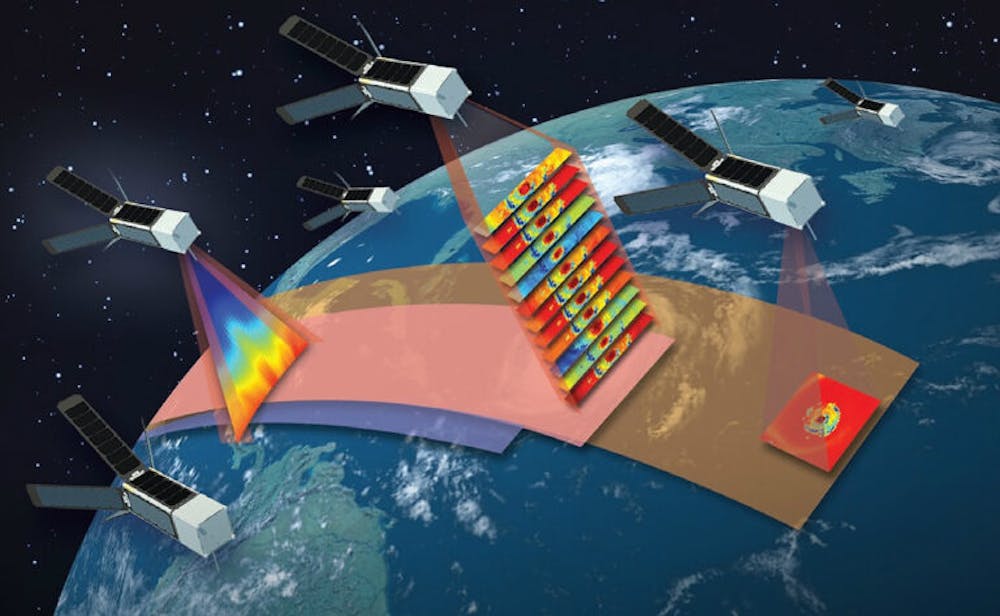
    A diagram showing four small satellites scanning Earth's science and taking layers of science data.
    Missions like NASA’s TROPICS use a network of small satellites to take more data than one satellite would be able to do alone. NASA Applied Sciences

    Multiple SmallSats working together in a constellation can take various measurements simultaneously for a high-resolution view of the Earth’s or Moon’s surface.

    SIMPLEx missions can use these SmallSats. Because they’re small and more affordable, they allow researchers to study questions that come with a higher technical risk. Lunar Trailblazer, for example, uses commercial off-the-shelf parts to keep the cost down.

    These low-cost, high-risk experimental missions may help geologists further understand the origin of the solar system, as well as what it’s made of and how it has changed over time. Lunar Trailblazer will focus specifically on mapping the Moon.

    A brief timeline of water discoveries on the Moon

    Scientists have long been fascinated by the surface of our closest celestial neighbor, the Moon. As early as the mid-17th century, astronomers mischaracterized ancient volcanic eruptions as lunar mare, derived from the Latin word for “seas.”

    Nearly two centuries later, astronomer William Pickering’s calculations suggested that the Moon had no atmosphere. This led him to conclude the Moon could not have water on its surface, as that water would vaporize.

    However, in the 1990s, NASA’s Clementine mission detected water on the Moon. Clementine was the first mission to completely map the surface of the Moon, including the lunar poles. This data detected the presence of ice within permanently shadowed regions on the Moon in low resolution.

    Scientists’ first water detection prompted further exploration. NASA launched the Lunar Prospector in 1998 and the Lunar Reconnaissance Orbiter in 2009. The India Space Research Organization launched its Chandrayaan-1 mission with the Moon Mineralogy Mapper, M3, instrument in 2008. M3, although not designed to detected liquid water, unexpectedly did find it in sunlit areas on the Moon.

    These missions collectively provided maps showing how hydrous minerals – minerals containing water molecules in their chemical makeup – and ice water are distributed on the lunar surface, particularly in the cold, dark, permanently shadowed regions.

    Novel mission, novel science

    But how does the temperature and physical state of water on the Moon change from variations in sunlight and crater shadows?

    Lunar Trailblazer will host two instruments, the Lunar Thermal Mapper, LTM, and an evolution of the M3 instrument, the High-resolution Volatiles and Minerals Moon Mapper, HVM3.

    The LTM instrument will map surface temperature, while the HVM3 will measure how lunar rocks absorb light. These measurements will allow it to detect and distinguish between water in liquid and ice forms.

    In tandem, these instruments will provide thermal and chemical measurements of hydrous lunar rock. They’ll measure water during various times of the lunar day, which is about 29.5 Earth days, to try to show how the chemical composition of water varies depending on the time of day and where it is on the Moon.

    These results will tell researchers what phase – solid or liquid – the water is found in.

    Scientific significance and what’s next

    There are three leading theories for where lunar water came from. It could be water that’s been stored inside the Moon since its formation, in its mantle layer. Some geologic processes may have allowed it to slowly escape to the surface over time.

    Or, the water may have arrived on asteroids and comets that collided with the lunar surface. It may even have been created by interactions with the solar wind, which is a stream of particles that comes from the Sun.

    Lunar Trailblazer may shed light on these theories and help researchers make progress on several other big science questions, including how water behaves on rocky bodies like the Moon and whether future astronauts will be able to use it.

    César León Jr., Ph.D. Student of Planetary Geology, Washington University in St. Louis

    This article is republished from The Conversation under a Creative Commons license. Read the original article.
  • From new commercial Moon landers to asteroid investigations, expect a slate of exciting space missions in 2025

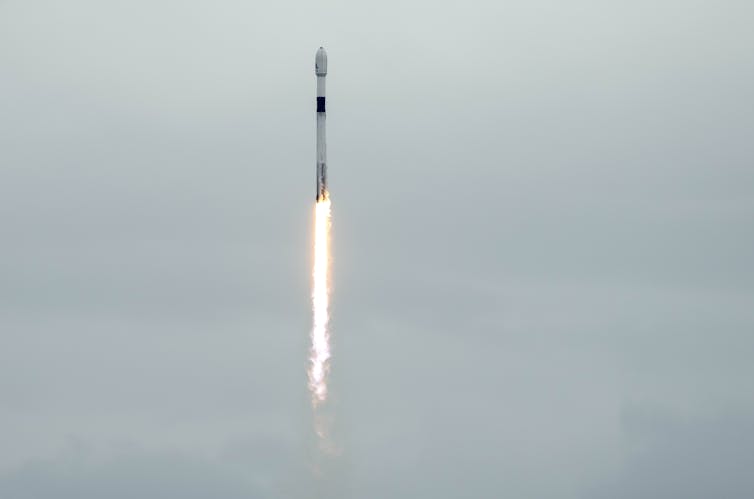
    A host of space missions are planned to launch in 2025. AP Photo/John Raoux

    Zhenbo Wang, University of Tennessee

    In 2024, space exploration dazzled the world.

    NASA’s Europa Clipper began its journey to study Jupiter’s moon Europa. SpaceX’s Starship achieved its first successful landing, a critical milestone for future deep space missions. China made headlines with the Chang’e 6 mission, which successfully returned samples from the far side of the Moon. Meanwhile, the International Space Station continued to host international crews, including private missions like Axiom Mission 3.

    As an aerospace engineer, I’m excited for 2025, when space agencies worldwide are gearing up for even more ambitious goals. Here’s a look at the most exciting missions planned for the coming year, which will expand humanity’s horizons even further, from the Moon and Mars to asteroids and beyond:

    Scouting the lunar surface with CLPS

    NASA’s Commercial Lunar Payload Services, or CLPS, initiative aims to deliver science and technology payloads to the Moon using commercial landers. CLPS is what brought Intuitive Machines’ Odysseus lander to the Moon in February 2024, marking the first U.S. Moon landing since Apollo.

    In 2025, NASA has several CLPS missions planned, including deliveries by companies Astrobotic, Intuitive Machines and Firefly Aerospace.

    These missions will carry a variety of scientific instruments and technology demonstrations to different lunar locations. The payloads will include experiments to study lunar geology, test new technologies for future human missions and gather data on the Moon’s environment.

    Surveying the sky with SPHEREx

    In February 2025, NASA plans to launch the Spectro-Photometer for the History of the Universe, Epoch of Reionization and Ices Explorer, or SPHEREx, observatory. This mission will survey the sky in near-infrared light, which is a type of light that is invisible to the naked eye but that special instruments can detect. Near-infrared light is useful for observing objects that are too cool or too distant to be seen in visible light.

    SPHEREx will create a comprehensive map of the universe by surveying and collecting data on more than 450 million galaxies along with over 100 million stars in the Milky Way. Astronomers will use this data to answer big questions about the origins of galaxies and the distribution of water and organic molecules in stellar nurseries – where stars are born from gas and dust.

    Studying low Earth orbit with Space Rider

    The European Space Agency, or ESA, plans to conduct an orbital test flight of its Space Rider uncrewed spaceplane in the third quarter of 2025. Space Rider is a reusable spacecraft designed to carry out various scientific experiments in low Earth orbit.

    These scientific experiments will include research in microgravity, which is the near-weightless environment of space. Scientists will study how plants grow, how materials behave and how biological processes occur without the influence of gravity.

    Space Rider will also demonstrate new technologies for future missions. For example, it will test advanced telecommunication systems, which are crucial for maintaining communication with spacecraft over long distances. It will also test new robotic exploration tools for use on future missions to the Moon or Mars.

    Exploring the Moon with M2/Resilience

    Japan’s M2/Resilience mission, scheduled for January 2025, will launch a lander and micro-rover to the lunar surface.

    This mission will study the lunar soil to understand its composition and properties. Researchers will also conduct a water-splitting test to produce oxygen and hydrogen by extracting water from the lunar surface, heating the water and splitting the captured steam. The generated water, oxygen and hydrogen can be used for enabling long-term lunar exploration.

    This mission will also demonstrate new technologies, such as advanced navigation systems for precise landings and systems to operate the rover autonomously. These technologies are essential for future lunar exploration and could be used in missions to Mars and beyond.

    The M2/Resilience mission is part of Japan’s broader efforts to contribute to international lunar exploration. It builds on the success of Japan’s Smart Lander for Investigating Moon, or SLIM, mission, which landed on the Moon using a precise landing technique in March 2024.

    Investigating an asteroid with Tianwen-2

    China’s Tianwen-2 mission is an ambitious asteroid sample return and comet probe mission. Scheduled for launch in May 2025, Tianwen-2 aims to collect samples from a near-Earth asteroid and study a comet. This mission will advance scientists’ understanding of the solar system’s formation and evolution, building on the success of China’s previous lunar and Mars missions.

    The mission’s first target is the near-Earth asteroid 469219 Kamoʻoalewa. This asteroid is a quasi-satellite of Earth, meaning it orbits the Sun but stays close to Earth. Kamoʻoalewa is roughly 131-328 feet (40-100 meters) in diameter and may be a fragment of the Moon, ejected into space by a past impact event.

    By studying this asteroid, scientists hope to learn about the early solar system and the processes that shaped it. The spacecraft will use both touch-and-go and anchor-and-attach techniques to collect samples from the asteroid’s surface.

    After collecting samples from Kamoʻoalewa, Tianwen-2 will return them to Earth and then set course for its second target, the main-belt comet 311P/PANSTARRS. This comet is located in the asteroid belt between Mars and Jupiter.

    By analyzing the comet’s materials, researchers hope to learn more about the conditions that existed in the early solar system and possibly the origins of water and organic molecules on Earth.

    Solar system flybys

    Besides the above planned launch missions, several space agencies plan to perform exciting deep-space flyby missions in 2025.

    A flyby, or gravity assist, is when a spacecraft passes close enough to a planet or moon to use its gravity for a speed boost. As the spacecraft approaches, it gets pulled in by the planet’s gravity, which helps it accelerate.

    After swinging around the planet, the spacecraft is flung back out into space, allowing it to change direction and continue on its intended path using less fuel. https://www.youtube.com/embed/0iAGrdITIiE?wmode=transparent&start=0 Spacecraft can fly by a planet to get a boost using gravity.

    BepiColombo, a joint mission by ESA and the Japan Aerospace Exploration Agency, JAXA, will make its sixth flyby of Mercury in January 2025. This maneuver will help the spacecraft enter orbit around Mercury by November 2026. BepiColombo aims to study Mercury’s composition, atmosphere and surface geology.

    NASA’s Europa Clipper mission, which launched in October 2024, will make significant progress on its journey to Jupiter’s moon Europa. In March 2025, the spacecraft will perform a flyby maneuver at Mars.

    This maneuver will help the spacecraft gain the necessary speed and trajectory for its long voyage. Later in December 2026, Europa Clipper will perform a flyby of Earth, using Earth’s gravity to further increase its momentum so it can arrive at Europa in April 2030.

    The ESA’s Hera mission will also perform a flyby of Mars in March 2025. Hera is part of the Asteroid Impact and Deflection Assessment mission, which plans to study the Didymos binary asteroid system. The mission will provide valuable data on asteroid deflection techniques and contribute to planetary defense strategies.

    NASA’s Lucy mission will continue its journey to explore the Jupiter Trojan asteroids, which share Jupiter’s orbit around the Sun, in 2025. One key event for Lucy is its flyby of the inner main-belt asteroid 52246 Donaldjohanson, scheduled for April 20, 2025.

    This flyby will provide valuable data on this ancient asteroid’s composition and surface features, which can help researchers gain insights into the early solar system. The asteroid is named after the paleoanthropologist who discovered the famous “Lucy” fossil.

    ESA’s Jupiter Icy Moons Explorer, or JUICE, mission will perform a Venus flyby in August 2025. This maneuver will help JUICE gain the necessary speed and trajectory for its journey to Jupiter. Once it arrives, JUICE will study Jupiter’s icy moons to understand their potential for harboring life.

    2025 promises to be a groundbreaking year for space exploration. With NASA’s ambitious missions and significant contributions from other countries, we are set to make remarkable strides in humanity’s understanding of the universe. These missions will not only advance scientific knowledge but also inspire future generations to look to the stars.

    Zhenbo Wang, Associate Professor of Mechanical, Aerospace and Biomedical Engineering, University of Tennessee

    This article is republished from The Conversation under a Creative Commons license. Read the original article.

  • Tip pressure might work in the moment, but customers are less likely to return

    Nobody likes feeling pressured. lechatnoir/E+ via Getty Images

    Sara Hanson, University of Richmond and Nathan B. Warren, BI Norwegian Business School

    Have you ever hesitated at the register, uncomfortable as an employee watched you choose a tip? It’s not just you. The rise of digital tipping systems – from point-of-sale devices held by employees to countertop screens that clearly display your selection – is changing the dynamics of tipping, often in ways that make customers feel scrutinized.

    As marketing professors who study digital tipping, we wanted to find out how customers respond to this sort of “tip surveillance.” So we conducted a field study analyzing 36,000 transactions and did four controlled experiments with more than 1,100 participants.

    We compared tipping setups with less privacy – such as when firms use handheld payment systems, when employees are facing customers, and when apps immediately show tips to employees – with setups with more privacy, such as countertop payment systems, employees who face away from customers, and apps that disclose tips only after the service.

    Our results were clear: High levels of surveillance are bad for business. Customers who felt watched while tipping were less likely to make a return visit or recommend a business. While privacy often made customers feel more generous and in control of their decisions, feeling scrutinized led to resentment and reduced loyalty.

    Interestingly, research shows that people enjoy being watched when they donate to charity. So why does tipping feel different? Perhaps because tipping isn’t entirely voluntary – it’s often seen as an expectation. When customers feel pressured, they lose the sense of control that makes tipping a positive experience.

    Welcome to the payment panopticon

    While digital tipping can be convenient, it can also contribute to “tipflation” – the feeling that tipping expectations have gotten out of hand. If companies want to make sure customers keep coming back, our research indicates they would do well to give customers privacy to tip.

    One issue might be that some employees think watching customers closely encourages them to tip generously. We didn’t find a straightforward relationship, however, between tipping privacy and tip amounts. While privacy empowers customers to tip less if they choose, we found it also often encourages them to feel more generous. These effects mean that customers tip similar amounts whether they have privacy or not.

    For companies, striking the right balance between giving customers control and fostering generosity is crucial. A business that trains its employees to give customers privacy to tip – and makes sure to pay those employees fairly, so they don’t need to pressure customers in the first place – will likely develop a better reputation and a more loyal customer base.

    The next horizons of tipping

    Tipping can be a feel-good experience, enhancing feelings of generosity and social status. It can also be a source of anxiety. And for better or worse, digital technology is changing the way we tip. Today, people tip more money, for more services, and in more places than ever before.

    As businesses, customers and even politicians debate how to best integrate digital tipping into our world, our research shows the importance of thinking holistically. In our view, the focus shouldn’t just be on boosting tipping revenue for employees but also on creating a positive experience for customers.

    More broadly, customers, workers, businesses and society may want to consider how to create a system of tipping that protects workers’ rights and dignity while guaranteeing fair pay, and that allows customers and business owners to reward employees who contribute by providing great service.

    Sara Hanson, Associate Professor of Marketing, University of Richmond and Nathan B. Warren, Associate Professor of Marketing, BI Norwegian Business School

    This article is republished from The Conversation under a Creative Commons license. Read the original article.
  • NASA wants to send humans to Mars in the 2030s − a crewed mission could unlock some of the red planet’s geologic mysteries

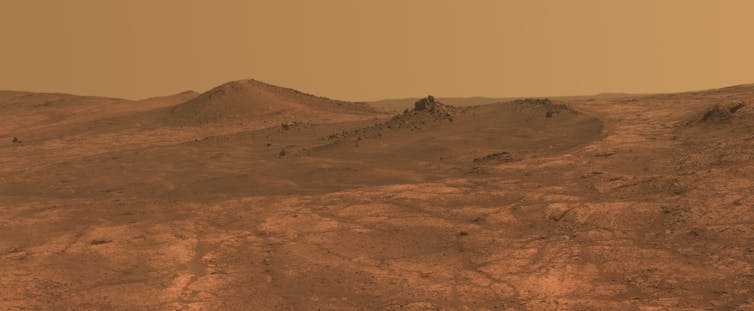
    Mars’ craters come from ancient collisions during the formation of the solar system. NASA/JPL-Caltech/Cornell University/Arizona State University via AP

    Joel S. Levine, William & Mary

    NASA plans to send humans on a scientific round trip to Mars potentially as early as 2035. The trip will take about six to seven months each way and will cover up to 250 million miles (402 million kilometers) each way. The astronauts may spend as many as 500 days on the planet’s surface before returning to Earth.

    NASA’s Artemis program plans to return humans to the Moon this decade to practice and prepare for a Mars mission as early as the 2030s. While NASA has several reasons for pursuing such an ambitious mission, the biggest is scientific exploration and discovery.

    I’m an atmospheric scientist and former NASA researcher involved in establishing the scientific questions a Mars mission would investigate. There are lots of mysteries to investigate on the red planet, including why Mars looks the way it does today, and whether it has ever hosted life, past or present.

    Mars, a dusty reddish planet, floating in space.
    Studying Mars can tell researchers more about the formation of the solar system. J. Bell/NASA via AP

    Mars geology

    Mars is an intriguing planet from a geological and atmospheric perspective. It formed with the rest of the solar system about 4.6 billion years ago. Around 3.8 billion years ago, the same time that life formed on Earth, early Mars was very Earth-like. It had abundant liquid water on its surface in the form of oceans, lakes and rivers and possessed a denser atmosphere.

    While Mars’ surface is totally devoid of liquid water today, scientists have spotted evidence of those past lakes, rivers and even an ocean coastline on its surface. Its north and south poles are covered in frozen water, with a thin veneer of frozen carbon dioxide. At the south pole during the summer, the carbon dioxide veneer disappears, leaving the frozen water exposed.

    Today, Mars’ atmosphere is very thin and about 95% carbon dioxide. It’s filled with atmospheric dust from the surface, which gives the atmosphere of Mars its characteristic reddish color.

    Scientists know quite a bit about the planet’s surface from sending robotic missions, but there are still many interesting geologic features to investigate more closely. These features could tell researchers more about the solar system’s formation.

    The northern and southern hemispheres of Mars look very different. About one-third of the surface of Mars – mostly in its northern hemisphere – is 2 to 4 miles (3.2-6.4 kilometers) lower in elevation, called the northern lowlands. The northern lowlands have a few large craters but are relatively smooth. The southern two-thirds of the planet, called the southern highlands, has lots of very old craters.

    Mars also has the largest volcanoes that scientists have observed in the solar system. Its surface is peppered with deep craters from asteroid and meteor impacts that occurred during the early history of Mars. Sending astronauts to study these features can help researchers understand how and when major events happened during the early history of Mars. https://www.youtube.com/embed/Cww3yVQpcjY?wmode=transparent&start=0 Mars’ volcanoes tower over any of the highest mountains on Earth.

    Asking the right questions

    NASA formed a panel called the Human Exploration of Mars Science Analysis Group to plan the future mission. I co-chaired the panel, with NASA scientist James B. Garvin, to develop and assess the key scientific questions about Mars. We wanted to figure out which research questions required a human mission to address, rather than cheaper robotic missions.

    The panel came up with recommendations for several important scientific questions for human investigation on Mars.

    One question asks whether there’s life on the planet today. Remember, life on Earth formed about 3.8 billion years ago, when Earth and Mars were similar-looking planets that both had abundant liquid water and Mars had a denser atmosphere.

    Another question asks what sort of environmental changes led Mars to lose the widespread, plentiful liquid water on its surface, as well as some of its atmosphere.

    These questions, alongside other recommendations from the panel, made it into NASA’s architectural plan for sending humans to Mars.

    How do you get to Mars?

    To send people to Mars and return them safely to Earth, NASA has developed a new, very powerful launch vehicle called the Space Launch System and a new human carrier spacecraft called Orion.

    To prepare and train astronauts for living on and exploring Mars, NASA established a new program to return humans to the Moon, called the Artemis program.

    In mythology, Artemis was Apollo’s twin sister. The Artemis astronauts will live and work on the Moon for months at a time to prepare for living and working on Mars. https://www.youtube.com/embed/_T8cn2J13-4?wmode=transparent&start=0 The Artemis program plans to return humans to the Moon, in anticipation of eventually sending humans to Mars.

    The Space Launch System and Orion successfully launched on Nov. 16, 2022, as part of the Artemis I mission. It made the Artemis program’s first uncrewed flight to the Moon, and once there, Orion orbited the Moon for six days, getting as close as 80 miles (129 kilometers) above the surface.

    Artemis I splashed back down to Earth on Dec. 11, 2022, after its 1.4 million-mile (2.2 million-kilometer) maiden journey.

    Artemis III, the first mission to return humans to the lunar surface, is scheduled for 2026. The Artemis astronauts will land at the Moon’s south pole, where scientists believe there may be large deposits of subsurface water in the form of ice that astronauts could mine, melt, purify and drink. The Artemis astronauts will set up habitats on the surface of the Moon and spend several months exploring the lunar surface.

    Since the Moon is a mere 240,000 miles (386,000 km) from Earth, it will act as a training ground for the future human exploration of Mars. While a Mars mission is still many years out, the Artemis program will help NASA develop the capabilities it needs to explore the red planet.

    Joel S. Levine, Research Professor, Department of Applied Science, William & Mary

    This article is republished from The Conversation under a Creative Commons license. Read the original article.

  • Repost: Community Decay… Part 2

    What exactly is community decay? Who does this apply to?

    The Community Decay Ordinance for Lincoln County (2018-05) reads “It is unlawful for any person to maintain conditions that contribute to community decay on property owned, occupied, or controlled by him or her on or adjacent to any public roadway within the county.”

    At this point, one might breath a sigh of relief. “On or adjacent to any public roadway”- that can’t apply to very much of the county, right?

    Ah, but this ordinance begins with definitions. Adjacent: “beside, next to, contiguous or nearby. Properties adjacent to any public roadway and properties within public view, as defined within this ordinance”

    This is a rather broad definition of adjacent, and I’d encourage the reader to consider how many places they know of that are “beside, next to, contiguous or nearby” a public roadway.

    Next. Public view: “any area visible from any point up to six feet above the surface of the center of any public roadway”

    So now we have any property “beside, next to, contiguous or nearby” any public roadway and “any area visible from any point up to six feet above the surface of the center of any public roadway”…

    I’d encourage the reader to imagine just how far one could see from six feet above the center of a public roadway on a hill.

    But wait- there’s more! All this assumes that we know what a public roadway is (it’s a road- right? Not quite). Fortunately, the ordinance includes a definition. Public roadway- “any highway, road, alley, lane, parking area, or other public or private space adapted and fitted for public travel that is in common use by the public”

    So, that leaves us with a rather broad idea of what sort of places community decay is not allowed. And we haven’t even gotten to what community decay actually is! More next time.