Trego's Mountain Ear

"Serving North Lincoln County"

Author: michaelmccurry

  • Thinking About H1-B Visas

    I see that Governor DeSantis (Florida) is moving to eliminate H1-B visas from Florida’s university system. My experience with the H1-B visa holders is limited – and at least ten years out of date – yet DeSantis’ comments match my experience: “They come in with these brokers who make a fortune of this with arbitrage. They bring them in and they are indentured to the company. So, the company can basically pay them low and they say no, we got to do this. You have to prove there are no Americans. They will put an ad in the classified sections of a newspaper. Nobody reads that section of the newspaper… It’s all become a total scam”

    The article explained the numbers: “The H-1B program exists to bring workers specifically from India and China: • 283,397 Indians in 2024 • 46,680 Chinese • Philippines came in at #3 — with 5,248.” My limited experience confirms DeSantis’ comments – Prasanthi was from India, and asked me to serve as a reference on her job applications as a way of getting out of the ‘indentured servitude.’ The last I heard from her was a very appreciative thank you note as she managed to get a job out of SDSU. She was hired to teach faculty to do distance-education courses, and it was a job I would not have taken – the technique was to assign busy work instead of academic inquiry. I will admit, I’m no fan of busy work. It fits right in there with group projects.

    The point is, she was hired to do a job that this American would not do. I can’t say H1-B is always bad – but she was hired to teach me to present in a way that didn’t really improve my students’ research skills (in my opinion – I could be wrong, but don’t believe I am). DeSantis said  “I don’t understand how is that specialized knowledge that only someone from these places can do. A $40,000 a year job working as the assistant at the athletic department? That’s an abuse of this whole idea. If there are things that the universities need, that somehow they just can’t find in Florida, to me, they, of all employers, would be the ones most responsible for why they can’t find what they need.”  Like I said, his comments are pretty much in line with my experience.

    Yet I learned a lot from working with Prasanthi – that there is a color discrimination in India that exceeds our own cultural racism, and that was a reason to accept the limitations of the H1-B to get to America. As I look at immigration, both legal and illegal, I realize that there is a lot more opportunity here than over there. And it seems to me that the difference between coming into the US as a mojado or with an H1-B isn’t so great – either way, it’s better to be in the land of the big PX.

  • Economic Activity or Pocketknife Swaps?

    I noticed that Tim Walz has explained that EBT (once known as Food Stamps) creates $1.80 in economic activity for every dollar that goes out. Economic activity is a term that doesn’t necessarily mean what it seems. An old rancher described it as swapping pocketknives – “I spend ten grand buying a herd bull from my neighbor this year, next year he spends ten grand buying a bull from me.” That’s economic activity – each needs a herd bull, and they pay each other an inflated price to (hopefully) raise the value of their livestock to other potential buyers.

    I took a class in economics back when I was a college freshman – the professor opened the first class by explaining no Republican had ever got better than a C in his class, then went on to explain Keynesian economics. I understood why – The Motley Fool describes Keynesian economics: “The United States has had a complicated history with Keynesian economics. While Keynesianism has frequently been used during downturns, the jury is still out on its long-term effectiveness.” https://www.fool.com/terms/k/keynesian-economics/

    Not all “economic activity” creates wealth – pocketknife swaps merely create the illusion of value. John Maynard Keynes theorized that “government intervention is needed to stimulate demand and stabilize the economy, particularly during recessions.” While Adam Smith held that a free market would provide full employment (meaning employees would accept the wages offered), Keynesians held that government spending would increase demand. I’m pretty sure that the amount of government spending we have means we’re all Keynesians. No other choices in a world filled with deficit spending.

    To Adam Smith, labor and the accumulation of capital were key components of economics – and Karl Marx basically agreed when he defined capital as dead labor (there are a lot of custom rifles built on old Mauser military actions, with new barrels and stocks added – pick your own example if you like). A pocketknife swap neither includes labor nor the accumulation of capital. It does include the illusion of value.

    I figure the SNAP program increases labor (some share of producing and processing food) and accumulation of capital (though that may go more to Sam Walton’s heirs). But I’m skeptical whenever a politician uses the words ‘economic activity.’ After all, I ended a career one floor above the economics department.

  • And Winter Approaches

    In 1960, I learned that the first snow of winter could be expected around Halloween. As a young adult, my winters included snow surveys – being paid to ride snowmobiles. Now, at 75, I’m reaching a stage where the body refuses to stay warm in the cold – I can almost understand the snowbirds who winter in the south and return north for the warm months. But not yet – I can still get in a few good hours in the Fall, as the leaves drop from the Serviceberries and the needles turn yellow on the Western Larch. With the yellow needles interspersed in the green of the Douglas Fir and Ponderosa Pine, and a glance upwards showing snow on Mount Marston and Stryker Peak, late October is our prettiest season.

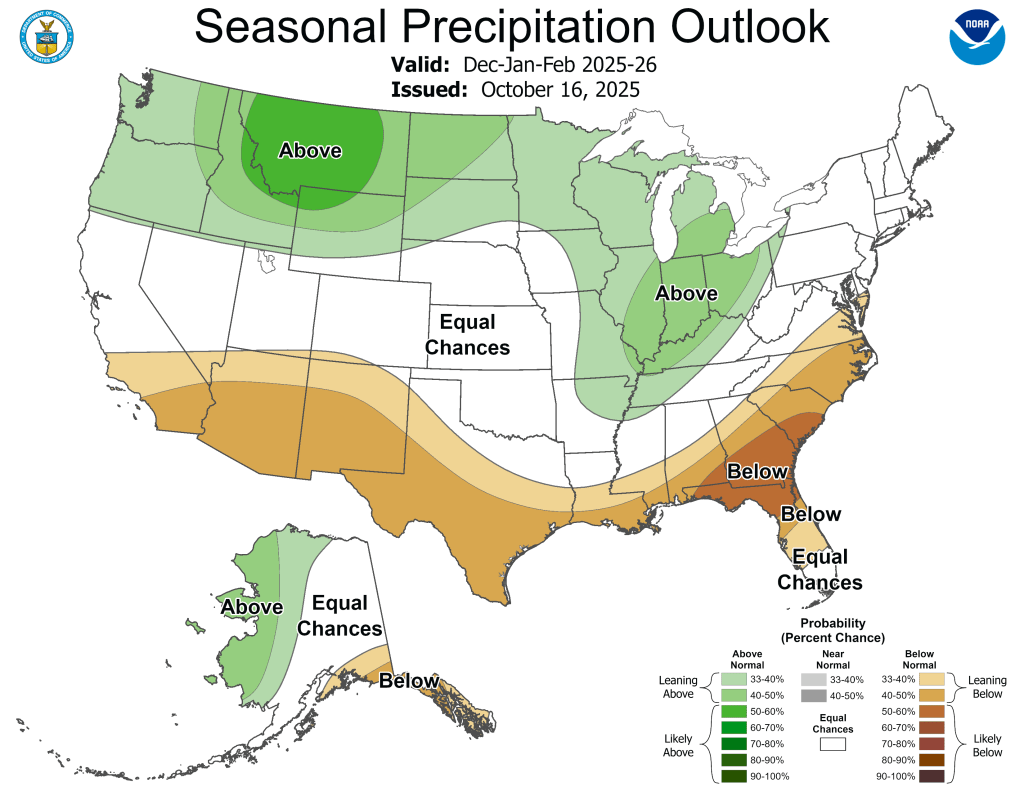
    Now, it’s about time to put the snowplow back on the old Ford – soon snow will cover the trees and give the winter scenery. NOAA has some projections for us that suggest we can expect colder temperatures than normal and more precipitation. Which translates to a bit more time bringing in firewood:

    Ah, well, I expect we will still encounter a January thaw and then March will bring Spring again. The extra snow should help fill the pond. I forgot to buy a 2,4,D mix with nitrogen fertilizer to hit the Canada thistles with a Fall growth surge that takes the root reserves from them – and I probably need to look for some Semaspore bait for next year’s grasshoppers.

  • The Price of Rifles

    In 1963, I entered high school. Minimum wage was $1.25 per hour. Five silver quarters – well, 90% silver. A couple of years later, they replaced that silver currency with clad coins. As I write this, the spot price of silver is a little over $52 and ounce. Gold in 1963 was $35 an ounce. Today it’s $4250. But at 13, I wasn’t interested in gold and silver. I do remember the prices on some of the rifles. The Ithaca model 49 – looked like a lever action but was more like a single shot Martini – was going for a twenty dollar bill.

    I saw one used at Cabela’s for a penny under $300. The Colteer – a single shot bolt gun from Colt – cost $19.95 new, and was priced at $400 as I viewed their inventory.

    A single shot 22 bolt gun, made in 1957 – now selling for 20 times its original price.

    I’m not sure that the price of gold reflects perfectly on the value of our currency – perhaps the increased value of old rifles is a better measure. In 1957, a nickel would buy a chocolate bar – and, while the chocolate bars shrank by the mid-sixties, nickel bars could still be found in 1966.

    Land values – in the fifties, land in Trego was pretty well established at $30 an acre. The twenty to one ratio from old rifles doesn’t fit there – but the hundred and twenty to one ratio of gold seems closer to the increased land prices.

    The Canadian dollar is now worth about 70 cents US. In my youth, when we still had silver, US coins were 90% silver, Canadian coins were 80% silver, and the Canadian dollar stayed constant at something like 90 cents US.

  • Irish Democracy – Not The AI Search Definition

    Looking for information online is getting a bit harder – a search for “Irish Democracy” yields this commentary from search assist: “Irish democracy refers to the system of government in the Republic of Ireland, which is a parliamentary representative democracy. This means that the government is elected by the people and is accountable to them, with powers divided among the legislature, executive, and judiciary to ensure checks and balances.” Artificial Intelligence at its finest – you have to scroll down to get to https://www.econlib.org/the-pros-and-cons-of-irish-democracy/ which begins with “If regular democracy isn’t doing so well, maybe it’s time to fall back on “Irish Democracy.’ That’s what Yale political scientist James Scott calls the passive resistance of a society that doesn’t like what its rulers are doing to it. In his book “Two Cheers for ­Anarchy,” he writes, “One need not have an actual conspiracy to achieve the practical effects of a conspiracy. More regimes have been brought, piecemeal, to their knees by what was once called ‘Irish Democracy,’ the silent, dogged resistance, withdrawal and truculence of millions of ordinary people, than by revolutionary vanguards or rioting mobs.”

    Perhaps it was best phrased by Heinlein: “I am free, no matter what rules surround me. If I find them tolerable, I tolerate them; if I find them too obnoxious, I break them. I am free because I know that I alone am morally responsible for everything I do.” Another of his reminders is: “Taxes are not levied for the benefit of the taxed.”

    Henlein died in 1988 – and still made the observation “Government! Three fourths parasitic and the other fourth stupid fumbling.” The thought could describe my neighborhood in 2025.

    Still, when legislators reduce the choices we can make through voting – and our elected officials have done that, Irish Democracy becomes the only alternative. We do need to be careful that we do not accept Irish Handcuffs – the technical definition is a drink in each hand, but the hazard is holding on to something, refusing to set it down, and for that reason being compelled to inaction.

  • Chet’s Wall Is Back

    When the old service station was built, the back of the building was set up as a separate barber shop. Kenny Gwynn had built things so that there was a space for Chet Apeland do do barbering as the boomtown grew rapidly and the workforce for the tunnel and the railroad relocation expanded geometrically.

    The times were against it – this was the mid-sixties, and men went from frequent, short haircuts to infrequent long shaggy haircuts. As the song says, “Blame it on the stones.” The style went from flat top and crew cut to the moptop, and haircuts became less frequent. With less demand for haircuts, Chet went back to tasks that needed done on his ranch. With no barber present, someone (likely Howard Mee) made the decision to pull the wall and expand the retail area for the gas station.

    The wall was structural – it’s removal caused the trusses to sag and, when Chuck Butler put sheetrock on the ceiling, it lasted briefly and then cracked.

    As Wayne and I looked at the ceiling, it was obvious that we needed a support under the crack – so we cut the sheetrock and old paneling out, then, with plumbob and 20 ton hydraulic jack, proceeded to replace the structural wall that was taken after Chet realized that Trego’s new residents weren’t particularly interested in haircuts. Now, with the structural wall replaced, the ceiling is dramatically improved. It’s amazing how the old marks in the concrete floor matched the ceiling crack, and how close, without blueprints, the replacement wall matches the old one. We have added one door.

    We’ll continue the remodeling – the outside walls – framed with 2×4 lumber – haven’t had enough insulation by today’s standards, so we’ll be framing in another 4-inch wall inside, then adding more insulation. We’ll replace the sink that was there in the barber shop days – though we have no idea if a barber or cosmetologist will ever want to operate in Trego.

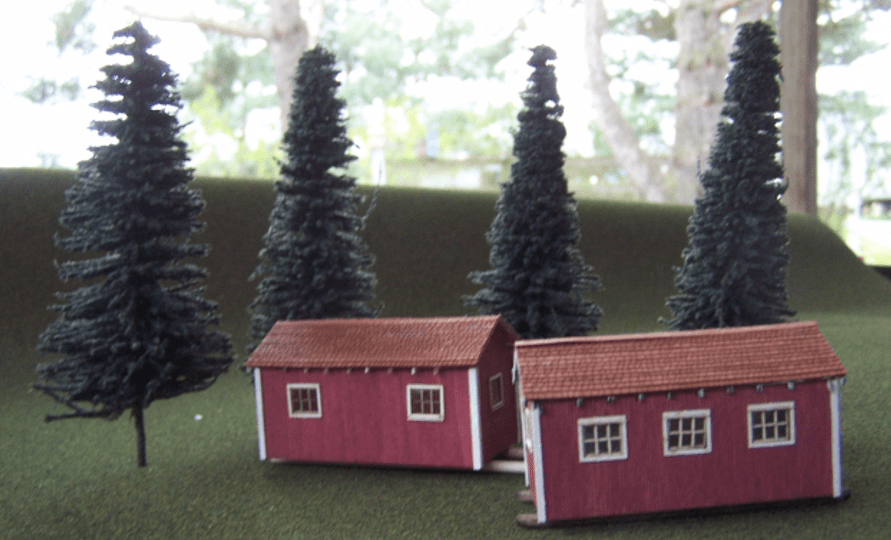
    Along with the internal remodeling, we’ll be jacking up the old cookshack and rolling it about 20 feet to the south. It’s one of the last remnants of the logging camp days, and (assuming minimal rot in the skids it was built on) we’ll be taking on the task of removing the shelving (Dad used it for storing grocery commodities) and getting the walls back to how things looked when Timber was king. That task will be next summer. These model railroad cookshacks give an idea how the building looked originally – I’ll try to find the actual designs

    Delayed maintenance is just another sort of debt – if it isn’t paid with labor and materials, destroying the historical buildings becomes a rational decision. Replacing the roof and getting rid of the leaks was the first step. Replacing the load-bearing walls was the second. On the other hand, the foundation or footings will be the challenge on the old cookshack.