Trego's Mountain Ear

"Serving North Lincoln County"

Author: michaelmccurry

  • I Found a Praying Mantis in Trego Friday Afternoon

    I have never before found a Praying Mantis in Trego. I suspect someone ordered the Mantis for pest control this summer and it wound up behind the old service station. I needed to move some wood to a burn pile – and had to cut the log up with my chainsaw in order to move it. When I saw the Mantis, I set the idling saw down, captured the insect, found a can to keep it in, then remembered to pick the saw back up before I took the beast home to show to Renata.

    This map, published just a month ago by https://fieldguide.mt.gov/speciesDetail.aspx?elcode=IIMAN01010 shows how lucky I feel to have spotted (and captured) one here in Trego. The field guide identifies my insect as a European Mantid.

    Not much else to say – just that I feel lucky to find one.

  • Thoughts On Tattoos

    I can’t claim to have a body free from tattoos. Mine came in 2009, when the radiation folks were zapping the body to kill off any remaining cancer cells. They added the tattoos to help sight in the radiation into the right areas. While my tattooing seems to have been successful, I still harbor some resentment – they should have at least given me a beer or two first.

    I’m reading of a politician in Maine who got an SS tattoo while drunk in eastern Europe. That is the sort of bad judgement I can understand. His excuse was being a young, drunk soldier. I learned differently as a kid – Dad was retired Navy, CWO4 (Chief Warrant Officer) and spent a career at sea without tattoos, and as a small boy I saw lots of tattoos, and heard stories of the problems associated with them.

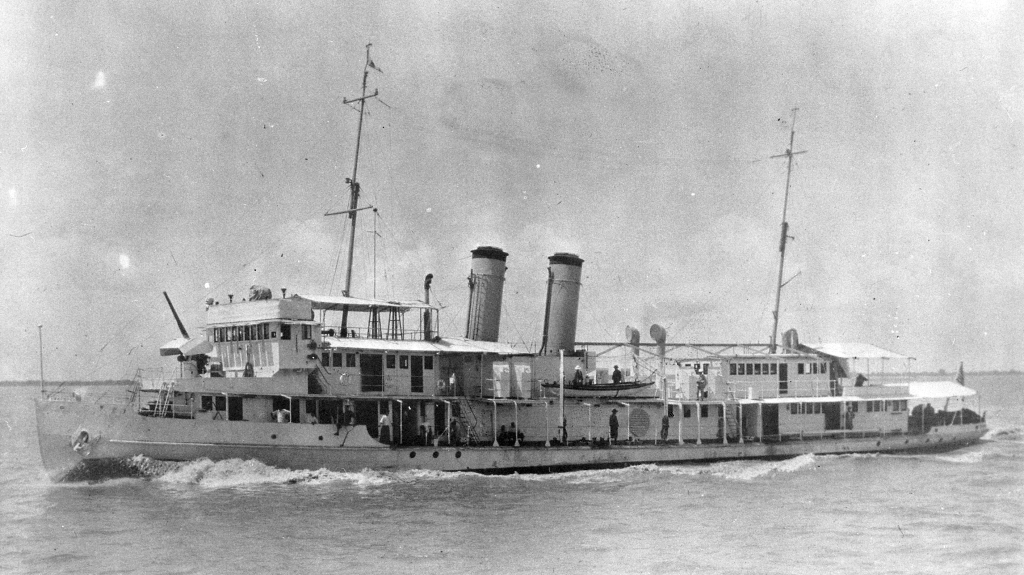
    I think the petty officer with the big tattoo was named Carillo – but the story came to me at least 70 years ago, so their may be some factual flaws. Carillo’s story went back to 1941 – he was Guamanian, and had taken a month’s leave to visit his family on Guam. Yeah, that month – December, 1941. When World War II came to the US, he was an American sailor on Guam – and, lacking any other way of avoiding capture, ditched his dungarees for native apparel. Unfortunately, he had a tattoo showing the gunboat Panay on his chest.

    In the 21st Century, the Panay is a mostly forgotten little ship – but in December of 1941, she was remembered by Americans and Japanese alike. https://military-history.fandom.com/wiki/USS_Panay_incident probably provides as good a link to the story as any:

    He had a picture of this little ship inked across his chest – and, as the article says “The USS Panay incident was a Japanese bombing attack on the U.S. Navy river gunboat Panay and three Standard Oil Company tankers on the Yangtze River near the Chinese capital of Nanjing on 12 December 1937. Japan and the United States were not at war at the time. The boats were part of an American naval operation called the Yangtze Patrol, which began following the joint British, French, and American victory in the Second Opium War.”

    The old petty officer spent the war as a POW, and credited the tattoo. The end of his tale was the simple admonition “Never get a tattoo.” There have been tattoos with some appeal – a pig and a rooster tattooed on your heal was said to prevent death by drowning. I knew older people with blue numbers tattooed on their arms – tattoos that spoke of their time in German camps. Still, the old man’s admonition “Never get a tattoo.” held for my first fifty-nine years. And I still think that common decency should have included a shot of rum or a beer before they tattooed sighting markers on my belly.

  • The Lady Wore Mink (or remodeling the gas station)

    As I unloaded material into the old service station, I had a visitor. A lady wearing a mink jacket – interested in what we’re doing there. I have a soft spot for ladies wearing mink, and it isn’t a common apparel in scenic downtown Trego, so I showed a bit of the unfinished project.

    Part of the deal with furs was my aunt Fay. Over half a century ago, she had examined yard sales and thrift stores for large women’s fur coats – which she would disassemble, and rebuild into vests for me. Afterall, it was the sixties. Later, after Renata and I married, I offered to get her a mink coat kit. She was less than impressed by a singe trap and a small skinning knife. The morning I drove to work and spotted a roadkill winter mink, I didn’t dare call her and ask her to pick it up for me. Sometimes discretion truly is valor’s better part.

    But back to the shop. We are remodeling it. The first step was replacing the leaking corrugated roofing – you can’t remodel when the roof leaks. The next stage is fixing the ceiling damage, and moving the stuff that has been stored there out of the way. I’ve built a 20 unit storage building, and one of those units is going to be full of stuff that is in the way when I work on remodeling. It’s easier to move boxes than to make a permanent decision about things we haven’t used in ten years.

    The service station was built to serve the population involved in building the tunnel. After that population changed, Retha McCully got the idea of changing it to a Convenience Store. When she died, Dad kept the store going – and took out the parts that made it a garage. I’m not remodeling the building for my ideas – at 75, my task is to remodel it into a building that fits with my daughter’s ideas. Today we brought a mini-split on line. Tomorrow, we bring back the wall that separated the gas and oil from the barber shop when it was built. By the time we finish, the building will include spaces for four small businesses.

    Then comes the other tasks – the southernmost building (that Dad put alongside the gas station) was originally a logging camp cook shack. If it can be restored, it will be moved another 20 feet south and be back looking like it did when it was part of a logging camp. The northernmost building was a logging camp bunkhouse. There is too much community history in those two logging camp buildings. The old service station is from the boom town days of the middle and late sixties, while those two portable buildings are from the logging camp days – two distinct times in Trego’s history.

    The center building looks like an old log building – but isn’t. Back when the railroad was relocated, and Libby Dam was built, a guy named Goldsberry bid in the task of salvaging railroad material from the area that was soon to be flooded. He figured that the cedar telegraph poles (installed in 1904) would still have value – but by 1970, they had spent their effective lifespans as telegraph poles. While the telegraph was high tech in 1904, by 1970 it was ho-hum. In the eighties, Dad set up a small mill and had Pat Eustace mill the telegraph poles and turn them into a small building – representing, in its own way, the first railroad relocation and Trego’s first initial boom. The first part of the remodel was taking off the handcrafted doors – unique, but so heavy that opening and closing them damaged the structure.

    As the new walls go up, it gets easier to see what’s coming in with the remodeling. You don’t need to wear a mink jacket to come by and see what’s going on – or to figure out if your dream business might fit into the old service station and downtown Trego’s future.

  • The Two Goat Herd

    My grandson, Remi, gave me his first complete sentence about six weeks ago. “I need a goat.” I thought back over 65 years – and realized that, just before Dad retired from the Navy, my parents bought their first house – in Washington – then bought an additional acre of blackberry brambles, and goats to eat down the brambles. I realized that I had liked having goats around as a kid – so I messaged a great lady I met who had goats.

    Long story short, she introduced Remi and I to a pair of Nigerian Dwarf does. Remi was enchanted, so I got him two goats just as soon as I got a small goat house set up for his front yard. There’s going to be a lot more work setting up the permanent goat corral.

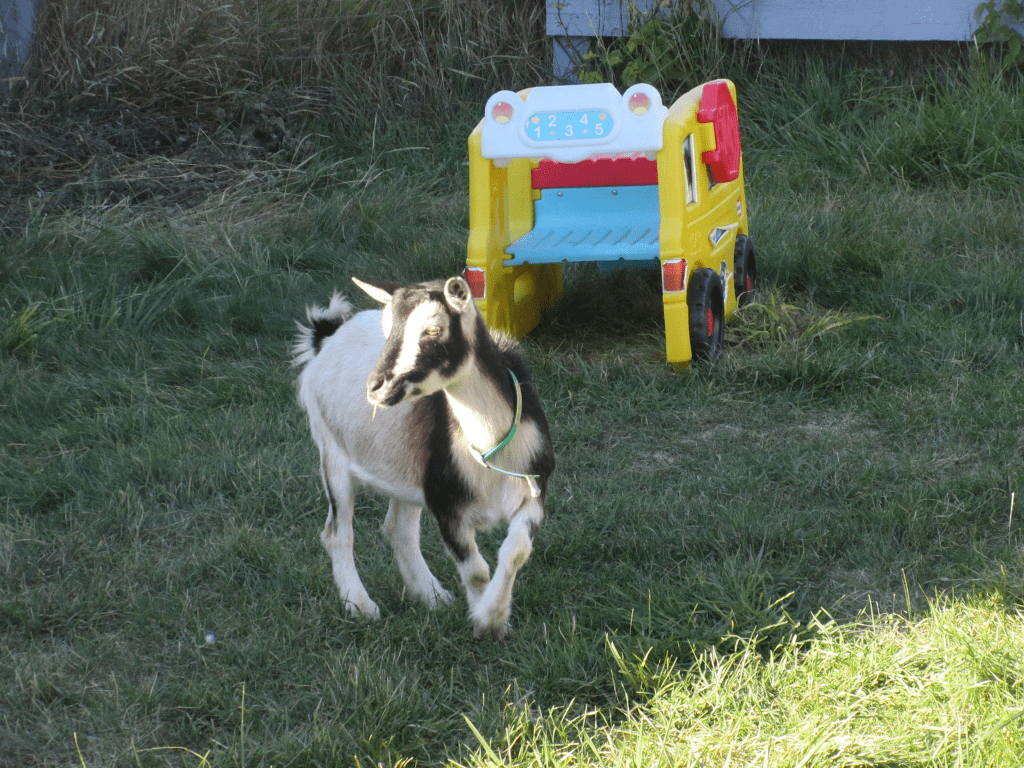
    I’m no expert on goats – but I started this project knowing you don’t get one goat. They’re a herd animal, and need a friend. So the deal was made for two little goats. The one pictured kept her original name – the other became ‘Stormy’. Which is a lot better than Sam referring to her as ‘that little black witch’ on her third escape the first evening we brought Remi’s goats home. The escapes were (I believe) just to show us she could do it – she might jump to the top of the goat house, and then over the fence, but leaving her friend wasn’t in the cards.

    Nigerian Dwarfs are small dairy goats – and the breed page says that they are primarily kept as pets. Which is fine by me – I’m guessing the smaller of the two weighs about 40 pounds and the larger a little over 50 pounds. The average dairy goat weighs in at 120 pounds – these little does are tiny. And they have all of us feeding them – family and neighbors. After the first night, they settled in and are getting by fine.

    I’m reading a post from the Brown Family Farmstead on Nigerian Dwarf goats: “Don’t let their small stature fool you, they may be small but they can still jump a six foot fence.” I thought a four foot fence was plenty. Sam and Jed have held out for a six foot fence. Now I realize the pair stay in the fence out of courtesy.

    On Sunday, we took the little goats out on a walk. After maybe a hundred yards, they remembered their 4-H training and enjoyed the walk. Then came the recollection – small humans often have treats stowed in pockets. So Remi is checked carefully for grain, pellets, etc. Remi’s complete sentences have gotten longer – “I’m taking my goats for a walk.” is a frequent comment.

  • Politics – Where We Disagree

    This morning, I read a quote from Mamdani – the Socialist candidate who seems to have cinched the race for mayor of New York: “We need to ban all guns.” I understand his point – if there were no guns, nobody would be shot (by guns). We can’t argue the point though – it was the big issue that made me cast a Trump ballot in 2016. I knew where Hillarie stood on guns, and had hopes that Trump was closer to my view. Here in northwest Montana, I don’t even need to go into any greater detail to be understood – and in New York, Mamdani doesn’t have to, either.

    Still, I’m not a single-issue voter. Economics – there is a point where borrowing money can lead to increased wealth. I don’t disagree with John Maynard Keynes on this premise. On the other hand, I can’t see how spending money our nation doesn’t have on some of the frivolities that DOGE has cut from foreign aid helps us any. It’s one thing to borrow to fund something that will produce income – and quite another to borrow to spend on a project that just gets us deeper in debt.

    I don’t particularly favor capital punishment – but I do recognize that there are some people wandering around whose misconduct won’t stop for anything less. I’ve researched the behavior of some of the worst in prisons.

    I had a lib come by at the fair years ago – he explained that, since my party had created the all the problems, I should by a raffle ticket to benefit the local democrats. He seemed totally lost when I asked “When have the libertarians been in charge and able to create these problems?” Our disagreements are areas where we don’t see the topic the other side is arguing.

    Abortion – one side argues against killing babies, the other side argues for reproductive freedom. Is it any wonder that, as we talk past each other we don’t find areas of agreement? Does political rhetoric exist only to arouse and anger its own side?

    As the final episode of MASH aired, I drove a U-Haul to Trinidad, Colorado. February 28, 1983. At the time, Mount San Rafael was the only hospital in the US performing transexual surgeries, and the only surgeon doing the work was Stanley Biber. I suppose I started seeing transexuals quite a while before the typical American – hell, I was teaching at the little college in the nation’s transexual surgery capital. I knew that Dr. Biber insisted on a lot of psych and counseling before he uncased his scalpel. I suppose I think that his pre-surgical caution is still justified. The relevant comment is “First, do no harm.” I don’t argue the topic – but I know my views on something I’ve observed for 40 years.

    I’m a fiscal conservative – and I’ve found that arguments against supporting fiscal conservativism usually break down to accusations of heartlessness. It’s hard to discuss the topic – I talk for being able to maintain a strong currency and I’m told that I’m heartless. There’s no convincing when the argument is on different topics.

    I think back to a transexual student’s Southern Baptist parents – depressed that there would be no grandchildren, and his (my student’s) concerns that he wasn’t comfortable as male. The love was there – but the common ground wasn’t.

    I recall a classmate, insisting there was no voter fraud. Using logic, all I had to do was document a single case. I did. The result was anger and discounting the conviction as only one case. We don’t even agree on the rules of debate.

    So I’ll continue to vote against candidates who vote against my interests. I don’t expect them to understand why. As we get more Republicans officeholders, there will probably be more Republicans who disappoint me. Then as we get more Democrats in office there will be more of them voting against my interests. As Milei said, “Viva la libertad! Carajo!”

  • A Bell Curve

    I saw this example of the political bell curve on a Canadian blog:

    I can’t say that it’s correct – but it does a fair job of showing how the political rhetoric plays out. The comment linked to a Brit article at https://www.conservativewoman.co.uk/the-great-far-right-myth/ .

    The article includes these two paragraphs “In an article published in 2021 by the Mises Institute, How and Why Fascism and Nazism Became the ‘Right’, Allen Gindler, a scholar born in the Soviet Union, explains the semantic upheaval. The National Socialist German Workers’ Party was not right-wing, real or imagined. In fact, the NSDAP had carried out a large-scale socialist reform consistent with its collectivist platform, virtually identical to the programmes of most socialist parties in Europe of similar inclination.

    Only three months after taking power, the Nazis banned communism and social democracy while crushing the trade unions. Like Mussolini and the Bolsheviks before him, Hitler eliminated opposition to consolidate the dictatorship of his party, which Stalin identified as possessing two defining features: nationalism and racism. The implications of this labelling, Gindler notes, were decisive. ‘Ordinary people lost sight of the socio-economic totalitarianism shared by fascism, Nazism and communism. All that the lay observer saw in fascist Italy and Nazi Germany was their chauvinistic bent; all that stood out in the Soviet Union was its proclaimed brotherhood of peoples.’

    The argument is simple enough – national socialism (Hitler and the Nazis) had a lot more in common with international socialism (Stalin and the Soviets). Calling one group right and the other left confounds the thinking – they’re neighbors, and not only a long way from the folks in the middle of the bell curve, they’re not opposites.

    The article covers the United Kingdom and Europe – it isn’t our normal Democrat/Republican split. For that reason, it’s worth reading.