Trego's Mountain Ear

"Serving North Lincoln County"

Author: michaelmccurry

  • Chesterton’s Fence

    As I move toward my 76th year, I have a fence to remove – mostly because I’m the last one left who knows why it was built about sixty years ago. It still has the original barbed wire, all the wooden posts have been replaced, and it’s not in a place where a fence should be.

    https://theknowledge.io/chestertons-fence-explained/ tells of Chesterton’s paradox on fences: “He once wrote: “There exists in such a case a certain institution or law; let us say, for the sake of simplicity, a fence or gate erected across a road. The more modern type of reformer goes gaily up to it and says, ‘I don’t see the use of this; let us clear it away.’ To which the more intelligent type of reformer will do well to answer: ‘If you don’t see the use of it, I certainly won’t let you clear it away. Go away and think. Then, when you can come back and tell me that you do see the use of it, I may allow you to destroy it.’”

    In other words, don’t be so quick to tear down things you don’t understand. That fence may have been put up for a very good reason, even if that reason is not immediately obvious. To ignore that reality risks unintended and potentially negative consequences.”

    That’s why I need to remove the fence. I know that it was put in when a cat skidder ran a line in to separate the ranchland from the trailer park – basically to solve a temporary problem. A problem of no more than five years duration. And if I leave it, my grandkids will be looking at Chesterton’s paradox – looking for the reason the fence was built. It’s in a spot where it’s downright inconvenient to maintain. It makes several acres of forest virtually impossible to keep thinned out and use. And, as the last person around when it was built, I owe it to the future generation to remove the dilemma. It briefly provided a solution to a small problem, was maintained to provide that solution when the problem no longer existed, and once it’s gone, the old cat line can provide a good firebreak for the next half-century.

    I don’t find any enjoyment in taking down a fence, rolling up barbed wire, pulling the metal posts and clearing things out. It’s an unpleasant task fraught with barbed wire knicks on my body. But it needs done – and Chesterton’s paradox reminds me that the work needs done in my lifetime – mostly because I know it was a bad solution installed because Walsh/Groves had a cost plus contract for the tunnel, and they made a profit whether the fence was put in a good place or a terrible one. And I don’t want the toddler to grow up and have to face Chesterton’s paradox without the necessary information.

  • The Storage Building

    Yes – we have built a storage building across the street from the Pub and the Post Office. Yes, we will have storage units for rent. Probably the most important thing is that we will be filling several with our own stuff. You see, stuff takes up space – and that stuff has been in the way of remodeling the old service station. When I returned to Trego, it was a place to put stuff that I didn’t need immediately. Ten years later, I’m looking at stuff that hasn’t been needed in a decade.

    One of the boxes that is destined for the storage buildings contains is labeled ‘Barbies’. Right now I’m looking at a toddler whose main interest is wheels. After Bruce Todd gave him a ride in his dump truck, he plays wih tractors and trucks, in that order. His little brother is almost crawling – along with mechanical noises. Barbie is headed for the storage building, until another little McCurry comes along that is more interested in dolls than rolling stock. There are a couple boxes of photo albums and such. All good stuff, all temporarily stored in the way of getting things done.

    Today, it would be called a meme – but the slogan “He who dies with the most toys wins.” came along before the internet.

    So what’s going on in the old service station? The first effort was the roof – originally of corrugated metal, it needed to be replaced before anything could be done inside. Then there needed to be a plan – Dad’s remodeling has effectively removed the shop (though most of my old Austin Healey is still there – and parts have been scattered throughout it and other buildings. Again, stuff that gets in the way of remodeling.) Phase 1 is pretty simple – increasing insulation and getting a heat pump added so we can work inside in the winter. Then remodeling the store area, and moving the old logging camp cook shack away from the south side. After all, it too has became storage.

    So Sam has already promised four of the storage units. I figure I’ll be using at least two. There are 20 units in the building. I’m sure that there is enough stuff in Trego to fill the ones I can’t.

  • Why Did He Have 22 Longs?

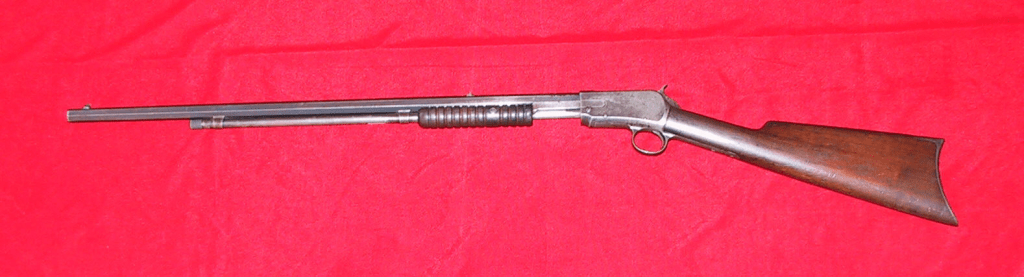
    I was just short of my twelfth birthday when John Clerget gave me a spilled box of 22 longs with the comment that if I could get them all back in the box right, he would let me have them. I didn’t understand why he used 22 longs instead of the cheaper, more powerful 22 long rifle cartridges – like Dad, he had a Winchester pump action 22, though his had a visible hammer.

    Much older, as I look back, I realize his rifle was a model 1890 – and that early pump action was designed to function exclusively with one cartridge – instead of 22 short, long, or long rifle, interchangeably, his second or third model 1890 worked only with 22 longs. Much later, I acquired a third model which fed only 22 Winchester Rimfire – a cartridge much harder to find than his 22 longs.

    Smith & Wesson brought out a revolver in 22 short back in 1857 – though it was just the 22 at the time. Their home page shows this revolver and explains that they produced 260,000 of them over the next 25 years.

    The 22 long came out in 1871, with a longer case (holding one more grain of black powder – a 25% increase in power). In 1887,a heavier bullet was added to the 22 long’s case to develop the 22 long rifle that we use today. By 1908, the Winchester Model 1906 was able to handle both 22 long and 22 long rifle interchangeably.

    There was a lot of development based on the humble 22 rimfire. At first, Winchester built the 22 short with a rifling twist rate of one turn in 20 inches. That was fine for the 30 grain bullet in the 22 short and long – but when 1887 brought the 22 long rifle cartridge, with it’s larger 40 grain bullet, it became necessary to speed up the twist. (I’ve heard that the ideal twist rate for the 22 short was one turn in 24 inches – and that it was a request from the Marine Corps during WWI that brought the change to 1:16 rifling for the 22 long rifle – list that as probably true, but I can’t back the statement up).

    Anyway, at age 12 I wound up with a box of 22 longs because my father’s friend had an older model rifle – and it took me a long time to understand that he chose 22 longs for the simple reason that John Moses Browning hadn’t worked out the problem of interchangeability when his rifle was built.

  • The Winter Outlook

    We’ve had a longer summer – and that longer growing season translates to dryer conditions. Despite that, we’ve made it through fire season without serious, project level fires in the neighborhood. It’s been good – possibly just due to luck, but we take the good when it arrives.

    La nina is kicking in this month – and that Peruvian pattern affects our local winters – in this case, cooler winter temperatures and more precipitation. NOAA’s projection maps for next winter are figuring it in:

    Looks like it’s time to put the snowplow back on the old pickup, and cut a little more firewood.

  • It Didn’t Start at Fort Sumter

    As I’ve been following posts about what’s happening, I keep encountering comments about a looming civil war. I think there are some crazy bastards out there that really want to see it happen. There may be as much disagreement politically as there was in 1860 – but it may be time to look at what occurred in the war between the states.

    It didn’t start in Charleston – the political violence started in Kansas. Sure, Robet E. Lee took John Brown out in Virginia – but the man began his career in Kansas. The fictional opening scenes from Eastwood’s “Josey Wales” provide a more realistic example than the courteous actual history at Charleston. The war between the states started in Kansas, and, as Eastwood showed, quickly spread to Missouri, then to most of the nation.

    By and large, the craziness didn’t make it to Montana. In 1863, our predecessors had better things to do – Union or Confederate, they had moved to Montana and left that war behind them. Definitely not cowards, the founding Montanans left a war they found unnecessary behind them and created a new state.

    Colorado almost did as well until a Methodist minister named Chivington took a group of volunteers to New Mexico, showed up at the wrong place, and for lack of anything worthwhile to do tackled a Confederate supply column, and became a hero for it. He got a star for his blunder, and his next action is known as the Sand Creek Massacre. A murderer in blue uniform that time. As the nation built up to the war between the states (and during that war) there was a similar emphasis on soft targets. We still remember William Quantrill and Bloody Bill Anderson as murderous Confederates. Our historians are a bit more inclined to remember John Brown for his anti-slavery stance than for the Pottawatomie Massacre – but crazies on both sides of the issue selected soft targets. We forget that George Hoyt, the lawyer who defended John Brown after the Harpers Ferry raid was also a captain in the Red Legs. On both sides, generally awful people who chose to kill those who disagreed with them, and sought out soft targets.

    As I write this, I’m thinking of the shooting at an LDS church and the North Carolina shooting, and the various school shootings – we’re seeing crazies attacking soft targets. And I read folks predicting a civil war – right against left, liberal against conservative. And somehow, it looks to me as if our nation’s whackos will claim the moral high ground as they endorse politics as their grounds for murder. I’ve seen news of one young man using his grandfather’s re-barreled Mauser to kill another – then the next whacko left cartridges that appeared to be 303 Brit (developed in 1888) when he shot at ICE and killed some poor mojado who ha been brought in for deportation.

    Montana’s early settlers chose to ignore the path of the crazies, leave the war between the states to those who either wanted it or couldn’t get out of it, and proceed to an area where, Unionist or Confederate, they could work together to build better lives, first in the mines, then in ranches. It’s still a good technique.

  • Truth In Accounting

    Truth in Accounting has issued its 2025 Financial State of the States report. Half the states didn’t have enough money to pay all of their bills. Montana, on the other hand, was 8th from the top – Fact #2 was “The outcome was a $3.5 billion dollar surplus, which breaks down to $8,600 per taxpayer.” One way of looking at this is that our legislators have been very responsible in fiscal matters. The other perspective is that they have overtaxed everyone in the state. I kind of suspect they’d prefer the first perspective – but taxing Montanans for 3.5 billion more than the government needs makes a credible case that they have overtaxed us. Definitely no austerity budgets in Helena.

    The 2025 Financial State of the States report is available at the link. North Dakota was #1 – with a surplus of $63,300 per taxpayer. South Dakota was #9, with a surplus of $8,200. On the other hand, New Jersey scored #50, in the hole for $44,500 per taxpayer – just for covering the 2025 expenses. California beat New Jersey, ranked 46th, in the hole for $21,800 for each taxpayer. Illinois ranked 48th, in the hole for $38,800 for each taxpayer. Maine ranked 25th – with a surplus of $100 per taxpayer.

    Click the link, and get the whole report. These excerpts are just to motivate you to dig deeper, and see how the states differ.