Trego's Mountain Ear

"Serving North Lincoln County"

Author: michaelmccurry

  • Misinformation

    It’s easy to spread misinformation. Unfortunately, we all have a tendency to believe data that supports our beliefs. On the morning of September 10, I wouldn’t have recognized Charlie Kirk if he had walked up and bit me on the leg. By the afternoon of that day, I heard the the President’s words confirming his death. The folding table, and the sign “Prove Me Wrong” were vaguely familiar – it turns out that I retired from the college campus scene about the time he was starting – so I looked at YouTube to see what he did.

    I watched him debate, or attempt to debate, a young man whose stance was that anyone who identified as a woman was a woman. Charlie Kirk’s stance was that it took two X chromosomes. He was using rationality against repetition – and, to me, it looked like he was on top of the debate. The guy who was arguing against him looked frustrated, angry and foolish.

    I tried rational discourse on Facebook years back. A classmate had posted that (based on her experience as an election official) there was no election fraud in Montana. It was too easy – all I needed was to show one 8conviction, and I had a dozen or more to choose from. Piece of cake – but my rational assessment wasn’t enough to overcome her beliefs. Confirmation bias has a lot of power.

    I read left-of-center publications as well as the right. If I limit my information sources to those I want to hear, confirmation bias will beat me. Years back, on Facebook, I cited data from Texas that showed illegal immigrants have higher rates of criminal activities than US residents in general. Texas was the only state collecting and publishing such data. I got a reply telling me my data source was bad because some right-wing pundit had used the same information. I would have preferred more sources – but as a social scientist, you use the best you can get. Unlike Charlie Kirk, I responded to the insult with an insult of my own. A long time ago, Chet Apeland told me, “Mike, you don’t want to get in an argument with an idiot – after the third exchange, nobody will know which is which.” Chet’s rule has been good advice. Whenever I have ignored it I’ve looked like a jerk.

    Some of the best information on a specific topic available deals with abortion. Every state collects, maintains, and publishes data on who gets abortions. It’s there. So when a lady from DC – a lawyer – told me that American Indians get abortions at the same rate as white women, I could check. They don’t. At least in South Dakota, American Indian women are less likely. What really shocked me was how much more likely South Dakota’s few black women were to get abortions (than whites). South Dakota is a state that is mostly white, then a lot of American Indians. Still, I was more shocked by the Attorney giving misinformation to the State Demographer. I’m still not sure if she was ignorant, or just believe that she was credible and I would accept her statement without checking.

    The data doesn’t affect the argument – one side argues for reproductive rights, the other argues against killing babies. It’s hard to debate when each side has it’s own topic. Makes confirmation bias even more powerful.

    Getting back to the murder of Charlie Kirk – when the photo of the assassin’s rifle showed up, I saw a comment: “That’s not a military rifle.” The rifle was a scoped 1898 Mauser with a black synthetic stock. The best guess I’ve seen is that over 100 million of these rifles were made between 1898 and the end of World War II. The 1898 Mauser might be the statistician’s primary example of a military rifle. I suspect I read an opinion from someone who first thinks of an AK-47 (also 100 million produced) or the AR-15 platform (over 30 million individually owned in 8the US). Confirmation bias leads to misinformation.

    I have a tendency to distrust all politicians – regardless of party. They live in a world of partisan bias – and, like the lawyer lady, want me to accept that view without checking. It’s easy to get misinformation – and there will always be unpleasant facts. I thought that “Trust but verify.” came from Ronald Reagan – it turns out that it’s a Russian proverb. It was a good idea in a country where the line went “there is no truth (pravda) in the news (isvestia) there is no news (investia) in truth (pravda). It’s probably just as good an idea here and now.
  • October, And No Frost

    When I moved to Trinidad, Colorado to begin teaching, I was surprised that the annual precipitation was about the same as it was in Trego. Trinidad was 6,000 feet elevation – downtown Trego is a little over 3,000. Trego is definitely timber – predominately Doug Fir, and in Trinidad you still have to go up the mountain to get to the timber.

    We moved to Trinidad along with the final episode of MASH – it took years for me to see that epic program – and we moved into a very arid climate. The record frosts (from Climate and Man) recorded for Fortine were May 29 and September 8. Annual precipitation was 17.43 inches. At Trinidad, the record frosts were May 2 and October 16. Annual precipitation was 16.2 inches. Trinidad showed 167 days of growing season, while Fortine showed only102 days of growing season.

    Back in the late seventies, one of the foresters I listened to spoke of ‘climax species’ – essentially the trees that will remain in a location until fire wipes them out, and a succession begins. So I knew that in Trego, with 17 inches of rain and 100 days between f8rosts, Doug Fur would remain. Now, fifty-odd years later, and with the experience of Trinidad’s arid, near desert environment, I’m looking at a longer growing season. I kind of prefer the term global warming to climate change. Can’t say for sure – when Climate and Man was published, they had less than 40 years record for Fortine and Trinidad. But one thing is sure – if you spread the same amount of precipitation over more growing days, it’s a good idea to look for plants that are more drought tolerant.

    I need to do more thinning – Dad like the forest unmanaged, and that was OK for his lifetime – but a longer growing season demands more space between trees, and probably a change in species – so when I can, I’m leaving Western Larch and Ponderosa Pine. They seem to be a bit more drought tolerant and fire resistant.

    The hayfield, despite being partially sub-irrigated, becomes drier with a longer growing season. On the other hand, when I was a kid, raising sweet corn was a challenge. No longer.

    The longer growing season may indicate a change in climate, or it may just be an anomaly. I don’t know – but I’m placing my bet on plants that are a bit more drought tolerant.

  • Reading an Actuary’s Substack

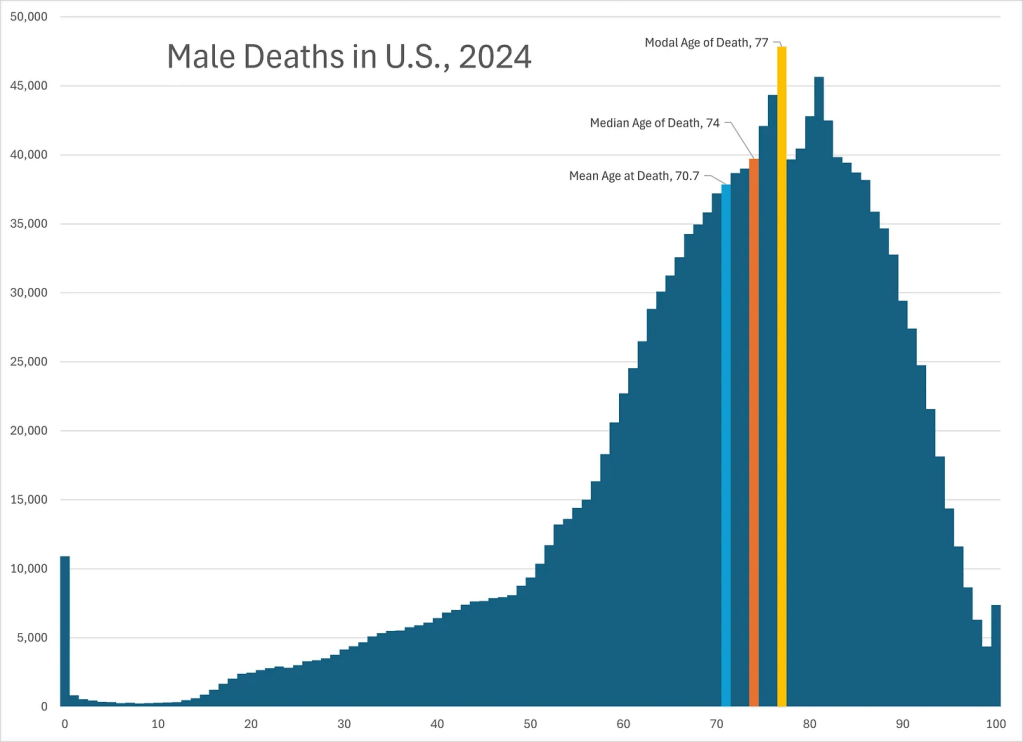
    I ‘ve been a free subscriber to Mary Pat Campbell’s substack for a while now. She’s an actuary – which is a bit more specialized than a demographer. A demographer has to know 3 things – births, migration and death. An actuary has just one topic – death. Still, actuaries are very good at their topic. This week, she got my attention with this graph:

    It’s quite a chart for a 75 year-old man to read – and note the columns she has emphasized – last year, for men, the mean age of death was 70.7, the median was 74, and the mode 77. As a brief explanation – the mean is the arithmetic average, the median is the middle value, and the mode is the most frequently occurring. Look at those numbers and think for a minute – for a guy who is 75, it isn’t surprising that it makes me feel infernally mortal. She’s still in her fifties, and female, so the chart isn’t nearly so personal for her. (She’s definitely worth reading and is at https://marypatcampbell.substack.com/p/rip-robert-redford-1936-2025-and?img=https%3A%2F%2Fsubstack-post-media.s3.amazonaws.com%2Fpublic%2Fimages%2F8c1e30b0-74f2-4108-a7a7-ed238182bd8a_3127x2268.png&open=false

    She does a nice job in showing how to use cohort life expectancy for planning pensions, annuities, etc. If you have any interest at all in actuarial tables and planning, log onto her site and subscribe.

  • Feeling Politically Normal

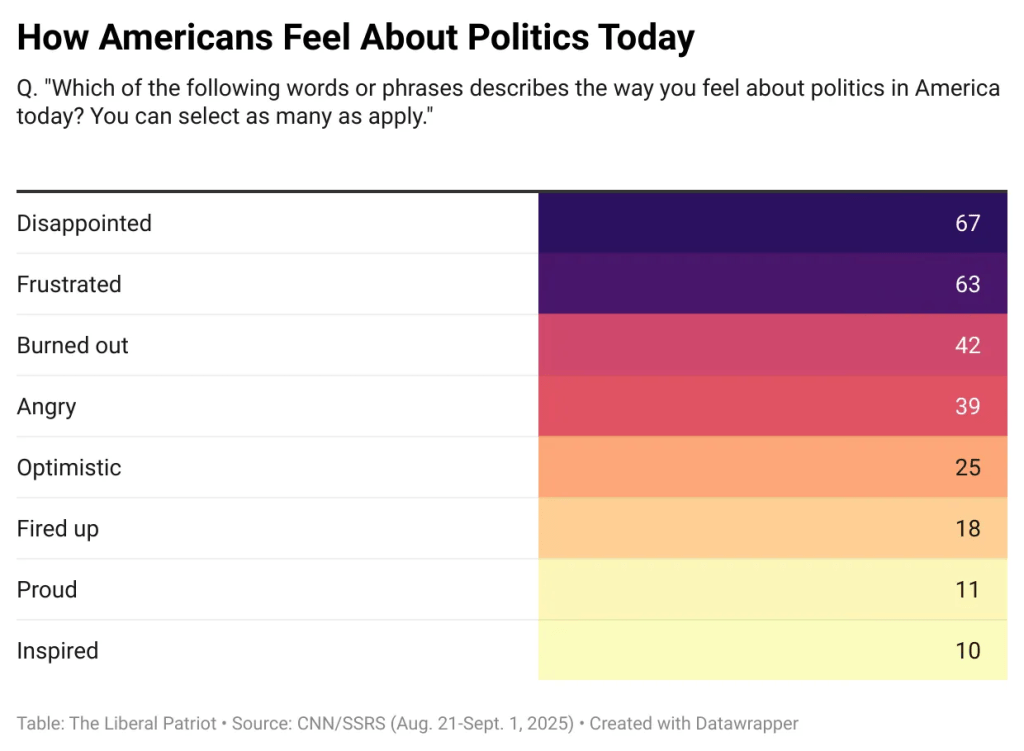
    I read a substack called “The Liberal Patriot.” It’s basically the writings of middle-of-the road Democrats – I can’t say that I fully agree with what is written there – but I’m within reach of some of the messages. This morning, in an article titled “The Independent Era Is Coming,” they included some polling results:

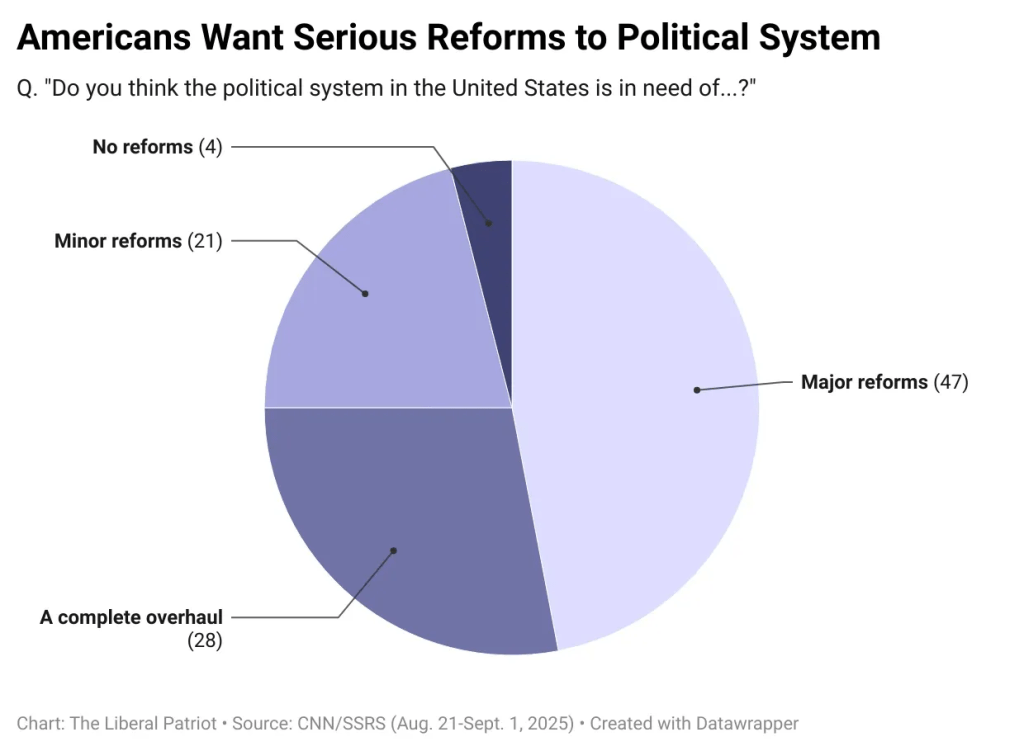
    I figure that translates to 2/3 of people agree with me – disappointed with government, and 5/8 are frustrated by government. The thing is, largely I’m disappointed by my elected officials and generally frustrated by the professional bureaucracy. That isn’t a winning percentage for either side. The article shows this pie chart:

    75% want major reforms or a complete overhaul of the system – and the one-time head of the FBI has been indicted by a Virginia Grand Jury. Comey is an example of the problem and the dissatisfaction with our political bureaucracy – with a Virginia jury of his peers he is likely to walk free with a hung jury, but that will only emphasize the feeling of a need to change the system.

    The article ends with : “Be yourself and not a partisan. If you’re economically populist and socially conservative and don’t see this represented in the two-party system, be yourself and support independent candidates who back a pro-worker, pro-family, pro-America agenda. Alternatively, if you really care about a specific economic or social issue and don’t feel that either Democrats or Republicans equally care about the issue, then be yourself and support those who do back the issue regardless of their party label. Some of these candidates may be Republican, some Democratic, and others may be independent. Make them work for your vote! Don’t be a partisan and blindly accept every position and argument on one side and reject those on the other. Don’t write off outsiders without a party label. The beauty of political independence is that you no longer must toe anyone’s line or feel any pressure to conform to a specific party platform or candidate. Embrace the liberation from partisan insanity!”

    It would please me if my readers went to the Liberal Patriot and read the articles. I don’t agree with all of them, but their substack does a nice job of showing that middle-of-the-road liberals exist – and they can still communicate with the rest of us. Give the Liberal Patriot a read.

  • Fixing The Jennie May

    A Montana ranchette needs about 30 horsepower of tractor. Now I have a soft spot for Massey Ferguson – and have a 59 hp model 40b – but Mrs. Ferguson doesn’t get through the trees well. Her job is to provide the weight and mobility for a small backhoe – and the loader does have enough strength to move some fairly large logs. Still, it’s time to pull her down and get a couple cylinders repacked. I can afford to sideline her because Jennie May is back on line.

    As I shopped used tractors – specifically in the 30 horsepower range – I kept looking at (in order of cost) John Deere, Kubota, and Chinese tractors. Jennie May is Chinese – technically a Jinma 284. Built in 2005, she showed 29 hours on the clock when I bought her – and a little ignorance is a dangerous thing. I didn’t know that on 50 hours, you’re supposed to retorque the head gasket. On 229 hours, I blew the head gasket. Fortunately I found a dealership with parts, and our friend Larry not only understands diesel engines, but has been teaching me how to repair them. Monday afternoon, Larry said it was time, I hit the starter, and Jennie Mae is back in business. We’ll be moving some more gravel to the east and west ends of the new storage building.

    So how should I describe the Jennie May? She looked like this one when she was new, but 20 years of being parked outside has the paint a bit faded.

    She has a 1.5 liter 3 cylinder diesel – and is about the same size as one of the old grey ford 9N tractors – but with four wheel drive, twelve speeds forward, and a live PTO. Fortunately, I can get parts from Keno tractors in Oregon, and there’s an owners group online with recommendations on how to keep a Jinma running.

    There are better tractors – but I have a small place and Jennie May does what we need.

    s

  • Seeing The Sights

    Aging eyes create challenges for a guy who carries a short gun. The old match pistols still have usable sights, but are heavy and long. The old 1911 sights became hard to see because of cataracts – and after cataract surgery still2 are hard to use because I am now far sighted. I can focus with the old sights if I wear reading glasses – but that kind of defeats the purpose.

    So I’ve gone over to three dot sights. They look something like these illustrations (taken from the NRA. The difference from my perspective is that the front sight is pretty well focused and the dots on the rear sight are a bit blurry.

    It’s not a problem. Forty years ago, I watched a man with a white cane, using a 1911, score well above me. Hoping I could learn something, I started a conversation, explaining that his score was higher than mine, and his white cane suggested I had better vision. His answer was simple: “Son, all I can see distinctly is the front sight. The rear sight is a blur. The target is a blur. You just have too many distractions. As you get older, you’ll get better at focusing on your front sight.” Well, I’m older. I can focus better on the front sight. And I did manage to put 8 rounds inside the 8 ring -despite being shaky. And yes, that’s at Bullseye’s 25 yards (though I was doing slow fire, where the match distance should be 50). It’s hard to take shooters seriously that shoot at 3, 7 and 15 yards.

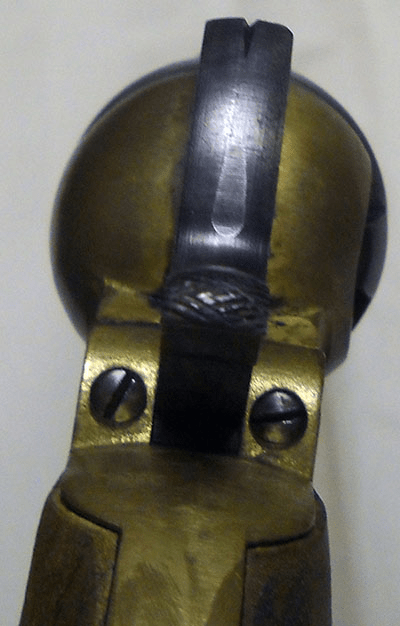
    Sights have improved over time – Hickock’s 1851 Navy Colts had a little notch in the hammer with a brass front sight – and it worked well for him.

    Sixty years later, John Moses Browning put slightly better sights on his model 1911. I could change to these more modern variants:

    Glocks have really nice sights – but I’m old fashioned. I want a hammer, not a striker. I prefer the Browning designs. So it’s either a new one, or a $45 expense to bring the 1911 technologically up to the 1990 sights.

    I’ll write on the newer optics when my vision further declines – I can still view the front sight clearly.