Trego's Mountain Ear

"Serving North Lincoln County"

Author: michaelmccurry

  • Studying Capitalism

    Karl Marx spent about six weeks writing the Communist Manifesto, and his entire life writing Das Kapital, but we know him as the originator of Communism rather than a long-term student of capitalism.   The possible relevance of Joseph Tainter – Niskanen Center interfaces some Marx-like observations of modern Capitalism (things that were not readily observable during Marx’ lifetime) with Tainter’s theory of Complexity:

    “capitalism is currently suffering from chronic, degenerative conditions – namely, faltering dynamism and inclusion combined with increasingly dysfunctional politics.”

    “After all, contemporary postindustrial capitalism features a mass elite of entrepreneurs, managers, and professionals. Comprising some 20 to 30 percent of the population, this is the largest elite, both in absolute numbers and in size relative to society as a whole, that any social order in human history has yet produced, and – making due allowance for all the problems that bedevil life at the top today – its members are flourishing at a level that would stagger the imagination of aristocracies past. Thus, capitalism as a system for producing mass flourishing is overextended: It works for the top quarter or so of society, but not so well for everybody else.” 

    Karl Marx died in 1883 – before capitalism managed to pull most people up from abject poverty.  He chronicled the problems associated with capitalism – yet years before his death wrote “If anything is certain, it is that I myself am not a Marxist.  Still now, 140 years after his death, the problem of Capitalism is that “capitalism as a system for producing mass flourishing is overextended.  It works for the top quarter . . . but not so well for everybody else.”  

    That phrase strikes me as today’s most legitimate criticism of capitalism.  It doesn’t lift everyone equally.

    I’ve worked and researched the most successful communist group in North America – the Hutterites.  Simply enough, their society functions for two reasons – first, the communal ownership they espouse has a strong religious component. The belief is that it is much easier to ascend to heaven from the communal society – which can be one heck of a motivator.  The second reason is that the folks who are born Hutterite but do not share the beliefs can easily move from the communal colony into the larger, mostly capitalistic society. I suspect that Karl Marx would have recanted his manifesto had he observed late twentieth century communism in all its forms.  

    So here’s the next quote from The possible relevance of Joseph Tainter – Niskanen Center

    “One fundamental reason for capitalism’s difficulties in promoting more widespread flourishing is the steadily diminishing nexus between economic growth and well-being. It’s not true that more money above a certain threshold has no effect on happiness: The most recent examination of this issue found that reported happiness, both in terms of positive affect and overall life satisfaction, continues to rise indefinitely. Importantly, though, happiness doesn’t increase in linear fashion as income rises; rather, it increases in linear fashion with every doubling of income.”

    And that brings us back to the chart that the Niskanen Center shows – demonstrating the decreasing returns to increasing complexity:

    Read the whole article.  I’ve seen the problems of communism on the small scale of the Hutterite Communes, the Soviet Union, and I owned a Yugo.  I don’t know how any economic system can make the lowest sixth flourish as well as any member of the top quarter.  Read the whole article,  The author does a lot better job at showing how Tainter’s theory applies to our own society than I can.   The possible relevance of Joseph Tainter – Niskanen Center

  • Complexity and Collapse

    The ending years of the 20th century saw three theorists developing hypotheses related to societal collapse of states.  George Cowgill (1988:263) saw internal economic reasons – societies that depend on taxation develop increasing numbers of people and organizations that are legally exempt from taxes . . . and increasing numbers of taxpayers find ways to avoid taxes illegally.  Bureaucracies – expensive bureaucracies – grow, with “increasing corruption, rigidity, incompetence, extravagance and inefficiency.”  Simultaneously, citizen expectations of state services increase.

    Jared Diamond looked at growing populations mandating agricultural intensification – and that intensification carries with it unanticipated consequences – soil erosion, problems with water management, deforestation, etc.

    Joseph Tainter looked at complexity – challenges in production are met with increasing complexity (1988:88-90) and listed 8 causes for the collapse of complex societies.

    1. Resource Depletion
    2. New Resources
    3. Catastrophes
    4. Insufficient response to circumstances
    5. Other complex societies
    6. Intruders
    7. Mismanagement
    8. Economics

    Economic factors and mismanagement kind of go together.  If we look at the bureaucracies that keep our nation state functioning, we find ( https://www.federalpay.org/employees

    2,807,126

    EMPLOYEES

    732

    AGENCIES

    $76,667.77

    AVERAGE SALARY

    $215.22B

    TOTAL SALARY

    Now if these numbers seem large, the Census provides us with numbers for state and local governments: 19,768,685 employees, with $89,265,296,554 in total salary.  Frankly, I don’t trust my data – it comes from two sources, and the proportions look a little strange.  But questionable data isn’t the problem – we’re talking over 22 million government employees to manage.  Tainter’s 7th cause of collapse is mismanagement.  

    The total number of jobs listed for the US in February 2022 was 150,399,000 – and a little bit of rounding tells us that about 2/15, or 13% of US jobs are for one form of government or another.  On one hand, 13% of the nation’s jobs are to make government work – which is a large expense.  On the other hand, there is a tremendous opportunity for Murphy to get into a system this large and complex and arrange for things to go wrong.

    Under the heading of Mismanagement, Tainter’s explanation is “The elite in a civilization may so abuse their power and direct so much of the surplus wealth and labor of their society to their own benefit that not enough is left for the maintenance of the economic and political system, leading to collapse.”

    If you’re politically on the left, you can readily see where the fat cat right wing elite can do this.  If you’re politically on the right, the stories of Joe Biden and son that are available support Tainter’s explanation.  If you’re somewhere in between, Tainter makes even better sense.

    Simply enough, the more moving parts there are in a system, the more opportunities Murphy has for things to go wrong.  The less competent management is, the more opportunity there is for systemic failure.  It kind of goes back to Malthusian demographics – for a bit over 225 years, our society has developed increasingly complex systems that made Thomas Malthus wrong.  The thing is, Malthus only has to be right once.

  • No Resident Pack Anymore

    When we first built the house by the pond, we moved in with a pair of coyotes for neighbors.  He was a beefy built coyote – deep chested, and occasionally reported as a small wolf.  He wasn’t – just happened to have a blockier, larger size body than the typical coyote.  It was only after Renata got the game cameras set up for a year or so that we realized his consort was missing her left eye – and their hunting patterns always included him on her blind side.

    Our old pair of coyotes are gone now – and they were good neighbors.  Don’t know if someone shot the old coyote, or if it was just old age and decrepitude that took the two from their home on the hill – but we no longer have local coyotes.  The pair  have been replaced by packs that come in from 3 directions – west, north and southeast.  The blessing of modern technology – trail cameras can provide a lot of information about where predators are coming from.

    We’ve had a feral cat population close by for years – living by the trailer court and north aways, and wandering from there to our field and to the school.  The trail cameras show that the three new packs are cat hunters.  Not a surprise – we lost one young house cat last year, but the trail camera leaves no doubt.  

    Before the feral cat population grew so large, the rodent population in the hayfield was fairly well controlled by resident weasels.  I suspect that the resident weasels were taken by the feral cats – for whatever reason, with the weasels gone, the vole population exploded.  The voles did enough damage to the fruit trees in the garden that I responded with bait stations to poison the voles.  

    I’m not real sure what the change in coyote population will bring – but 3 packs coming in to hunt cats is starting to make a big dent in the feral cat population.

  • Where We Came From

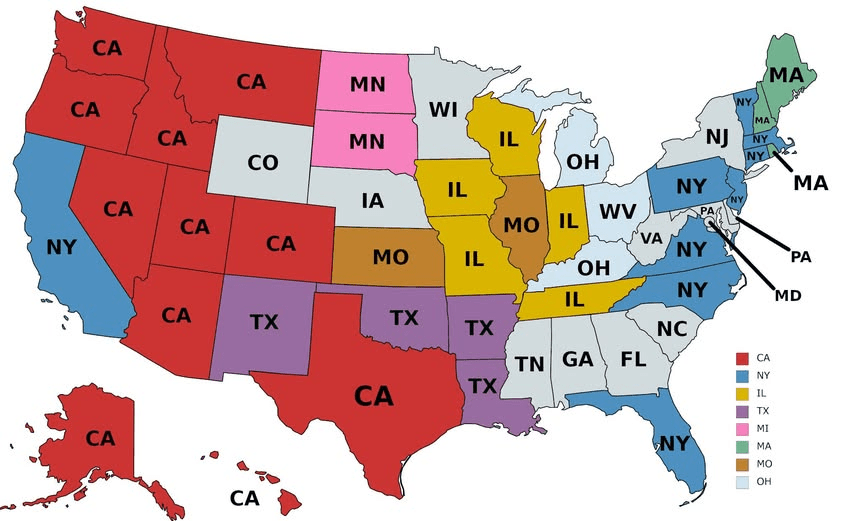
    I spotted a map that shows the state where folks who aren’t native-born came from – and across the west, most of us hail from California. Earlier today I was reading that the Californians who move to Texas are more conservative than the native Texans.

    I figure it’s the same here in Montana. Most of the recent immigrants from California – at least in my neighborhood – come from around Bakersfield. According to https://bestneighborhood.org/conservative-vs-liberal-map-bakersfield-ca/ “Bakersfield tends to be a political battleground based on voting results in recent elections. Compared to other nearby cities, Bakersfield has more republican voters. Compared to the nation as a whole, Bakersfield leans more republican.”

    That doesn’t mean I’m correct. It just supports my assertion that the folks who move into Trego from California are more conservative. I suspect I could check the origins of every place flying a Trump flag – but I’ve been listening. I’m fairly sure that our California immigrants aren’t bringing a whole lot of California values in their luggage.

  • A Right to Your Own Opinion But Not Your Own Facts

    I always credited this quote to Senator Daniel Patrick Moynihan. It turns out that the original was Bernard Baruch, “Every man has a right to his own opinion, but no man has a right to be wrong in his facts.”

    According to QuoteInvestigator.com “In 1983 U.S Senator Daniel Patrick Moynihan was a member of the National Commission on Social Security Reform. He employed the saying within an op-ed piece in the “Washington Post”:

    “There is a center in American politics. It can govern. The commission is just an example of what can be done. First, get your facts straight. Everyone is entitled to his own opinion, but not his own facts. Second, decide to live with the facts. Third, resolve to surmount them. Because, fourth, what is at stake is our capacity to govern.” So I have the original Moynihan quote – and it is a little different from the Baruch quotation.

    My father credited Moynihan with the destruction of the Black family – when I finally asked the right question – basically a why do you believe this- I realized he had never read the Moynihan report – the title is The Negro Family: The Case For National Action (published in 1965 and available at https://old.blackpast.org/african-american-history/moynihan-report-1965/

    Dad had confused the messenger with the message. Perhaps because Lyndon Johnson continued his ‘Great Society’ message and policy despite Moynihan’s recommendations, possibly because Johnson never bothered to read Moynihan’s report. Moynihan wrote the facts as he saw them in 1965 – and history has demonstrated that he was correct.

    I’m sure Moynihan never knew that Dad had the wrong opinion of his report and the wrong facts. I’m fairly sure that he knew President Johnson had a flawed opinion based on incorrect facts.

    A lot of our current political differences can be seen as people insisting on their own facts. When the definition of “woman” becomes something we don’t agree on, we have a communication problem. I have a tendency to accept Mussolini’s definition of fascism – others accept Joe Stalin’s. Those different ‘facts’ have been around for nearly a century – and the Soviet definition included all Capitalists.

    When the definitions change, people have their own facts. In the mid-eighties, when I taught at Trinidad, only one hospital – Mount San Rafael – and only one surgeon – Dr. Stanley Biber – was performing transexual surgery. Biber required a lot of counseling before performing the surgery – no one considered the surgery, available only in a rural Colorado hospital – to be normal. Now, with athletes and assassins arguing the meaning of the word “woman”, and with at least one Supreme Court Justice unclear on the definition, we have disagreements over facts.

    Are Palestinians facing genocide, or did they attack and murder/kidnap 1300 people a couple years back? It’s past time to quit changing definitions. We can’t afford to have people who are a couple bubbles off making their own facts.

  • The Decline of Representation

    The past three Presidents – Obama, Trump and Biden – have each wound up governing by executive order. True, Obama managed to squeak a healthcare bill through Congress – but even with that, Trump was complaining that executive orders were no way to run a country, that we needed real leadership. Now Trump is also choosing the Executive order route – and the branch of government contesting his executive orders is the judiciary.

    I’ve watched the challenges of representative government from a school board – and much of what got accomplished was because three out of five board members were in agreement on that particular issue. It took a long time, and a lot of effort, to get a pay matrix for teacher contracts approved. It took even longer to get a classified pay scale voted into existence. The addition of the pre-school that started this Fall was first brought up in 2020. I’ve been taught how hard it is to get a representative democracy working with only five elected trustees and no political affiliations. How much worse it must be with 435 representatives narrowly split between two parties.

    I think I’m seeing Trump make the same decision that Obama made – “if I can’t get Congressional authorization, I’ll do it based on my own authority.” Montana’s laws do not give a schoolboard chair that power – by law the board chair chairs the meeting, and the board has only a collective power, utterly lacking individual power for the chair. Still, the board chair does have the (unlegislated) power of asking advice from the board association’s attorneys and setting the meeting agenda.

    So nationally, we’re seeing folks who disagree with Trump taking his decisions to judges who disagree with Trump – when the reality is that our House of Representatives are locked in a pattern of behavior where they can’t do their job. The problem isn’t the President or the Judges – a representative democracy fails to work when most of the representatives come from the extremes. As I was looking for a way to finish, I noticed this meme:

    It’s not quite what I wish it was – but I’ve been called both a Trumpkin and a Libtard. I have the feeling that it’s more a question of where the caller sits on the spectrum than where I am. It would be nice to have more folks from the middle in Congress.