Trego's Mountain Ear

"Serving North Lincoln County"

Author: michaelmccurry

  • Second-hand Information

    Most of my information, my knowledge, is second hand. I know Venezuela exists because I have been there – but my knowledge of Viet Nam comes from other people, their spoken stories and written ones. The world is too big to have a preponderance of experience.

    I’m looking at the photographs and videos posted on the internet about the flooding in south Lincoln County. My first-hand information is from floods down Libby way in the 70’s and 80’s when I worked for the Soil Conservation Service. My second-hand information is from people taking pictures with cell phones and drones yesterday and today. It’s a lot more relevant than my first-hand information. The change in technology though – that is impressive. I recall driving down to Libby with my 35mm camera, and vividly recall calling Oly Euland at the state, to fund a flight to get photos of the flood before it receded, the weather turned cold again, and snow covered all the damage.

    My first-hand knowledge won’t do anyone any good. Although there may be a chuckle at the expense of a landowner on Callahan Creek, who saw my government truck as I was photographing the flood, came up to me, said something nice about the government doing well to get there so quickly, then cursed me when I responded to his question of “You have a check for me, right?” with “No.” It was interesting to meet a man who went so quickly from compliments to curses.

    For the folks who are looking at Lincoln County being declared an emergency – up a Trego, we’re a little damp, but fine. Down Libby way, they’re at about 2,100 feet above sea level. Troy is about 1900 feet. We’re at 3,100 feet. The general rule is that you lose 5.2 degrees Fahrenheit for every 1000 feet of elevation increase. (That’s second-hand information, too – someone better than I did the calculations) Troy (well, actually where the Kootenai leaves Montana for Idaho) is the lowest point in Montana. That low elevation makes Libby and Troy very susceptible to flooding during winter thaws. On the other hand, there’s a big advantage in having Libby Dam, where the Corps of Engineers can crank the flow down and minimize the Kootenai’s impact on the flooding.


  • The Broken Radio

    It was a day that wound up highly scheduled – which is unusual for a retired guy. Renata had a dental appointment at 9:15, mine was at 10, and then we wound up with babysitting duties for the youngest grandson. Despite hanging out in the dentist’s reception room for a couple of hours, he was close to being the perfect baby – until it was time to get into the carseat and go home. Then it became howling time.

    I grabbed the infant and carseat and headed out to load him up. He didn’t quiet – so I turned on the radio. No channel, just extra loud static. I tried all the buttons. Just extra loud static – so I stuck in Kris Kristofferson. I did get rid of the static, but it was still at maximum volume. Well, I’m hard of hearing, Renata blew an eardrum with this last cold – so we drove home, sounding like 1970, as Kris sang at full volume about the Silver Tongued Devil, and Don’t Tell Me How the Story Ends, until we got home and hit the big switch.

    Nathaniel hadn’t tried to compete with Kris and the broken radio. He had gone to sleep, possibly recognizing that an infant’s lungs were overmatched. Or maybe he just likes Kristofferson.

    When the rain slacked off from the veritable downpour, I went outside, popped the hood, and pulled the fuse. I can again drive in relative silence. The only problem is that, without the radio, I don’t have a clock in the car. I think it’s going to be worth it.

  • Weather Changes – And Climate Does Too

    I’m looking at the ten day forecast – basically rain and above freezing. The precipitation side matches the NOAA long-term outlook, while the temperatures do not. Still, the national outlook suggests that the lines on NOAA’s map just wound up a few miles off. Weather forecasting is a science where errors are not uncommon – and climate is not constant. If it were, there would be glaciers north of Eureka covering the drumlins.

    One of the consistencies is the adiabatic lapse rate – the decrease in temperature as a chunk of moist air rises. It’s not a perfect way of modifying a weather prediction for Eureka – but if I guesstimate that, because of the 3,100 feet elevation at Trego (opposed to 2,700 feet at Eureka) the temperatures will be 2 degrees (Fahrenheit) cooler than Eureka, it winds up fairly close. Right now, with lows around the freezing mark, I figure most of the snow will be gone before it gets cold again – and the pond will be full before it freezes a second time. The predictions call for daytime thaws until the solstice – and after the solstice, the days begin to get longer.

    Ten thousand years ago the area went into an interglacial – a time when the glaciers went away. Technically, so long as we have polar (and Greenland) ice sheets, we’re in an ice age. Still, at the least, more melting can lead to a longer interglacial. This interglacial was the time when most (an argument could be made for all) of our food crops were developed. Warming may give us a longer growing season – but if our local precipitation stays the same, water, not growing degrees becomes the limiting factor.

    But the management choices are the same – my hay needs to include water tolerant, drought tolerant, and salt tolerant species. As I can get out with the chainsaw, the timber needs to be thinned for better growth, for a return to grazing and for fire control. Climate, like weather, changes.

  • Can’t Be Unseen

    Gollum

  • A Tea Party For The Left?

    I was reading the Liberal Patriot. The first sentence was “Democrats must first come to terms with Americans’ strong distrust of government.” The third paragraph went a bit farther: ” Progressives by definition are supposed to be invested in making government work and proving the value of a more active state. For insurgents who have made it into office, the allure of attacking the system on the campaign trail has typically given way to the exigencies of preventing government from appearing more dysfunctional than it already seems—even when Republicans hold most of the cards.”

    I was reminded of a grad student who was explaining that libertarians should never be elected because their basic belief is that government doesn’t work. If I were listening to his comments today, I’d be pointing out how well government worked in Minnesota, with a bunch of fraudsters ripping off billions. Or the Ukrainian bribes going to Hunter Biden. In my 76 years, I’ve seen many occasions where government was used for private financial enhancement.

    The Liberal Patriot continues with this: “Democrats, primed to defend government from the right’s wrecking crew, still fail to see that a proper Tea Party of the left would indeed overhaul government bureaucracies, eliminate fraud and waste, and tame veto-wielding and rent-seeking interests in equal measure, precisely in order to make the state a nimble and credible agent of widening opportunity and national redevelopment.”

    It’s enjoyable to read a dem author who is also in the middle of the road. Still, I don’t expect the Liberal Patriot to lead the Democrats with this sort of observations.

  • Does Dropping in Social Class Increase Socialism’s Appeal?

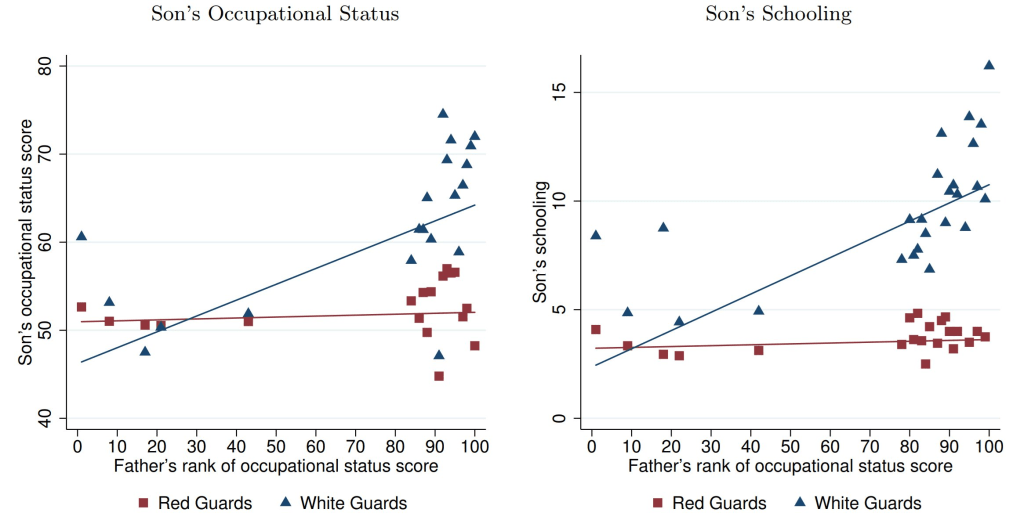
    I saw these quotes and graphs on Instapundit: “Those born in a high social class and who have inherent low ability, and thus fall a social class, are the most resentful and vocal. They also are the least impactful people on long term trends, yet are deceptive in their overcrowding of the present zeitgeist.” Cremieux had posted these graphs taken from Finnish social scientists, commenting: “There’s a lot of truth to this. Wherever we have data, we see this repeated: Communists tend to be downwardly mobile. They are, always and everywhere, disproportionately likely to be their generation’s losers. Consider this Finnish data on the Red and White Guards:”

    It just may make sense – the problem socialists have with Americans is that we all believe we’re middle class with a chance to be higher. I don’t know about folks with unemployable college degrees (and my degrees are in the much mocked field of sociology). I do like the Finn’s study of the Reds and Whites at the time of the Russian revolution.