Trego's Mountain Ear

"Serving North Lincoln County"

Category: A Science for Everyone

  • April’s Eclipse will disrupt Solar Power- Vahe Peroomian

    April’s eclipse will mean interruptions in solar power generation, which could strain electrical grids
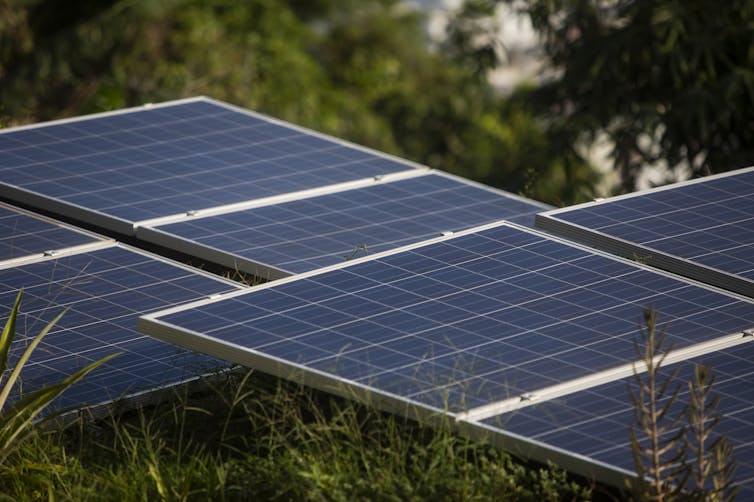
    Solar panels in Brazil. AP Photo/Bruna Prado

    Vahe Peroomian, USC Dornsife College of Letters, Arts and Sciences

    During the most recent total solar eclipse visible in the U.S., on Aug. 21, 2017, the skies darkened as the Moon crossed in front of the Sun. It blocked out all sunlight – except for that from a golden ring visible around the Moon’s shape, called the corona. Not surprisingly, solar power generation across North America plummeted for several hours, from the first moment the Moon began to obscure the Sun to when the Sun’s disk was clear again.

    On April 8, 2024, another total solar eclipse will track across the U.S., causing perhaps an even greater loss of solar power generation. Although this will be the second total solar eclipse visible in the U.S. in under seven years, these events are a rare occurrence. Nevertheless, they present a unique challenge to power grid operators.

    I am a space scientist with a passion for teaching physics and astronomy. Though I have seen many partial eclipses of the Sun, I have yet to witness a total solar eclipse. My road trip to Bryce Canyon National Park in Utah in October 2023 to see the “ring of fire” annular solar eclipse was unforgettable, and April 8 will surely find me handing out eclipse glasses once again.

    When the Moon’s shadow blocks the Sun

    During a solar eclipse, the Moon partially or completely blocks the view of the Sun. Since the Moon is nearly 400 times smaller than the Sun and nearly 400 times closer, the Moon’s shadow, visible from Earth, tapers to a width of 70 to 100 miles (112 to 161 kilometers).

    Within this region, called the path of totality, observers see a total solar eclipse. Observers close to but outside this path witness a partial eclipse of the Sun, where the Moon covers a fraction of the Sun’s disk.

    During the April 8, 2024, total solar eclipse, the path of totality in the continental U.S. will extend from Texas in the south to Maine in the northeast. Elsewhere in the U.S., Miami will see a partial eclipse in which a maximum of 46% of the Sun’s disk is obscured. In Seattle, far from the path of totality, the Moon will cover only a maximum of 20% of the Sun. In southern Texas, where the path of totality first crosses into the U.S., the eclipse will last just under three hours, with totality a mere 4 minutes and 27 seconds.

    Increasing reliance on solar power

    The worldwide trend toward renewable energy has seen a significant increase in solar, or photovoltaic, power generation in the last decade. Solar power generation capacity is set to double worldwide between 2022 and 2028, and the U.S. now has the capacity to generate three times more solar energy than at the time of the 2017 total solar eclipse.

    The most obvious obstacle to solar power generation is cloud cover. On a cloudy day, the energy produced by solar panels drops to 10% to 25% of its output on a sunny day.

    The North American power transmission grid is divided into six major regions and more than 150 local and regional subgrids. Electrical system operators in each local grid continuously balance the amount of electricity production with the “load,” or the demand for electricity by consumers.

    System operators can tap into energy from various power generation mechanisms like solar, wind, hydroelectric, natural gas and coal. Local grids can also import and export electricity to and from their grid as needed.

    System operators have accurate models for the amount of solar power generated across the U.S. on a daily basis, and these models account for the parts of the continental U.S. that may have cloudy skies. By pairing solar power generation with battery storage, they can access electricity from solar even when the Sun isn’t shining – on cloudy days or at night.

    To plan for an eclipse, electrical system operators need to figure out how much the energy production will drop and how much power people will draw from the reserves. On the day of the 2017 total solar eclipse, for example, solar power generation in the U.S. dropped 25% below average.

    Because solar power production falls quickly during the eclipse’s peak, grid operators may need to tap into reserves at a rate that may strain the electrical transmission lines. To try to keep things running smoothly, grid operators will rely on local reserves and minimize power transfer between grids during the event. This should lessen the burden on transmission lines in local grids and prevent temporary blackouts.
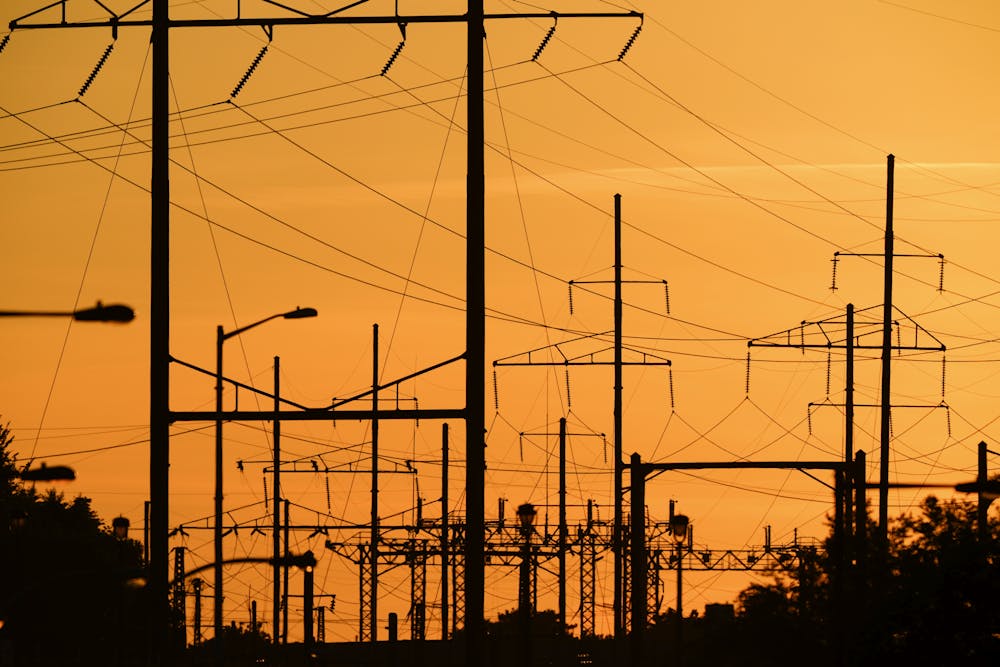
    Electrical towers and power lines shown against a sunset.
    Solar eclipses can stress the power grid. AP Photo/Matt Rourke

    Renewable energy during eclipses

    Solar isn’t the only type of renewable energy generation that goes down during an eclipse. Since it’s not as sunny, temperatures along the path of the eclipse fall by as much as 10 degrees Fahrenheit (5.5 degrees Celsius). Lower temperatures lead to slower wind speeds and less wind power generation.

    During the August 2017 eclipse, the loss of renewable power generation added up to nearly 6 gigawatts. That’s equivalent to the energy usage of 600 million LED lightbulbs or 4.5 million homes.

    Grid operators compensated by planning ahead and increasing power generation at natural gas and coal-powered plants, which don’t depend on sunlight.

    Over the duration of the eclipse, this increase in nonrenewable energy use led to approximately 10 million pounds of extra carbon dioxide emissions. That’s about the annual carbon dioxide emissions of 1,000 cars.

    On April 8, eyes across the U.S. will turn upward to catch a glimpse of the eclipsed Sun.

    Thanks to the vigilance of electric grid operators, the lights should stay on, and observers won’t have to worry about anything but the stunning show in the sky.

    Vahe Peroomian, Professor of Physics and Astronomy, USC Dornsife College of Letters, Arts and Sciences

    This article is republished from The Conversation under a Creative Commons license. Read the original article.

  • What are Artificial Sweeteners, actually?

    What are Artificial Sweeteners, actually?

    The short definition would be a chemical other than glucose (sugar) that our taste buds interpret as “sweet”. These are the substances typically behind”diet” and “zero calorie” foods.

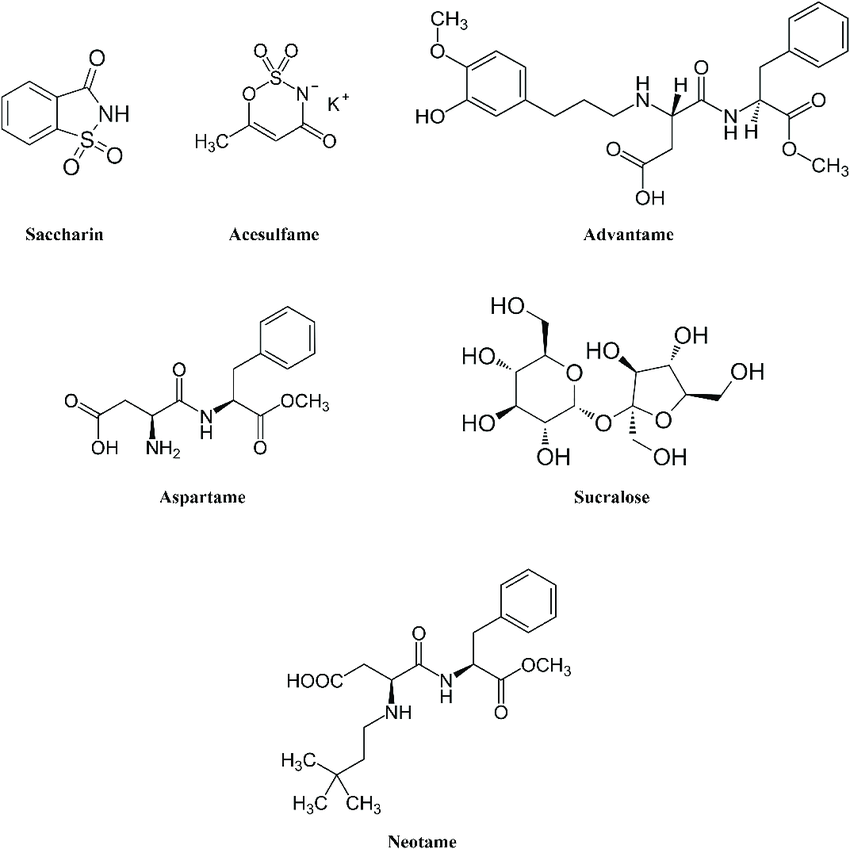
    What are they? In the US, we’re likely to find those approved by the FDA:

    • Aspartame
    • Acesulfame potassium (Ace-K)
    • Sucralose
    • Neotame
    • Advantame
    • Saccharin

    How do they work? (Or, to phrase it differently, how do they fool our tongues?)

    To understand how artificial sweeteners work, we have to first consider how sugar (glucose) works. We have five basic tastes or, perhaps more accurately, five types of signals our tongue sends to our brain about the food we’re eating. Sugar is sweet because of how it bonds to our taste receptors.

    Glucose is a popular molecule. The formula might be familiar from studies of photosynthesis or cellular respiration. It has 6 Carbons, 12 Hydrogen, and 6 Oxygen. It chemistry, arrangement is as important as formula. Flip a bond and glucose changes from a form we can digest into one we cannot.

    It makes a degree of sense, then, that artificial sweeteners share some structural similarities with glucose. They are not equivalent to glucose in sweetness, however. Relative sweetness appears to be related to the ability to hydrogen bond with the taste receptors. Aspartame is probably at least a hundred times sweeter than glucose, and Saccharine is sweeter still.

    Alsunni, Ahmed. (2020). Effects of Artificial Sweetener Consumption on Glucose Homeostasis and Its Association with Type 2 Diabetes and Obesity. International Journal of General Medicine. Volume 13. 775-785. 10.2147/IJGM.S274760.

    It’s of note that while this type of chemical drawing is generally easier to read, it often neglects to include some of the hydrogen in the structure (those familiar with the format are expected to know, from the structure, where they go). To someone familiar with the illustration style, it’s clear that these molecules all have areas with plenty of hydrogen.

    For the most part, these are substances that our bodies are not able to break down for energy; Aspartame is an exception, and is not “zero calorie” but is generally used in smaller quantities.

    One of the many interesting characteristics about artificial sweeteners, is that while they fool our taste buds, they do not fool our gut. Some studies with rats showed that even without taste buds, they were able to distinguish between sugar and saccharine (and preferred the real thing). Taste is not merely an artifact of the taste buds- but more on that system another time.

  • On polarized lenses.

    I recently got a pair of polarized prescription glasses, and have been amazed by how much better I am able to see the world, particularly when driving in the morning and evening, confronted by people’s bright headlights.

    While they do make my world noticeably dimmer, they bring out many small details, and seem to make colors more intense – I find myself able to discern grass stalks and foliage from much further ranges than I used to be able to. I suspect it’ll help with spotting wildlife as well.

    It’s important to realize that not all glasses claiming to be polarized are – many cheap lenses claim to be polarized, while merely being tinted. If a lens is truly polarized, it will block out a portion of polarized light, meaning light that vibrates more in a certain direction. What portion of light is blocked out depends on the lenses’ orientation.

    The lenses on most glasses are polarized to filter out horizontally reflected light, i.e. from puddles on roads, or from bodies of water, plastic, or a well-maintained car. Meanwhile, light reflected from bare metal generally won’t change its polarization. Here’s a link explaining the physics, and explaining what makes light polarized or unpolarized.

    If you’d like to check if sunglasses that claim to be polarized are genuine, you can take two pairs of them, place them so their lenses overlap, and rotate them until they are perpendicular to each other. This should noticeably darken the view through the lenses, as you are filtering out most of the incoming light.

    Alternatively most laptop screens are linearly polarized, so rotating a pair of polarized lenses in front of one should have a clearly bright orientation, where nearly all light emitted from the screen passes through the lenses successfully, and a clearly dark orientation (about perpendicular to the bright orientation) which blocks out nearly all the the light emitted from the screen.

    The polarized lenses, aligned to allow all light emitted by the polarized computer monitor to pass through.
    Nearly aligned to filter out all incoming polarized light,
    but not quite, so some light still passes through the lenses.
    Perfectly aligned, and now all the polarized light emitted from the screen is blocked by the lenses.

    As a side effect of filtering out horizontally reflected light, my new lenses should help block out reflections from bodies of water, meaning I should be able to see fish moving beneath the surface of the water. Here’s a video showing the effect of looking through polarized lenses at water. Looking forward to getting out there, and seeing how efficient that is.

  • Reilly’s Law of Retail Gravitation

    We’re in a good location to observe Reilly’s law – Libby attracts very little commerce from North County, and we’ve had a great example of how a political decision that minimizes travel at Roosville changes the retail industry. 

    Reilly’s law best applies to the midwest plains – an area where mountains and rivers have minimal effect.  On the other hand, where 37 is the route to Libby, and 93 the route to Whitefish and Kalispell, the limits created by mountains and rivers kind of cancel out.   

    From the web-site article: “Reilly realized that the larger a city, the larger a trade area it would have and thus it would draw from a larger hinterland around the city. Two cities of equal size have a trade area boundary midway between the two cities. When cities are of unequal size, the boundary lies closer to the smaller city, giving the larger city a larger trade area.

    Reilly called the boundary between two trade areas the breaking point (BP). On that line, exactly half the population shops at either of the two cities.

    The formula is used between two cities to find the BP between the two. The distance between the two cities is divided by one plus the result of dividing the population of city B by the population of city A. The resulting BP is the distance from city A to the 50% boundary of the trade area.

    One can determine the complete trade area of a city by determining the BP between multiple cities or centers.

    Of course, Reilly’s law presumes that the cities are on a flat plain without any rivers, freeways, political boundaries, consumer preferences, or mountains to modify an individual’s progress toward a city.”

    The populations can be accessed readily – the census count for Eureka is 1,380. The Census lists Libby at 2,775, Whitefish at 7,751 and Kalispell at 24,558.  With Libby and Kalispell essentially equal distance from Eureka, the retail gravitation of Kalispell greatly overpowers Libby – even if we ignore the population that is outside the city limits (and north-county has a higher percentage outside town limits).  In terms of county solidarity, Libby just doesn’t attract north-county commerce.

  • Energy’s Unyielding Numbers

    I’m a positivist – which basically says my science is confined to numbers.  Since I’m also a stats guy, it means my numbers aren’t always precise – the world is usually plus or minus.  That’s OK.  Then there is the problem of units of measurement.  They need to be consistent.

    So here’s a local set of numbers – Eureka is about 50 miles of deadhead run from highway 2.   A gallon of gas provides enough energy to move a ton of material about 50 miles by truck, or about 200 miles by rail.  Folks fortunate enough to use barges and water can move that same ton about 500 miles – but Koocanusa just isn’t set up for commercial traffic.  A century ago Fortine Creek was commercial navigation – logs moved downstream to the mill in Eureka – but we don’t have commercial waterways like the Great Lakes, the Mississippi, Ohio, lower Missouri, etc.

    Basically the economics of energy mean that our retail prices have to be higher than Kalispell.  As fuel prices increase, that 50 miles of deadhead run costs twice – once to get the munchies to the grocery store in Eureka, and once to get the empty truck back.  That same economics of energy isolates us further from the county seat in Libby – 37 is a deadhead route either way, while Libby and Troy are on Highway 2.

    At Trego, I’m 50 miles from Walmart.  Eureka is 30% further.  Stryker is 10% closer in terms of energy.  The equations don’t change.  They affect our shopping patterns.  They affect our ability to market local products.  This chart  shows the energy equivalents in terms of gallons of gas:

    Gasoline Gallon Equivalents

    Fuel TypeUnit of MeasureBTUs/UnitGallon Equivalent
    Gasoline (regular)gallon114,1001.00 gallon
    Diesel #2gallon129,5000.88 gallons
    Biodiesel (B100)gallon118,3000.96 gallons
    Biodiesel (B20)gallon127,2500.90 gallons
    Compressed Natural Gas (CNG)cubic foot900126.67 cu. ft.
    Liquid Natural Gas (LNG)gallon75,0001.52 gallons
    Propane (LPG)gallon84,3001.35 gallons
    Ethanol (E100)gallon76,1001.50 gallons
    Ethanol (E85)gallon81,8001.39 gallons
    Methanol (M100)gallon56,8002.01 gallons
    Methanol (M85)gallon65,4001.74 gallons
    Electricitykilowatt hour (Kwh)3,40033.56 Kwhs

    I’d make a wild guess that it takes somewhere around 100 gallons of gasoline equivalent to run a logging operation for a day.  The cost of fuel for a truck was a management decision when that log truck could run to American Timber (Olney), Ksanka (Fortine) or Owens & Hurst (Eureka).  With fewer mills, more distant, energy costs reduce the value of our main product.  Increased energy costs effectively reduce the value of labor as they increase the cost of living.

    Electric vehicles for transportation?  We’ll know when the cost of fuel has begun to match the cost of electric vehicles when we see Lincoln Electric linemen driving electric trucks.  As long as our electric co-op finds it cost-effective to use gasoline and diesel, they operate as an indicator – heck, they buy fossil fuels at retail or close to it, and buy electricity wholesale.  The numbers may not be precise when I type at my kitchen table – but they are good enough for the calculations I need.

    The cost of housing increased dramatically with inmigration – unlike our boomtown days with the highway and railroad relocation and the tunnel, private investment isn’t moving in to supply more housing quickly.  I see what may be the beginning of a trend – long-time residents selling and moving away.  I’ve looked at what happens when an area moves into the recreation dependent and retirement destination classifications.  The first noticeable step is long-time locals moving into jobs that serve the new landowners in new houses – the folks who are replacing them.

  • Personal Carbon Disposal

    Personal Carbon Disposal

    I noticed this meme and it brought me to the topic of personal organic carbon – how much impact does each of us have on atmospheric CO2 enrichment as we leave our bodies behind.

    Fortunately, I can figure out roughly how much carbon I am – the atomic mass of carbon is a little over 12, oxygen a little under 16, nitrogen a little over 14 and calcium a touch over 40.  Since that’s the lion’s share of amino acids, a little research can give me the percentage carbon in my body.  Another alternative is to google it and learn that about 18% of my body is carbon. 

    That means that at 220 pounds, the planet will regain about 40 pounds of carbon from my lifeless carcass one day.  I can handle that – but it isn’t my decision.  My thoughts go with a shallow burial in a shroud, to become carbon that is sequestered in the soil three or four feet down.  Depending on the energy required to dig the small ditch and fill it back in, this may be the most environmentally friendly way of dealing with the carbon that is no longer mine.

    An August 31, 2021 Huffington Post article explains that “cremating a single corpse usually takes between two and three hours and releases almost 600 pounds of carbon dioxide.”  Making the assumption that, at 220 pounds I’m at the top end of normal, let’s use that 600 pound number.  Carbon is 12, oxygen 16, so carbon dioxide is 44.  12/44 is .2727, so multiplying that with 600 puts about 164 pounds of carbon into the atmosphere.

    It does make one wonder about the level of environmental responsibility in the Service poem “The cremation of Sam McGee.”  There’s something that just seems wrong about adding 160 pounds of carbon – 600 pounds of greenhouse gas – to the atmosphere when we could add 40 pounds of carbon to the soil.

    Laura van der Pol explains “Agriculture covers more than half of Earth’s terrestrial surface and contributes roughly one-third of global greenhouse gas emissions. Paying farmers to restore carbon-depleted soils offers a tantalizing opportunity for a natural climate solution that could help nations to meet their commitments under the international Paris climate agreement to stabilize global warming below 2 degrees Celsius.

    An international initiative called “4 per 1000,” launched at the 2015 Paris climate conference, showed that increasing soil carbon worldwide by just 0.4% yearly could offset that year’s new growth in carbon dioxide emissions from fossil fuel emissions.”

    Gasoline is about 5 ½  pounds of carbon per gallon – so each gallon produces about 20 pounds of CO2 – so, while my cremated corpse would be equivalent to 30 gallons of gas in the atmosphere, sequestering that carbon in the soil would be roughly 4 gallons of unburned gasoline.