Trego's Mountain Ear

"Serving North Lincoln County"

Category: Meteorology

  • I Could Visualize the Adiabatic Lapse Rate

    Fall ended, and my winter started in December.  It may be due to a warming global temperature – but in the seventies, when much of my life was dedicated to snow surveys, I would have been explaining it by la nina.  Add the tilde to the second n – the Spanish word for little girl, the situation of the coast of Peru that increases precipitation here in the northwest.

    I’m not one to complain about rain – one of the predictable portions of our climate is that early Summer has rain, and we tend to harvest alfalfa later than the optimal 10% bloom because of rain.  After July 4, we’re moving into the dry times that make drying hay easier – even if its a bit late.  You develop an appreciation for rain when your climate gives you long, hot dry spells.

    This Fall, I could watch Mount Marston and Stahl Peak as the snow would come and go – I have a good view of their western slopes, and my thermometer lets me watch the difference in temperature.  I live at about 3,000 feet elevation.  The top of those two mountains is about 6,000 feet.  It’s one of the great things of living here – mountains are great, and altitude kind of sucks.  Nothing personal, but I like 3,000 foot valleys and 6,000 foot mountains a lot more than 6,000 foot valleys and 10,000 foot mountains.  My lungs fit better.

    Back to the topic – the adiabatic lapse rate.  As you go up, atmospheric pressure goes down.  It is kind of obvious – as you climb the mountain, there is less atmosphere above you.  Less atmospheric pressure means that there are fewer particles of atmosphere – nitrogen and oxygen – in any particular unit of volumetric measurement you care to use.  Colloquially, the air is thinner.

    It kind of makes sense – with more space between the molecules, molecules hit each other less frequently.  Fewer molecular collisions correlate with a drop in temperature.  (Physicists might invoke causation here – my training really doesn’t let me offer an explanation, but I can point out a correlation.)

    So we need two tools to develop an understanding of the adiabatic lapse rate – the thermometer and the barometer.  Evangelina Torricelli invented the barometer in 1643.  Fahrenheit invented the alcohol thermometer in 1709, and a more useful mercury thermometer in 1714.  Paul Kollsman modified the idea of the barometer and developed a usable altimeter in 1928.

    The adiabatic lapse rate is defined as the rate at which the temperature of an air parcel changes in response to the compression or expansion associated with elevation change, assuming no heat exchange occurs between the air and its surroundings.  Aviation, and icing wings gave an impetus to quantifying this rate of temperature change – and the need for weather forecasts provided even more.  The number is 5.2 degrees Fahrenheit for every 1000 vertical feet, or 5 degrees Celsius per 1000 meters.  (in the real world it can vary from 4 to 9 depending on humidity, etc)

    So this Fall, with its snows and thaws, left me with elevation contours I could watch on the mountainsides – something that the deep snows of winter do not readily allow in the Spring as things warm up.  Since nobody came along and asked “What’s the temperature half-way up Marston?” it has been a private observation – but it has been fun to watch.
  • Blessed Rain

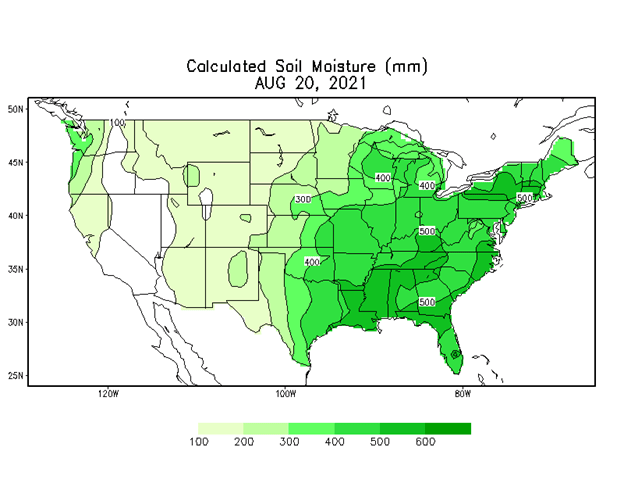
    It isn’t perfect, but it is improving.  My alfalfa seedlings are recovering from the long dry spell – on the other hand the deer are discovering them and trying to graze them down.  NOAA shows this map for soil moisture:

    This next map shows precipitation during August – again, it isn’t perfect, but coming out of a drought it shows us on the fringe of recovery – far ahead of southeast Washington down through most of Oregon and California.

    It may be too early to say that we dodged the bullet for another month or so – but at least the recent precipitation has moved us to a place where we can dodge. At least the long-term predictions are pretty much back to normal probabilities of precipitation:

  • Lightning Strikes and Power Outages

    Can lightning cause power outages?

    As it turns out, lightning doesn’t even have to strike a power pole or knock over a tree to cause a power outage. The build up of charge nearby can actually cause power surges -no contact necessary.

    Additionally, lightning gives off electromagnetic radiation. The phenomenon itself is called “sferic“, and it means you might notice static on the AM radio frequencies around the time of a strike.

    That said, outages are more likely to be due to tree branches hitting power-lines than an actual lightening strike; Power-lines are often in the position of being the most attractive thing around for a lightening strike, and that is considered in their design.

    What brought all this to mind?

    It was a dark and stormy night. Well, it was a bit after midnight on what had just become Saturday morning. Heavy Rain. A flash. A house-shaking kaboom. The power suddenly out. It seems to have been the start of an outage on the section of power-line that goes up along Griffin Road. Lincoln Electric had everything back up and running later on Saturday.

    Speaking of outages, though- there’s a planned one this week (11 PM Wednesday ’til 5AM Thursday) for everyone served by Lincoln Electric. Another overnight maintenance outage, courtesy of Bonneville Power Administration, since they need to replace structures damaged by gunshots (They’d love to have more information about that- call the BPA Hotline if you have any).

  • What Last Week’s Rains Did for Us

    These maps, taken from NOAA’s website show what the early August rains did to change the moisture stored in our soil.  For us, the rains lifted the pond by almost an inch and a half.  They didn’t add enough soil moisture to fill the cracks in the vertisols, or create any puddles – but we have hopes that the slight increase in soil moisture will help at least some of the little alfalfa plants survive. At any rate, the NOAA website demonstrates how much more information on weather is available now compared to a half-century ago.  The difference between July 31 and August 9 is impressive – though we will probably check again next week to see how the soil is doing.

  • Thinking About Smoke

    As I went for the allergy meds this morning, I thought of Wylie Osler.  For those who never had the opportunity to know Wylie, I can only wish that I had a record of all his stories – Wylie saw the humor in most everything he encountered. 

    Wylie had asthma – and his story about smoke was that he was the only person in Montana who had a prescription, written by Dr. Schroeder, to leave his home on Dickey Lake and spend the weekend in an airconditioned motel in Spokane.  I misremember if the story grew out of a disagreement on tax preparation or what – but it was a time when air conditioning was not common in the valley.  Our normal way to keep a house cool was opening windows at night.  While the technique let us escape the heat, it didn’t allow us to escape the smoke.

    My own asthma was never as severe as Wylie’s – at the worst, all I’ve had to do is sit down and concentrate on breathing calmly to keep it under control.  As a youngster, I had a benzedrine inhaler.  It was a wonderful thing – sniff through it and nasal congestion disappeared.  Up until I turned 10.  My otc inhaler that gave me normal breathing was banned by the FDA in 1959 – but I was a kid, and didn’t notice the ban until it quit working a couple years later.  It seems the FDA was protecting me because some folks were taking the inhalers apart, soaking the strip of benzedrine treated paper, and squeezing the amphetamine out.  It’s kind of the first time I learned that government intervention may be in someone’s best interest, but not mine.  From my early teen years until my early thirties my susceptibility to allergens of all sorts increased – that, and a shoulder injury brought me a 1-Y draft classification . . . I think it translates to “the nation will be really desperate before we need this guy.”  In my thirties, the new wonder was a steroid shot for asthma – it was great, but I needed too many.  My physicians stopped that, and called for desensitization shots.  Somehow, I still think of that 39 cent inhaler that brought me such easy breathing . . . and the politicians who took it away.  It was such an easy and affordable solution.

    My experience with relatively mild asthma gives a little perspective into the challenges that led to Wylie’s prescription for a weekend in an airconditioned motel away from the valley – and I suspect we have neighbors today who have even less physical ability to cope with the smoke.

  • Our Predicted Weather

    Our Predicted Weather

    These maps show our weather predictions for November-December-January (taken from NOAA website).  It looks like above average precipitation for us, and normal temperatures.  Personally, I think that means “put the plow on the front of the tractor and the snowblower on the back.”  To some it may mean “Fill the woodshed.”  Next year’s predictions for each 3 months are available here.  

    Predicted Precipitation for November 2021-January 2022
    Predicted Temperature for November 2021-January 2022