Trego's Mountain Ear

"Serving North Lincoln County"

Category: A Science for Everyone

  • Meriwether Lewis and his Assault Weapon

    Meriwether Lewis and his Assault Weapon

    There weren’t any AR-15’s on the Lewis and Clark expedition.  But Lewis’ Girandoni air rifle served the purpose of showing firepower at the time.  We’re looking at half the congresscritters wanting to ban magazines that hold more than 10 rounds – and the Girandoni was a 20 round repeater.  The whole story is here: https://www.beemans.net/lewis-assault-rifle.htm and it’s worth reading.  To convince you, I’ll bring in a few high points.

    The Journals of Lewis and Clark that I read in my youth were incomplete – actual publication of the “whole story” didn’t come around until 2001 – so little was in print about Lewis’ air gun.  The Girandoni came from Austria.  About 1,500 of these air rifles made it into the Austrian army, beginning around 1770, and all were surveyed out of commission in 1815.  We know that Lewis bought it in Pennsylvania, and that he wasn’t fully proficient with it as he started the expedition:  “Thomas Rodney, who was a day visitor to Captain Meriwether Lewis while he was traveling down the Ohio River at Wheeling, Ohio in September of 1803, contains a tiny passage which has caused new thinking about the Lewis airgun. The passage reads:

    Visited Captain Lewess barge. He shewed us his air gun which fired 22 times at one charge. He shewed us the mode of charging her and then loaded with 12 balls which he intended to fire one at a time; but she by some means lost the whole charge of air at the first fire. He charged her again and then she fired twice. He then found the cause and in some measure prevented the airs escaping, and then she fired seven times; but when in perfect order she fires 22 times in a minute. All the balls are put at once into a short side barrel and are then droped into the chamber of the gun one at a time by moving a spring; and when the triger is pulled just so much air escapes out of the air bag which forms the britch of the gun as serves for one ball. It is a curious peice of workmanship not easily discribed and therefore I omit attempting it.”

    (Beeman’s excerpt of Thomas Rodney’s letter.)

    Other articles describe how Lewis would show that his rifle could fire 20 shots without reloading when he met with natives – and that they really weren’t sure that his was the only repeater.  For years, I believed the expedition was armed with model 1803 rifles – until I got to TSJC, and the college library showed the first 1803 was completed in October.  It looks like Lewis highgraded the Harpers Ferry arsenal for fifteen 1792-94 contract rifles – and he may have had some cut down by arsenal smiths, as his journals refer to “short” rifles.  Authorized more than the 15 men he had rifles for, the record suggests that the rest brought their model 1795 muskets along.  With Clark bringing a 36 caliber rifle, the expedition definitely did not have standardized weaponry.

    Again – the Beeman article is worth reading – click on it, and enjoy reading how the most unusual gun carried by the Lewis and Clark expedition was discovered and identified by its history of repairs.

  • Mass Shootings and Jumping to Conclusions

    I noticed reports of a supermarket shooting in Colorado – at first the perp was a white supremacist, then an ISIS influenced domestic terrorist, and, most recently a Syrian-born immigrant with mental health issues.  There’s a challenge when you need to get a story into print quickly, and the first story often changes.

    Mass shootings have been a topic for research, and data is available online.  I’ll refer to  Emma Friden’s study in the Journal of Interpersonal Violence – it can be accessed at here.

    
                        figure

    Excerpts show some of the challenges in dealing with the topic.  Friden begins by separating these into 3 categories- familial, public and felony. 

    The public area mass shootings are what we tend to think of most frequently, but her chart shows that the most common mass shootings are familial, when someone loses it and murders their family.  Felony mass shootings refer to the shootings that occur during a felony, often to get rid of witnesses.  Her descriptive statistics are below.

    Sometimes the interesting part of the statistics is what isn’t there – in this case, there is no category for sex of the offender.  I’m not certain, but I suspect it’s all male in the data set. 

    The second set of numbers that set off a mental bell was for immigrant offenders.  It seems disproportionately high – though I’ll need to use Census data to check.  I like seeing data – it makes things much more understandable.

    I can’t make a good excerpt of the paragraph that sums up her work, so I’ll ask you to read the whole thing: “These findings are broadly consistent with prior research, as familicides are primarily differentiated by victim characteristics, felony killings by offender characteristics, and public massacres by incident characteristics. Specifically, offender and victim characteristics distinguish family from felony murder; victim and incident characteristics distinguish family from public killings; and offender and incident characteristics distinguish felony from public massacres. However, only a few traits consistently differentiate each type from all others: Family killers target children and other family members of the same race, felony offenders rarely perish after their crimes, and public attackers use guns to injure as many victims as possible. More interesting than these anticipated differences among the three groups are the traits that do not significantly vary, contrary to traditional assumptions. Although previous studies have suggested that family killers are older than their counterparts, suffer from financial stressors, and tend to target more female victims, none of these predictors could significantly differentiate familicide from the other two types when all other variables were accounted for in the model. Similarly, felony killers are no more likely to be Black over White in comparison with family killers, and no more likely to have a violent criminal record than either of the other categories. Far from mentally ill pseudo-commandos, public killers were just as likely to have been treated for mental illness or have military experience as other assailants.”

    Usually, criminology isn’t my thing – generally, crime is defined socially and is kind of a moving target.  I’ve watched marijuana go from felony to legal, varying by time and state line.  This study deals with something that is consistently considered a crime, and categories that are definitive.  Her article is definitely worth reading.

  • Life Expectancy Reported Down, with multiple reasons

    I’ve seen another release about the US life expectancy dropping a year during 2020 – but this one didn’t credit Covid exclusively.  It pointed out that the US Life expectancy has been dropping for several years due to an increase in drug overdoses and suicides.  Please remember – causality is inferred, not statistically proven.

    Covid, with most fatalities occurring among the the oldest, has a hard time reducing the life expectancy by a year. (Social Security has its work on life expectancy, going back to 1940, another table, for life expectancy at specific ages, is available at here)

    The article reminded me of the drop in life expectancy that followed the end of the Soviet Union.  That was credited to alcohol overdoses, violent death, and suicides.  The chart shows that it happened there, so it can happen here.  The thing about the calculated life expectancy is that one 21-year-old male death takes 55.91 years from the life expectancy chart, while a 75-year-old male death takes only 11.14 years from the collective pool.

    The Soviet figures suggest that a major economic or governmental change can have some immediate changes – though today’s Russians, who made it through the collapse of the Soviet Union were back on track in 2019.  CDC has released data showing excess US deaths in 2020, but they are by state and weekly.  Hopefully they will condense the data – 50 states and 52 weeks make a spreadsheet that takes a lot of effort to get through.  Summing up the data to one nation and one year will make it a lot easier to comprehend,  The data that is currently available is at this link.  It is interesting to look at – and I expect that they will have it compiled at a national level soon.

  • The Excess Death Data is Available from the CDC

    The Excess Death Data is Available from the CDC

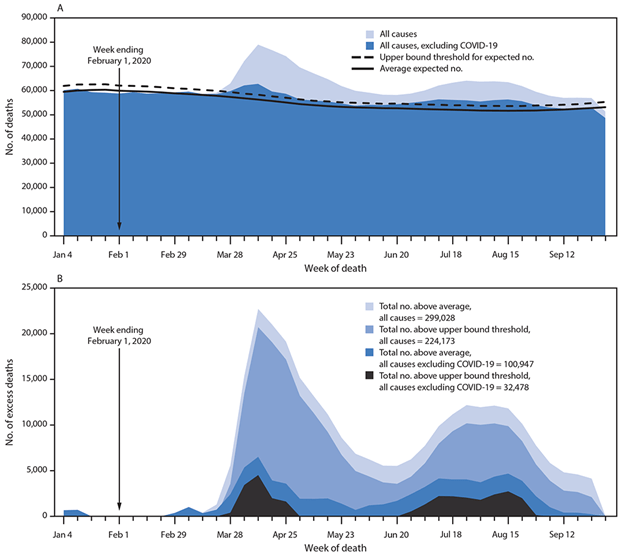
    The Center for Disease Control has compiled and released the excess death data for 2020 that gives us a better handle on Covid.  The first charts give a bit of a handle on what was happening:

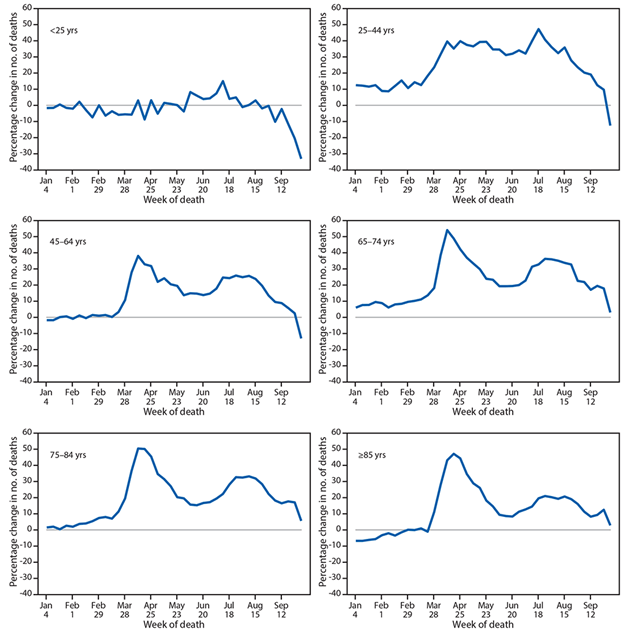
    There are a couple of interesting conclusions – first is that about a third of the excess deaths are not due to covid.  The second is that either the virus treats hispanic and black people different than whites, or that there are intervening variables or spurious correlations.  First, let’s look at the charts by age cohorts

    They confirm that Covid was a greater threat to older folks than younger – just like the statistics have been showing us. Next, let’s look at the charts by race and hispanic ethnicity:

    I’m not real sure about the relationship based on hispanic ethnicity – one of my colleagues qualifies as hispanic, but mostly Apache ancestry.  Gina is hispanic, but both parents were born in Spain.  Heck, genetically I have some Spanish or Portuguese ancestry, and my people otherwise come from Scotland and points north of there.  On the other hand, I’m waiting for the research that explains the extreme deaths in the category.

    The lower left chart shows that the disease did not hit the white population so hard – which intrigues me because that is the oldest of the groups.  I’ll be waiting for more data before I make any inferences.

    So click the link, read the CDC article, and start wondering – what hit us half as hard as covid at the same time?

  • Race and Physical Anthropology

    I start from the sociological perspective – race is a social construct.  Years ago, in one class or another, I learned that “There is more difference within a race than between races.”  As I recollect, about 250 years ago, a grad student, working on his dissertation, examined and classified 60 skulls and moved the concept of race from ethnicity to physical anthropology, and folks have been looking in the wrong direction ever since.  Never have had much respect for Johann Friedrich Blumenbach’s research methodology, and I figure his conclusions kind of suck – but I wasn’t on his committee.  Can you believe looking at 60 skulls and coming up with 5 races? 

    Ibn Khaldun pretty much  wiped out the idea of basing race on skin color about 7 centuries back.  He was pretty much the world’s first sociologist, but it took a while to get his work translated into French, and later English.  His arguments weren’t perfect, but were a whole lot better than Blumenbach’s.

    Another nail in the coffin of racial definition is genetic diversity.  If I remember my own lectures correctly, and I bloody well do, there is more genetic diversity in chimpanzees separated by one river than in the entire human race (Donelly, at Oxford, was the principal author of the study).

    Darwin kind of summed it all up in Descent of Man: “Man has been studied more carefully than any other animal, and yet there is the greatest possible diversity amongst capable judges whether he should be classed as a single species or race, or as two (Virey), as three (Jacquinot), as four (Kant), five (Blumenbach), six (Buffon), seven (Hunter), eight (Agassiz), eleven (Pickering), fifteen (Bory St. Vincent), sixteen (Desmoulins), twenty-two (Morton), sixty (Crawfurd), or as sixty-three, according to Burke. This diversity of judgment does not prove that the races ought not to be ranked as species, but it shows that they graduate into each other, and that it is hardly possible to discover clear distinctive characters between them.”

    If you want the paper on when Europeans unconsciously made the decision to be more white, this article provides the modern explanation from the physical anthropologists.  Please note, the discussion is on white skin, not race.

  • Right Wing, Left Wing, Whole Bird

    This last election showed something around 155 million ballots cast for one candidate or the other.  I don’t know how many voters each candidate had – but the number of ballots seems like a solid chunk of data.  And there was a lot of name calling about extremists – whether it was proud boys, antifa, or whatever.  In my lifetime, I’ve met a few extremists from both the right wing and the left wing, and I figure we can grade on the bell curve – where 68% fits within a standard deviation of the mean (average).  I don’t believe I’m stretching reality if I arbitrarily claim you need to be two standard deviations from the mean to qualify as an extremist. 

    So, if we look at things from my bell curve perspective, 95 percent of the voters do not qualify as extremist.  68 percent are in the middle of the road, there are another 13 ½ percent to either side that qualify as, let’s call it, solidly partisan.  So if I’m at the hypothetical middle, I need to look over two standard deviations left or right to spot an extremist.  They aren’t that easy to see from the middle.  But if I’m standing at the edge of that 13 ½ percent I defined as solidly partisan, there are 2 standard deviations between me and that hypothetical average. 

    The problem is, we generally consider ourselves normal, but there’s a lot of difference under the bell curve:

    (images taken from https://www.mathsisfun.com/data/standard-normal-distribution.html  it’s a great explanation and worth reading the whole thing)

    Back to the election – most Trump voters, and most Biden voters fall into that central 68 percent – but our perception of extremists is dependent on where we sit on the bell – the number of standard deviations away from the norm.  If you’re still making facebook posts about the evils of Trump 6 weeks after he left office, you’re likely a standard deviation or two to the left of the norm.  If you’re still flying a Trump banner, you’re probably a standard deviation or two to the right.  It’s OK – the problem is when you forget where you are and start seeing normal folks as extremists.  As the man said, both wings are attached to the same bird.