Trego's Mountain Ear

"Serving North Lincoln County"

Category: A Science for Everyone

  • Statistically Remote Doesn’t Mean Impossible

    My post-Uvalde thoughts move toward hardening our own little school.  School shootings are always statistically unlikely.  The timeline at Uvalde shows that at 11:27, a teacher props the door open. It remains open for 6 minutes before the crazy little bastard enters the school.  He doesn’t close it – the door remains open and is the access point for police.  A safety protocol broke down.  The crazy little bastard had a six-minute window of opportunity.  Twenty-one people died and 17 more were wounded.  Six minutes.

    In demography, our phrase is “Malthus only has to be right once.”  I listened to a Fed describing terrorist attacks  – “They have to get lucky once.  We have to get it right every day.”  The exercise showed how hard that was.  A teacher, secure in the misbelief that a statistically unlikely event wouldn’t happen, propped a door open.  For 6 minutes.  The crazy got in.  The statistically unlikely event happened.  We play poker hoping for statistically unlikely events to occur. 

    It’s easy to look at the police failures – but the initial failure was the teacher who wedged the door open . . . secure in the belief that there was no risk in violating that simple safety protocol.  Staying alert, maintaining security against something that does not occur, day after day, is difficult. 

    I can think of many situations where a teacher wouldn’t want to keep unlocking the door.  It’s Spring – the time when contracts are, or are not renewed.  We’ve had that this year at Trego – and seen a bit of hostility over it.  It gives me a perspective that, in Uvalde, the shooter gained access not through police failure, but through a teacher’s carelessness.  I can understand both carelessness and resentment.

    I have forgotten the name of the teacher who left his female engineering students to be killed at the Montreal Polytechnique Massacre.  I hope he came to some sort of grips with his failure – I know I could not have accepted that decision had it been mine.  Perhaps the Uvalde teacher who spent 20 lives for easier access to the door can come to grips with that conduct.  I would hate to have to rationalize it had it been my blunder.

    It is difficult to stay constantly on the alert for the statistically unlikely occurrence.  Years of boredom are eventually interrupted by a few minutes of stark terror.  Uvalde’s police, like Parkland’s, made poor choices – but the timeline shows that a teacher who propped the door open had the best opportunity to eliminate the shooter’s opportunity.  Was it just casual carelessness?  Was it carelessness coupled with resentment?  I do not know – but I have read the pricetag, and it was too high.

  • Stahl Peak on 5/23

    Stahl Peak on 5/23

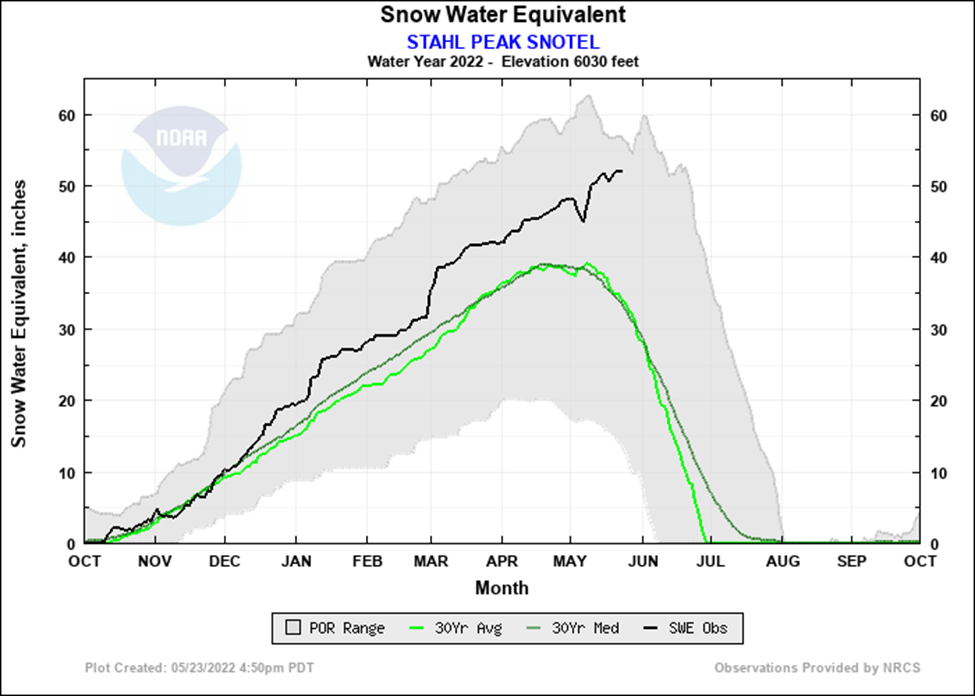
    It’s the time when the snowpack can rise quickly – a cool, rainy Spring.  The latest observation is 34.3 inches of water on the pillow – 151% of the 30 year average.  It is definitely a lot easier to click the link than it was to haul the snow tubes up to get the data in the late seventies.

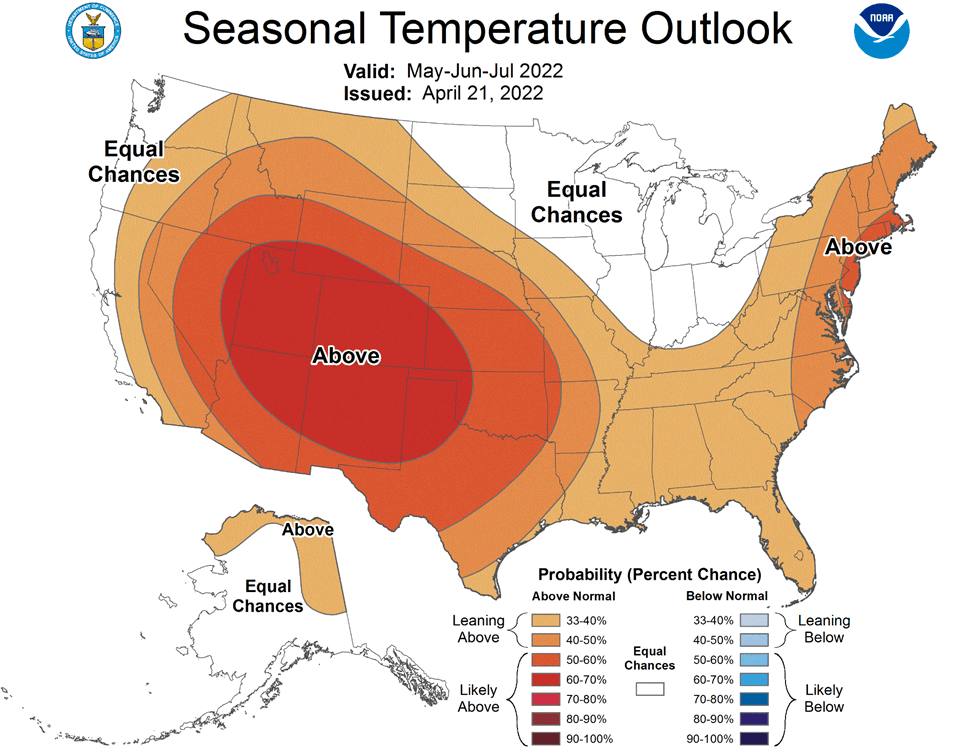
    What happens next is a question for the weather forecasts.  NOAA has released these projections for June, July and August. 

    The folks who know about these things are calling for a warmer and drier summer than normal.  If that’s the case, it is good to be going in with a little extra water in the high country.

  • Mitochondria and Aging

    Mitochondria are one of the types of organelles (cell equivalent to organs) found within our cells. They’re often referred to as the “Powerhouse of the Cell” because of their role in metabolizing food into usable energy. But they may also play a role in aging.

    There has to be considerable amount of communication between the nucleus (which controls the cell and houses your DNA) and the mitochondria. Over time, this communication can break down, and this may be what leads to aging (or at least an element of aging).

    It makes a certain sense that mitochondria would be important- energy generation is an essential function. Diseases of the mitochondria are severe. But- watch the whole thing:

  • Thoughts on Inflation

    I’ve been watching monetary inflation since 1976 when I voted for Jimmy Carter.  I still don’t give Jimmy full credit for that spate of inflation – Nixon made the call that the US dollar would no longer be backed by gold in August of 1971.

    1968 had been an interesting election – I recall the unhappy observation “Nixon, Humphrey, Wallace – three strikes and you’re out.”  The picture below brought back memories of a happier time, when I would add a million dollar Zimbabwe bill to a retirement card, so that my retiring colleagues would be millionaires as they left the university.  Ten bucks bought all the Zim million dollar notes I needed for a slew of retirement receptions.

    Now the thing about inflation is that it taxes savers, and can move into being a tax on investors.  If we look at the value of gold during the California Gold Rush – 1849 – it was $18.93 per ounce.  That same value held through the Virginia City days, and basically took Montana from wilderness to statehood.  In 1920, gold finally topped $20 per ounce.  When Franklin Roosevelt was elected President, gold was at $20.69 per ounce – the next year, 1933, it was $26.33.  In 1934, it went to $34.69.

    A couple of old Winchester catalogs, from 1900 and 1916, suggest that my Grandfather paid about $19.50 or a little more for his 1894 32 special rifle.  A glance online suggests somewhere close to $1,200 dollars today.  As I write this, gold is going for $1890.35 – roughly 100 times higher than when the rifle was made in 1902 along with the new, more powerful 32 special.  The cost of the rifle hasn’t kept up with gold.  Inflation or not, it’s kind of nice to look off the front porch and see the spot where my grandmother got a four-point in 1922.

    At that turn of the century, land here was still available for homesteading – land here in Trego had little value.  Thirty dollars per acre was still a norm for accessible land in the 1950’s.  It’s another basis for calculating inflation – and if memory serves, Lee Harvey Oswald was paid 85 cents per hour in 1963. 

    Median family incomes were somewhere around $500 per year in 1900, and had risen to about $3,300 by 1950.  Still, that half century was a time of many new developments and a greatly improved living standard.  Part of the change was that people could buy more – much like during our more recent inflationary times – along with the inflation of the eighties came the personal computer, the compact discs, video players etc.  Technical advances reduced the impact of inflation.

    There is a certain irony in Putin’s decision to tie the Russian ruble to the value of gold.  Since that decision the ruble has gone up 6% compared to the US dollar.  He’s kind of the anti-Nixon, creating a stronger currency instead of a weaker one.  I guess that inflation often boils down to a handful of government officials making the decision to print more money.  I have a hunch inflation helps the folks who get the new dollars a lot more than it helps those who are trying to hang on to the existing dollars.

  • My Neighborhood Doesn’t Reflect My Nation

    One of the advantages of social media is that folks with different views post their different opinions.  One of the disadvantages is that those different opinions come from different – often very different – locations. 

    Let’s take climate change opinions for a simple example – I live just a touch south of the 49th parallel and a little over 3,000 feet above sea level.  Simple facts are that raising the sea level by a couple hundred feet isn’t going to affect my place.  Getting another three weeks of growing season is a positive thing for my garden.  If I were living in Paramaribo, just a little north of the equator and about 6 feet above sea level, my perspective would be different.  My greatest risk is wildfire – in Paramaribo even the dry season is rainy.

    One of the readily available measurements of population is the percentage of foreign-born residents in a community.  In San Francisco, 34.4% of the population were born outside the United States.  Statewide, 26.9% of California residents were born outside the US.  Here in Lincoln County, Montana 2.6% of our population are foreign born (and I suspect half of those are Canadian).  It makes for a different point of view.

    Race?  I live in a state where most of the population is white, and the second largest group is American Indian (6.6%).  Contrast that with Washington DC, where the Black population is 46.4% (compared to Montana’s 0.6%).  West Virginia somehow has the lowest percentage of foreign born residents and the lowest percentage of American Indian population.  Maine (94.6%) is the whitest state.  I have a hunch that who your neighbors are might affect your viewpoint.

    18.7% of Montana’s population is over 65 – and five states are even higher.  Just 11.1% of Utah’s population is over 65.  (29.5% of Utah is under 18).  Who you see around you affects your perspective. More information is available at indexmundi.com

    Washington DC has the nation’s highest median household income – $92,266 . . . but it is skewed by race.  The median for Black households is $42,161, while the white median is $134,358.  Montana’s median household income was $65,712.  Mississippi came in last at $45,081.

    West Virginia has the highest home ownership rate – 74.6%, while Montana’s rate is 69.7%.  Home ownership rate in Washington DC is around 42.5%.

    Just a few spots where we can look at how our locality affects how we perceive the universe.

  • Stahl Peak Snow Pack Still Increasing

    Stahl Peak Snow Pack Still Increasing

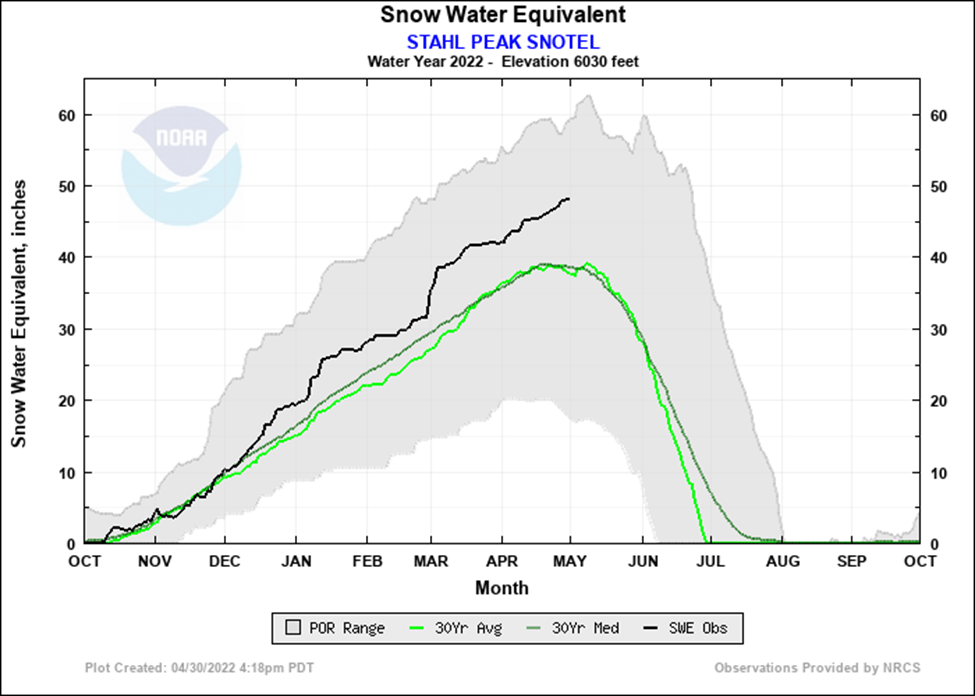
    This graph, from 4-30-22 shows that the snowpack on Stahl is still increasing.  The upper line on the record suggests that there’s only a week or so left for it to increase.  Still, 127% of the long-term average is nice to see.

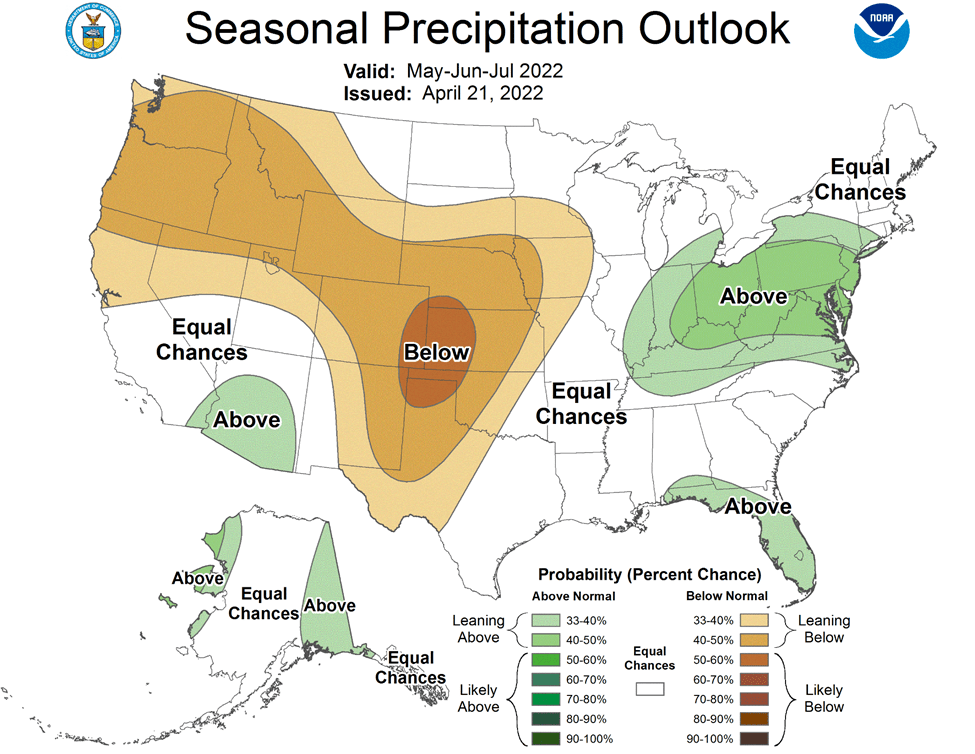
    NOAA has this posted for May-June-July, suggesting we can expect the chances of warmer temperatures and less than normal precipitation coming up.