Trego's Mountain Ear

"Serving North Lincoln County"

Category: Ask The Entomologist

  • Your Annual Reminder: The time to start trapping wasps is now.

    While winter isn’t quite done with us yet, we’ve had a good period of warmth recently. Wasps, as well as bears, are waking from their winter hibernation. I’ve seen a few queen paper wasps scouting for new nesting sites.

    With this in mind, if you want to control wasps in or around your property, the time to start is now. If you can catch and kill the wasp version of a queen, you’ll stop her whole colony from bothering you the rest of the summer.

    (A wasp queen is called a “gyne”, which means “woman” in ancient Greek. Gynes are quite large – perhaps twice the size of a standard wasp. Gynes are the wasps most likely to not die in hibernation.)

    While most paper wasps will try to hibernate through the winter (the reason we see them moving indoors in fall), most are unsuccessful. Most wasp queens have to start anew in spring, building their new colonies (and sometimes their nests) from scratch.

    Raising kids can be hard work, as any parent can tell you. It’s no different for wasps. As gynes start building their new nest, and laying their first eggs of the season, they spend most of their time looking for food for their young.

    (A gyne’s first eight or so children are called “haplogynes” meaning “half-women” – these are about half as large again as a standard wasp. These haplogynes take over caring for their little siblings, leaving the gyne free to lay more eggs and expand the nest.)

    Developing wasp larvae, just like developing human children, need diets rich in protein to grow and build muscle tissue. As such, a gyne caring for her first batch of larvae will spend much of her time looking for meat to feed them with. Later in the year, wasp larvae will often be fed caterpillars. But early on, carrion forms much of the available meat.

    If you want to control your wasp problem before it starts, consider setting a wasp trap and baiting it with a bit of leftover meat and letting it spoil. If you manage to catch and kill a gyne, or her crew of haplogynes, you’ll have won a war before giving it a chance to start.

    (Bear in mind, we do live in an area with bears, who are also beginning to leave hibernation. Be bear aware, and cautious in your use of meat to bait wasp traps.)
  • Our inchworms and their violent kin

    Our inchworms and their violent kin

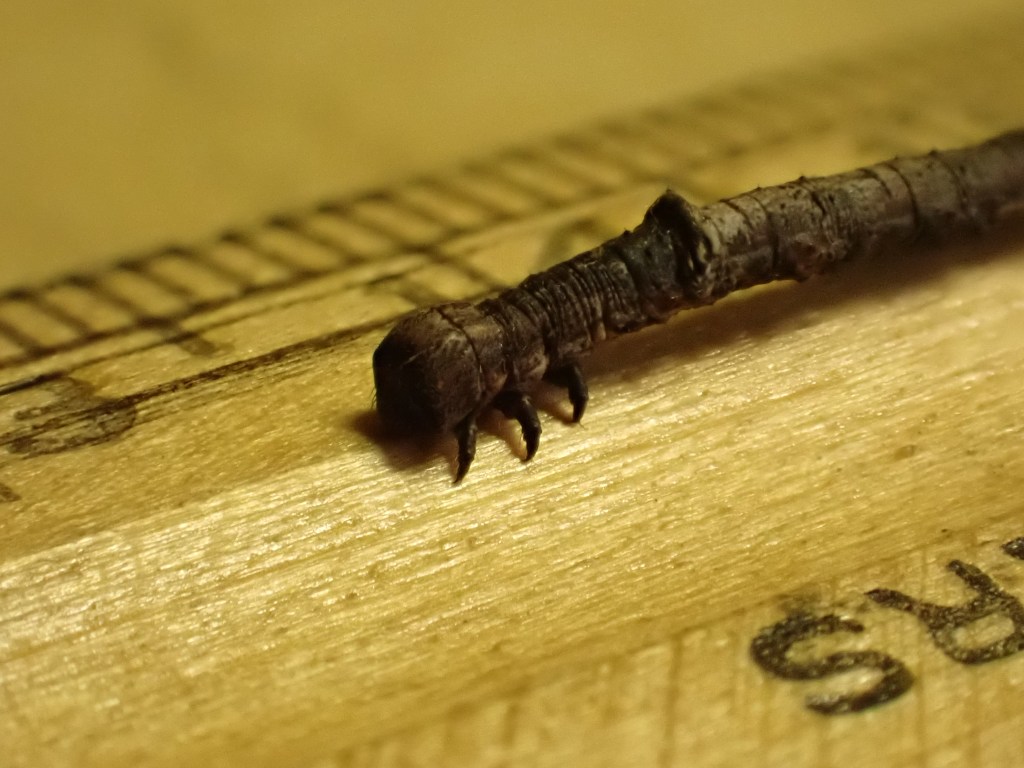
    Mike found this inchworm in the woods recently.

    Inchworms are moth caterpillars, specifically members of family Geometridae. Their family name means something like “the earth measurers”, after how they fold up and then stretch themselves out, like a surveyor’s measuring rope.

    As you can see, this little fellow nearly lives up to the name.
    About 6 millimeters too short, though.
    And its classic gait. – note that it has all three pairs of real legs right by its head, at the left. The footlike things on the right are just extensions of the abdomen.

    Ours around here aren’t all that interesting. They’re pretty standard caterpillars – standard herbivores, or opportunistic omnivores. And, like most larvae, they are very hard to identify beyond family until they molt to adulthood.

    Hawaii, however, has an interesting lineage of carnivorous inchworm caterpillars. The prevailing thought is that when the Hawaiian islands were first colonized by insects, few of those pioneering species were predatory. After all, carnivores require a healthy prey population to do well. As time went on, a certain group of inchworm caterpillars adopted a predatory role – after all, there wasn’t much competition.

    A good videoclip of an ambush hunter inchworm.

    As time went on, the caterpillars radiated into different species with different preferred prey and hunting tactics. Some mimic twigs, others mimic leaves. Some rely on ambushes alone, while others bind up their prey with silk before consuming them. The ones I first read about prefer hunting flies, while others eat things as strange as snails.

    Looking at a caterpillar move, it’s initially hard to fathom it ever moving with sufficient speed and dexterity to grab a fly, but amazing things can happen with time and the right selective pressures.

    And another brief video of one of the fly-hunting species.

    While we in the lower 48 do have a few omnivorous caterpillars, I’m not aware of any strict carnivores. Omnivory is easy to understand – say you have a passel of siblings all competing for the same leaves… sooner or later that sibling rivalry will result in somebody taking a bite out of a brother, and realizing that he’s pretty decent food.

    Many insect mothers lay extra unfertilized eggs, just in case some of the early hatchers are in the mood to eat potential siblings. Gives the slow larvae a bit longer to escape their hungry siblings.

  • Amorous Beetles

    Amorous Beetles

    With fire so near to us, and this oppressive ground-clinging smoke left after last night’s badly-needed rain, I’m reminded of beetles. Specifically, amorous beetles.

    Wood-boring beetles, such as jewel beetles and long-horned beetles, are attracted by the smell of distressed trees. Burnt forests draw them in, as does the smell of wood on the air after I’ve been running the stump grinder.

    But, much like humans, male jewel beetles are visual creatures. What really gets them in the mood for love is the sight of a female. Or something that looks a lot like a female.

    The Emerald Ash Beetle is an invasive jewel beetle, currently approaching us from the East. It’s just a matter of time until it gets here, and entomologists are working hard at devising good traps for it. Traps are most effective when they match the beetles’ taste in mates’ colors – light green (preferred by the males) and purple (preferred by the females)…

    Many insect traps also use sex pheromones to complete the illusion of “single bugs near you looking for love”. But either way, the fragrance of a distressed tree is a near-must if you want to attract its wood-boring insects.


    In most cases, that is. Distressed plant scents aren’t always involved.

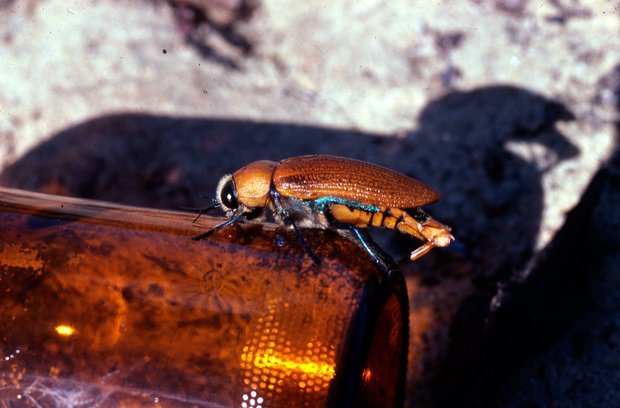
    Julodimorpha bakewelli male having a good time with the most attractive female he’s ever met.
    (photo credit: Darryl Gwynne – one of the two young entomologists who discovered this phenomenon)

    Australia very nearly lost a large and very attractive species of giant jewel beetle, Julodimorpha bakewelli, thanks to male sexual confusion.

    You see, just as in the Emerald Ash Borer, color and sheen are very important to the Australian Jewel Beetle. Females of this species are a lovely golden brown, with wingcases covered with little dimples that catch the light. To males of this species, the ideal female is one much larger than them – well-fed, healthy, and able to lay many eggs.

    Unfortunately, textured beer bottles discarded along Australian highways proved irresistible to the male beetles. “Her size! Her color! The way she glimmers in the light!I’ve never known anyone this stunning”

    It was simply impossible for females to compete for their males’ affections. All across Australia, female jewel beetles were spending nights alone by themselves in the Eucalyptus trees.

    Meanwhile generations of males spent themselves on discarded beer bottles who never reciprocated their affections. The most beautiful female jewel beetle or a beer bottle? Males had a clear preference.

    As the years went by, it became clear that the giant jewel beetle birth rate was severely affected. Surprisingly, the beer industry stepped in and designed a new bottle, less attractive to beetles. Thus saving the Australian Jewel Beetle from extinction. Here’s a brief video on the beer-bottle-loving beetles.

    We can only dream of stumbling on something as attractive to control our lumber pests.

  • Cicadas – not just Brood X!

    Cicadas – not just Brood X!

    Chances are you’ve seen internet articles about the mass cicada emergences that’ll be happening across the eastern United States this year. Here’s a decent writeup from the National Park Service.

    Periodical cicadas are named for the long stretches of time between their emergences (13 or 17 years, depending on the lineage). The thought is that this makes them an unreliable source of food for predators – it’s hard to be a specialist wasp if your food species vanishes and is unaccessible below ground for over a decade at a time.

    And, when you emerge, surrounded by thousands of others like you, it’s statistically unlikely that you’ll be the one who gets eaten – be it by bird, dog, or unattended small child. Though many of your kin will be devoured, you’ll probably be safe. It’s the same tactic the now-extinct Passenger Pigeon used. Passenger Pigeons built undefended nests on the ground, and relied on numbers to make any individuals odds of survival better. A tactic that worked excellently until it didn’t.

    Here we have a little member of genus Okanagana, the whip cicadas.
    Fittingly for this area, they’re named after one of Canada’s First Nations which spoke a Salish tongue.

    While we don’t have periodical cicadas (genus Magicicada) this far west, we do have other types of cicadas, especially genus Okanagana. I’ve been hearing their males sing in the trees on my drive back from work over the past couple of weeks. One way cicadas avoid predators is by being active in the sweltering heat when nothing wants to hunt. Cicadas cope with the heat by drinking tree sap nearly constantly, and releasing excess moisture through pores in their thoraxes, much like how we humans sweat to cool down.

    Our cicadas here have life cycles maxing out in the 3-year range. As such, these species can be pretty reliable hosts for certain predators, like the cicada killer wasp… but our cicadas lead a charmed life. The Western Cicada Killer Wasp only goes as far east as Idaho, and the Eastern Cicada Killer Wasp only really goes as far west as the Dakotas.

    Our local cicadas are convinced that this truly is God’s country.

    An Okanagana cicada I met last fall – note that this one has brighter orange markings.
  • Mayflies

    Mayflies

    True to schedule, the mayflies have returned. Of course, the mayflies didn’t wait for May proper… they’ve been with us for the past month at least.

    Here’s the shed skin of one I watched emerging this past week. Note the three tail filaments – this is how you can tell it is a mayfly skin.

    It’s hard to get an ID from a cast skin –
    I’ll be keeping my eyes peeled for an adult to photograph.

    Our pond tends to have the smaller species of mayflies in good abundance – primarily genus Callibaetis. Here are some higher-quality photographs of other mayfly nymphs, so you can get a sense of the variety.

    All mayflies belong to Order “Ephemeroptera”, which is Greek for “ephemeral things with wings”. While their winged life-stages may be here today and gone tomorrow, their aquatic young live much longer – a year or more below the surface before taking to the skies.

    Mayflies are of an ancient lineage – they were around before creatures with backbones colonized the land. In those early days, the skies were relatively free of predators, far safer than below the water. Far different from the world they inhabit now.

    Today, mayflies are a staple food for many creatures – fish, birds, and bats (as well as many insects)… All eat prodigious amounts of mayflies. Fly-fishers are well aware of fish’s dependence on mayflies. Many fly-fishers tend to be insect-watchers, and tailor their flies to match the most abundant mayflies are in their location and season.

    We can anticipate our mayflies staying around far longer than the month of May – new adults will emerge all summer long, and can be found well into October, depending on the weather. Their presence can also be used to assess how healthy a body of water is – mayflies don’t do well in polluted areas.

    Here’s an adult Callibaetis mayfly that joined me on a walk last fall.
    And here’s a writeup on flyfishing to match Callibaetis mayflies’ emergence patterns.

    This adult’s size is about right for the shed skin in the top image,
    but it’s quite possible that our area contains several species from this genus.
  • Thatch Ants

    Thatch Ants

    A question we received last month – our apologies for the delay in answering.

    Thank you to Sandra Elster for prompting this piece.

    Our mound-building ants in this part of the country are Western Thatching Ants, Formica obscuripes. 5′ by 5′ is quite an impressive mound! I suspect it had quite a few active queens in it at one time… These ants are rather special because they generally have multiple active queens in a single colony – the young queens often help out and reproduce at home, instead of founding their own new colonies.

    While Thatching Ant queens can live about a decade, they will eventually die. And when they do so, if there aren’t other queens waiting in the wings, the whole colony will go down with them. I’m guessing this is what happened at your daughter’s place.

    Workers at the entrance of a Western Thatching Ant nest near my home.
    Busy despite the overcast day.

    This species is most interesting to me when it sets about starting new colonies… You see, Western Thatching Ants often start out as social parasites! Queens of the red-colored wood ants, including our species of Thatch Ant, don’t start from scratch… They use others ants’ labor to get started.

    The Queen is dead, long live the queen!”

    A young queen of the Western Thatch Ant, instead of going to the backbreaking work of digging and founding a new colony all by herself, will tend to infiltrate nests of related ant species. Once inside, the young queen kills the old queen, acquires her smell, and steps into her role.

    Over time, the new queen’s offspring will far outnumber those of the old queen, and the nest will eventually be a single species again. Fancy folks call this “temporary social parasitism“.

    If the colony is very successful, it may divide into smaller colonies – a way new colonies sometimes form without using social parasitism. If a colony gets sufficiently large, daughter queens may take control of certain sections of it, forming a “satellite colony” instead of leaving to form an entirely separate one. Many linked colonies form a “supercolony”. The largest I’ve heard for this species is 210 linked colonies in eastern Oregon.

    I wrote about wasp control not too long ago… Well, ants are your number one natural means of keeping wasps, and most other pest insects, in check. If a wasp colony is under stress, ants will often invade and carry away the baby wasps to be food for the colony. Controlling your Thatch Ants may lead to you having more wasp problems.

    That said, if you want to exterminate your Western Thatch Ant colony, Washington State University Extension has some advice.

    When they emerge, I’ll address Carpenter Ants & how to control them.