Trego's Mountain Ear

"Serving North Lincoln County"

Category: Ask The Entomologist

  • The time to start trapping wasps is now.

    While winter isn’t quite done with us yet, we’ve had a good period of warmth recently. Wasps, as well as bears, are waking from their winter hibernation. I’ve seen a few queen paper wasps scouting for new nesting sites.

    With this in mind, if you want to control wasps in or around your property, the time to start is now. If you can catch and kill the wasp version of a queen, you’ll stop her whole colony from bothering you the rest of the summer.

    (A wasp queen is called a “gyne”, which means “woman” in ancient Greek. Gynes are quite large – perhaps twice the size of a standard wasp. Gynes are the wasps most likely to not die in hibernation.)

    While most paper wasps will try to hibernate through the winter (the reason we see them moving indoors in fall), most are unsuccessful. Most wasp queens have to start anew in spring, building their new colonies (and sometimes their nests) from scratch.

    Raising kids can be hard work, as any parent can tell you. It’s no different for wasps. As gynes start building their new nest, and laying their first eggs of the season, they spend most of their time looking for food for their young.

    (A gyne’s first eight or so children are called “haplogynes” meaning “half-women” – these are about half as large again as a standard wasp. These haplogynes take over caring for their little siblings, leaving the gyne free to lay more eggs and expand the nest.)

    Developing wasp larvae, just like developing human children, need diets rich in protein to grow and build muscle tissue. As such, a gyne caring for her first batch of larvae will spend much of her time looking for meat to feed them with. Later in the year, wasp larvae will often be fed caterpillars. But early on, carrion forms much of the available meat.

    If you want to control your wasp problem before it starts, consider setting a wasp trap and baiting it with a bit of leftover meat and letting it spoil. If you manage to catch and kill a gyne, or her crew of haplogynes, you’ll have won a war before giving it a chance to start.

    (Bear in mind, we do live in an area with bears, who are also beginning to leave hibernation. Be bear aware, and cautious in your use of meat to bait wasp traps.)

  • Tick diseases in Montana

    Tick diseases in Montana

    Spring has sprung, and our first ticks are out and about.
    When folks start talking about illnesses transmitted by ticks, the first to come up almost always seems to be Lyme Disease. While Lyme Disease is the most common tick-borne disease among Montanans, you don’t need to worry about picking it up around here – it tends to be something folks pick up on vacation.

    The Black-Legged Tick, also known as the deer tick, is the primary culprit responsible for transmitting Lyme Disease. Black-legged ticks are not found in Montana – they are, however, found all across the eastern half of North America. A related tick on the west coast, the Western Black-Legged Tick, is a less-effective vector of Lyme Disease.

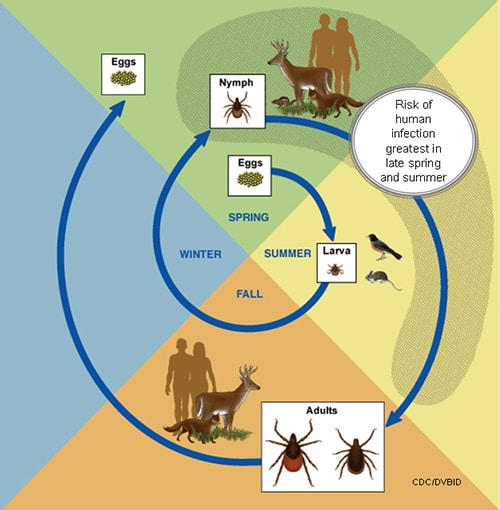
    A black-legged tick feeding on you isn’t a guarantee of disease – to transmit the disease, the tick first needs to feed on a small mammal (usually a White-Footed Deer Mouse) which is infected with the bacterial agent responsible for the disease… Because these ticks eat blood meals only once per life stage (once each as a larva, nymph, and an adult), you’re most likely to get the disease from a black-legged tick nymph. The adults prefer deer to us humans, anyways.

    The lifecycle of the Black-Legged Tick, sometimes known as the Deer Tick.
The common hosts for each life stage are pictured as well.
    The CDC’s helpful graphic on the black-legged tick lifecycle.

    Our northwestern corner of Montana is untroubled by tick-vectored disease. That said, if you venture into the southern portions of the state, we do have four tick-borne illnesses you could contract.

    Rocky Mountain Spotted Fever
    -About 6 cases reported in MT per year.
    -This disease is potentially deadly, moreso than Lyme Disease. Symptoms include achiness and fatigue, as well as a distinctive mottled rash.
    -This disease is vectored by larger ticks, the Rocky Mountain Wood Tick and the American Dog Tick, both of which should be easier to spot.

    Tularemia
    -About 4 cases reported in MT per year.
    -Sudden high fever, swollen lymph nodes, and pervasive weakness.
    -Tularemia can be vectored by the same two ticks that transmit Rocky Mountain Spotted Fever. However, more people catch it from contact with blood from infected rodents and especially rabbits. Something to keep in mind if you’re fond of skinning.

    Colorado Tick Fever
    -1 to 2 cases reported in MT per year.
    -This feels much like flu – aching, fever, chills, fatigue – which makes sense, as flu and Colorado Tick Fever are both are caused by viruses. Not too dangerous, usually goes away after 1-3 days.
    -Like the previous two diseases, this one is transmitted by both the Rocky Mountain Wood Tick and the American Dog Tick.

    Tick-Borne Relapsing Fever
    -Extremely rare, but it does occur in MT.
    -Fever rapidly develops after the initial infection, but then subsides, and reocurs in cycles about four days long.
    -Transmitted by soft-bodied ticks that specialize on chipmunks and pine squirrels – avoid contact with small woodland mammals and sleeping in dilapidated cabins and you should be okay.

    I would strongly advocate wearing clothes treated with permethrin if you’ll be in good tick habitat for a while – especially if you’re someplace with more interesting tick-borne diseases, like Red Meat Allergy, in the American southeast.

    The ticks you’re most likely to find here in Montana are these two… but if you come across something odd, there’s the CDC’s tick ID page, and beyond that I’d be more than happy to take a look at any bugs you might have for me!

    A poster from the MT Department of Health & Human Services
    Communicable Disease Epidemiology Program
  • Ask The Entomologist: What’s this bug in my breakfast?

    Ask The Entomologist: What’s this bug in my breakfast?

    “This guy and its buddy were both about 5 mm (1/5 inch) long, in my Malt-O-Meal.”

    Excellent question, and an attractive little fellow it is.
    This furry worm-like beastie is a larder beetle larva, a member of family Dermestidae.

    If you’ve ever watched a criminal mystery program on television, you’ve probably seen these insects’ relatives make an appearance with forensic entomologists. Dermestid beetles are often used to clean meat off bones, whether for criminal investigations or by folks who prepare skull mounts. They’re better than chemical treatments, as they leave no markings on the bones themselves, and can be stopped before they destroy the connective tissues holding the creature together.

    While entomologists call these things dermestid beetles, there’s a variety of names for them, depending on the species and what they like to eat. Often the bone-cleaning ones are called hide beetles” or “skin beetles The household stored-product pest names you might be familiar with are larder beetles or carpet beetles. As these names imply, there’s quite a bit of variation in what these insects eat.

    These insects are survivors. Many species of dermestid beetle occupy some of the worst, least-tasty carcasses out there… These beetles tend to come late to bodies, after most of the good juicy bits have been eaten or have spoiled. I’ve found dermestid larvae between dry ocean fish vertebrae, inside a variety of mammal skulls, as well as in the dried out bodies of little things like mice, songbirds and lizards.

    While some species can be helpful at times, most can become pests, especially to taxidermists or fur preparers. It’s an absolute nightmare trying to get dermestid beetles out of museum collections – they’re happy to eat just about anything dry and once living – aged fabrics and hide clothing, pressed plant specimens in herbariums, as well as taxidermied animals (skins as well as hairs or feathers). They don’t discriminate between vertebrates and invertebrates either – dermestid beetles are quite happy to eat pinned insect collections, too.

    This three-color band pattern is very common in dermestid beetles.
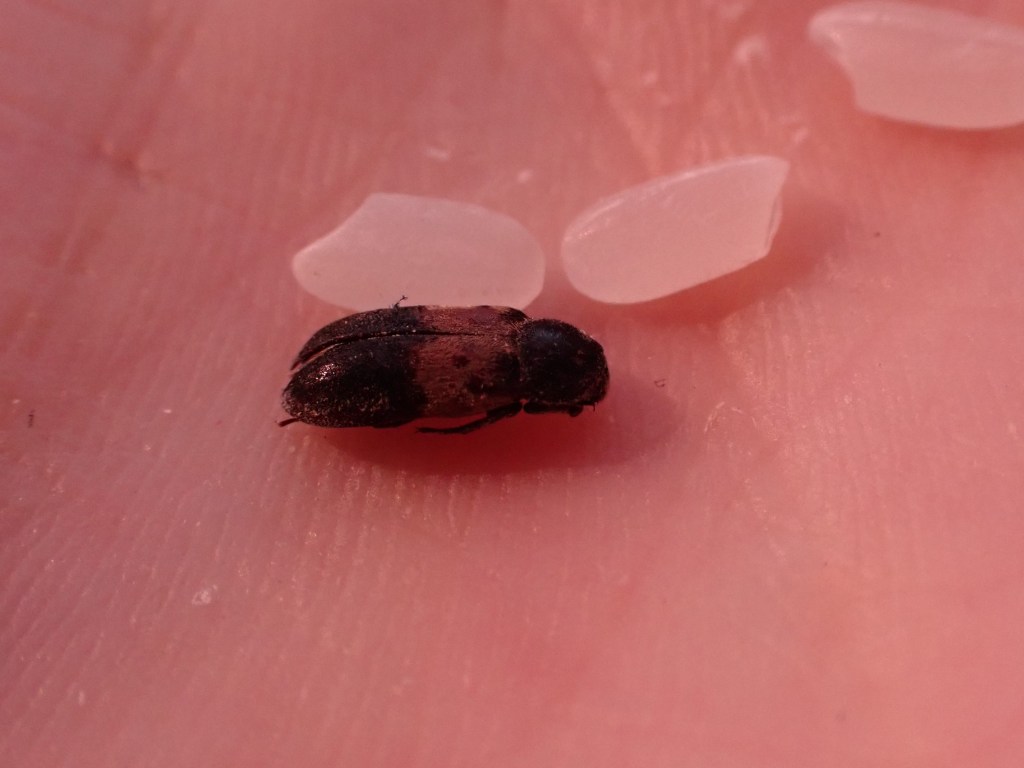
    This particular individual is a true larder beetle, found in my sack of short-grain sticky rice.

    Some dermestids have found that sacks of grain are to their liking as well. Here’s a stowaway I found in one of my sacks of rice recently – a diet much more similar to that of your malt-o-meal beetle. It stands to reason, of course – they’re the same species, Dermestes lardarius.

    Should you have problems with these in your own home, both Colorado State University and The Ohio State University have made nice informational sheets on how to control larder beetles and other dermestids.
    CSU’s dermestid info & control sheet & OSU’s dermestid info & control sheet.
    If they should get into your emergency food cache, though, don’t worry. They’re good eating.

    And a closeup – this adult larder beetle is just a little bit bigger than the larva in the ID request photo.
    Just over 1/4th inch, as opposed to 1/5th of an inch.

  • Ask the Entomologist: Ladybugs – which types bite?

    Ask the Entomologist: Ladybugs – which types bite?

    First off, this is an excellent question.
    All ladybeetles have jaws and the ability to bite, but some certainly seem to do so more often.

    I’m fond of this question for more than that, though.
    I got my start in entomology as a highschooler in South Dakota. Dr. Louis Hesler, a USDA lab scientist who specialized on ladybeetles took me under his wing, and helped me learn to identify them. I specialized in dissecting and identifying tiny ladybeetle species, often less than 1/10th of an inch long. That was the first time in my life that I felt I was doing work that couldn’t be easily replaced, and it was an addictive feeling.

    If you have ladybeetles in your home, and have been bitten by them, I’d expect them to be Multicolored Asian Ladybeetles. Other ladybeetles are quite capable of biting, too, even if they don’t do so terribly often.
    It’s more a question of what kind of ladybeetles we regularly encounter in our homes.

    This past autumn I saw just over a dozen species of ladybeetles around our place… and I wasn’t searching for them. For comparison, South Dakota is currently known to have 80 species of ladybeetles. Chances are good that Montana has a similar or higher number. Despite all the ladybeetle species we had outdoors this summer, the only species I’ve seen in our home this winter is the Multicolored Asian Ladybeetle.

    Why are these beetles in our homes? To avoid the cold weather.
    While most ladybeetles need to avoid freezing to survive winter, not all do so in the same way.

    European ladybeetles, such as the Seven-Spotted Ladybird Beetle (now common in North America as well) often overwinter in leaf litter. New World ladybeetles, such as the Convergent Ladybeetle, tend to overwinter inside rotting trees, much like Cluster Flies further from human structures do. Smaller ladybeetles are known to overwinter inside ant burrows, feeding on their larvae through the winter.

    The Multicolored Asian Ladybeetle, has a different history, though. This species has lived alongside soybean farming for ages – the soybean was domesticated in the 11th Century BC. The Asian Ladybeetle’s ancestors overwintered in barns after the soybean harvests, and its descendants seek out shelter in human-made structures as well… It is this behavior that brings them into conflict with humans more than other species of ladybeetle.

    Not all entomologists think that Asian Ladybeetles are likely to bite.
    This write-up found that only about 1/4 of Asian Ladybeetles bit the author when given the opportunity… When not removed from his hands after they began biting, the Asian Ladybeetles happily feed on him for about a half hour. I suspect few people besides entomologists have personally experienced this phenomenon, however. One can see how similar behavior on fruits can quickly make these into pests.

    How can I prevent the Asian Ladybeetles from invading my home in the winter?
    Well, I can tell you what doesn’t work, and what ostensibly should work.

    Putting up “Ladybug Houses” will not work at all. These beetles aren’t stupid – they can tell it’s warmer in your home than in the ladybug house, so your home will be their clear preference for winter quarters.

    It’s theoretically possible to caulk your house so well that insects won’t be able to get inside. In practice, I don’t think this is viable at all. Good luck getting all those 1/16th inch cracks closed! There will always be a few tiny gaps that you miss, and the insects will invite themselves in to the warmth.

    If you feel the need to remove your ladybeetle infestation, I’d suggest vacuuming. With a good suction attachment, you’ll be able to remove the Asian Ladybeetles without smushing them and making stains. I’d suggest emptying the vacuum bag promptly, or they’ll crawl out and continue on their merry way. Purdue Extension advocates using socks when vacuuming bugs.

    Vacuuming them up can also be a wise idea if you’ve got a dog who likes to eat ladybeetles. Consuming sufficiently large quantities of ladybeetles, regardless of the species, can make your pets sick. But, as Paracelsus said, “The dose makes the poison”. It takes a special dog to eat one ladybeetle and decide to follow it up with fifteen more. I suspect your beasties may be a bit more discerning.

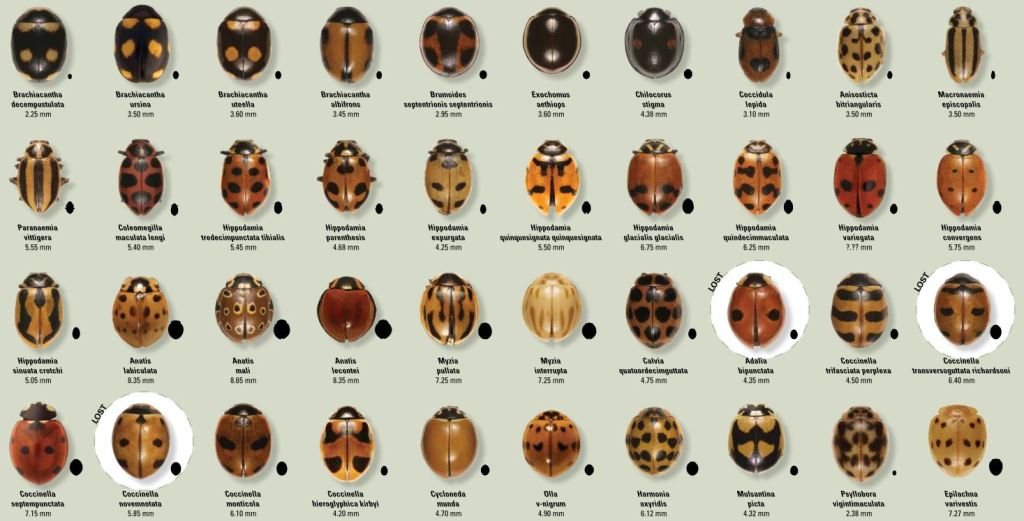
    An excerpt from my mentor’s poster of the Ladybeetles of South Dakota.
    I’ve observed many of these species here in Montana as well.

  • Thoughts on Invertebrate Houseguests

    Thoughts on Invertebrate Houseguests

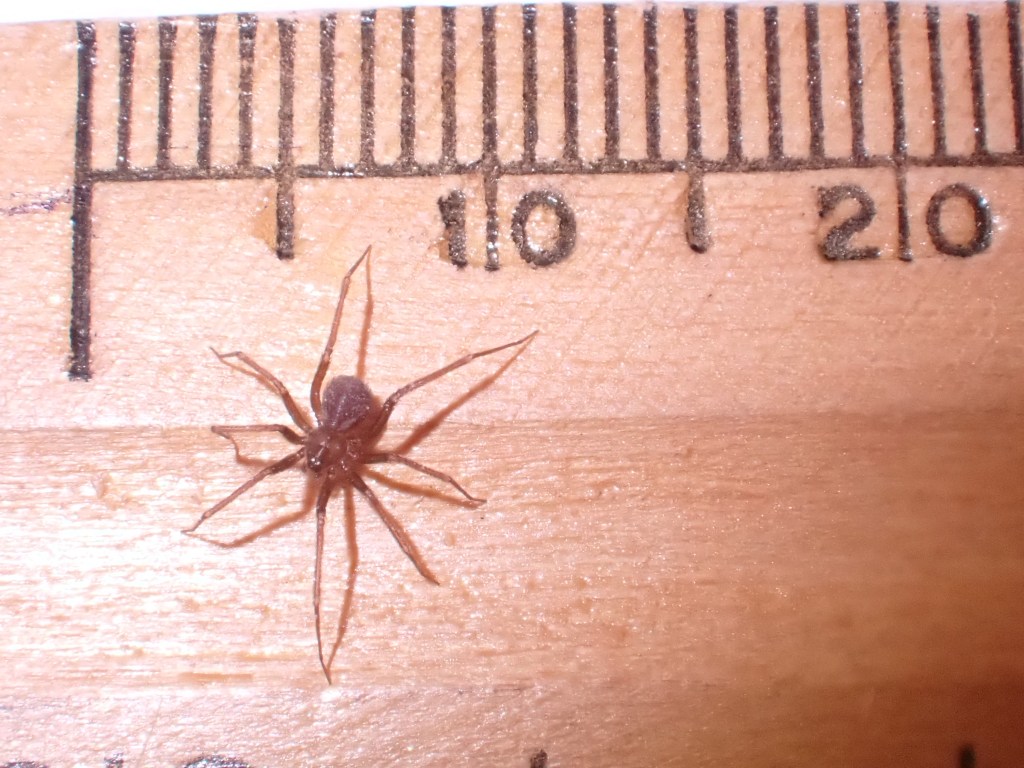
    Just last night, my wife asked me to identify a spider that was perched on the wall of our shower. A small thing, its body was only about 3 millimeters long, or about 1/10 an inch. It was an immature spider, and I didn’t manage to get a good look at the layout of its eyes, so I was unable to identify it as well as I’d like. (Many identification resources tend to be more helpful for identifying adult bugs than immature bugs).

    While I myself couldn’t identify it to genus level, I shared the observation to iNaturalist, in hopes that somebody with more expertise in spiders would be able to get a closer identification. Regardless of what it is, the chances of its bite and venom being of medical importance are just about nill. The only spider of real medical importance we have here in Montana is the Western Black Widow.

    From just in front of the eyes to the tip of the abdomen, about 3 mm.
    Sadly, I could only make out the two central eyes, and I’d need to see the others to identify her.

    Insects and their kin have been living alongside humans for a very long time – it’s thought that some of our current house-dwelling insects started out as cave dwellers, also living alongside our human forbears. Some early cave art even features cave crickets, as in the Cave of the Three Brothers in southwestern France.

    An ongoing project on iNaturalist, “Never Home Alone”, attempts to learn more about our long-term arthropod houseguests. Thus far, this project has led to the discovery of a number of new species – organisms whose behavior “in the wild” is entirely unknown. They’ve only ever been observed and collected from human dwellings.

    The scientific paper that this project arose from found that upwards of 100 species of insects could be found in just about every home they surveyed. Defying the stereotype, folks with larger homes in better parts of town had more species of insects, not fewer! Regardless of homeowner’s income, the vast majority of the insect houseguests discovered were non-pest species, and some hadn’t been observed in the region before.

    If an entomologist finds that your home is full of bugs, you shouldn’t feel too bad – chances are good that your neighbors’ homes have similar numbers of insects. They’re mostly harmless, and some are even beneficial…. Case in point, at closing time, the spider from the shower had been identified as a harmless variety of cellar spider, Pholcophora americana, who had likely been feeding on moth flies from our drains.

    At present, the cellar spider has been relocated to the holly to join our Christmas Spiders.

  • Winter Crane Flies: widespread and little-known

    Winter Crane Flies: widespread and little-known

    As I was walking over to my in-law’s place one chill and sunny afternoon, I happened to spot a fly. A gangly, long-legged fly, seeming to bounce up and down in the brisk winter air. Unlike the cluster flies lining the edges of our ceilings, this one was fairly active, despite the temperature.

    Naturally, I snatched it out of the air for a better look.

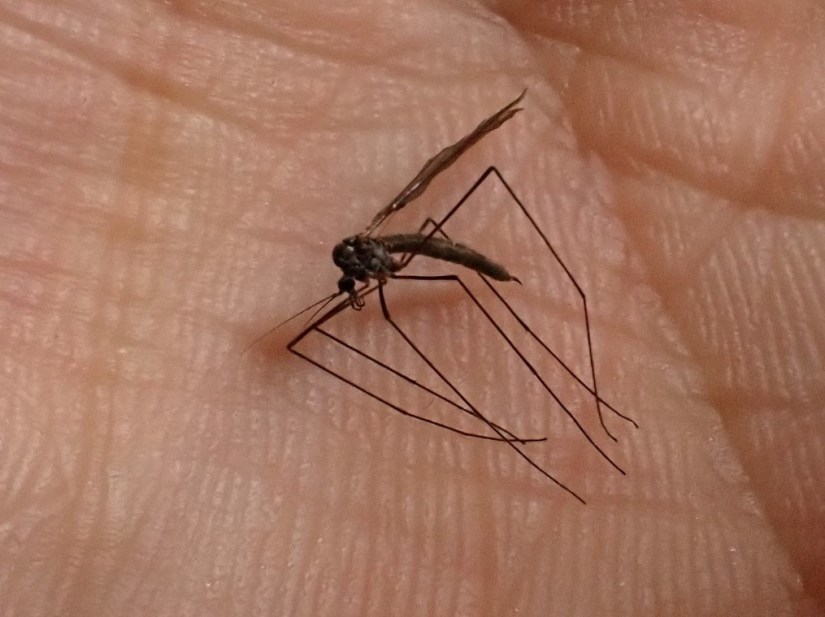
    It wasn’t just any fly – at first glance it appeared to be a crane fly… but parts of it weren’t quite right. It had simple eyes in the center of its forehead, something absent in true crane flies. Nor was it quite the right size – it’s perhaps 1.5 to 2 times the size of an average mosquito, whereas crane flies can be far larger, and with a broader leg-span. It was a winter crane fly.

    If you look closely, you’ll find that the winter crane fly, like its true crane fly relatives,
    does not have stabbing mosquito-like mouthparts.

    While not true crane flies, winter crane flies are close relatives, and both develop in similar areas and eat similar foods. Wet spots on land, perhaps along a stream or seep, are perfect for a growing winter crane fly maggot. True crane fly maggots (often called “leatherjacket slugs”) prefer to swim in the stream itself, and can make excellent fishing bait. Both types of maggot like places that have plenty of moist decaying plantstuff to feed on.

    Interestingly, winter crane flies have been documented gathering in large numbers underground… both here and in the Old World. I observed this in a number of western Kentucky stream caves while I was studying a group of eyeless cave beetles, but little has been written on the behavior in this organism. I wonder if it could be similar to how mosquitoes overwinter in caves…

    To my surprise, Winter Crane Flies have become invasive in Antarctica in the past decade… it’s thought that they started out by colonizing the polar scientists’ sewage treatment plant, and escaped to the outside. Impressive for a wee beastie that is only active for a couple of months out of the year here. Of course, the Winter Crane Flies invading Antarctica have much less competition than those around here!

    What is a pest in one place may be entirely harmless in another.