Trego's Mountain Ear

"Serving North Lincoln County"

Category: Ask The Entomologist

  • Ask the Entomologist: Bug on my kitchen wall

    Ask the Entomologist: Bug on my kitchen wall

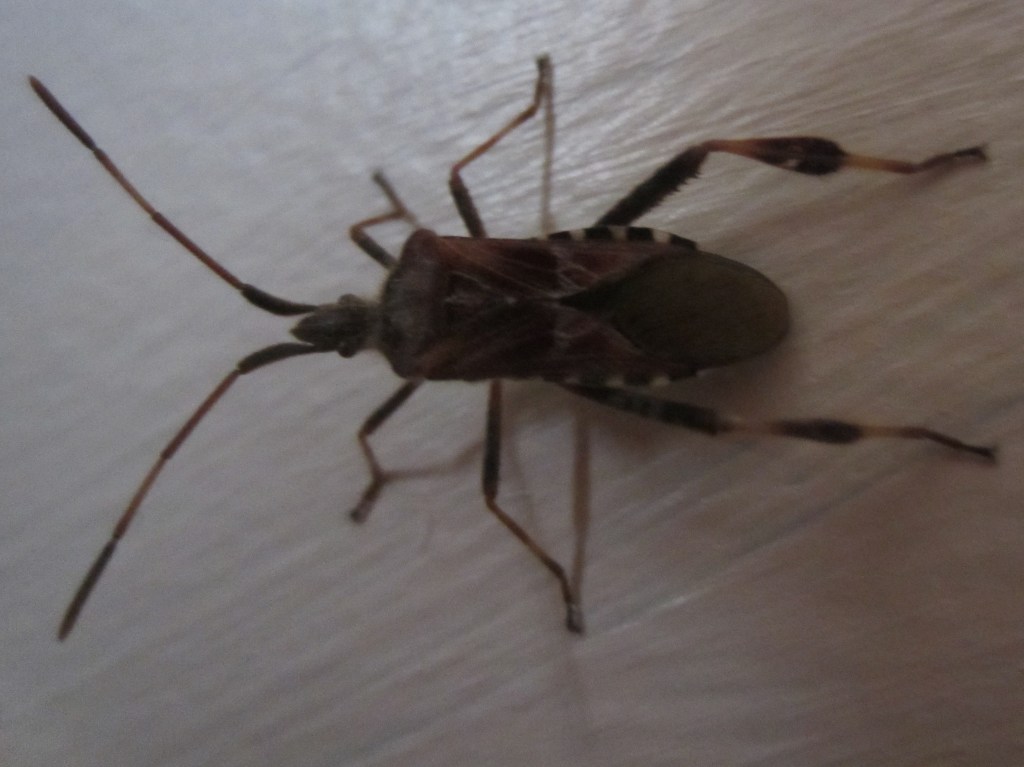
    “Is this a stink bug? Our house has a few of these, and they’re often walking on the walls. Why?”

    Your particular leaf-footed bug is Leptoglossus occidentalis, the Western Conifer Seed Bug.
    Very nice photo, by the way.

    This isn’t a stink bug, but that’s a very good guess!
    This is a leaf-footed bug, a close relative of the stink bugs – they’re both members of Hemiptera, what entomologists call “the true bugs”. Beyond this, leaf-footed bugs and stink bugs both belong in Infraorder Pentatomorpha. While leaf-footed bugs do emit a strong smell when stressed or handled, but it’s not nearly as strong as a stink bug’s scent, in my experience.

    These bugs are similar in behavior as well – they have piercing mouthparts, and tend to be herbivorous, especially seed-feeding. Both have been crop pests – stinkbugs are detrimental to agricultural pursuits like soy farming, while leaf-footed bugs tend to be more damaging in tree plantation contexts. In some regions, both may be present as minor citrus farming pests.
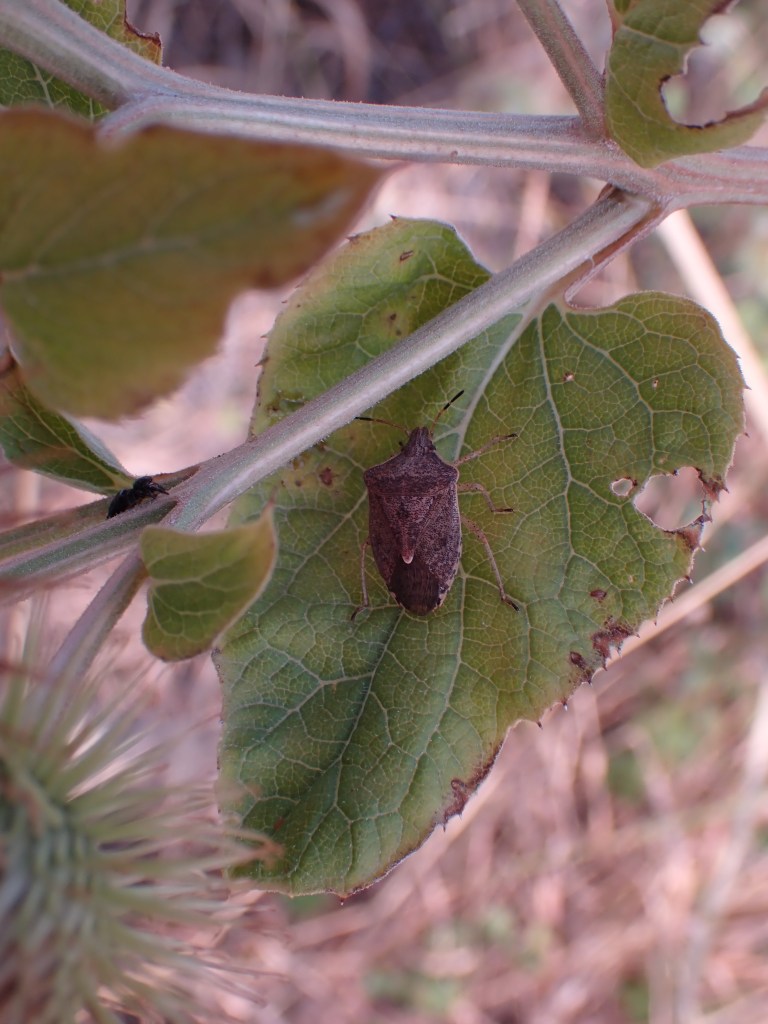
    Here’s a stink bug I met this fall, perched on a burdock leaf. Note the differences:
    The leaf-footed bug is slender and has fins on its hind legs.
    The stink bug is stout in comparison and has larger spines on its shoulders.

    However, when the weather turns cold, both stink bugs and leaf-footed bugs seek shelter from the elements. In winter, both stink bugs and leaf-footed bugs build up protective alcohol-based compounds in their blood that make it much more difficult for them to freeze. However, if they do end up freezing, they die. Leaf-footed bugs are what entomologists would call “cold-tolerant, freeze-avoidant“. Their quest to find someplace warm to spend the winter sometimes leads them to bother us indoors. Without human homes to invade, leaf-footed bugs and stinkbugs both tend to overwinter inside large dead trees.

    While they may be annoying for a time, rest assured that neither stink bugs nor leaf-footed bugs are harassing your houseplants this winter. During overwintering, these bugs avoid feeding – after all, the more moisture they take in, the more likely it is that ice crystals could form inside them. However, many leaf-footed bugs do release aggregation pheromones which spread the news that your home is a great warm place to wait out the winter.

    As for why your new houseguests are walking on your walls, that I don’t have as good an answer for.
    I imagine that your walls might be warmer than the floor, and that could make them more attractive. I’d also hazard a guess that your leaf-footed bugs prefer being on inside walls, rather than outside walls.

    Thank you for the question!

  • Non-human immigrants

    Non-human immigrants

    As Thanksgiving draws near, and we hear tales of “The First Thanksgiving”, and explanations of the tales’ inaccuracy, my mind turns to other immigrants. For better or worse, humans from the Old World journeyed across the Atlantic Ocean, and carved lives for themselves here in the New World. But humans are far from the only species to have done so.

    Once upon a time, the Americas had no grasshopper species – genetic evidence suggests that our North American “Bird Grasshoppers” are descended from West African grasshopper immigrants which flew across the Atlantic. While this sounds rather far fetched at first, it become less so, when realizes that Schistocerca grasshoppers flew from West Africa to the Caribbean in 1988…
    A decade before, in 1977, related Bird Grasshoppers flew from Central America to Hawai’i with the help of a strong storm system, where they have since caused problems. Most invasive species, though, have made use of human help to travel such vast distances.

    Here in Montana, we have no shortage of invasive weeds, and many of them are immigrants that are here thanks to human activity. Spotted Knapweed stowed away in seed shipments, Mullein, Plantain, Dandelions, even Stinging Nettle All came over with European settlers, and were put to many uses.
    On the other hand, Spotted Knapweed, both a more recent import and a more noxious weed, was not deliberate. Its seeds stowed away as contaminants in seed shipments, and the species has since spread through much of North America.

    Honeybees, as well, are newcomers to this continent – deliberate introductions, unlike many insects. According to Thomas Jefferson, Native Americans called the honeybee the “white man’s fly,” and thought it associated with European settlements. While North America once had its own native species of honeybees, they went extinct long before the European honeybee made American landfall in the 1600s.

    Our homes’ infestations of Cluster Flies? I suspect their introduction was less than planned. Likewise, European Paper Wasps, Asian Longhorned Beetles, and Multicolored Asian Ladybeetles were all stowaways who have done quite well for themselves here in the Americas.

    Immigrant species aren’t all bad, however. Indeed, I’m very glad we have immigrant species – for every “bad” one, there’s another out there, somewhere, that presents a solution. Biological control can be a wonderful way to put imbalanced systems back into stability.

    If you’re interested in learning more about what species became immigrants alongside European colonists, consider browsing Nunn & Quian’s “Columbian Exchange“. It gives a good summary of what foodstuffs, diseases, and technologies arose from immigrant species on both sides of the Atlantic.

    Some of my favorite insect immigrants – flies which help control knapweed.
    These two adults died with the coming of the cold,
    but their young are safely overwintering inside seed heads.

  • Why are there flies in my house? There’s snow outside!

    Why are there flies in my house? There’s snow outside!

    If your home is anything like ours, it has had an abundance of flies lately. You may ask yourselves “why now?” – after all, it’s snowy out, and there can’t be much food for them. Shouldn’t they die with the cold like everything else?

    You’d be entirely right in thinking so. Regardless of the type of fly, most of the good food sources are rather scarce this time of year, and the cold kills many. However, insects are just as uninterested in freezing to death as we are. Most of these gathered indoor flies are trying to avoid that particular fate.

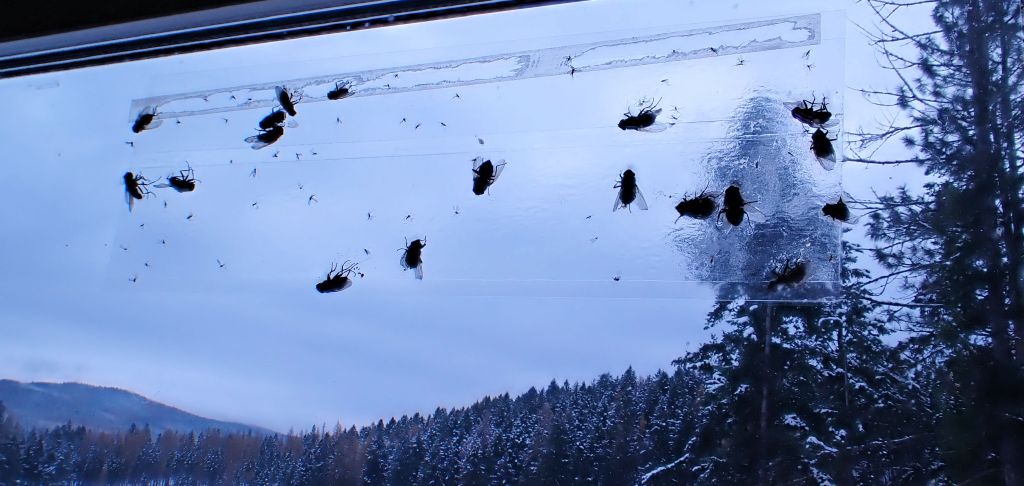
    My Mother-in-Law’s elegant, clear sticky traps, thoroughly filled with Cluster Flies and Fungus Gnats.

    While we see many house flies, flesh flies, and blow flies in the summer, they aren’t the primary species to invade our homes in the winter (though I’ve met a few of each overwintering inside my home).

    The vast majority of our new fly guests are a different group entirely – the Cluster Flies. Until quite recently, the Cluster Flies were grouped as a special sort of blowfly, but just over a year ago, they were given their own scientific family name, Polleniidae.

    Cluster Flies get their name from their habit of gathering in large groups, often in windows. Some try to stay warm outdoors, nestled deep inside rotting tree trunks. More sensible ones move inside with us to stay warm and survive the winter. Cluster Flies don’t want anything to do with your food, plants, or pets – they’re just here to avoid freezing.

    Eternal optimists, Cluster Flies often come out on warmer days, and try to find their way outside.
    Thus the accumulation of dead ones on your windowsills when weather turns cold again.

    It’s this habit of moving inside for the winter that is thought to have introduced Cluster Flies to the New World. You see, the Cluster Flies we have now aren’t North American natives. No. They’re thought to have sailed over from the Old World with some of the first European colonists.

    Back when European countries were busy sending ships to build colonies in the New World, they brought many unintentional stowaways with them. Many of these scalawags are with us today, for better or worse. In this story, we care about two such emigrants. Earthworms (especially the Green Worm) and Cluster Flies.

    It’s thought that earthworms were transported across the Atlantic in ships’ ballast. Meanwhile, some Cluster Flies took refuge from bad weather inside the ships themselves, just like they’re doing in our homes this winter, and so found their way to America as well.

    Earthworms flourished when ships made landfall. Many of the formerly-glaciated parts of North America no longer had earthworms, and were ripe for Lumbricid conquest. The spread of earthworms, in turn, opened up North America to the spread of Cluster Flies. Both spread like wildfire, and now can be found all over our continent.

    Why are earthworms important to Cluster Flies? You see, Cluster Flies are specialist parasites. Their maggots feed almost exclusively on earthworms. Mother Cluster Flies sensibly lay their little ones near earthworm burrows, and the newly-hatched maggots then see about journeying into earthworm burrows. There they lurk in ambush, waiting for a worm to pass by.

    Thinking of tiny maggots catching hold of vast earthworms with their mouth-hooks as the worm passes by very much brings scenes of Frank Herbert’s “Dune” to my mind. I like to imagine the tiny Cluster Fly maggots singing this song as they hunt their earthworm prey, and carve their way inside.

    Our friendly, local Cluster Fly – Pollenia pediculata.
    As you can see, they’re a bit larger and hairier than our common houseflies, as well as easier to catch.

    Because of their worm-based diet, Cluster Flies are actually remarkably clean compared to other flies with carrion- or dung-based diets. While you may not appreciate Cluster Flies’ presence, at least they will not spread disease.

    Additionally, both my dog and I can attest to their superb flavor.

  • Are there bugs in your mail?

    Are there bugs in your mail?

    I recently started working for the United States Postal Service, and, while I’ve been seeing quite a few bugs lately, few are the kind I like. While I’m not terribly fond of them, the sheer numbers these bugs occur in has been very impressive.

    Mercifully, with elections past, there’s been a sizeable reduction in the numbers of incoming bugs in our P.O. boxes.

    I’m talking about union bugs, specifically printers’ union bugs. These minuscule beasties seem to be on well more than half of our political junk mail this season! Here’s some fine examples of the species:

    These strange ink-based critters colonize almost all publications that come out of unionized printing presses.

    If you’ll notice, there’s a certain bias in the political affiliation of these bugs. At present, almost all Democrat-leaning political flyers are published in unionized print shops. Republican-leaning political flyers, on the other hand, are seldom published in unionized print shops, and most lack union bugs.

    Republican flyer, lacking the Union Bug

    This trend doesn’t necessarily hold constant across the country, though. Nor has it held constant over time – unions used to be strongly supported by the right, as a way that capitalism led to better worker conditions. And, alas, the presence of the union bug is no longer as indicative of an entirely union-made product as it once was…

    Due to prevalent local political sentiments, certain political flyers have been disguising themselves to sneak their messages into new homes. Take a look at this piece of political mail – at first glance, you’d assume that LR-130 is opposed to the Second Amendment.

    But look closer!
    A union bug. This indicates a union press was used, and the flyer in question was most likely published by a left-leaning group. When we examine the bones of this legislation, LR-130 is actually in favor of the Second Amendment.

    Cleverly camouflaged flyers and a fair bit of funding led to a surprisingly close vote on LR-130. It’s important to be well-informed on what the issues we’re voting on actually are – legislation and flyers rarely aim to be straightforward.

    Mercifully, while pests of a sort, political flyers do not reproduce, unlike invasive insects. Personally, I’m rather grateful that we only have to deal with this volume of political propaganda once every four years.

  • Harvestmen, or Daddy-Long-Legs

    Harvestmen, or Daddy-Long-Legs

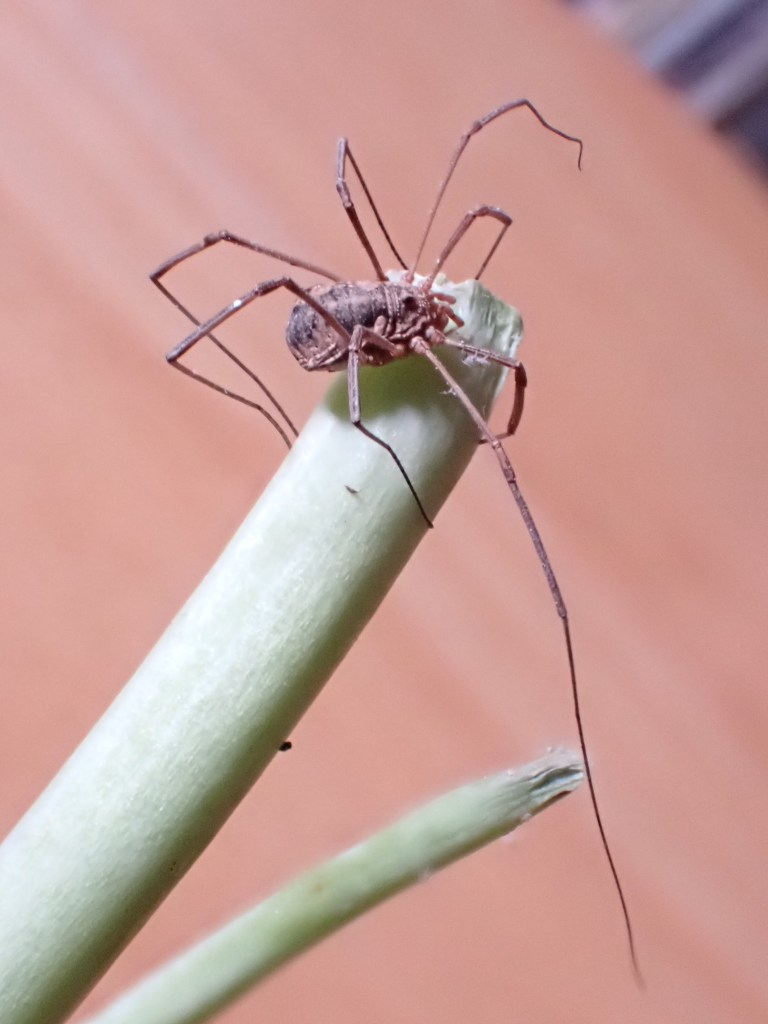
    Earlier this week, I met a Harvestman while making supper. It had stowed away on some kale from the garden, and was still walking about on it… even after a week or so in the refrigerator.

    The refrigerated Harvestman was promptly photographed and released in our garden’s cold frames.

    Harvestmen have a rather well-known urban legend. Perhaps you’ve heard people say that “they’re the most venomous spiders in the world, but are harmless to humans because their fangs are too small to puncture our skin.”This myth is mostly untrue. While Harvestmen are harmless to humans, they are NOT spiders – they’re closer kin to scorpions and mites. Additionally, they don’t have venom, though they do have some chemical weapons and chemical defenses. Some species, however, rely more on physical armor than chemicals.

    This Ecuadorian Harvestman sees no reason to limit itself:
    it has spiny armor and is putting chemicals on an arm, which it will then use as a whip!

    While many people call Harvestmen “Daddy-Long-Legs”, this common name is rather vague, and I try not to use it. It can also refer to Crane Flies and Cellar Spiders, and I prefer being specific. Incidentally, the harvestmen myth is equally untrue for those two organisms as well.

    Unlike most other arachnids, Harvestmen aren’t primarily hunters. Actually, many Harvestmen prefer to eat things that are already dead… They’re great scavengers, happy to eat dead vertebrates, dead invertebrates, and even droppings. One European species has been claimed to hang about bee hives, eating the dead worker bees that worker bees on the custodial shift are tossing out.

    Harvestmen are beneficial for our gardens though, because they can and do hunt small insect pests such as springtails. They use their tiny little pinchers and fancy chemical glue to catch their prey. If you’d like to see their feeding behavior yourself, I’d suggest waiting by a porchlight at night – I’ve found that they like to ambush and eat little moths. If you’re a bit more hands-on, Harvestmen are easy to keep in captivity, and could make a great science project (drop me an email if interested in more details).

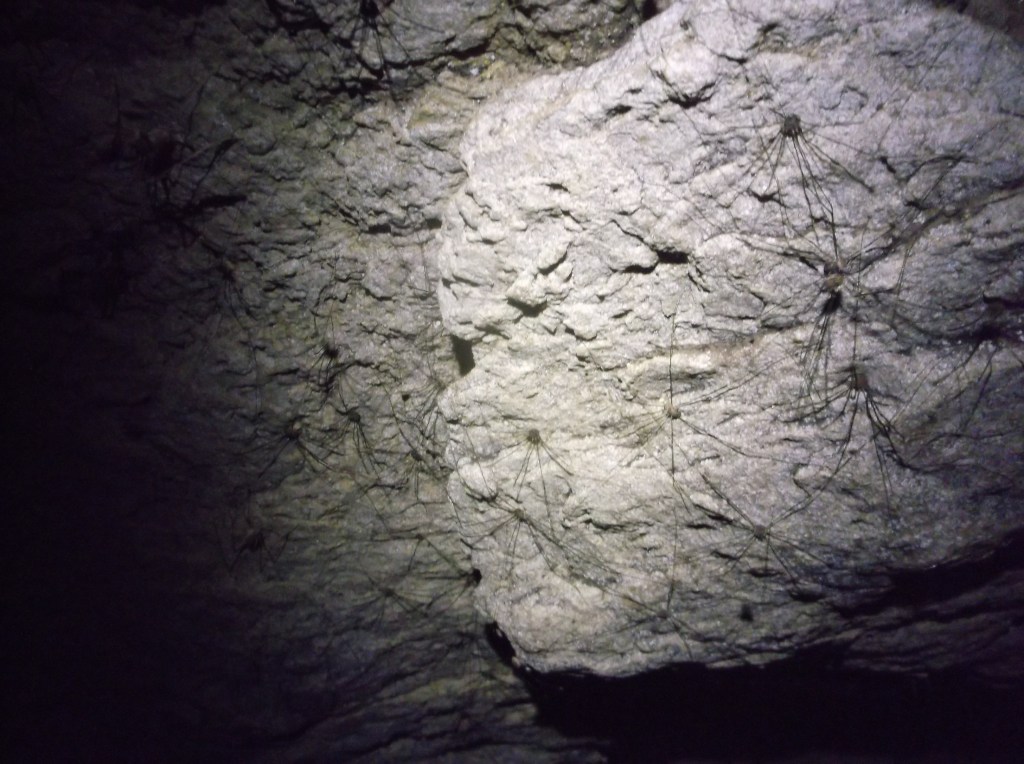
    As for why my Harvestmen was still alive in the refrigerator, these invertebrates tend to be Cold-Tolerant and Freeze-Avoidant. They’d prefer to be warm, increasing their odds of survival, so in autumn one can find large aggregations of Harvestmen. Sharing warmth, sheltering from the elements, and trying to survive the winter. This overwintering behavior frequently happens in caves, though in eastern North America, Harvestmen also overwinter in leaf litter.

    A disturbed aggregation of overwintering Harvestmen from a cave in Northern Tennessee.

    What have you observed Harvestmen doing?
    Hunting? Mating? Overwintering?

  • Ichneumonid wasps, imposing allies

    Ichneumonid wasps, imposing allies

    Last Thursday I saw this lovely Ichneumonid wasp (pronounced ICK-new-mon-id, from Greek “Ιχνευμων” which means “Tracker”). Most of the time I see Ichneumonids, they’re on the sides of trees, ovipositing (laying eggs) in boring insect larvae. This one’s behavior was very odd indeed.

    An Ichneumonid wasp, Pimpla pedalis, oviposits into a newly split piece of Douglas Fir.

    As you can see, this particular Ichneumonid wasp was laying her eggs inside a freshly split piece of Douglas Fir … or rather, inside a boring insect inside the Douglas Fir. Curious to see what insect she was laying her eggs inside, I peeled away layer after thin layer of wood …

    Uncovering the beetle grub (at left, mid-height) the wasp laid her eggs in.

    … And after an inch and a half of wood was removed, exposed a boring beetle grub. This is a Jewel Beetle grub, a member of family Buprestidae. These beetles can be lumber pests, though they’re unlikely to damage treated wood. While none of our Montanan Jewel Beetles are quite as bad, the Emerald Ash Borer has been devastating to ash trees throughout eastern North America.

    There it is, a Buprestid beetle grub, just to the left of the burrow it gnawed in the wood.

    I have very fond childhood memories of Giant Ichneumonid wasps. Most Sundays, my family would go to the arboretum of South Dakota State University’s then-public gardens. Among my favorite things there were some large multi-trunked cedars, which, in autumn, attracted some very large wasps. Presumably, the cedars also had very large wood-boring larvae that the Ichneumonids were parasitizing. Despite being a typical small human, making noise, climbing trees, and being generally bothersome, the Ichneumonid wasps never showed any sign of interest in me.

    While their large stingers and stinger sheaths look quite formidable, Ichneumonid wasps very rarely sting mammals or other large animals. Unlike typical colony-living wasps and bees, Ichneumonid stingers are almost exclusively used for laying eggs inside of host insects. Eventually the eggs hatch, and the baby wasps eat the host insect from the inside out. Parasites that always kill their hosts are called parasitoids (think of the Xenomorphs from the Alien movies).

    Fortunately for us, in addition to not stinging us or our pets, Ichneumonid wasps are also great at controlling garden pests. They take out a variety of garden pests (tomato hornworms, cabbage worms, etc.) as well as lumber pests (long-horned beetles, jewel beetles, bark beetles, etc.).

    All in all, they’re neighbors I’m quite glad to have.