Trego's Mountain Ear

"Serving North Lincoln County"

Category: Ask The Entomologist

  • Louse flies

    Louse flies

    It’s autumn. Among the many little signs of this are the appearance of Western Deer Keds, or louse flies, as they’re often called. As I was walking in the woods this past week, a number of them flew about me, a couple landed on my hand and ran up and down my arms. A poor life choice for them, as they were swiftly collected.

    Louse flies are members of family Hippoboscidae, and are best known for their very odd reproduction. They have their young one at a time, much like us humans. Females fertilize a single egg from stored sperm, the egg then hatches inside the mother fly’s reproductive tract. The resulting maggot nurses from a “milk” gland and molts several times inside the uterus. After about a week of this, the mother fly gives birth to a large late-stage maggot. In the case of the Western Deer Ked, the mother generally does this where the deer beds down for the night.
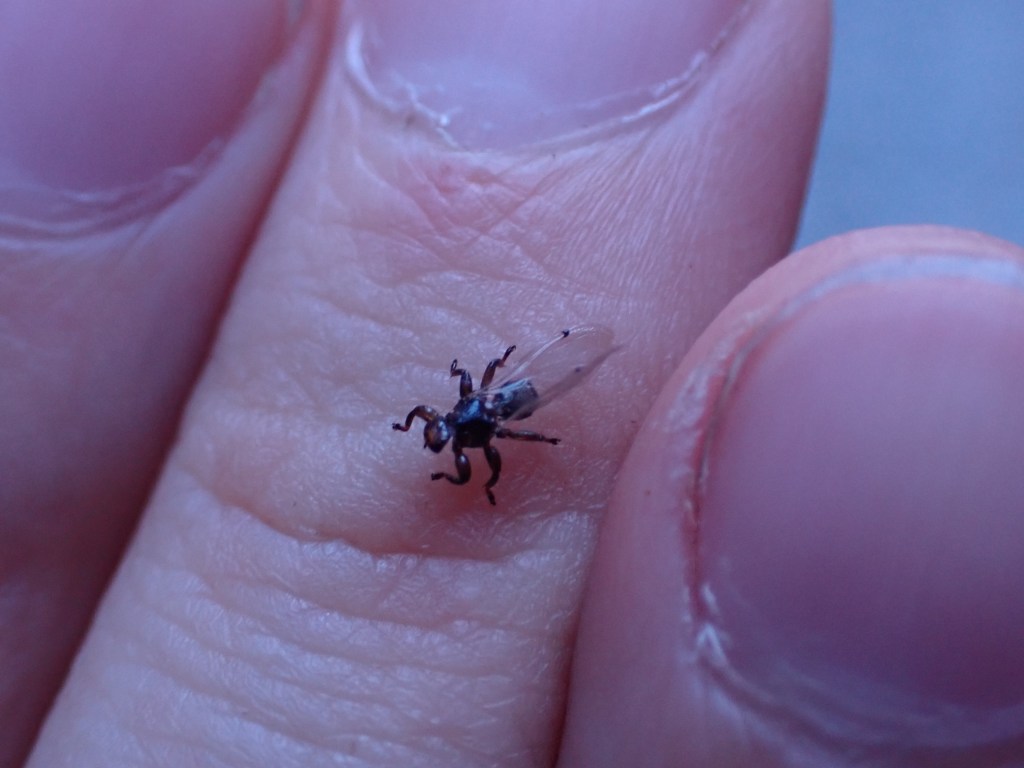
    Liptoptena depressa, a deer ked, courtesy of my in-laws’ dog (an unsuitable host).

    The late-stage maggot pupates immediately. After emerging from its pupal case as an adult in the fall, the new adult louse fly will take off in search of a suitable host. Once it finds a host, it will start feeding on blood, shed its wings, and will remain on the host until its dying day. Western Deer Keds can survive on Mule Deer, White Tailed Deer, Elk, and Moose. They may try to feed on other species – they can certainly bite. But they won’t be able to survive for long off of their proper hosts.

    Keds are best known as livestock pests – sheep keds are somewhat famous for the economic damages they can inflict. Native to Europe, sheep keds immigrated with humans, and are present across almost all of North America and much of South America, as well as parts of Africa, Asia, and Australia. While sheep keds have been reported, there is not good evidence that they can survive long on Bighorn Sheep or Mountain Goats.

    If you hunt turkey, and have tried for the “Grand Slam” you might have encountered turkey keds in the American southeast as well. There’s several species of turkey keds, but to the best of my knowledge, none have made it west of the Rocky Mountains yet.

    Have you met louse flies before? When, and on what?
  • Ask the Entomologist: Massive spider

    Ask the Entomologist: Massive spider

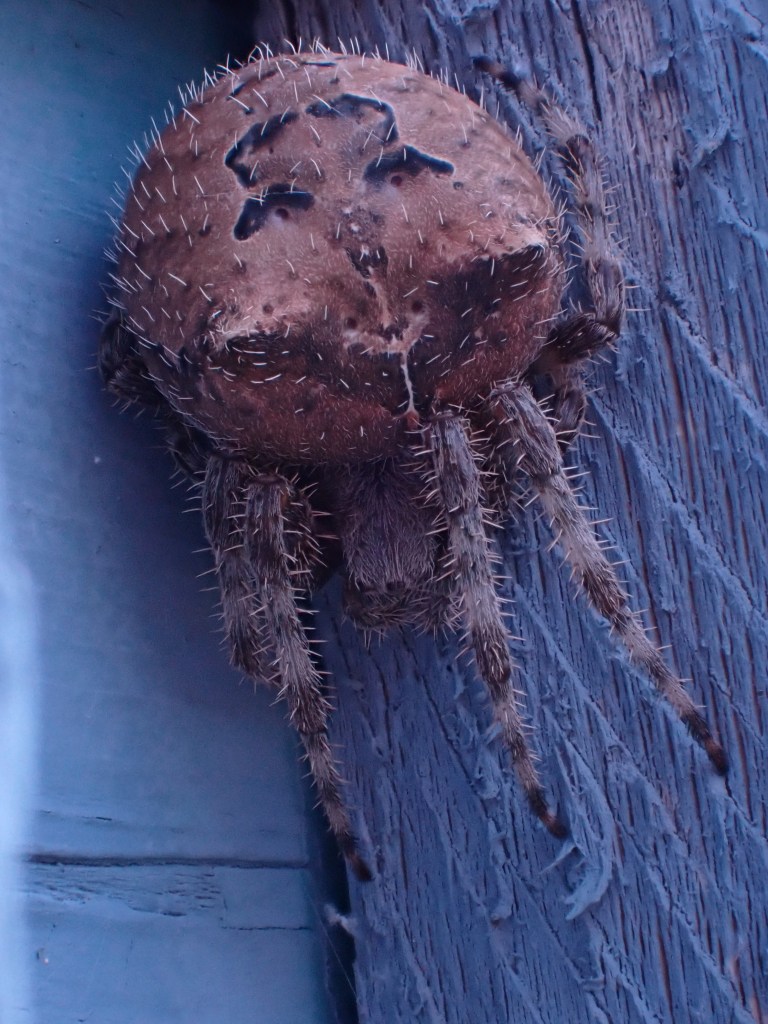
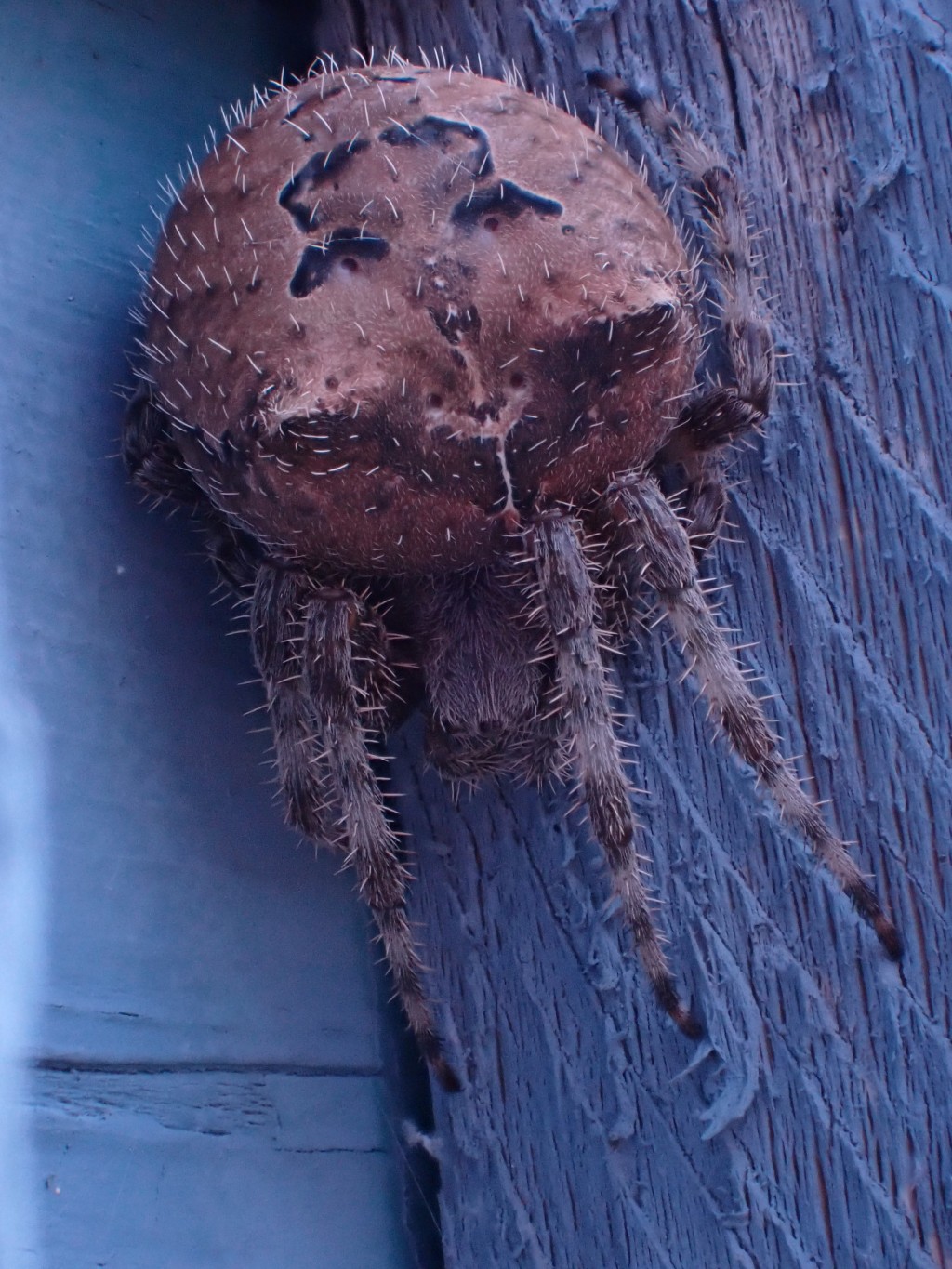
    This past week I had an identification request from a bit closer to home. This giant spider was perched right below one of our windows and my wife wanted to know what it was.

    Araneus gemma, the Gem-Shaped or Cat-Faced Spider.

    While I’d seen and admired her webs before, this was the first time I met the web’s weaver. She must have spent most days hidden behind the window AC unit. Revealed now that we’d removed it, now that fire season and the heat of summer seem to be past.

    As an entomologist, I have to say that I’ve met larger spiders, but this is the largest one I’ve seen up here in Trego. She’s an Orb-Weaver, a spider in family Araneidae. These are classic storybook spiders, straight out of Charlotte’s Web. When you see those beautiful wheel-shaped webs, big and round, full of droplets from the morning’s dew, these are the spiders responsible.

    I rather like Orb-Weavers – these spiders have pronounced sexual dimorphism. Females are often far larger than males – routinely twice the size, sometimes up to four times as large. Our A. gemma was quite large for her species, a 2/3 inches across the abdomen, and over an inch in length if we measure from the tip of her abdomen to her outstretched legs.

    At over an inch in length, she’s one of the largest spiders I’ve met here.

    As far as medical importance is concerned, the Gem-Shaped Spider’s bite is harmless to healthy humans. Additionally, I’ve handled many related Argiope orb weavers, and have never been bitten by them, so I don’t think receiving a bite from one of these is likely. However, if you or your loved ones are immunocompromised, elderly, or very young, more caution may be merited.

    Which common name do you prefer – the Gem-Shaped Spider or the Cat-Faced Spider?

  • Shiny flies

    Shiny flies

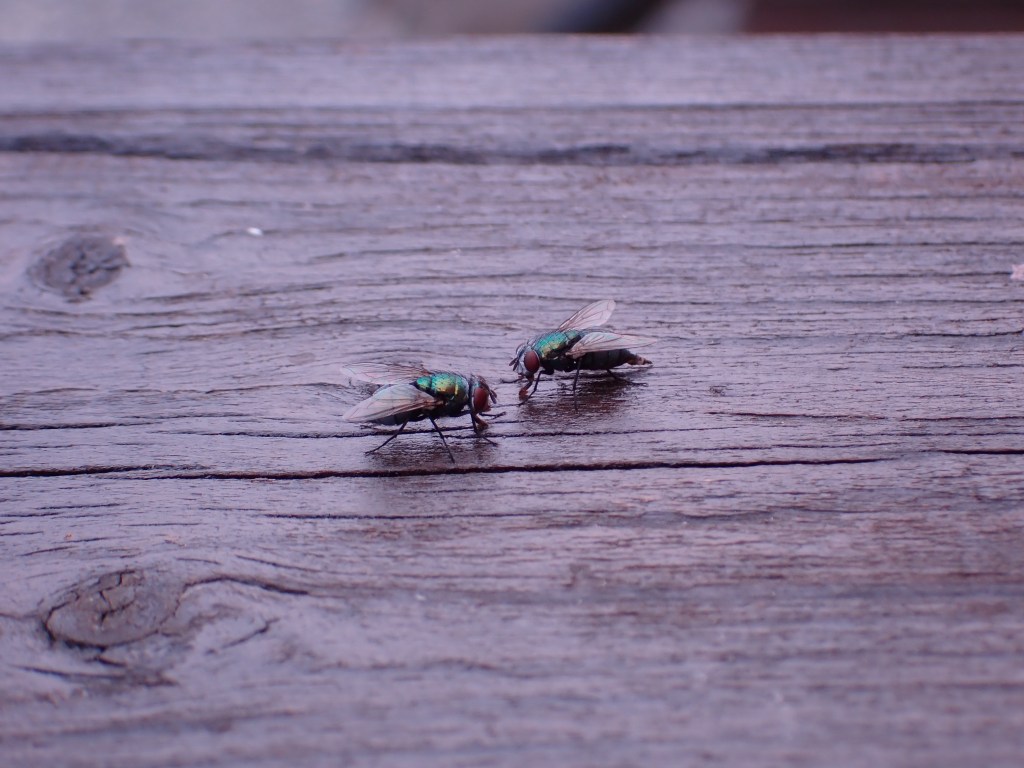
    Earlier this week we visited Trego School, to see the results of the salmon snagging fieldtrip. After the fish were had been cleaned and packed away for children to take home, I saw many bluebottle and greenbottle flies, as well as a few paper wasps, flying about outside of the school, sucking up fish juices.

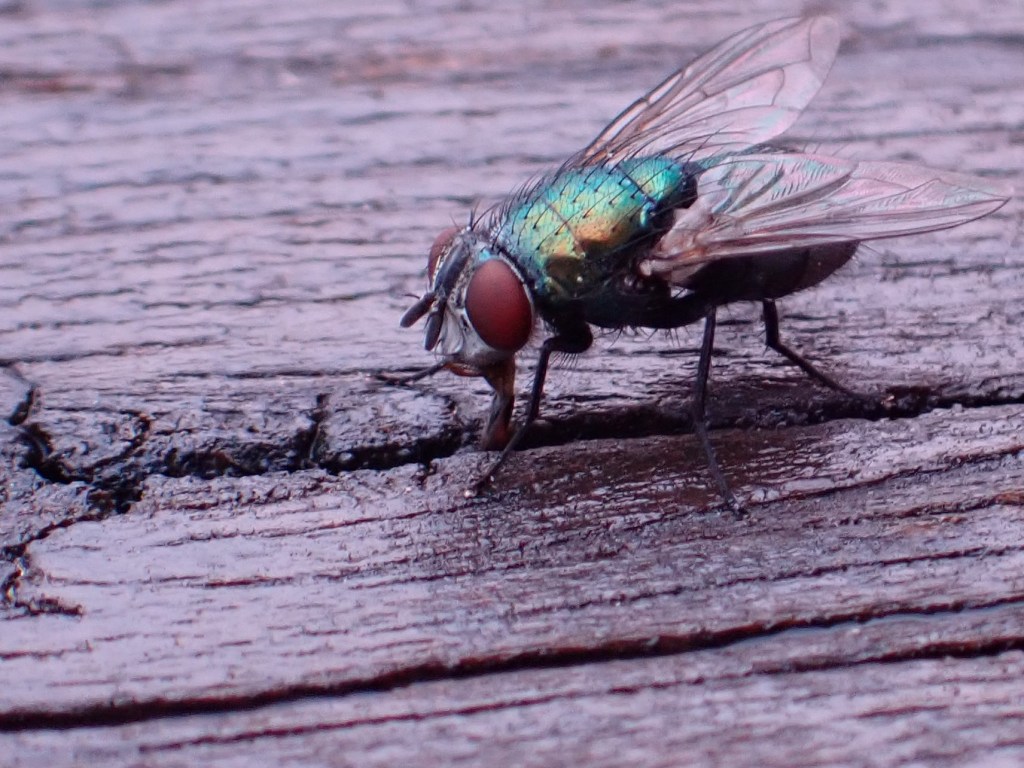
    Bluebottle and greenbottle flies are blowflies, members of family Calliphoridae, a name which translates to “carriers of beauty”. Rather fitting, given their bright metallic hues. Additionally, adult blowflies are excellent pollinators, and a very good thing to have in your garden.

    Two greenbottle flies, genus Lucilia, contemplating romance over a salmon dinner.

    Blowflies have an incredible sense of smell. In most parts of the world, blowflies find bodies within minutes of death, detecting the first smells of decay long before humans are able to. When they find the right sort of decay (some blowflies prefer dung to death), blowflies quickly mate and lay eggs before flying off.

    People throughout ancient Greece and Egypt believed that these shiny flies were the souls of the dead. Even today, some people in those countries consider it bad luck to swat at them, for fear that you might kill someone’s ancestor. I think this is a particularly beautiful story.

    Imagine, sitting gathered with family and friends as a loved one passes on, breathes their last breath. Within minutes, you can see their soul, in the form of a beautiful fly, flying about their mouth, nose, and eyes. Almost as if the soul is sorry to leave the body, as if the person wants to stay with their family. Perhaps they say “goodbye” before flying off to the afterlife.

    Today blowflies are appreciated for more than their attractive colors and spiritual significance. They are the most useful insects in forensic investigations – their young are very useful for figuring out time (and sometimes place) of death. While other insects can be used, blowflies are a forensic detective’s best friend.

    Blowfly maggots have even been used in medicine, as a way to clean dead flesh out of wounds, preventing sepsis and gangrene. Medical maggot use predates antibiotics! Napoleon’s surgeons noticed that fly maggots increased soldier survival! In the American Civil War, both sides used blowfly maggots to clean deep wounds. Maggots continued to serve and save lives in World Wars I & II, and are used for some conditions even today.

  • Pine Bark Beetles and Fire Risk

    Pine Bark Beetles and Fire Risk

    The dense smoke currently hanging over our part of the country has had me thinking about beetles. Why beetles, you say? Pine bark beetles and relatives (genus Dendroctonus) are notorious for killing large stands of coniferous trees (Fir, Larch, Pine, etc.) – even their scientific name translates to “tree killer”.

    As time goes by and environmental stressors increase, we’re seeing more and more tree die-offs related to these bark beetles. Death by bark beetle can triple the rate at which trees go up in flames. It’s not fair to put all the blame on the beetles, though – tree death is ultimately caused by infection from the fungi that the beetles spread. The one bright side of how destructive these beetles and fungi are is that they have been well studied. As a result, there are many ways of controlling their infestations.

    Douglas-Fir Beetles I found under bark while splitting some Douglas Fir wood.
    Note the “galleries” (tunnels) they’ve made – many bark beetles can be identified by the shape of their galleries.

    The most effective way we can control pine bark beetles on our own is by good management of our forest resources. Keep tree stands resistant to pine bark beetles by thinning trees to a healthy density – beetles are most likely to become a problem in over-crowded woods. Beetle damage will become evident by “boring dust” – spots of reddish sawdusty powder along the trunk, and “pitch tubes” – globs of resin the tree has pushed out, trying to stop a beetle’s tunneling (red pitch tubes likely indicate infestation, while yellow ones often indicate successful defense).

    Remove stressed, fire-damaged, and wind-thrown trees. Promptly clean up fallen timber. Damaged and downed trees are excellent places for pine bark beetles to reproduce, and should be removed before new beetles emerge! Where one beetle feeds and reproduces, there will soon be more – pine bark beetles attract each other to damaged trees by releasing aggregation pheromones.

    A close-up of three Douglas-Fir Beetles – they have since been executed for their crimes.

    My favorite method of control involves removing the pine bark beetles’ symbiotic fungi. Without these fungi, most of the beetles can’t reproduce well. Because it’s not practical to directly remove fungi from beetles in the wild, scientists have raised pine bark beetles in captivity. These captive-raised beetles can be inoculated with special aggressive fungi which can outcompete and kill the fungi that wild pine bark beetles carry. The thought is that captive beetles could be released and will interact with wild beetles, spreading their different fungi like a disease. The new fungus will prevent beetle reproduction and thus stop small infestations from becoming large and economically devastating ones.

    Unfortunately, beetle-delivered fungal control treatments aren’t ready for public use yet – ask your Forest Service folks what beetle controls they are researching and testing! If you’re particularly concerned about pine bark beetle infestation, they may be able to use chemical measures like anti-aggregation MCH pheromone to lessen the risk.

    Have you been seeing signs of pine bark beetle damage near your home?

  • Ask The Entomologist: Fluffy caterpillars

    Ask The Entomologist: Fluffy caterpillars

    Last week I received an “Ask The Entomologist” identification request.
    What is this fluffy caterpillar? It was found feeding on blackberry bush leaves.

    First off, adorable. This is a Tussock Moth caterpillar, so called after the little clumps of hair on their backs. Many fluffy caterpillars are in this group, family Lymantriidae. This particular species is called the Spotted Tussock Moth, and is native to our region. It’s not a picky eater, and will gladly eat willow, birch, and a range of other deciduous trees. We have another related species in the area, the Douglas Fir Tussock Moth, which can become an awful lumber pest, and has been linked with some health conditions in forestry workers.

    Beware! While Tussock Moths’ long hairs can feel soft if you stroke them gently, they often conceal shorter special defensive hairs! These “urticating” (itchy) hairs are like tiny spears and can be quite painful – some even come with venom. Many types of Tussock Moth urticating hairs can cause allergic reactions, the Spotted Tussock Moth (the one above) has even caused one case of anaphylactic shock. Even if you’re not allergic to the caterpillars, there’s the possibility of bacterial infection if the hairs break off beneath your skin.

    Tussock moth caterpillars can prove even more dangerous if eaten! Whether by livestock (abortions in mares, presumably others as well), pets (tongue rot documented in dogs), or unattended toddlers (often surgery, no deaths reported yet…) . The most serious condition resulting is that the eaten caterpillars’ hairs can puncture the digestive tract. This may cause bacteria to seep from the intestines into the body cavity, and can cause serious illness. While a healthy organism may be able to survive this, it often proves fatal to unborn young, which don’t have sufficiently developed immune systems.

    These caterpillars can be perfectly safe, and kids can have a great time watching them grow up into pretty little moths, but do be careful! If you think you, your kids, or your pets have been injured by contact with a caterpillar, Mayo Clinic has some medical advice. If you want to kill your Tussock Moth caterpillars, I suggest rubber gloves and a jar of soapy water.

    Looking forward to more bug questions,

    EntomologistJed

  • Paper Wasp Body Language

    Paper Wasp Body Language

    If you know what signs to look for when you meet a wasp, it’s easy to avoid being stung.

    Have you ever been buzzed by a bee or a paper wasp? They dive bomb you, fly close to your face, even collide with you, but without stinging? Those were probably sentries for a nest, trying to keep danger away. Sentry wasps can be stationed 10 to 20 feet away from the nest they’re guarding, and circle back to it from time to time. These wasps are the ones you’re most likely to come into conflict with.

    Yesterday, I went out looking for some pleasantly aggressive sentry wasps I had met earlier in the week. No luck – the day was too blustery, and all the sentries were huddled alongside the nest. Cold weather is a good time to pull down wasp nests, if you need to do so: fewer active defenders.

    At the nest itself, you’re more likely to see a different set of behaviors than the sentry flight routine. If the wasps in the nest consider you a threat, they will turn to face you, will lower the front of their bodies, and may open their jaws at you. If there are many wasps present, they may pulse their abdomens in unison, indicating that they may sting if provoked.

    A wasp threat display:
    Note the bend in its front elbows, the lowered chest, and the slight spread to its jaws.

    Beyond this, certain individual wasps are more aggressive than others. In the European Paper Wasp (the primary wasp discussed last week), as well as many related species, there’s a wide range of face patterning even among close relatives.

    Two European Paper Wasps – note their face patterning differences!

    European Paper Wasps with spottier faces are more likely to be aggressive than those with more uniformly pale faces. Generally, wasps with less dominant faces stay out of the way of wasps with more dominant face patterns. This seems to hold true for wasp-human interactions as well as wasp-wasp interactions. In the below picture, the European Paper Wasp with a spotted face pulsed its abdomen at me (a threat of stinging) while the pale-faced wasp did not.