Trego's Mountain Ear

"Serving North Lincoln County"

Category: Laws, Ordinances & Regulations

  • Repost: Community Decay: Part 3

    At long last, what exactly is community decay?

    Community decay “may include, but is not limited to any discarded substance, item, or material, such as cardboard, paper, pallets, tires, iron, or metal; demolition waste; construction or building material, such as bricks, concrete, or wood; junk vehicles; ruined or unusable boats, trailers, campers, or mobile homes, vehicle or machine parts; dead animals or animal parts; appliances; furniture; branches, logs, yard trimmings, or garden waste; or any other similar materials, items, waste, parts, or substances.”

    So, what is, and what isn’t community decay? I’ll offer some examples and consider whether they might potentially be community decay.

    • That old car your neighbor is working on. It’s blocked up and he’s been making repairs on it after he gets home from work

    Is that old car community decay? Looking at the definition of junk vehicles…
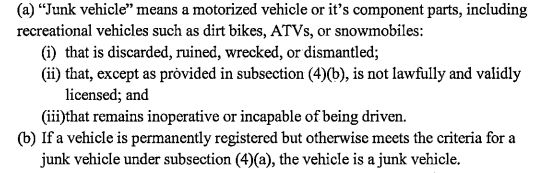
    That car could be described as dismantled, and it’s definitely not capable of being driven at this precise moment. So, junk vehicle? Based on this definition, it may well be one. Is it community decay? To meet the definition of community decay, the car would have to be “discarded”, so probably not. The more interesting question is how long can the project car sit, while the owner is busy with other things, before it is considered “Discarded”, and thus, community decay?

    The community decay ordinance fails to provide a definition for discarded, but one suspects it’s a word with gradations of meaning. After all, my “I’ll get to this project again someday” pile looks an awful lot like abandoned clutter until I get back to the project.

    Community Decay…Part 1

    One could be forgiven for assuming that community decay ordinances were the business of rather fussy municipalities in places other than here. One would, as it happens, be wrong on two counts. Lincoln County, Montana, has one. Back in December of 2018 the Lincoln County Board of Commissioners adopted Ordinance 2018-05 “An Ordinance to Control Community Decay Within Lincoln County and to Establish Procedures for its Enforcement”. So, this leaves us with several pressing questions: What exactly is community decay? Who does this apply to? Enforcement? None of these have short answers, so I’ll discuss each in depth in later…

    Community Decay… Part 2

    What exactly is community decay? Who does this apply to? The Community Decay Ordinance for Lincoln County (2018-05) reads “It is unlawful for any person to maintain conditions that contribute to community decay on property owned, occupied, or controlled by him or her on or adjacent to any public roadway within the county.” At this point, one might breath a sigh of relief. “On or adjacent to any public roadway”- that can’t apply to very much of the county, right? Ah, but this ordinance begins with definitions. Adjacent: “beside, next to, contiguous or nearby. Properties adjacent to any public roadway…

  • Repost: Community Decay… Part 2

    What exactly is community decay? Who does this apply to?

    The Community Decay Ordinance for Lincoln County (2018-05) reads “It is unlawful for any person to maintain conditions that contribute to community decay on property owned, occupied, or controlled by him or her on or adjacent to any public roadway within the county.”

    At this point, one might breath a sigh of relief. “On or adjacent to any public roadway”- that can’t apply to very much of the county, right?

    Ah, but this ordinance begins with definitions. Adjacent: “beside, next to, contiguous or nearby. Properties adjacent to any public roadway and properties within public view, as defined within this ordinance”

    This is a rather broad definition of adjacent, and I’d encourage the reader to consider how many places they know of that are “beside, next to, contiguous or nearby” a public roadway.

    Next. Public view: “any area visible from any point up to six feet above the surface of the center of any public roadway”

    So now we have any property “beside, next to, contiguous or nearby” any public roadway and “any area visible from any point up to six feet above the surface of the center of any public roadway”…

    I’d encourage the reader to imagine just how far one could see from six feet above the center of a public roadway on a hill.

    But wait- there’s more! All this assumes that we know what a public roadway is (it’s a road- right? Not quite). Fortunately, the ordinance includes a definition. Public roadway- “any highway, road, alley, lane, parking area, or other public or private space adapted and fitted for public travel that is in common use by the public”

    So, that leaves us with a rather broad idea of what sort of places community decay is not allowed. And we haven’t even gotten to what community decay actually is! More next time.

  • Re-Post: Community Decay…Part 1

    Editor’s note: With recent events making waste disposal more interesting, I thought it worth reminding people of the ordinance the county health department enforces with regards to waste management.

    One could be forgiven for assuming that community decay ordinances were the business of rather fussy municipalities in places other than here. One would, as it happens, be wrong on two counts. Lincoln County, Montana, has one.

    Back in December of 2018 the Lincoln County Board of Commissioners adopted Ordinance 2018-05 “An Ordinance to Control Community Decay Within Lincoln County and to Establish Procedures for its Enforcement”.

    So, this leaves us with several pressing questions:

    • What exactly is community decay?
    • Who does this apply to?
    • Enforcement?

    None of these have short answers, so I’ll discuss each in depth in later posts. For now, the quick summary:

    • Community Decay
      • Anything that is injurious to health, indecent, offensive to the senses, or an obstructive of the free use of property so as to interfere with the comfortable enjoyment of life or property...” that affects multiple people. Unless it’s agricultural- then, it’s okay.
    • Who does this apply to?
      • Renters/Landowners on property in the county adjacent to a public roadway (We’ll discuss what exactly a public roadway is, for these purposes, at a later date)
    • Enforcement
      • Misdemeanor: Fine up to $500 and/or 6 months imprisonment (Each day of violation is a separate violation…)
  • Why Did it Have to be …Guns? by L. Neil Smith

    Why Did it Have to be …Guns? by L. Neil Smith

    Editor’s Note: This seemed timely, so we’re running it again.

    Why Did it Have to be … Guns?

    by L. Neil Smith

    lneil@lneilsmith.org

    Over the past 30 years, I’ve been paid to write almost two million words, every one of which, sooner or later, came back to the issue of guns and gun-ownership. Naturally, I’ve thought about the issue a lot, and it has always determined the way I vote.

    People accuse me of being a single-issue writer, a single- issue thinker, and a single- issue voter, but it isn’t true. What I’ve chosen, in a world where there’s never enough time and energy, is to focus on the one political issue which most clearly and unmistakably demonstrates what any politician—or political philosophy—is made of, right down to the creamy liquid center.

    Make no mistake: all politicians—even those ostensibly on the side of guns and gun ownership—hate the issue and anyone, like me, who insists on bringing it up. They hate it because it’s an X-ray machine. It’s a Vulcan mind-meld. It’s the ultimate test to which any politician—or political philosophy—can be put.

    If a politician isn’t perfectly comfortable with the idea of his average constituent, any man, woman, or responsible child, walking into a hardware store and paying cash—for any rifle, shotgun, handgun, machinegun, anything—without producing ID or signing one scrap of paper, he isn’t your friend no matter what he tells you.

    If he isn’t genuinely enthusiastic about his average constituent stuffing that weapon into a purse or pocket or tucking it under a coat and walking home without asking anybody’s permission, he’s a four-flusher, no matter what he claims.

    What his attitude—toward your ownership and use of weapons—conveys is his real attitude about you. And if he doesn’t trust you, then why in the name of John Moses Browning should you trust him?

    If he doesn’t want you to have the means of defending your life, do you want him in a position to control it?

    If he makes excuses about obeying a law he’s sworn to uphold and defend—the highest law of the land, the Bill of Rights—do you want to entrust him with anything?

    If he ignores you, sneers at you, complains about you, or defames you, if he calls you names only he thinks are evil—like “Constitutionalist”—when you insist that he account for himself, hasn’t he betrayed his oath, isn’t he unfit to hold office, and doesn’t he really belong in jail?

    Sure, these are all leading questions. They’re the questions that led me to the issue of guns and gun ownership as the clearest and most unmistakable demonstration of what any given politician—or political philosophy—is really made of.

    He may lecture you about the dangerous weirdos out there who shouldn’t have a gun—but what does that have to do with you? Why in the name of John Moses Browning should you be made to suffer for the misdeeds of others? Didn’t you lay aside the infantile notion of group punishment when you left public school—or the military? Isn’t it an essentially European notion, anyway—Prussian, maybe—and certainly not what America was supposed to be all about?

    And if there are dangerous weirdos out there, does it make sense to deprive you of the means of protecting yourself from them? Forget about those other people, those dangerous weirdos, this is about you, and it has been, all along.

    Try it yourself: if a politician won’t trust you, why should you trust him? If he’s a man—and you’re not—what does his lack of trust tell you about his real attitude toward women? If “he” happens to be a woman, what makes her so perverse that she’s eager to render her fellow women helpless on the mean and seedy streets her policies helped create? Should you believe her when she says she wants to help you by imposing some infantile group health care program on you at the point of the kind of gun she doesn’t want you to have?

    On the other hand—or the other party—should you believe anything politicians say who claim they stand for freedom, but drag their feet and make excuses about repealing limits on your right to own and carry weapons? What does this tell you about their real motives for ignoring voters and ramming through one infantile group trade agreement after another with other countries?

    Makes voting simpler, doesn’t it? You don’t have to study every issue—health care, international trade—all you have to do is use this X-ray machine, this Vulcan mind-meld, to get beyond their empty words and find out how politicians really feel. About you. And that, of course, is why they hate it.

    And that’s why I’m accused of being a single-issue writer, thinker, and voter.

    But it isn’t true, is it?

    “Permission to redistribute this article is herewith granted by the author—provided that it is reproduced unedited, in its entirety, and appropriate credit given.”

    L. Neil Smith passed away recently – for folks who are unfamiliar with his writings, many are available at https://lneilsmith.org/   It’s worth checking out.  I’ve learned that few of these blogs live longer than a year past the author, and Neil Smith was worth reading.

  • The Petit Bourgeoisie Role in Irish Democracy

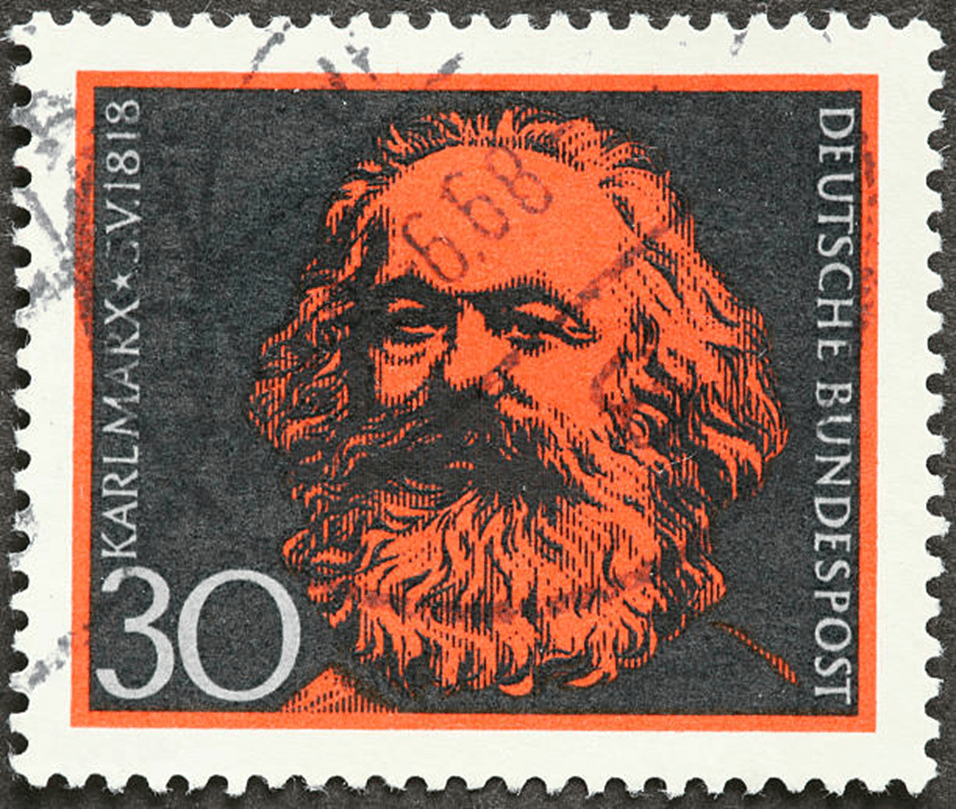
    Karl Marx thought the petit bourgeoisie would have a decisive role in the revolution – and I can’t think of better, more salt of the earth, examples of petit bourgeoisie than owner-operator truckers, farmers, and ranchers.  To Karl, the petit bourgeoisie were the small merchants, the self-employed artisans . . . folks who owned at least a part of their means of production.

    I’ve known quite a few owner-operator truckers, and met a whole lot more.  A CDL alone and the driver is a proletariat.  A CDL, with a down payment and a bank loan, and you’re looking at a member of the petit bourgeoisie.  The social distinction between proletariat and petit bourgeoisie isn’t hard to cross in the trucking business.  I doubt if there are a whole lot of haute bourgeoisie in the trucking industry, but the business converts the proletariat to petit bourgeoisie overnight.

    And truckers are near-natural participants in Irish Democracy – uncoordinated, wide-spread civil disobedience.  The multitude of regulations over the industry create awesome opportunities for civil disobedience.  The petit bourgeoisie with a restaurant has to stay put and conform.  The trucker, with 18 wheels, is harder to locate. 

    It is hard to think of an occupation more likely to bring Irish democracy into a political rally.  I have often listened to owner/operators who explained the need to keep two separate sets of books to make a living.  I recall the popularity of CB radios that announced where the bear was on the road.  I recollect radar detectors. “Irish democracy”  may be more pervasive among truckers than in Ireland.  And the Canadian government decided that they would need to quarantine for two weeks after crossing the US border.  If you look at populations (the old demographer talking here) about 70 percent of Canadians live further south than I do in Trego.  Somewhere around 85% of Canadians live within 100 miles of the US border.  Geography and demography have a lot of influence on where truckers drive. 

    Truckers – particularly owner-operators – are an occupation that can be described in Marxist terms.  A member of the lumpenproletariat with a commercial drivers license, a bank loan and a used truck moves into the petit bourgeoisie.  Equally important, if the truck goes and there is still money owed to the bank, he is back in the lumpenproletariat.  Close to the bottom margin of the petit bourgeoisie, the owner operator is in a position where carefully picking which regulations he (or she) observes makes the day more profitable.  The two week quarantine would end that trucker’s ability to make the payments on the truck.  Heck, a couple of hours beyond the legal allotment helps the bottom line.  Trucking is an industry that practices Irish Democracy during the good times.

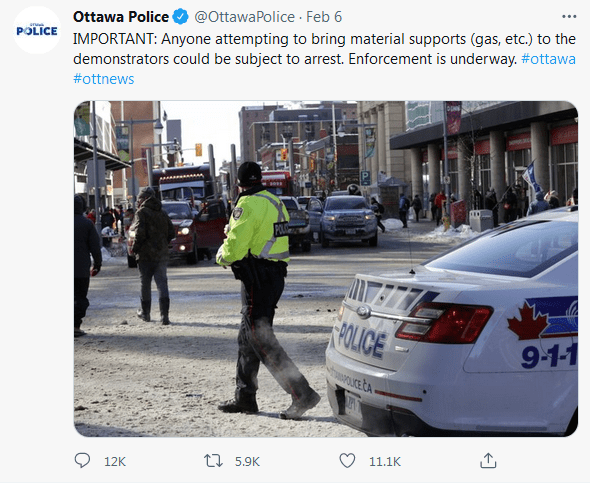
    So I’m watching my northern neighbors – they started with a Freedom Convoy driving to Ottawa, and now trucks and tractors have closed the main 24 hour crossing between Montana and Canada, over by Sweetgrass.  By Stalin era definitions, the petit bourgeoisie are right wing – so I can understand the cartoonist who labels the trucks fascist, and how the national media calls the convoy “right wing.”  Different ideologies have differing definitions. The libertarian sees a fascist as someone who comes up with, or enforces, rules that interfere with freedom. 

     It seems a bit strange that left-wing politicians turned out unable to use Marx’ definitions, class descriptions and the dialectic to see that the truckers were the social class, the industry, that could bring the protest to the capitol.  The small businessman with the restaurant, motel or grocery store is stuck in place.  Eighteen wheels and a diesel engine is a business that makes Irish Democracy more natural than compliance.

  • Canadian Libertarian Leader on Mandates

    Tim Moen, from up near Edmonton, has led the Canadian Libertarian party for the past 7 years.  His views regarding the unacceptability of pandemic mandates are available at timmoen.net.  He doesn’t write like the late L. Neil Smith – and the article I’ve linked to is definitely beyond Biden. 

    Moen starts with details on the non-aggression principle – while he describes it as completely as Smith did, it’s a bit harder read:

    Libertarians hold that the only morally legitimate use of force is in response to the initiation of force against a person or their property. So when we are determining whether the use of force is ethical (or legal in a libertarian order) we need to know whether the force was initiatory or defensive (in response to initiatory force).”

    He adds

    The argument being made by radical centrists (ie most politicians and establishment bureaucrats) is that all sorts of force must be used during a pandemic in the name of protecting people or decreasing pandemic spread or death. Libertarians do not judge government force (policy) based on whether it had the desired outcome, we judge it based on whether that force is moral or immoral, defensive or initiatory.”

    Moen offers thoughts on essential and non-essential workers:

    During the covid pandemic the government divided people into two classes; essential workers and non-essential workers. Ironically the language “essential worker” used to be used by government to force striking employees to go to work and now its being used to force people to not work. If you disobey government orders and open your “non-essential” comic book store, restaurant, or movie theatre you’d get some warnings and eventually men with guns would come and use force to shut you down. Is this force justified?

    A business owner is not initiating force against anyone by opening his store and serving customers. The customers are not initiating force against anyone by patronizing that store. So any force used against these peaceful people engaged in consenting activity ought to be considered criminal. It is not defensive force because it is not responding to any initiation of force. On the other hand if a person in that store is covid positive then they are initiating force against others assuming that their exhaled air containing harmful contagious pathogens is being inhaled by those around them. Force would be justified against the force initiator but not the innocent individuals.”

    It isn’t an easy read – but he does make his points and reasoning clear – which is a lot different than most of the political rhetoric we read.