If you leave trash sitting around long enough (about 50 years), something mysterious happens and it stops being litter (punishable by a $200 fine) and becomes an archaeological resource which if you remove from federal land could lead to a $500 fine and six moths in jail.
What’s the difference?
Litter is, according to the Lincoln County Ordinance:
“Litter” means any quantity of uncontained or openly stored materials which may be classified as trash, debris, rubbish, refuse, garbage or junk, including but not limited to: a) any worn out or discarded material that is ready for destruction or has been collected or stored for recycling or salvage; b) old or scrap metals, wire, rope, batteries, paper, tires, cardboard, plastic, cans, wood, concrete, glass, crockery, or rubber; c) dead domestic animals; d) animal and vegetable wastes from the handling, preparation, cooking, and the consumption of food that is not incorporated into a properly maintained compost system; e) discarded, broken, or unusable furniture, fencing, or building materials, f) discarded, broken, or non-functioning appliances, campers, mobile homes, junk vehicles, machinery, fixtures, or any component parts thereof, that are serving no apparent purpose, or will not be made to function within a reasonable time;”
Ordinance 2018-02 – Litter Control
It’s probably worth noting that Lincoln County’s litter ordinance doesn’t just apply to roadsides: “It is unlawful for an owner, lessee, or occupant of private property to allow litter to accumulate on his or her property.” As with the community decay ordinance, there appears to be some potential for overlap between “yard art” and “illegal”.
Archaeological resources are broadly defined by federal law, and include trash over 50 years in age (though only if it is of archaeological interest– that is, “capable of providing scientific or humanistic understanding of past human behavior, cultural adaptation, and related topics…”) Archaeological resources are covered by 36 CFR 261.9 (theft of government property, penalty of up to 500$ and/or up to 6 months imprisonment), which means that they are illegal to remove from federal lands.
So, 50+ year old trash? If it’s on federal ground, leaving it is the safer bet. On private property, while explaining it was an artifact rather than litter might make for an interesting argument, that $200 (each day) fine might also prove persuasive.
Litter, to be removed? Or an artifact to remain? Sometimes labels provided clues, allowing the item to be dated, and making the determination easier.
It’s amazing just how many regulations/rules/statutes/ordinances/laws are out there.
What we learned in grade school civics is simple and elegant, and unfortunately far from the complete picture. In elementary school we are taught the three branches of government: executive, legislative, and judicial. This is accompanied by the simple explanation that the legislative branch (the legislature) makes the laws and the executive branch (the president) enforces them. The same model is used by the state. Simple. Easy to understand. Incomplete.
While in the strictest sense the legislature can and does pass laws and the executive branch of government does enforce them, the actual situation is far more complex. Often, what the executive branch does is create a regulatory agency to enforce the law. For example, back in the 1970’s, President Nixon established the Environmental Protection Agency and charged it with enforcing the Clean Air Act. Of course, the EPA quickly grew to handle far more than just the Clean Air Act. Like other federal departments and agencies, the EPA creates rules and regulations which have the force of law. They aren’t laws in the same sense that the laws created by the legislature are, per say, but for the guy trying to follow them, there just isn’t much difference.
How many federal regulations are there?
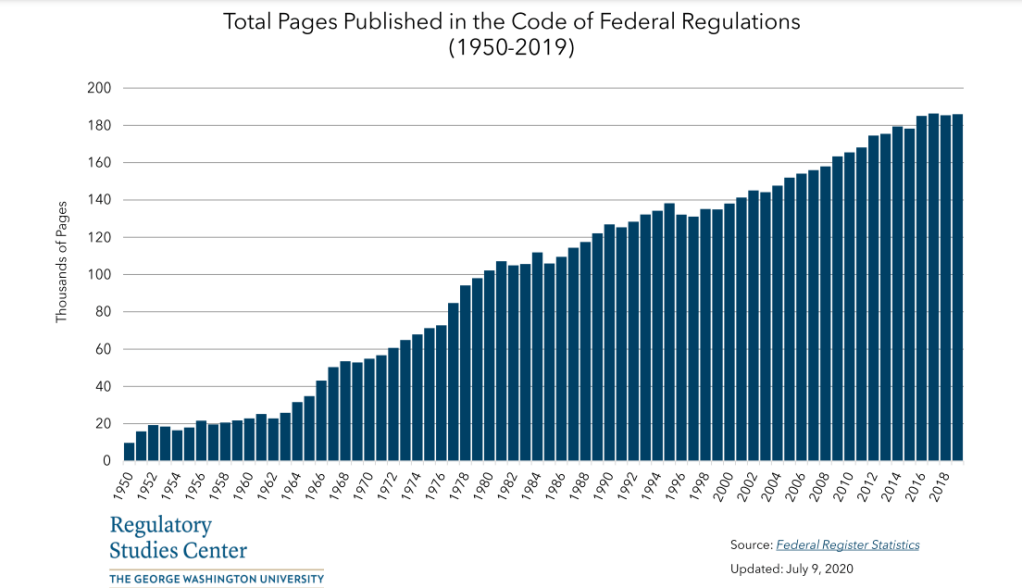
Statistics about federal regulations can be found here, provided by George Washington University. The entire collection of regulations is available online via the electronic code of federal regulations.
Given that George Washington University’s very nice bar graph has units in “thousands of pages”, it’s rather easy to conclude that there are lots of federal regulations. Of course, it’s likely that most of them won’t apply to any given individual, but how is one to know which ones do? Alas, without reading all of them, there doesn’t seem to be a good way to know.
And, of course, this is just federal. Each state and state agency has its own collection of regulations, plus county and local governments can pass laws (and regulations with the force of law).
The County’s list of ordinances is at least, mercifully short (Silver Butte Road, Community Decay, Park Rules of Conduct, Dog Control, Litter Control, Recodifying Ordinance). That said, the county’s regulations aren’t nearly as easy to find, being spread out across various departments.
The Lincoln County Board of Health is meeting Wednesday? To discuss what? A number of things, among them changing the procedures for public comment. Of course, it’s not entirely clear from the Agenda what precisely the board is expecting to talk about, but there are number of action items included.
The Lincoln County Board of Health will meet this Wednesday, at 6PM. The Agenda can be found here. It will be possible to attend via zoom. At the end of the last meeting (informational), Board Member Jim Seifert described a proposal for grading businesses. The meeting closed with Board Chair Jan Ivers remarking that the proposal would probably be discussed at the next meeting.
Looking at the agenda:
New Business (all action items): Nominate Officers, Set meeting schedule, Board Recommendation. No details beyond that, so it’s entirely unclear what exactly the board expects to be making a recommendation on.
Approval of Minutes
Program Reports: Community, Public Health, Environmental Health, Solid Waste and Recycling, Asbestos Resource Program.
Community: The first report is “Mental Health Coalition”. It’s not clear what this is, but the only thing on the county website that matches that search is Best Beginnings. The second is “Team 56”. Team 56 is those folks who’ve been holding the facial recognition contests (Which, yes, being faceblind, I found to be in rather poor taste). They can be found on facebook, where they’re not exactly widely popular (211 Followers, when the county population is over 19,000). The next report is “COVID Response Coordination & Communication Strategy, followed by Medical Provider Summary
Public Health: The first report for public health is “COVID-19”, which is followed by an action item: “CHEMPACK plan”. No further details are included.
Focus Area Liaisons: Asbestos (two action items) and Groundwater. The Action items include a property evaluation notification regulation, and the appointment of liaisons for superfund area.
City Representative Reports: While there aren’t any details given, the city representatives on the Board of Health include: Laura Crismore (representing Libby), Jim Seifert (representing Troy), and Debra Armstrong (representing Eureka)
Health Officer Report: Again, no details, but the Health Officer is Dr. Brad Black. (Interestingly, this isn’t information available on the county website.)
Old Business: Proposed Update to Operating Procedure #2. Operating Procedure #2, found here, is for how the board will handle public comments. It makes for an interesting read. Did you know that under the current Operating Procedure, all public comments or correspondence with the board will be available for review by any member of the public.
Public Comment: Under the current operating procedures, people commenting are required to address the board as a whole, and are allowed 3 minutes (more at the discretion of the Board Chair). Comments can be cut off if they are “not relevant, personal attacks, or not presented in a respectful manner”
Well, should be interesting. It’s not entirely clear if Jim Seifert’s proposal will be discussed, indeed, there’s a fair bit that isn’t entirely clear. Regardless, Wednesday, at 6 PM.
Last week, we asked if the County Board of Health was a fair representation of the county. We’ve looked at how people are distributed in the county before, in “Searching Lincoln County Data” and “If LCHS District were a County” and have mostly compared high school districts (which is a handy way of splitting the county into three).
Splitting the Board of Health into representation by high school district:
High School District
% of County Population
% of Vote on Health Board
Libby
50 %
57.1 %
Eureka (LCHS)
32 %
28.6 %
Troy
18 %
14.3 %
Considering things in terms of the high school districts makes for a much fairer picture than looking at them in terms of Libby, Eureka and Troy- but three members of the board do represent Libby, Eureka and Troy, specifically. There are only three members (plus one county commissioner) available to represent the rest of the county.
Comparing the representation of Eureka, Libby and Troy to that of the rest of the county leaves a rather different picture:
Area
% of Population
Board Representation
Eureka + Libby + Troy
23.1 %
Minimum of 3/7, or 42.9 %
The Rest of the County
76.9 %
Maximum of 4/7, or 57.1 %
Note that those are minimum and maximum values. The board is structured so that Eureka, Libby and Troy each get to appoint a representative, with the remaining 4 appointed by the County Commissioners. It is impossible, under the current structure, for Eureka, Libby and Troy to have less than 42.9% combined representation on the board.
Of course, as was evident in last week’s article, this is a fairly good deal for Troy and Eureka; Troy, with only 4.7% of the county population is guaranteed 14.3% of the vote on the board. Eureka, with 5.2% of the county population gets the same. Libby, at 13.2% is only slightly under represented. (Of course, these are minimums. Nothing says the county commissioners can’t appoint four Libby residents to the board…)
The Lincoln County Board of Health next meets on the 13th of January. The agenda, when available, should be posted on the county website along with the zoom link.
The County Board of Health met Wednesday, December 16th for an informative meeting. It wasn’t just an informative meeting though- it contained a proposal (one which the board anticipates discussing at the next meeting). The proposal (by Jim Seifert of Troy), while at the end of the meeting, was sufficiently surprising that we included it in part 1 last week.
The meeting began with Jan Ivers (board chair) discussing viruses and predicting another pandemic. Then, County Commissioner Mark Peck presented on the legal foundations of the Board of Health and gave a brief “how it all works” explanation. After, Kathi Hooper (Director of the County Health Department) explained the board’s budget.
Presentation about Testing: Lyn Thompson, a laboratory scientist, spoke via zoom about testing for the virus. She spoke with great enthusiasm about her topic, three tests: Molecular Diagnostic, Antigen test and Antibody test. According to Thompson, the four important characteristics of a lab test are: accuracy, timeliness, sensitivity, specificity.
A couple big things about the molecular part of it [testing], what it does not do: It does not tell you if the patient is infectious. It does not tell you if the patient is contagious. “
Lyn Thompson
Thompson clarified that the test itself simply detects or does not detect the virus. Antigen testing looks for a protein, rather than DNA, and is less specific and less sensitive but a quicker test. Antibody tests, meanwhile, are more useful for determining if someone has had a virus than if they are currently infectious.
A lot of these tests are only supposed to be done on symptomatic patients. Specifically the antigen test is really dependent on the person has to be symptomatic with covid-like symptoms in the first five days.”
Lyn Thompson
Thompson continued to explain that delaying an antigen test could result in a negative result, even in someone who had Covid-19, if they delayed long enough. Furthermore, an asymptomatic patient with Covid-19 could still have a negative result with an antigen test.
Presentation on Collaborative Medical Care: Sara (presumably Dr. Sara Mertes of Cabinet Peaks Medical Center, new member of the health board) spoke about the procedures used to both care for patients and avoid potential exposures. When a patient tests positive, the information is given to the Health Department, which does follow-up and contact tracing with the patient.
Cabinet Peaks Medical Center is able to send patients home with a monitor, which checks for drops in oxygen levels or tachycardia (rapid heart rate). Unfortunately, these monitors require WiFi or cell service, so are of limited utility.
Presentation onContact Tracing: Jenn McCully, Lincoln County Public Health Manager, discussed what happens when the Health Department is notified of a covid case. Contact tracing assumes that someone is contagious either two days before symptoms, or two days before the positive test (whichever is sooner). Isolation is supposed to be at least 10 days, and to include being isolated from other household members. It will also include occasional calls and check-ins from the department.
Presentation on Vaccinations: Dr. Kelli Jarrett, of the Northwest Community Health Center, gave an overview about how vaccines work. Then, she went into more detail about the Covid-19 vaccine. The vaccine is an mRNA vaccine, which makes it somewhat different from the vaccines we are used to.
The reason that mRNA technology is actually really nice, especially in this circumstance is that it can be scaled up much faster than our current vaccine technology.”
Dr. Kelli Jarrett
Dr. Jarrett provided a detailed overview of the safety data for the Pfizer vaccine, and observed that the number of adverse reactions seen in the trials is comparable to commonly used vaccines (adverse reaction can include pain, fever or muscle aches; it needn’t be severe). The efficacy rate of the vaccine seems to be quite high.
The presentations wrapped up with contact information: Anyone with questions for specific presenters should contact Kathi Hooper, the director of the County Health Department.
Finally, the meeting closed with a comment from Jim, the Board of Health member representing Troy. Seifert proposed giving businesses an A/B/C/D rating, primarily based on mask wearing (both of employees and customers). His proposal seems to entail members of the county health department inspecting and rating businesses.
The Board of Health next meets on January 13th. According to Board Chair Jan Ivers, Seifert’s proposal will probably be on the agenda.
Did a member of the Board of Health actually propose a “grading system” for local businesses, based on compliance? Where does the County Board of Health come from? What powers does it have?
First, some background: The Lincoln County Board of Health has seven members. It is chaired by Jan Ivers of Libby. Of the seven members, three are “Lincoln County Representatives”, another three represent Libby, Eureka and Troy, and the final member is a County Commissioner (at this time, Josh Letcher).
Wednesday’s meeting was for the purpose of informing the public, rather than deciding/voting on policy. It began at 6 pm, and could be attended via zoom. A full recording of the meeting is available here– it’s about an hour and 15 minutes. I’ll give the short version here, and do my best for accurate quotes (with the right names associated, but as I’m faceblind, mistakes do sometimes slip through).
The meeting was shared by DC Orr of Libby, whom I presume can be credited with the recording.
The meeting had 7 presenters, and began with an explanation by Board Chair Jan Ivers, about viruses and pandemics. Talking about pandemics, Ivers predicted another pandemic and listed some reasons.
There will probably, as soon as we get this one under management, there will probably be another pandemic in the future. And there are a couple reasons for this: Population growth. We have a lot more people, a lot more crowding. We’ve gone from agriculture/rural into higher density populations. There’s some deforestation due to needing more agricultural land. Modern travel. I mean we can go almost anywhere to home in 24 hours which means that organisms don’t have that far, or that long to go. Increased Trade due to imported foods, exotic pets. And Change in the weather patterns that makes a difference in when these viruses go into humans. Here we don’t have this problem as much, but lack of access to public health is a big issue as far as [coughing] virus”
Jan Ivers
The first presentation was by County Commissioner (District 1) Mark Peck on the topic of Organizational Structure. Peck remarked that “There’s a lot of confusion over who has what authorities”. Peck explained:
“Essentially, Montana Code Annotated 50-2-106 covers how health boards are formed. There’s a few different kinds of health boards… We chose a number of years ago to go with the city county health board model because it allows the three cities as well as the county to have joint representation and have representation for themselves on the board.
So essentially what that means is that at minimum you have to have a county commissioner. The city of Libby has one position that they can pick at large. The city of Troy has one they can pick at large. And The city of Eureka has one they can pick at large. And then we decided within the bylaws of the board, and this was a concurrence from the commissioners and the three city councils and mayors that the commissioners would have an additional three positions. So you’ve got four positions that are selected from the county commissioners and then one from each of the cities and that’s where the seven positions come from.”
Mark Peck
With three Board Members coming out of the cities, it makes sense to consider what percentage of the county population the cities are.
City
Population
Percentage of County
Eureka
1037
5.2%
Libby
2628
13.2%
Troy
938
4.7%
All three
4603
23.0%
The numbers are from the 2010 Census (the 2020 data isn’t out yet) the County population was 19,980
Basically, the three incorporated communities, with 23% of the county’s population are guaranteed 43% of the board membership.
Peck continued, discussing the County Health Board and the appointed Health Officer:
Know a lot of people think well the county commissioners, we can just do away with this board. Well, actually we can’t. We have to have concurrence of the three cities to do that. Very similar to, well, the cities can’t blow it up on their own either and that’s a check and balance to make sure we’ve got consistency.
So anyway the authority of the cities and commissioners in Title 50 is strictly to appoint the Health Board. The Health Board has its own set of authorities and regulations that the cities and county don’t have, because per law that’s been delegated down to the Health Board. And those responsibilities you’ll find them in Montana Code Annotated 50-2-116 and one of the first authorities and requirements of the health board is to appoint a health officer.
The health board has appointed Dr. Black as the county health officer. The county health officer, those authorities fall under 50-2-118 so it’s a different, although they’re very similar authorities, the health officer has unique authorities that the health board does not…
Mark Peck
Peck went on to answer several questions he had been asked by his constituents. Can the health board be reorganized or disbanded?
…Yes, in theory the health board can be reorganized but it’s not a matter of just the county commissioners doing it. We would have to have all three cities as well as the county commissioners agree to disband the board….
Mark Peck
Why isn’t the sheriff enforcing the mandates?
We still are in a state and a country of laws, and the sheriff can only enforce laws that he’s been given authority through Montana Code Annotated… the Sheriff does not have authority under title 50 to go arrest somebody or to enforce the Governor’s mandate. They can assist if there’s some type of an issue. But that’s why you’re seeing law enforcement agencies not running around enforcing this…”
Mark Peck
Is the health officer completely autonomous?
No, he isn’t. The health board could replace the health officer…”
Mark Peck
After Mark Peck finished, Kathi Hooper, Directer of the County Health Department began the second presentation of the evening. The topic was finances.
The finances of the Board of Health are really pretty simple. They have a small budget that’s approved annually by the commissioners. In the previous fiscal year which is July of 2019 through June of 2020 the Board of Health expenditures $15,790. And of that total 95% was professional services, including approximately $9,400 for legal services and $6,300 for local health officer. So far this fiscal year which started July 1st the Board of Health expenditures totaled $3,198.”
Kathi Hooper
If a business spent 57% of it’s budget on legal services, well, that might suggest some problems.
Skipping ahead a bit in my summary, towards the end of the meeting Health Board Member Jim Seifert (Representative of the City of Troy) spoke for the five or so minutes of the video below. Seifert outlined a proposal that did indeed involve giving businesses grades.
I want to bring up a proposal. What I want to do is I want to do exactly what the health department already does. The health department right now regulates restaurants and food establishments. I want to regulate public spaces for the same thing for our response to covid. And what that is, is we have three things that we can do that are positive. We can do masking, social distancing and hand washing. Well, it’s hard to monitoring hand washing because you can’t be there all the time, but the masks and the social distancings[sic] we can. And what I want to do is go to public places, excluding churches and excluding schools because they’re mandating their own, and set up a A/B/C/D rating for these establishments.”
Jim Seifert
Seifert stated that he would give an A+ rating to a business that makes everyone that comes in put on a mask, a business where all the employees wear masks (but they don’t greet people at the door and inform them to put on a mask) a B, with the grade lowering for incorrectly mask wearing. C rating would be for businesses in which only some employees where masks, and D rating for those businesses that do not where them.
Jim Seifert of Troy proposes a rating system for businesses
Who would enforce Seifert’s proposal? He was quick to say not the government, and not the police. Rather, Seifert states that he expects the citizens of Lincoln County to do the enforcement. He imagines businesses being rated on social media, and in the newspaper, signs placed on their doors, and these signs helping citizens to decide where to shop.
Now, Seifert is the board member that represents the city of Troy. The 2010 population of Troy was 938, or 4.7% of the county’s population. He certainly has ideas for the whole county though!
Seifert went on to talk about vaccines, stating that the idea that vaccines would be mandated (people would be forced to get them), is a propaganda conspiracy-theory.
“We don’t do that in the United States that I know of. And what I call that, is I call that gas-lighting.”
Jim Seifert
The meeting closed with the reminder that the next Board of Health meeting is the 13th of January (the second Wednesday of the month), and the thought that Seifert’s proposal will probably be on the agenda. Written Comments or questions to the board should be addressed to Kathi Hooper. While written comments are accepted at any time, they must be received a week in advance of the meeting to be addressed at that meeting. For a comment to be addressed at the next meeting, it should be sent in no later than January 6th.
Meeting Summary to continue in next week’s Mountain Ear. If you can’t wait- feel free to watch the whole thing (and write the rest of the summary- get in touch, we’ll post it!)


 Trego's Mountain Ear