Trego's Mountain Ear

"Serving North Lincoln County"

Category: Weird Words

  • Rendezvous Again

    Since it’s that time of the year again- it also seems time to revisit what we’ve said about the origins of the word.

    Origins of the Word Rendezvous

    One of the reasons that English is described as difficult to learn is the number of words- over 170,000! Of those, the majority are loan-words, words taken from other languages.

    The word Rendezvous is one such word. It was appropriated from the French, around 1600 (during a brief period in which Britain and France were not at war- as a result of competition with Spain). The original usage appears to be a verb: rendez vous meaning present yourselves. This then becomes the noun describing the place of meeting we are accustomed to.

    English has borrowed from different languages at different times. At the time Rendezvous joined the English vocabulary, a significant number of the new words were coming from French.

    About two centuries after Rendezvous was appropriated from the French, William Ashley held the first trappers’ Rendezvous. These lasted for only fifteen years. Some of them were so large as to create temporary towns. Other gatherings in the same time period are occasionally given the same name. Our local Rendezvous has outlasted the original.

  • Origins of the Word Rendezvous

    One of the reasons that English is described as difficult to learn is the number of words- over 170,000! Of those, the majority are loan-words, words taken from other languages.

    The word Rendezvous is one such word. It was appropriated from the French, around 1600 (during a brief period in which Britain and France were not at war- as a result of competition with Spain). The original usage appears to be a verb: rendez vous meaning present yourselves. This then becomes the noun describing the place of meeting we are accustomed to.

    English has borrowed from different languages at different times. At the time Rendezvous joined the English vocabulary, a significant number of the new words were coming from French.

    About two centuries after Rendezvous was appropriated from the French, William Ashley held the first trappers’ Rendezvous. These lasted for only fifteen years. Some of them were so large as to create temporary towns. Other gatherings in the same time period are occasionally given the same name.. Our local Rendezvous has outlasted the original.

  • Two bits on inflation.

    Two bits on inflation.

    Recently a friend explained the meaning of the phrase “two bits” to me.
    It means “25 cents”. He recalls hearing a song on the radio when he was young that went “two bits, four bits, six bits, a dollar”. While I was unable to find this song (the closest I came was a Florida state sports cheer), I did stumble on some more of the history behind the expression.

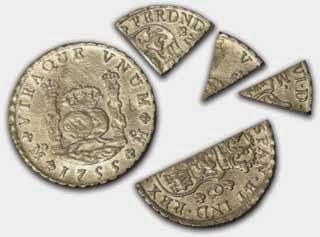
    Back when the Age of Discovery was still underway, many countries were basing their currency on the Spanish silver dollar. Spanish silver dollars were often cut into eight pieces (like the slices of a pie). These smaller pieces were used as coins worth fractions of a dollar. Thus the Spanish silver dollar coin was also sometimes called “a piece of eight”, as it could be cut into eight “reales” or “bits”.

    See the source image
    A silver dollar, as well as 4-bit, 2-bit, and 1-bit pieces.

    Many fledgling governments based their currency on the Spanish silver dollar. In 1792 the US government created a standardized currency for itself. The newly-founded U.S. Mint fixed the value of the American dollar to that of the Spanish silver dollar. When the first American quarter-dollars were minted, each was worth two 1/8 bits of a Spanish silver dollar.

    Of course, inflation happened, as it usually does, and the Spanish pieces of eight (or “pesos”) were made with less silver than older ones, and their size kept dropping. The same could be said of Mexican Pesos, which started out based on the Spanish silver dollar as well. Eventually America went off the gold standard as well.

    This brought the tune of “shave and a haircut (two bits)” to mind… Those words accompanying the tune date back to the 1930s… and provide us with an inkling of prices then.

    It’s hard for the younger of us to imagine that a quarter used to be worth that much.
    Nowadays I understand that a haircut tends to cost about $25.00 – one hundred times as much, in less than a hundred years.

    It’ll be interesting to see how much one costs five years from now.

  • Weird words: Petrichor, stone’s blood.

    Weird words: Petrichor, stone’s blood.

    Stepping outside after this weekend’s much-needed downpours, I was met with a familiar fragrance. The smell of the earth after rain, sometimes called “Petrichor”.

    This is a fairly modern word, cobbled together by a couple of scientists in 1965.
    It’s derived from two Greek word roots. Petra (πετρα) meaning “rock” and ichor (ιχωρ) meaning “blood”. But ichor is usually a special sort of blood – the juice that flows in the veins of a god or giant, perhaps a monster, not a mere mortal.

    Petrichor’s scent is strongest after rain beats down on hot, dry soil. When rain pummels the earth, it stirs up waste from tiny soil bacteria called Actinomycetes… tossing tiny particles of something chemists have named “geosmin” into the air.

    Interestingly enough, this same compound that brings us that lovely post-rainstorm aroma is also responsible for strong earthy flavors.

    It’s why catfish and other bottom-feeders can taste a bit muddy at times (especially when caught in hot weather). It’s also why fungi and vegetables can taste a bit earthy, even after being thoroughly washed. Personally, I’m fond of strong-flavored catfish and earthy beets and mushrooms, but to each their own.

    If you’re not fond of those earthy flavors, consider adding an acid during cooking (such as vinegar). This will cause geosmin to break down and give you less-fishy tasting fish or vegetables that taste less of dirt.

    On a more entomological note, mosquitoes are attracted to geosmin’s smell in preparation for laying their eggs. A number of entomologists and chemists are currently experimenting on traps using geosmin extracted from beetroot skins.

    I look forward to seeing how geosmin trap technology develops – but I suspect it’d be quite possible to come up with a homemade trap based on the same principles that’d work well. After all, if we can collect and destroy many mosquito eggs, we should see some dint in next years’ mosquito populations.

    There are few scents I’d rather breathe in.

  • Weird Words: Emoluments

    Perhaps we should call this “ask the etymologist”…

    Emolument comes to us by way of Latin – specifically, ēmŏlŭmentum literally means “something that is produced from work”. Different forms of the Latin word “emolument” meant striving for success and achieving success, but it also referred to profits, gains, or benefits. “Emolument” can be dissected into a couple of word roots to help us remember the meaning of “emolument”.

    “Ex-“ or “E-“ means “out/out of” in both Greek and Latin. Think of organ removal surgeries – an appendectomy is when an appendix is taken out, likewise a hysterectomy is when one’s uterus is removed. Alternatively, some Christians believe in creation “ex nihilo”, God’s creation of the universe “out of nothing”.

    “Melere” means “to grind” in Latin. This word root has a fine and storied history, older by far than Latin, going all the way back to Proto-Indo-European. Think of all the words we have that come from this today! Our grinding teeth are called “molars”, certain hammer-related crushing tools are called “mauls”, a “miller” crushes things in a “mill” and the resultant “meal” is what has been crushed.

    So, if we mash those two word roots together ex-melere → e-melere emolument would roughly translate as “the outcome of grinding” (money, if you’re the miller).

    This word appears prominently in the Foreign Emoluments Clause in the U.S. Constitution. This clause was put in place to limit the amount of governmental corruption, particularly by outside money… A worthy goal, if hard to achieve.

    The idea is that we don’t want our officials, either elected or appointed, using their positions to achieve personal gain. Most organizations, whether community, state, or national-level have safeguards to prevent emoluments. One doesn’t want an employee giving preferential treatment to certain people because of secret bargains. It’s also a common word to see in Nepotism laws.

  • Developing International Socialism

    As you could figure, the problem with Marx’ theoretical communism is in two concepts – first “from each according to his abilities, to each according to his needs” kind of breaks down fast in the real world scenario, and second, when all property is publicly owned,  real decision-making is in the hands of the manager.  Lincoln Electric is our closest example – with the slogan “owned by the people we serve.”  I remember how many of the owners showed up over 30 years ago to take the co-op back – and what an unusual accomplishment it was.  The cooperative is technically owned by the members – but it is controlled by the manager except for rare occasions.

    The term for the manager controlling a socially owned means of production was first used by Joseph Weydemeyer – a lieutenant colonel in the Union army, a Republican and a Marxist. He formed the first Marxist organization in the US.  I never did get a quiet chance to ask Winton Weydemeyer politely about what he might know about Joseph, and still regret the unasked question – there just never was a courteous opportunity.   Anyway, since a socially owned means of production can’t be managed by the owners, Joseph Weydemeyer gave us the term “dictatorship of the proletariat.”  It is an important term in differentiating between Marx’ view of communism and the international socialism we think of as communism.

    While Marxist communism couldn’t get past this management problem, it wasn’t a problem until the Russian Revolution.  All at once the communists had a big country to manage – and the successor to Marxism was Leninism.

    “Leninism can be explained as the political theory that works towards the organization of a vanguard party which is revolutionary and achieves to attain dictatorship of the proletariat in order to establish socialism. This vanguard party’s aim was supposed to provide the proletariat consciousness about their class in order to destroy capitalism in Imperial Russia. He knew that imperialism was caused by capitalism and it was the exorbitant point of capitalism. Communism is a higher form than that of capitalism, it was proposed that the revolution by the proletariat had to occur first in the economically and industrially advanced countries.

    According to Lenin, the Communist party consisted of a scientific understanding of the history and of a society guided by the Marxist principles. They were deeply committed to ending capitalism and replacing it with socialism. They believed that this was only possible with the acquisition of political power. The aim of achieving this political power made them do anything that was possible, be it violence or revolution if required. Lenin argued that the workers or proletariats alone could acquire revolutionary and class consciousness that was needed. Deep within he was afraid that the proletariats would become easily content with smaller gains in their living as well as working conditions acquired through the various trade union activities. He feared that the proletariats would be diverted easily in their motive to dethrone capitalism. This was the point where Leninism differed from Marxism. For the Marxists, material conditions were enough to facilitate the workers to realize their need for revolting . . . Some of the unprecedented results of Leninism were that its pursuit of creating a socialist society led to the creation of a totalitarian state where all the social, economic, cultural, aspects of life were being controlled by the Communist party. Marxism and Leninism predicted the victory of the proletariat; it resulted instead in the increased power of the state.”

    Basically, Joseph Weydemeyer and V. I. Lenin melded the dictatorship of the proletariat to the utopian socialist ideals of Robert Owens and the Communist Manifesto of Marx and Engels to develop the ideology of Leninism – the ideology of the Union of Soviet Socialist Republics – international socialism.