Trego's Mountain Ear

"Serving North Lincoln County"

Tag: animals

  • The Two Goat Herd

    My grandson, Remi, gave me his first complete sentence about six weeks ago. “I need a goat.” I thought back over 65 years – and realized that, just before Dad retired from the Navy, my parents bought their first house – in Washington – then bought an additional acre of blackberry brambles, and goats to eat down the brambles. I realized that I had liked having goats around as a kid – so I messaged a great lady I met who had goats.

    Long story short, she introduced Remi and I to a pair of Nigerian Dwarf does. Remi was enchanted, so I got him two goats just as soon as I got a small goat house set up for his front yard. There’s going to be a lot more work setting up the permanent goat corral.

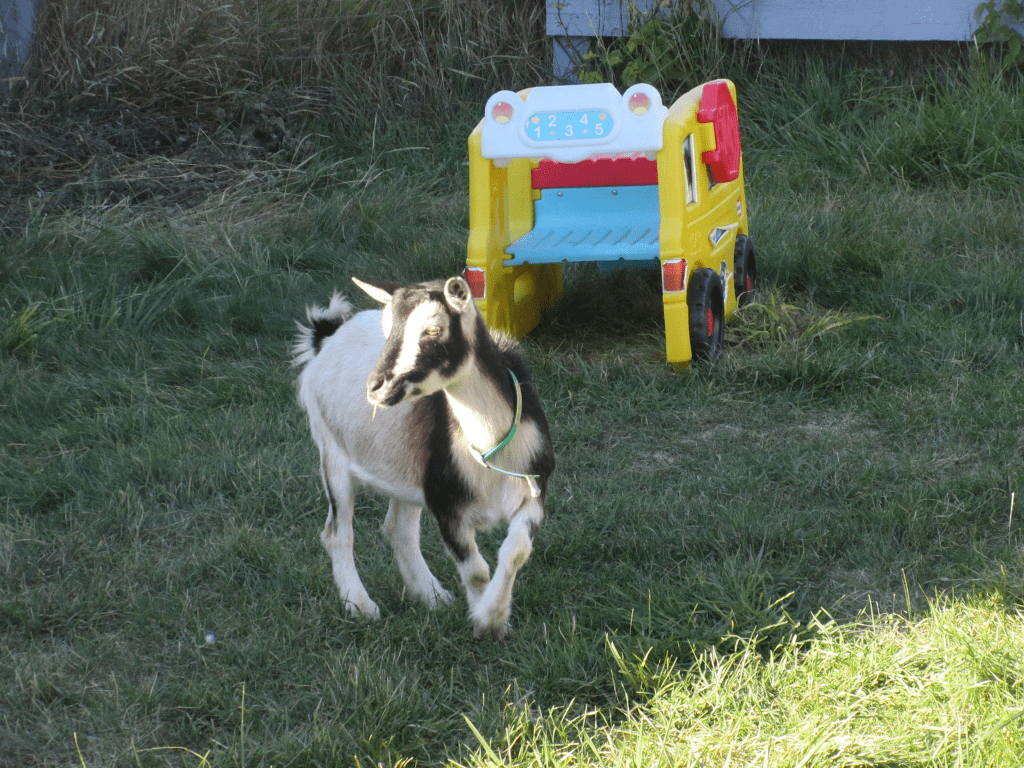
    I’m no expert on goats – but I started this project knowing you don’t get one goat. They’re a herd animal, and need a friend. So the deal was made for two little goats. The one pictured kept her original name – the other became ‘Stormy’. Which is a lot better than Sam referring to her as ‘that little black witch’ on her third escape the first evening we brought Remi’s goats home. The escapes were (I believe) just to show us she could do it – she might jump to the top of the goat house, and then over the fence, but leaving her friend wasn’t in the cards.

    Nigerian Dwarfs are small dairy goats – and the breed page says that they are primarily kept as pets. Which is fine by me – I’m guessing the smaller of the two weighs about 40 pounds and the larger a little over 50 pounds. The average dairy goat weighs in at 120 pounds – these little does are tiny. And they have all of us feeding them – family and neighbors. After the first night, they settled in and are getting by fine.

    I’m reading a post from the Brown Family Farmstead on Nigerian Dwarf goats: “Don’t let their small stature fool you, they may be small but they can still jump a six foot fence.” I thought a four foot fence was plenty. Sam and Jed have held out for a six foot fence. Now I realize the pair stay in the fence out of courtesy.

    On Sunday, we took the little goats out on a walk. After maybe a hundred yards, they remembered their 4-H training and enjoyed the walk. Then came the recollection – small humans often have treats stowed in pockets. So Remi is checked carefully for grain, pellets, etc. Remi’s complete sentences have gotten longer – “I’m taking my goats for a walk.” is a frequent comment.

  • No Resident Pack Anymore

    When we first built the house by the pond, we moved in with a pair of coyotes for neighbors.  He was a beefy built coyote – deep chested, and occasionally reported as a small wolf.  He wasn’t – just happened to have a blockier, larger size body than the typical coyote.  It was only after Renata got the game cameras set up for a year or so that we realized his consort was missing her left eye – and their hunting patterns always included him on her blind side.

    Our old pair of coyotes are gone now – and they were good neighbors.  Don’t know if someone shot the old coyote, or if it was just old age and decrepitude that took the two from their home on the hill – but we no longer have local coyotes.  The pair  have been replaced by packs that come in from 3 directions – west, north and southeast.  The blessing of modern technology – trail cameras can provide a lot of information about where predators are coming from.

    We’ve had a feral cat population close by for years – living by the trailer court and north aways, and wandering from there to our field and to the school.  The trail cameras show that the three new packs are cat hunters.  Not a surprise – we lost one young house cat last year, but the trail camera leaves no doubt.  

    Before the feral cat population grew so large, the rodent population in the hayfield was fairly well controlled by resident weasels.  I suspect that the resident weasels were taken by the feral cats – for whatever reason, with the weasels gone, the vole population exploded.  The voles did enough damage to the fruit trees in the garden that I responded with bait stations to poison the voles.  

    I’m not real sure what the change in coyote population will bring – but 3 packs coming in to hunt cats is starting to make a big dent in the feral cat population.

  • Watching Predators and Prey

    Off and on, I’ve been watching the interplay between predator and prey on this place for 65 year. In 1960, and through the mid-seventies, the hay field had a serious gopher (Columbia Ground Squirrel) population. A lot of the farm activities fell in my realm as I entered the teenage years – I recall poisoning the critters, first with strychnine, then with compound 1080. My most memorable year was the year when I caught a badger in a gopher trap. I saw she was a lactating female, worked the trap loose, cleaned all the traps from the field, and was surprised as hell the next day when she showed up to hunt gophers with me. The partnership lasted maybe six weeks – but is a memory to revisit – she had decided that gopher hunting could be a lot more successful when I assisted with the 22.

    Thirty years later – around 2000 – the gopher population dropped. With less grazing on the field, natural predators – a few weasels – were driving the gophers out. Apparently the gophers were more vulnerable to weasel predation than the voles were. Sam and I shot few ground squirrels in 2004 and 2005 when we visited my parents – the weasels controlled the population well over about 15 acres.

    By 2008, a feral cat population began growing in the trailer court a quarte-mile away. By 2017, I saw my last little weasel – feral cats were now the predator, controlling weasels, ground squirrels, and voles.

    So now, cats – whether feral or housecat – have became the prey species. When we built the house, we had a resident pair of coyotes that caused us no problems. They’re gone now – hopefully painlessly after living lives that caused us no problems. With the resident coyotes gone, three packs are edging into our place – the game cameras show one pack from the west, one from the north, and a third from the southeast. One pack has coyotes that specialize in hunting cats – the game cameras have shown coyotes walking down the trail with a cat in the mouth.

    Over time predators and prey roles can change. But you have to live quite a long life attached to the same piece of ground to notice it.

  • A Rough Year for Fawns – and Skunks

    The first two fawns we saw this Spring were in the mouths of coyotes on the game cameras. It’s a data point, not necessarily proving any trend – but it does support my hypothesis. Coyote predation has changed – and here’s the story as I see it.

    For several years, we had a pack of two elderly coyotes on the hill. He was buff – several times I had folks who glimpsed him tell me of a wolf. I had better views – for some reason of his own, watching me on the tractor was a worthwhile activity for him. I don’t know why -with his deep chest there may have been a little bit of dog in his genetics. Makes no difference – he knew he coexisted with humans, and left the house and my little dogs alone.

    His consort was missing an eye – the sort of thing it takes a lot of observation and trail camera time to observe. When they hunted, he was invariably to her left. If she did any tractor watching, she picked better concealment than he.

    I don’t know what took out the old coyotes – it could have been someone with a rifle, but it is probably just as likely that it was old age. If he went first, the wild life would have had no place for her disability. For whatever reason, my small pack of neighborhood coyotes is gone.

    In the absence of a resident pack, the trail cameras show that we now are included in the overlapping ranges of 3 larger packs – one group comes from the north, a second from the southeast, and the third from the west. Where we once had a pair of coyotes making a living full-time, we now have over a dozen hunting on the edges of their expanded ranges.

    The prey species has changed – the trail cameras show that the new packs have all focused on feral cats. Non-ferals, too – we don’t know how Cream disappeared, but circumstantial evidence points to the west coyote pack. And the population of feral cats living in downtown Trego is declining on the trail camera. I don’t know which pack has developed a taste for skunks, but fewer skunks are showing up on the cameras (I can’t believe we would have three packs of skunk-eaters.) I suppose that reducing the skunk and feral cat populations does help keep the area free of rabies.

    I kind of miss the old pair of coyotes that coexisted well with us – on the other hand, an uncontrolled population of feral cats pretty much calls for something to start preying on them. Studies in Chicago show that coyotes keep cat populations confined to residential areas.