Trego's Mountain Ear

"Serving North Lincoln County"

Tag: Ask The Entomologist

  • Ask the Entomologist: Bug on my kitchen wall

    Ask the Entomologist: Bug on my kitchen wall

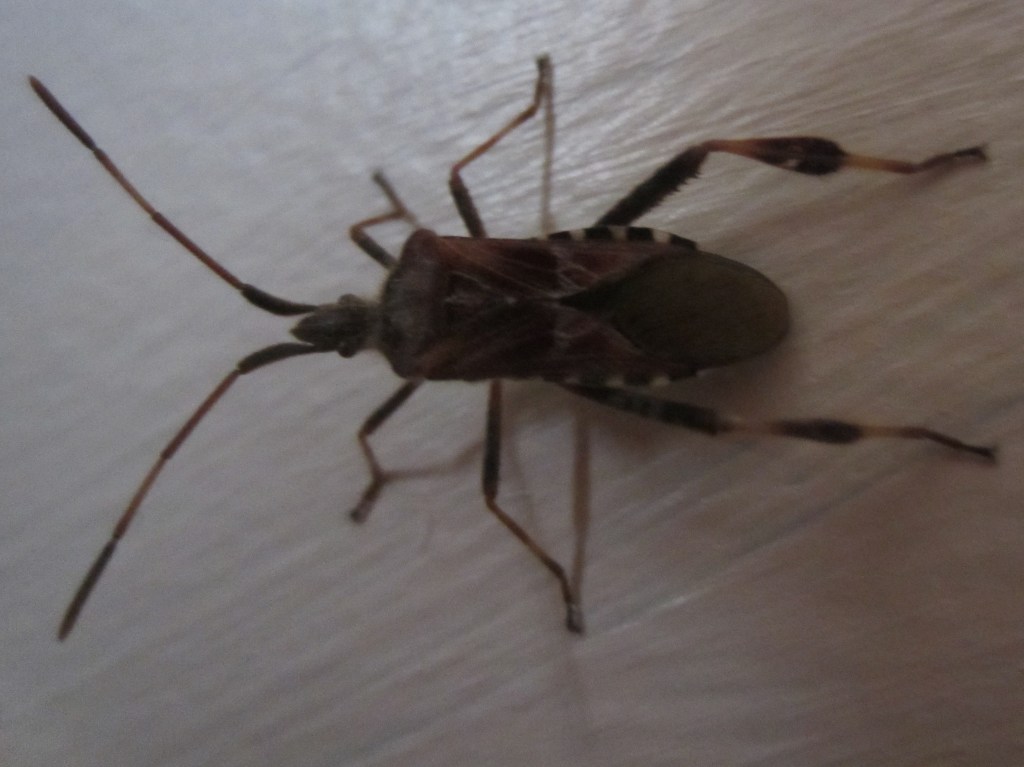
    “Is this a stink bug? Our house has a few of these, and they’re often walking on the walls. Why?”

    Your particular leaf-footed bug is Leptoglossus occidentalis, the Western Conifer Seed Bug.
    Very nice photo, by the way.

    This isn’t a stink bug, but that’s a very good guess!
    This is a leaf-footed bug, a close relative of the stink bugs – they’re both members of Hemiptera, what entomologists call “the true bugs”. Beyond this, leaf-footed bugs and stink bugs both belong in Infraorder Pentatomorpha. While leaf-footed bugs do emit a strong smell when stressed or handled, but it’s not nearly as strong as a stink bug’s scent, in my experience.

    These bugs are similar in behavior as well – they have piercing mouthparts, and tend to be herbivorous, especially seed-feeding. Both have been crop pests – stinkbugs are detrimental to agricultural pursuits like soy farming, while leaf-footed bugs tend to be more damaging in tree plantation contexts. In some regions, both may be present as minor citrus farming pests.
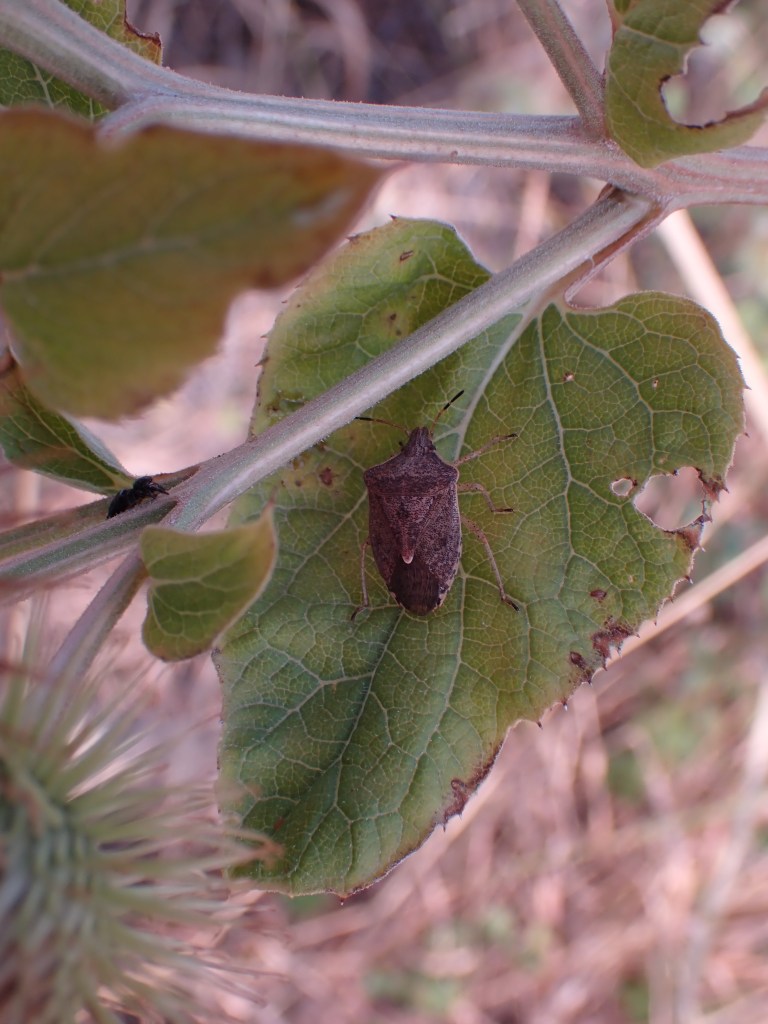
    Here’s a stink bug I met this fall, perched on a burdock leaf. Note the differences:
    The leaf-footed bug is slender and has fins on its hind legs.
    The stink bug is stout in comparison and has larger spines on its shoulders.

    However, when the weather turns cold, both stink bugs and leaf-footed bugs seek shelter from the elements. In winter, both stink bugs and leaf-footed bugs build up protective alcohol-based compounds in their blood that make it much more difficult for them to freeze. However, if they do end up freezing, they die. Leaf-footed bugs are what entomologists would call “cold-tolerant, freeze-avoidant“. Their quest to find someplace warm to spend the winter sometimes leads them to bother us indoors. Without human homes to invade, leaf-footed bugs and stinkbugs both tend to overwinter inside large dead trees.

    While they may be annoying for a time, rest assured that neither stink bugs nor leaf-footed bugs are harassing your houseplants this winter. During overwintering, these bugs avoid feeding – after all, the more moisture they take in, the more likely it is that ice crystals could form inside them. However, many leaf-footed bugs do release aggregation pheromones which spread the news that your home is a great warm place to wait out the winter.

    As for why your new houseguests are walking on your walls, that I don’t have as good an answer for.
    I imagine that your walls might be warmer than the floor, and that could make them more attractive. I’d also hazard a guess that your leaf-footed bugs prefer being on inside walls, rather than outside walls.

    Thank you for the question!
  • Why are there flies in my house? There’s snow outside!

    Why are there flies in my house? There’s snow outside!

    If your home is anything like ours, it has had an abundance of flies lately. You may ask yourselves “why now?” – after all, it’s snowy out, and there can’t be much food for them. Shouldn’t they die with the cold like everything else?

    You’d be entirely right in thinking so. Regardless of the type of fly, most of the good food sources are rather scarce this time of year, and the cold kills many. However, insects are just as uninterested in freezing to death as we are. Most of these gathered indoor flies are trying to avoid that particular fate.

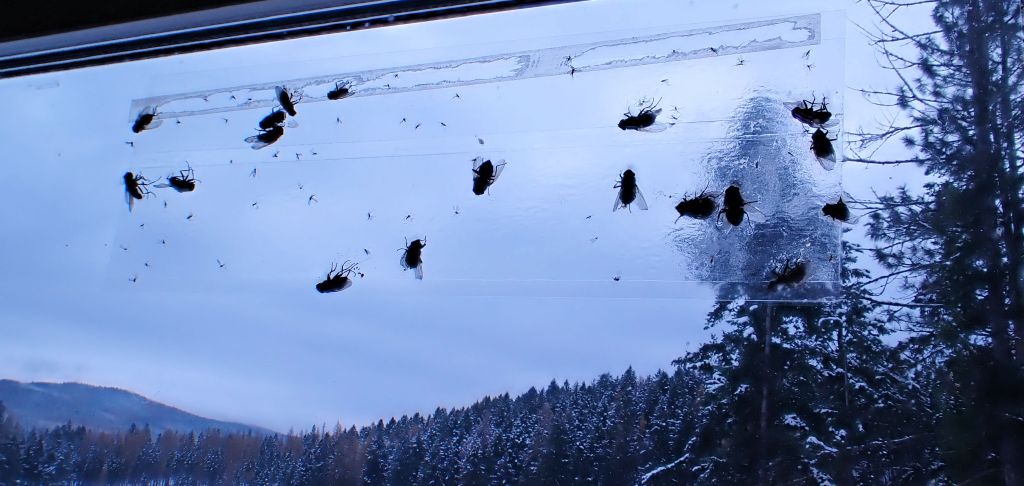
    My Mother-in-Law’s elegant, clear sticky traps, thoroughly filled with Cluster Flies and Fungus Gnats.

    While we see many house flies, flesh flies, and blow flies in the summer, they aren’t the primary species to invade our homes in the winter (though I’ve met a few of each overwintering inside my home).

    The vast majority of our new fly guests are a different group entirely – the Cluster Flies. Until quite recently, the Cluster Flies were grouped as a special sort of blowfly, but just over a year ago, they were given their own scientific family name, Polleniidae.

    Cluster Flies get their name from their habit of gathering in large groups, often in windows. Some try to stay warm outdoors, nestled deep inside rotting tree trunks. More sensible ones move inside with us to stay warm and survive the winter. Cluster Flies don’t want anything to do with your food, plants, or pets – they’re just here to avoid freezing.

    Eternal optimists, Cluster Flies often come out on warmer days, and try to find their way outside.
    Thus the accumulation of dead ones on your windowsills when weather turns cold again.

    It’s this habit of moving inside for the winter that is thought to have introduced Cluster Flies to the New World. You see, the Cluster Flies we have now aren’t North American natives. No. They’re thought to have sailed over from the Old World with some of the first European colonists.

    Back when European countries were busy sending ships to build colonies in the New World, they brought many unintentional stowaways with them. Many of these scalawags are with us today, for better or worse. In this story, we care about two such emigrants. Earthworms (especially the Green Worm) and Cluster Flies.

    It’s thought that earthworms were transported across the Atlantic in ships’ ballast. Meanwhile, some Cluster Flies took refuge from bad weather inside the ships themselves, just like they’re doing in our homes this winter, and so found their way to America as well.

    Earthworms flourished when ships made landfall. Many of the formerly-glaciated parts of North America no longer had earthworms, and were ripe for Lumbricid conquest. The spread of earthworms, in turn, opened up North America to the spread of Cluster Flies. Both spread like wildfire, and now can be found all over our continent.

    Why are earthworms important to Cluster Flies? You see, Cluster Flies are specialist parasites. Their maggots feed almost exclusively on earthworms. Mother Cluster Flies sensibly lay their little ones near earthworm burrows, and the newly-hatched maggots then see about journeying into earthworm burrows. There they lurk in ambush, waiting for a worm to pass by.

    Thinking of tiny maggots catching hold of vast earthworms with their mouth-hooks as the worm passes by very much brings scenes of Frank Herbert’s “Dune” to my mind. I like to imagine the tiny Cluster Fly maggots singing this song as they hunt their earthworm prey, and carve their way inside.

    Our friendly, local Cluster Fly – Pollenia pediculata.
    As you can see, they’re a bit larger and hairier than our common houseflies, as well as easier to catch.

    Because of their worm-based diet, Cluster Flies are actually remarkably clean compared to other flies with carrion- or dung-based diets. While you may not appreciate Cluster Flies’ presence, at least they will not spread disease.

    Additionally, both my dog and I can attest to their superb flavor.

  • Are there bugs in your mail?

    Are there bugs in your mail?

    I recently started working for the United States Postal Service, and, while I’ve been seeing quite a few bugs lately, few are the kind I like. While I’m not terribly fond of them, the sheer numbers these bugs occur in has been very impressive.

    Mercifully, with elections past, there’s been a sizeable reduction in the numbers of incoming bugs in our P.O. boxes.

    I’m talking about union bugs, specifically printers’ union bugs. These minuscule beasties seem to be on well more than half of our political junk mail this season! Here’s some fine examples of the species:

    These strange ink-based critters colonize almost all publications that come out of unionized printing presses.

    If you’ll notice, there’s a certain bias in the political affiliation of these bugs. At present, almost all Democrat-leaning political flyers are published in unionized print shops. Republican-leaning political flyers, on the other hand, are seldom published in unionized print shops, and most lack union bugs.

    Republican flyer, lacking the Union Bug

    This trend doesn’t necessarily hold constant across the country, though. Nor has it held constant over time – unions used to be strongly supported by the right, as a way that capitalism led to better worker conditions. And, alas, the presence of the union bug is no longer as indicative of an entirely union-made product as it once was…

    Due to prevalent local political sentiments, certain political flyers have been disguising themselves to sneak their messages into new homes. Take a look at this piece of political mail – at first glance, you’d assume that LR-130 is opposed to the Second Amendment.

    But look closer!
    A union bug. This indicates a union press was used, and the flyer in question was most likely published by a left-leaning group. When we examine the bones of this legislation, LR-130 is actually in favor of the Second Amendment.

    Cleverly camouflaged flyers and a fair bit of funding led to a surprisingly close vote on LR-130. It’s important to be well-informed on what the issues we’re voting on actually are – legislation and flyers rarely aim to be straightforward.

    Mercifully, while pests of a sort, political flyers do not reproduce, unlike invasive insects. Personally, I’m rather grateful that we only have to deal with this volume of political propaganda once every four years.

  • Ask the Entomologist: Massive spider

    Ask the Entomologist: Massive spider

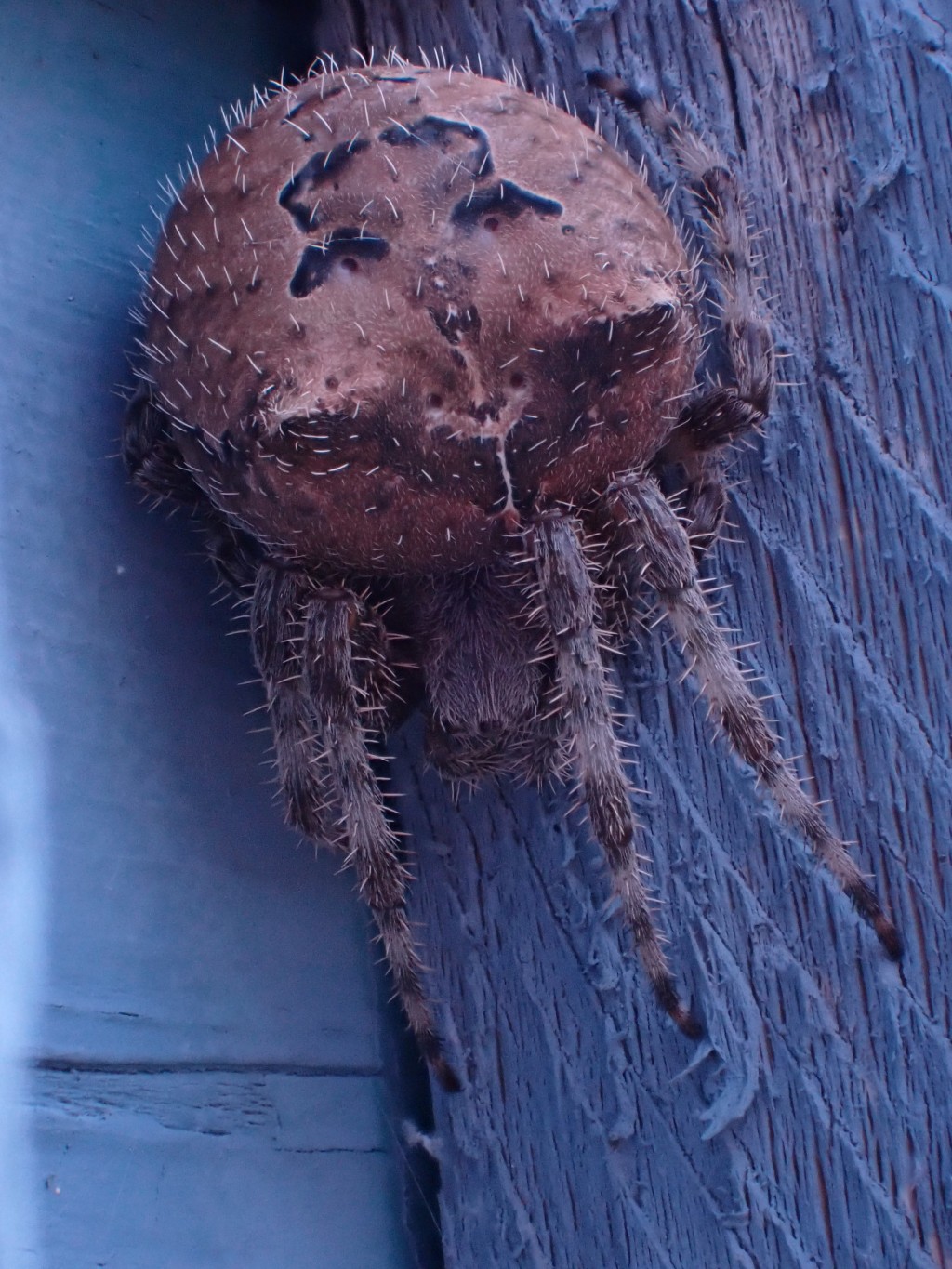
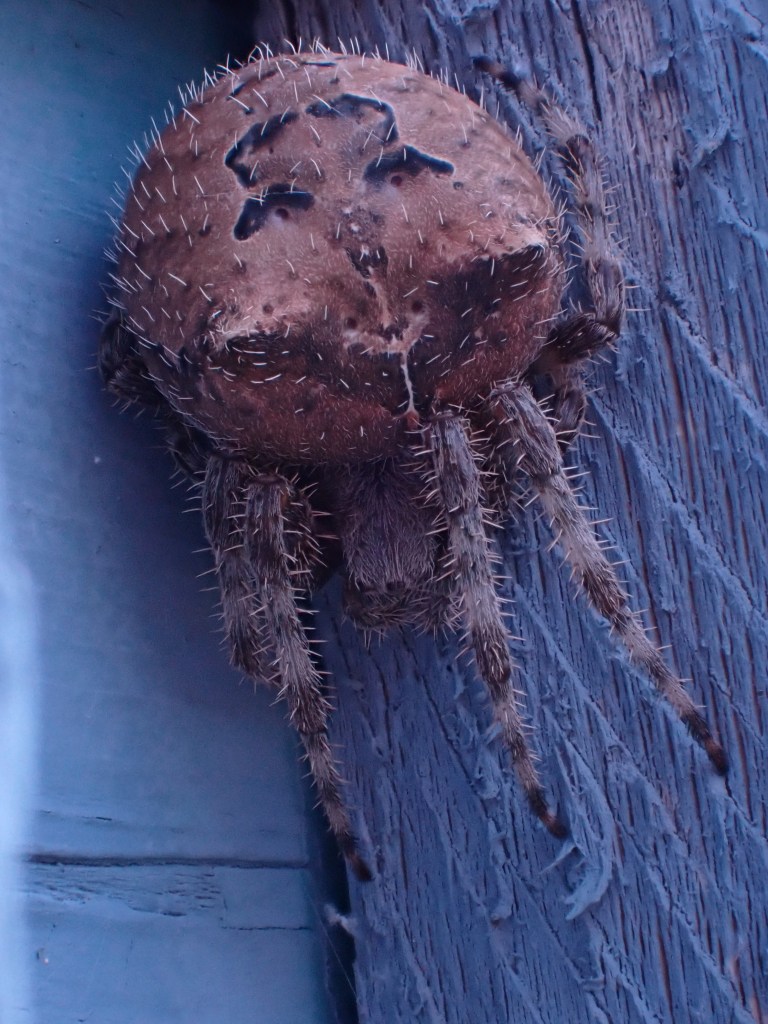
    This past week I had an identification request from a bit closer to home. This giant spider was perched right below one of our windows and my wife wanted to know what it was.

    Araneus gemma, the Gem-Shaped or Cat-Faced Spider.

    While I’d seen and admired her webs before, this was the first time I met the web’s weaver. She must have spent most days hidden behind the window AC unit. Revealed now that we’d removed it, now that fire season and the heat of summer seem to be past.

    As an entomologist, I have to say that I’ve met larger spiders, but this is the largest one I’ve seen up here in Trego. She’s an Orb-Weaver, a spider in family Araneidae. These are classic storybook spiders, straight out of Charlotte’s Web. When you see those beautiful wheel-shaped webs, big and round, full of droplets from the morning’s dew, these are the spiders responsible.

    I rather like Orb-Weavers – these spiders have pronounced sexual dimorphism. Females are often far larger than males – routinely twice the size, sometimes up to four times as large. Our A. gemma was quite large for her species, a 2/3 inches across the abdomen, and over an inch in length if we measure from the tip of her abdomen to her outstretched legs.

    At over an inch in length, she’s one of the largest spiders I’ve met here.

    As far as medical importance is concerned, the Gem-Shaped Spider’s bite is harmless to healthy humans. Additionally, I’ve handled many related Argiope orb weavers, and have never been bitten by them, so I don’t think receiving a bite from one of these is likely. However, if you or your loved ones are immunocompromised, elderly, or very young, more caution may be merited.

    Which common name do you prefer – the Gem-Shaped Spider or the Cat-Faced Spider?

  • Shiny flies

    Shiny flies

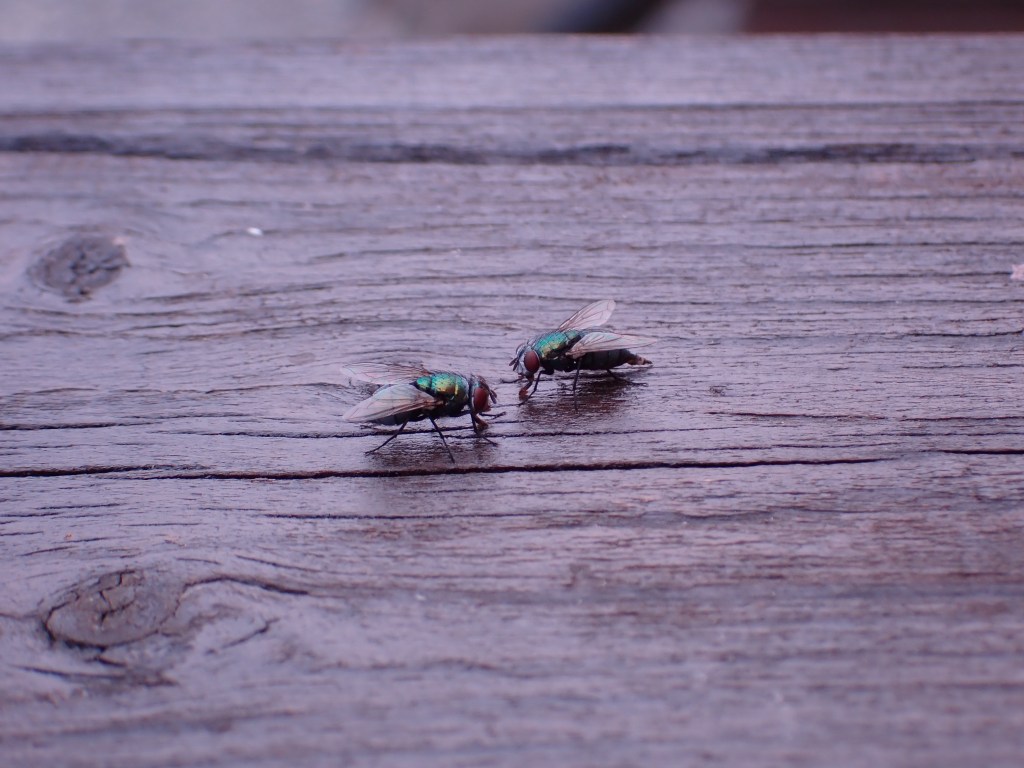
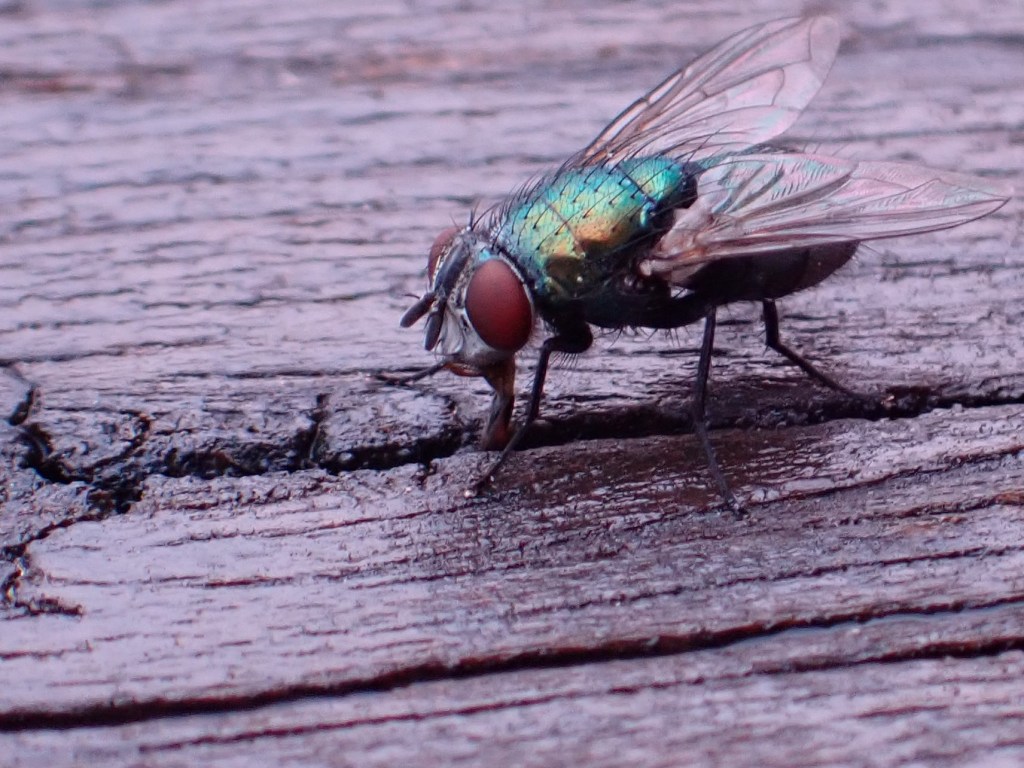
    Earlier this week we visited Trego School, to see the results of the salmon snagging fieldtrip. After the fish were had been cleaned and packed away for children to take home, I saw many bluebottle and greenbottle flies, as well as a few paper wasps, flying about outside of the school, sucking up fish juices.

    Bluebottle and greenbottle flies are blowflies, members of family Calliphoridae, a name which translates to “carriers of beauty”. Rather fitting, given their bright metallic hues. Additionally, adult blowflies are excellent pollinators, and a very good thing to have in your garden.

    Two greenbottle flies, genus Lucilia, contemplating romance over a salmon dinner.

    Blowflies have an incredible sense of smell. In most parts of the world, blowflies find bodies within minutes of death, detecting the first smells of decay long before humans are able to. When they find the right sort of decay (some blowflies prefer dung to death), blowflies quickly mate and lay eggs before flying off.

    People throughout ancient Greece and Egypt believed that these shiny flies were the souls of the dead. Even today, some people in those countries consider it bad luck to swat at them, for fear that you might kill someone’s ancestor. I think this is a particularly beautiful story.

    Imagine, sitting gathered with family and friends as a loved one passes on, breathes their last breath. Within minutes, you can see their soul, in the form of a beautiful fly, flying about their mouth, nose, and eyes. Almost as if the soul is sorry to leave the body, as if the person wants to stay with their family. Perhaps they say “goodbye” before flying off to the afterlife.

    Today blowflies are appreciated for more than their attractive colors and spiritual significance. They are the most useful insects in forensic investigations – their young are very useful for figuring out time (and sometimes place) of death. While other insects can be used, blowflies are a forensic detective’s best friend.

    Blowfly maggots have even been used in medicine, as a way to clean dead flesh out of wounds, preventing sepsis and gangrene. Medical maggot use predates antibiotics! Napoleon’s surgeons noticed that fly maggots increased soldier survival! In the American Civil War, both sides used blowfly maggots to clean deep wounds. Maggots continued to serve and save lives in World Wars I & II, and are used for some conditions even today.

  • Ask The Entomologist: Fluffy caterpillars

    Ask The Entomologist: Fluffy caterpillars

    Last week I received an “Ask The Entomologist” identification request.
    What is this fluffy caterpillar? It was found feeding on blackberry bush leaves.

    First off, adorable. This is a Tussock Moth caterpillar, so called after the little clumps of hair on their backs. Many fluffy caterpillars are in this group, family Lymantriidae. This particular species is called the Spotted Tussock Moth, and is native to our region. It’s not a picky eater, and will gladly eat willow, birch, and a range of other deciduous trees. We have another related species in the area, the Douglas Fir Tussock Moth, which can become an awful lumber pest, and has been linked with some health conditions in forestry workers.

    Beware! While Tussock Moths’ long hairs can feel soft if you stroke them gently, they often conceal shorter special defensive hairs! These “urticating” (itchy) hairs are like tiny spears and can be quite painful – some even come with venom. Many types of Tussock Moth urticating hairs can cause allergic reactions, the Spotted Tussock Moth (the one above) has even caused one case of anaphylactic shock. Even if you’re not allergic to the caterpillars, there’s the possibility of bacterial infection if the hairs break off beneath your skin.

    Tussock moth caterpillars can prove even more dangerous if eaten! Whether by livestock (abortions in mares, presumably others as well), pets (tongue rot documented in dogs), or unattended toddlers (often surgery, no deaths reported yet…) . The most serious condition resulting is that the eaten caterpillars’ hairs can puncture the digestive tract. This may cause bacteria to seep from the intestines into the body cavity, and can cause serious illness. While a healthy organism may be able to survive this, it often proves fatal to unborn young, which don’t have sufficiently developed immune systems.

    These caterpillars can be perfectly safe, and kids can have a great time watching them grow up into pretty little moths, but do be careful! If you think you, your kids, or your pets have been injured by contact with a caterpillar, Mayo Clinic has some medical advice. If you want to kill your Tussock Moth caterpillars, I suggest rubber gloves and a jar of soapy water.

    Looking forward to more bug questions,

    EntomologistJed