Trego's Mountain Ear

"Serving North Lincoln County"

Tag: History

  • Trego’s History Is Twentieth Century

    I’ve been encouraged to research and write Trego’s history.  This first section basically covers 1900 to 1925, from a Sociologist’s perspective rather than a historian’s.

    Trego’s history begins with social and economic events – there is no individual responsible for building the community, despite the fact that Octav Fortin was the first settler.  The first official institution was the school – School District 53 was created by the Flathead County Commissioners in 1904, as they looked at a location with a single operating ranch that had development barreling down on it – from the southeast, railroad reconstruction moving the mainline through the area that would become Trego, to the southwest was construction of the logging dam on Fortine Creek (though in those days, it was Edna Creek all the way down to its juncture with Grave Creek where the two streams joined to become the Tobacco River) and, to the North, where the Forest Service was beginning construction of the ranger station at Ant Flat.  Simply enough, Trego started as a construction boom town, and the official focus wasn’t the town, but the elementary school.

    A drive to Kalispell shows the narrow passage between stream and stone as you travel past the Point of Rocks – a name that preceded the restaurant that burned several years ago.   You can note it as you drive between Eureka and Olney – a place where the rock wall almost pushed the early travelers into the Stillwater River. The first ten years of the 20th Century opened travel to Trego – partially with the railroad pushing a line through from Whitefish to Eureka, where it joined the paths down the Kootenai River from Canada.

    For those who want to look at history as occurring due to exceptional men – there were exceptional men.  John F. Stevens was the engineer who relocated the Great Northern main line to run through Trego (he also located Marias Pass and the Panama Canal.  “Big Daddy” Howe headed the Eureka Lumber Company, and was responsible for bringing the logging dam into existence and its twenty-year operation.  Fred Herrig, the rough rider who tracked and recovered  Teddy Roosevelt’s lost mules during the Spanish American War in Cuba,  became the Fortine District’s first ranger.  And, of course, Octav Fortin who was here first. The reality is that Trego was twice a boomtown, both times due relocation of the railroad and building of a new dam.

    The most credible story I’ve heard for the town’s name is that a Great Northern employee who was courting a girl in Minnesota or Michigan, named Jeanette Trego, assigned the name to get along a bit better with her Father.  Then, in a predictable error, the railroad station next to Octav Fortin’s ranch got the Trego sign, while the Fortine sign wound up posted at the next station to the north.  There are other stories – if you prefer them, I won’t argue.

    For Trego, commercial transportation began with the Splash Dam on Fortine Creek – built around 1905, and last used in 1924.  The remains of the dam are about a mile south of Trego School, on the Dickinson place.  This photo, from 1922, gives an idea of Trego’s early history.  (Note the logs along the bank, waiting for the next flood to transport them to the mill in Eureka)

    I recall my grandmother’s concerns about playing by the creek – and hadn’t realized that the final use of floods to transport the logs occurred thirty years earlier.  And that memory brought the message home that most folks who live here don’t realize just how important the dam was in settling Trego.

    A dozen years after the dam was built, Trego became the site of labor unrest.  ‘Big Daddy’ Howe ran the lumber company in Eureka, and the laborers who ran the logs down Fortine Creek and the Tobacco River were unionizing – chief among their demands was a call for hot showers as part of the working requirements. 

    Waseles was known as Mike Smith – and ran the crew that specialized in the twenty-mile river run that kept the mill running in Eureka.  He died without any known next-of-kin, so P.V. Klinke (assigned as executor by the county) sold his homestead (just below the dam) and bought the large tombstone you see as you drive into Fortine Cemetery.  

    Their 1917 strike grew into a nationwide timber strike, and ‘Big Daddy’ Howe refined his already existing hatred of organized labor . . . specifically the International Workers of the World, the IWW.  

    When Waseles died, he was under indictment for torching a logging camp, and for sabotaging the log runs by throwing all the tools he could into the pond behind the dam.  (I am still using a double bit axe whose head I recovered from Fortine Creek, and, with a new handle, a recovered cant hook now works my small mill a century after the log runs and the great strike)

    Trego was typecast as a hotbed of socialist wobblies for many years by Eureka’s more prominent residents – a view that diminished rapidly with the many union jobs that came into both communities with the railroad relocation that accompanied Libby Dam in the sixties. 

    By Loco Steve, CC BY 3.0, https://commons.wikimedia.org/w/index.php?curid=54585133

    The logging dam operated for about twenty years, and was mostly gone by the time the railroad mainline bypassed both Trego and Eureka – but the sounds of the trains still are heard in Trego in the 21st Century.  And the Jake brakes of logging trucks have replaced the floods that moved the logs down Fortine Creek to the sawmills.

    The Great Depression came early to Trego – while my Grandfather kept the two homesteads that he bought in 1917 and 1918, he moved his family to a small town near Spokane in 1925.  He continued to spend parts of summer and fall in Trego, pruning and harvesting Christmas trees.  The big mill in Eureka had closed, and Trego’s industry was left to small mills and tie hacks for the next 30 years.  While the automobile age was well begun in 1925, my grandfather moved to the Spokane area with his children in a covered wagon.

    Next Chapter – 1925 to 1950 – active years with few records

  • Why Lincoln County Government Doesn’t Work

    I was reading an article that described several reasons why the government doesn’t work.  It was a generalized article, and as I thought of the additional challenges our three county commissioners have – beginning with the geographic challenges – I realized that it was time to develop a few articles that explain the challenges to good government that our county faces.

    It isn’t that we have bad county commissioners – as I was retiring from SDSU and moving back home, Lincoln County had one of those rare elections for commissioner . . . one with two good candidates, Mike Cole and Steve Curtiss.  Mike won – but whichever way the vote had gone, the county would have had a good commissioner.  After a single term, Mike Cole lost his bid for reelection to Josh Lecher.  This year, after a single term, Josh lost the primary to Noel Durum.   And whether he does a good job or a poor one, Noel is unlikely to win reelection at the end of his first term.

    To understand why Lincoln County’s government doesn’t work well requires a bit of study.  I’m going to start in 1909, when Lincoln County was carved out of Flathead.  Things started with a good, logical base.  The problem in function came 60 years later, with a change in geography.

    Lincoln County was created to duplicate the Kootenai’s drainage – and along with that, the county was connected by the railroad.  In 1909, the county towns (excepting Yaak and Sylvanite) were connected by the railroad.  A slow train, stopping at each station, connected what had been isolated communities.  It wasn’t a bad idea.

    Sixty years later, the gates at Libby Dam closed, and Ural, Warland, Rexford and Gateway were flooded.  The railroad was relocated to a spot where it runs through Stryker, Libby and Troy, stopping only at Libby.  Still, the railroad served as central to the county for a short time – but the link was the ranches and towns along the Kootenai.  When Libby Dam was complete and Koocanusa filled, the commercial link between north county and south county was severed.  J. Neils had linked lumber workers from Libby through Rexford for 60 years – but the Dam ended the railroad, the social linkages and the commercial timber connections.

    For the past half-century, Lincoln County has been disconnected, with a nearly unpopulated area that exists from Jennings Rapids to the mouth of Pinkham Creek – connected by the lonely highway 37.

    Next issue – why our elected county government lacks control over our hired bureaucracy.

  • Rendezvous Again

    Since it’s that time of the year again- it also seems time to revisit what we’ve said about the origins of the word.

    Origins of the Word Rendezvous

    One of the reasons that English is described as difficult to learn is the number of words- over 170,000! Of those, the majority are loan-words, words taken from other languages.

    The word Rendezvous is one such word. It was appropriated from the French, around 1600 (during a brief period in which Britain and France were not at war- as a result of competition with Spain). The original usage appears to be a verb: rendez vous meaning present yourselves. This then becomes the noun describing the place of meeting we are accustomed to.

    English has borrowed from different languages at different times. At the time Rendezvous joined the English vocabulary, a significant number of the new words were coming from French.

    About two centuries after Rendezvous was appropriated from the French, William Ashley held the first trappers’ Rendezvous. These lasted for only fifteen years. Some of them were so large as to create temporary towns. Other gatherings in the same time period are occasionally given the same name. Our local Rendezvous has outlasted the original.

  • Origins of the Word Rendezvous

    One of the reasons that English is described as difficult to learn is the number of words- over 170,000! Of those, the majority are loan-words, words taken from other languages.

    The word Rendezvous is one such word. It was appropriated from the French, around 1600 (during a brief period in which Britain and France were not at war- as a result of competition with Spain). The original usage appears to be a verb: rendez vous meaning present yourselves. This then becomes the noun describing the place of meeting we are accustomed to.

    English has borrowed from different languages at different times. At the time Rendezvous joined the English vocabulary, a significant number of the new words were coming from French.

    About two centuries after Rendezvous was appropriated from the French, William Ashley held the first trappers’ Rendezvous. These lasted for only fifteen years. Some of them were so large as to create temporary towns. Other gatherings in the same time period are occasionally given the same name.. Our local Rendezvous has outlasted the original.

  • A Spy on Pinkham Creek

    Well, maybe we should call him an undercover agent.  In my youth, the term would have been narc.  Still, this story, from the old Forest Supervisor, C.S. Webb, is the closest to an official story of a Forest Service spy, working from the Supervisor’s office, monitoring the Pinkham Creek residents.  His whole story is at npshistory.com.

    In 1933, we were allotted 4 CC camps, and in 1931 the 4 CC camps returned and sufficient Dev-Nira and Imp-Nira funds were allotted to hire 200 men all season. In these two years, we built many miles of low-standard road, new towers and houses on dozens of lookouts, and telephone lines to serve them. A good start was made on a topographic map of the forest, and we built all the ranger stations as they stand today, except the Libby Station and the residence structures at Sylvanite, Warland and Rexford. The latter three were remodeled. The airfields at Troy and Libby were also constructed during those years. Times were hard, men plentiful, and the local populace was very appreciative of the employment provided by the Forest Service.

    It was in 1932 that Charlie Powell, ranger at Rexford, overheard a conversation at a trail camp between two Pinkham Ridgers, indicating that the Ridge-runners planned some incendiarism. He promptly reported this to me. The Ridge-runners were a rather canny clan who migrated from the mountains of West Virginia and Kentucky years earlier and took homesteads on Pinkham Creek and Pinkham Ridge. Their chief pursuits were stealing tie timber and moonshining, but occasionally they would set a few fires, “just for the hell of it – to bother the ‘Govment’ men,” and also to provide a few days’ work. A bad epidemic of these fires was experienced in 1922.

    Their planning in 1932 was to make lots of work. Bill Nagel, supervisor of the Blackfeet, and I hired an undercover man to go to Eureka to loiter and fish and get in with the Ridgers. He took an old Ford, rambled around the country, got acquainted with all of them, and finally joined their planning discussions after being accepted into their confidence. They completed their plans and set a date (August 22) for setting a string of fires from Edna Creek on the Blackfeet clear through to Sutton Creek on the Kootenai. A man was appointed to go into each drainage and the approximate spot was prescribed where he would set his fire. The complete plan, which was pretty thorough, was reported by our man directly to Nagel at Kalispell. This man was always around Eureka in the daytime, and whenever he had anything to report he drove into Kalispell during the night and was back before morning. We never phoned or wrote to him, nor did he to us. He was an ex-forest officer known to Nagel and me as a fully reliable man.

    The day before the scheduled setting of the fires, we had two or three men in the vicinity of where each fire was to be started and quite a few others at anticipated places of travel by the Ridgers in or out of the woods. Our men met several of the Ridgers, who appeared very surprised to see someone. Our fellows saw others they did not meet, and likely our men were seen, too. We had hoped to catch at least one or two Ridgers in the act, but not a fire was set. Our undercover man was out on the fire-setting expedition with one of the Ridgers and joined in their talks after they returned to Eureka. They had tumbled immediately to the fact that we had gotten wind of their plans, since everywhere they went they encountered someone. But, they never suspected our undercover man, and to this day, old timers there are wondering how we got next to their plan. I have never heard since of any attempts at incendiaries in that area. Previously, there had been several outbreaks, and one man served time in Deer Lodge for setting a fire on Pinkham Ridge.”

  • Climate Change: Technology and the Little Ice Age

    I like the term “Anthropic Global Warming” better than the generic “Climate Change.”  Living in an area that was covered by glaciers 15,000 years ago, I have ample evidence to convince me that climate changes – my challenge is quantifying how much is human caused and how much has natural causes.  And I like a term that defines the direction of change.

    English history – from the Roman occupation forward – provides records of a warm climate cooling off and entering what is termed “The Little Ice Age.”  There is a historical record of climate change, and, equally important to a Non-Malthusian demographer, the technological changes people developed to deal with the climate change is written down.

    Connections, by James Burke, offers this: “Among the earliest references to the change comes from the Anglo-Saxon Chronicles, kept by monks for the year 1046: ‘And in the same year after the 2nd of February came the severe winter with frost and snow, and with all kinds of bad weather, so that there was not a man alive who could remember so severe a winter as that, both through mortality of man and disease of cattle; both birds and fishes perished through the great cold and hunger.” (p157)

    Connections explores the connections between events and technical development.  It continues further down the page: “The chief stimulus to change was the need to stay alive through winters that became increasingly severe, as the monks had noted.  The first innovation that came to the aid of the shivering communities was the chimney.  Up until this time, there had been but one central hearth, in the hall during winter, and outside during summer.  The smoke from the central fire simply went up and out through a hole in the roof.  After the weather changed, this was evidently too inefficient a way of heating a room full of people who until then would have slept the night together.”


    Ultimate History Project: “Conisbrough Castle built in the 12th century has the earliest extant chimneys.”
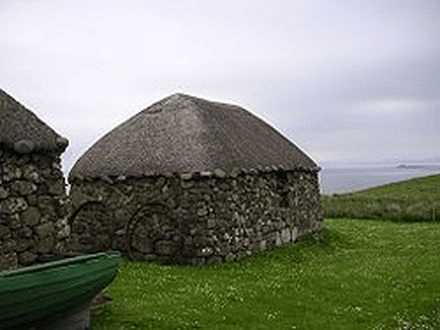
    Ultimate History Project: “Scottish Black Houses are named for the smoke seeping from their chimneyless roofs.”

    Page 159 continues:  “The building to which the new chimney was added had already begun to change in reaction to the bad weather.  The open patio-style structure had been replaced by a closed off building, built to withstand violent meteorological changes.  The new chimney, whose earliest English example is at Conisborough Keep in Yorkshire (1185) also produced structural changes in the house.  The use of a flue to conduct away sparks meant that the center of the room was no longer the only safe space for a fire.  To begin with, buildings were by now less fully timbered so the risk of fire was less, and the flue permitted the setting of the fire in a corner or against a wall. . . The hood on the fireplace prevented sparks from reaching the ceiling, and as a smaller room could more readily be heated than a larger one, the ceilings could now be lower.”

    “Two major innovations occurred by the fourteenth century, at the latest: knitting, and the button.  The earliest buttons are to be seen on the Adamspforte in Bamberg cathedral, and on a relief at Bassenheim, both in Germany, near Hapsburg around 1232.   The first example of knitting is depicted in the altarpiece at Buxtchude, where the Virgin Mary is shown knitting clothes for the infant Jesus.  Both buttons and knitting contributed to closer-fitting clothes that were better at retaining heat.”

    Buxtehude Madonna
    First Example of Knitting

    Burke’s books – Connections and The Pinball Effect are loaded with examples of how events are connected with technical development.