Trego's Mountain Ear

"Serving North Lincoln County"

Tag: History

  • Homesteading and Risk

    Homesteading and Risk

    I saw a vague statistic the other day – an estimate that between 46 million and 93 million Americans are descended from homesteaders.  The number seems low – but my work experience is in the West . . . I have received a few paychecks from Minnesota, but most of my working life has been in Montana, Colorado, and South Dakota.  I suspect that, at least in Montana and South Dakota, the majority of my coworkers had homesteader grandparents and great-grandparents.

    My maternal great-grandparents had a story about Sitting Bull and his two wives stopping by their homestead right after my grandmother was born.  The dates of her birth and his death make the story possible, but don’t verify.  At the least, she was born in the same area and time where Sitting Bull was for the last year of his life.  My maternal great-grandparents were homesteaders,  My grandfather homesteaded in North Dakota, then finished proving up on two homesteads (which he bought) in Trego.  There is a special place for the legislation that authorized both homesteading and the land grant colleges – they were passed at a time when most of the Democrat legislators were in Richmond, not Washington.

    The Homestead Act granted free land – but the homesteader had to live on that tract, raise a crop and build a house.  I’ve seen the log cabins and soddies that were their initial homes, and realize how limited the toolbox on the homestead was.  Yet the risks and hardships associated with the homesteading movement are the basis real estate investment for about a tenth of the land in the United States.  Not a tenth of the private land – a tenth of the total land mass. 

    Checking the records in South Dakota, I learned that the majority of female homesteaders near my home were Indian women – not all tribes received reservations, and these Indian women didn’t wait until 1924 for the rights of US citizenship – they were recognized as citizens upon proving up their homesteads.  Single women, white or Indian, former slaves, immigrants, all could qualify for homesteads.

    Not all succeeded.  Along the Milk River, that reliable water source also brought disease – typhus if memory serves correctly.  Homesteads were being claimed when Custer was still on active duty.  Risks from all sources were high.  Yet the Homestead Act gave Americans of all backgrounds the opportunity to risk it all for the chance to become landowners.

    Some died.  Some gave up, sold the homestead and found a job in town.  Some became landowners – property owners.  The Homestead Act provided a framework for upward mobility in rural America.  That opportunity to choose risk and hard work as a way to property doesn’t exist in today’s risk averse society.
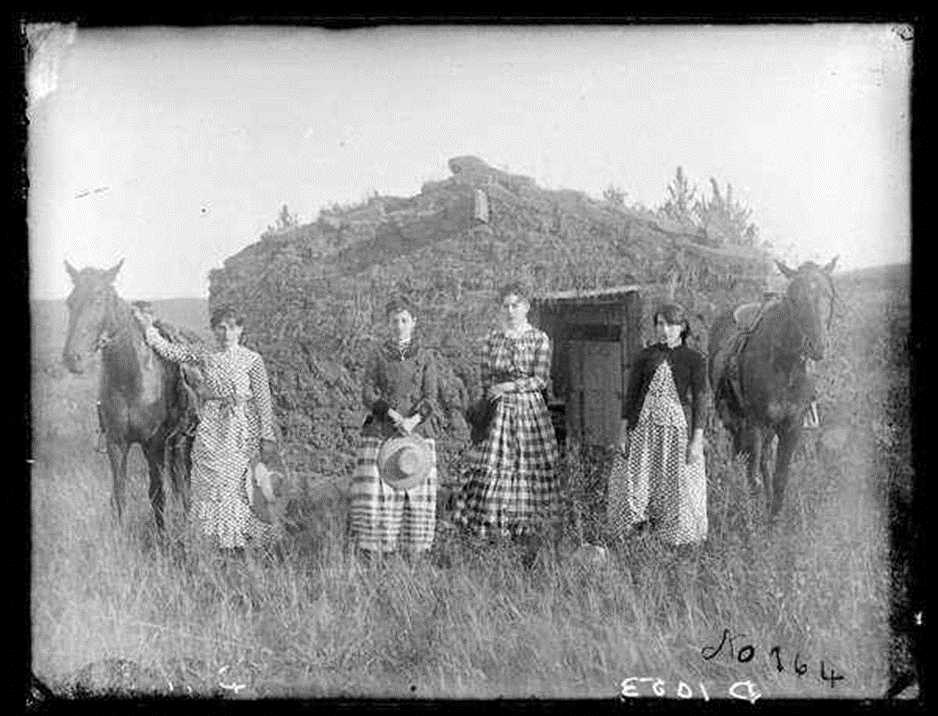
    I think we’ve lost that link with the homesteaders – when my grandparents moved to Trego, their neighbors were people like them, homesteading to become property owners and eking out a living until the land became their own.  My last link with that generation went with the passing of Loretta Todd – I doubt if she ever realized that her comments on “Fahlgren’s Pond” were my last touch with a grandfather who died before my fifth birthday.

  • Not All Canadians

    Not All Canadians

    I noticed a headline that referenced “North of the 49th Parallel” as a descriptor for Canadians.  Here, where I’m 20 miles south of the 49th Parallel, that’s correct – basically the Canadians I know are north of 49.  Still, they’re unusual Canadians.  Toronto is further south than Sioux Falls, South Dakota.  72% of Canadians live below the 49th Parallel. 

    This website shows that half of Canada’s population lives below “the redline”, a line drawn at 45 degrees 42 minutes.  From a westerner’s perspective, this map makes Canadian politics a lot easier to understand.  Half of them live further south than Billings.  And, as you can see from the map, they’re crowded together – unlike our own northern neighbors.

    The Red line is drawn at 45 42 minutes- For Context, the Canadian Line we border is at the 49th Parallel

    There’s a Durham report going around now, as Durham reports on the shenanigans around the Trump-Russia investigations.  It’s about 180 years ago that Canada had its own Durham report, after a bit of civil unrest.  Back then, Canada was divided into upper Canada and lower Canada.

    Upper Canada was the area just north of the great lakes – largely settled by Loyalists (Tories) after the American revolution.  The head of each family received 100 acres for settling there, with 50 acres more for each additional family member.  Soldiers who had fought for the crown received significantly more.  Family histories go way back – and at the turn of the 19th century, this area was home to some downright anti-US Canadians.  The Canadian Encyclopedia  provides us this description:

    “The term Family Compact is an epithet, or insulting nickname; it is used to describe the network of men who dominated the legislative, bureaucratic, business, religious and judicial centres of power in Upper Canada (present-day Ontario) from the early- to mid-1800s. Members of the Family Compact held largely conservative and loyalist views. They were against democratic reform and responsible government. By the mid-19th century, immigration, the union of Upper and Lower Canada, and the work of various democratic reformers had diminished the group’s power. The equivalent to the Family Compact in Lower Canada was the Château Clique.”

    If we think about those early settlers of “Upper Canada” – the area that today is shown below the “red line”,  they weren’t folks who wanted the representative democracy that was established in the new American republic.  They were monarchists, and Canada bloody well had a king.  Sure, it’s a couple centuries back, but the Tories (Loyalists) had soldiered for the crown, and the government they wanted was not a representative democracy. 

    In 1837 and 1838 there were rebellions in both Upper and Lower Canada.  Basically, the French Canadians didn’t particularly like the English speaking Canadians, and that was reason enough for small uprisings in Lower Canada, and the newer settlers of Upper Canada didn’t particularly like being governed by the old guard Loyalists.  Lord Durham looked the situation over, and recommended uniting the provinces into a single Canada – remember, the Brits had a lot of experience ruling conflicted peoples in Ireland . . . there it was Protestant and Catholic, but it could work.  So he moved things to a spot where the English speakers wound up with a readily identifiable political opposition – while Durham’s report is regarded as paving the way for Canadian independence and responsible government, the roots of that government were planted by moneyed Loyalists who lost the American Revolution, and largely made their identities in opposition to the US form of government.

    As we watch the truckers protest, it may be a good idea to remember that there is a lot of historical difference between the Canadians of Eastern British Columbia and Alberta whom we know and the heirs of the Family Compact and the Chateau Clique.  Somehow, it seems appropriate that Durham reports are a historical commonality.

  • The Man Sounded Knowledgeable and Confident

    A pleasant man stopped by asking to hunt on the place.  He explained that he uses black powder, and his bullet can only travel 70 yards.  He sounded confident in his assertion. If I hadn’t had the opportunity to teach a computer course for gunsmithing students half a lifetime ago, I might have believed him.  I did make the comment that I had watched a movie about a guy named Quigley, and he seemed to have shot a bit farther than 70 yards.  His response was that he uses round balls.

    It wasn’t like I was being paid to educate him.  So he left with a no hunting answer – and yet the incorrect statement, and the confidence bothers me.  He isn’t making an Alec Baldwin quality mistake – but the error remains.  A round ball leaves a lot to be desired when it comes to aerodynamics.  That’s why the minie ball (invented in 1849) replaced the round ball when the war between the states came along.  Still, it’s not like a round ball rifle has a 70 yard range – my math tells me that if I can put a 50 caliber roundball out of the barrel at 1800 feet per second, I have a projectile that, if I sight in 3 inches high at 50 yards, will be pretty much on target at 125 yards. 

    There’s the Civil War story of General Sedgwick – Confederate sharpshooters were firing from around 1000 yards away when the general said “Why are you dodging like this? They couldn’t hit an elephant at this distance.”  He was apparently unfamiliar with the Whitworth rifle and the fact that the Confederacy had at least 20 of them.  There is no record of the Confederates hitting an elephant that day, but one marksman did hit General Sedgwick. 

    Tim Murphy is credited with a 350 yard shot from a flintlock at the battle of Saratoga, in the American Revolution, that ended the career of the Scots general Simon Frazer.  There are arguments as to who actually fired the shot that took the general out and what the range actually was – but it would take another 75 years before the minie ball was developed. 

    Black powder has been effective for a long time.

  • 50 Caliber Artifact

    Most of the artifacts I find on the place are historical instead of archaeological.  Two, found about a half-century apart were cartridge cases from the Sharps “Big Fifty.”  Both were probably not just ejected, but rather discarded.  Each had a split along the sidewall, suggesting that they had been reloaded and re-used at least once past their “best-used before” date.

    It is hard to figure out the story behind this brass.  The “Big Fifty” was introduced in 1872 as the 50-90, but with differing bullets these old empties could have been 50-100 or 50-110 cartridges.  Sharps Rifle Company folded its tent in 1881, the last of the great buffalo herds was slaughtered in 1884 (Standing Rock, North Dakota) and, by 1890 the rifle and cartridge were obsolete.  Both were found in wooded areas that overlooked spots where long shots -a bit over 200 yards- might have been possible – but the only solid inference I can make is that each was discarded after the shooter noticed the split.

    Another empty from a “buffalo gun” showed up maybe 25 yards from one of the big fiftie empties.  This one could probably still be reloaded safely.  The 45-75 Winchester was the original chambering for Winchester’s 1876 rifle.  It was found in a spot that was unwooded, and coming from a lever gun, might well have been ejected for a fast second shot.  The rifle was produced until 1897, and the cartridge until 1935.  I suspect there were two different hunters using buffalo rifles long after the herds were gone. 

    I have never encountered a 32 special empty – despite it being the only centerfire rifle my Grandparents used here.  I suspect they carefully hoarded each piece of brass – but on the other hand, the empty case is small, and every acre has 43,560 square feet for the years to conceal all evidence.

    I still encounter haywire artifacts in the woods.  I started moving bales in 1960, and worked with twine-tied square bales.  The first incarnation wire-tie bailer was developed in 1879, so it’s hard to pin a date on that.  Occasionally tangling a foot in haywire along an old logging trail suggests that bales were brought in for a lunch for horses that were skidding logs out.  I haven’t ran across much haywire in the fields – but my explanation could be out to lunch.  Still, I think the baling wire came after the cartridge cases.

    The orange artifacts are Dad’s – it’s amazing how long orange baler twine can last when it becomes one with the ground.  It’s equally amazing how long I have had to lie on the ground with a Kabar cutting it out of the rototiller.  I had to sharpen the knife 6 times before I got the last of the bailer twine cut out of the tines.

  • The Modoc War

    One of the more interesting tales from the Indian Wars is the Modoc War, in Oregon and Northern California, 1872-73.  A Native friend was of Modoc descent, so the history interested me.  It’s difficult to find much justification for the US, and the Modocs had fewer than 60 warriors amid 3 bands.  $20,000 would have funded the small reservation they asked for, and the war wound up costing about $500,000.

    It was a small war by today’s standards – 37 US military dead, 2 scouts and 16 civilians.  Another 67 wounded.  Either 15 or 17 Modoc warriors killed . . . and that includes four hanged after surrender – Captain Jack, Boston Charlie, Schonchin John, and Black Jim.  

    The recorded names of the Modoc leaders and warriors are predominately in English – Bogus Charlie, Boston Charlie, Curly-headed Doctor, Steamboat Frank, Ellen’s Man George, Greasy Boots, Shacknasty Jim and his brother Shacknasty Frank, Mooch, and, of course, Captain Jack.  Legend has it that Shacknasty Jim and Shacknasty Frank received their names because of their mother’s housekeeping – but the linguists make a good case that Shacknasty was a corruption of the Modoc word for left-handed. 

    At the end, roughly a thousand US troops, led by Colonel Jefferson C. Davis, fought less than 60 Modocs, led by Captain Jack.  As near as I can tell, the Modocs won every battle.  The largest ethical problem was that Captain Jack killed General Canby at a peace conference, and that sort of thing isn’t condoned.  On the other hand, Colonel Davis had killed General William “Bull” Nelson in a hotel lobby.  If there is another war where both sides were led by men who murdered US generals, I haven’t found its mention.

    After murdering General Nelson, Colonel Davis fought his way through the American Civil War, and formal charges never caught up with him.  After the war between the states, he was sent north to Alaska as its first military commandant.  After surrendering, Captain Jack was hanged for the murder of General Canby, and 153 Modocs were sent to Oklahoma, where the descendants of Captain Jack’s band remain, the smallest tribe in Oklahoma.  In 1909, 51 surviving Modocs were allowed to return to the Klamath reservation in Oregon.  The histories do not have great details about 51 people over a century ago.  Bogus Charlie became the Chief who succeeded Captain Jack.  Steamboat Frank became a minister. 

    It was not a splendid little war.

  • Bismarck’s Belief

    There is a Providence that protects idiots, drunkards, children and the United States of America.”   Otto von Bismarck, 1907

    Three fourths of my neighbors voted for Trump, and I figure even more believe that Biden won through some form of chicanery.  As I look at media comments, I see fears of what will happen – from tax increases to gun grabs to civil war.  There is comfort in Bismarck’s observation “There is a Providence that protects idiots, drunkards, children and the United States of America.”  I recall that, a century ago, my country elected a president – Warren G. Harding – who was even slower than Joe Biden.  And Harding replaced Woodrow Wilson.  I can make a strong case that Woodrow Wilson was more racist than any American President, including Jefferson Davis.

    You might argue corruption, and cite the investigations finally underway on Hunter and James Biden.  Remember,  “There is a Providence that protects idiots, drunkards, children and the United States of America.”  The history textbooks tell of Harding’s Secretary of the Interior and the Teapot Dome scandal.  Remember, Woodrow Wilson had a stroke in October 1919, paralyzing him, and that caused the greatest crisis about presidential disability, presidential incapability, in our country’s history.  According to whitehouse.gov, “Wilson returned to campaign for Senate approval of the peace treaty and the League of Nations Covenant. His health failed in September 1919; a stroke left him partly paralyzed. His constant attendant, Mrs. Wilson took over many routine duties and details of government. But she did not initiate programs or make major decisions, and she did not try to control the executive branch. She selected matters for her husband’s attention and let everything else go to the heads of departments or remain in abeyance. Her “stewardship,” she called this.”  That was 16 months with a non-functional president.  Joe may indeed be going into dementia – but we have Wilson’s example, with fewer problems for the nation after his stroke than before it.

    I have been unable to find any record of where Otto Von Bismarck really said “There is a Providence that protects idiots, drunkards, children and the United States of America.”  – but it is an optimistic way to look at any election.