Trego's Mountain Ear

"Serving North Lincoln County"

Tag: Insects

  • Climate Change and Screwworms

    The United States eradicated the New World Screwworm back when I was in high school. I’m reading about a guy in Maryland diagnosed with screwworm infection – but he had been in Honduras before the diagnosis. According to Scientific American https://www.scientificamerican.com/article/flesh-eating-screwworm-parasites-are-headed-to-the-u-s/ “The pest is marching northward at an alarming rate and has now moved some 1,400 miles from southern Panama to southern Mexico in about two years. Screwworms are disastrous for ranchers, whose cattle can become infected when the flies lay eggs in cuts or wounds, after which their resulting larvae burrow, or screw, into that flesh. The northernmost sighting is currently about 700 miles south of the U.S. border. ” For years, the NW Screwworm has been controlled by releasing batches of sterile male flies into the Darien Gap region – but that technique and location is no longer adequate. “That invisible wall holding the screwworm back has crumbled, however. “I don’t know how it got away so quickly,” says Maxwell Scott, an entomologist at North Carolina State University, who studies genetic methods to control populations of the fly. “There had to be some movement of infested livestock, particularly through the middle [of Central America]…. It just moved too fast,” Scott says about the swift speed of the screwworm spread. “

    I’m not particularly concerned about screwworms, since I live just below the 49th Parallel – but this old map does a fairly nice job of showing where the damned things could overwinter in 1952 – and the line correlates with a combination of altitude and latitude. In other words, our dates of first and last frosts may also show where the screwworm can overwinter.

    Pesky Little Critters https://peskylittlecritters.com/how-climate-change-influences-the-distribution-of-screwworm-flies/ concludes their article with “Climate change is reshaping ecosystems worldwide—including those influencing pest species like screwworm flies. Through rising temperatures, shifting humidity patterns, altered host distributions, and more frequent extreme weather events, the range and population dynamics of screwworms are changing.”

    It’s not a huge drama – but it is interesting that the actual effects of global warming may first be measurable in insect ranges.

  • Harvestmen, or Daddy-Long-Legs

    Harvestmen, or Daddy-Long-Legs

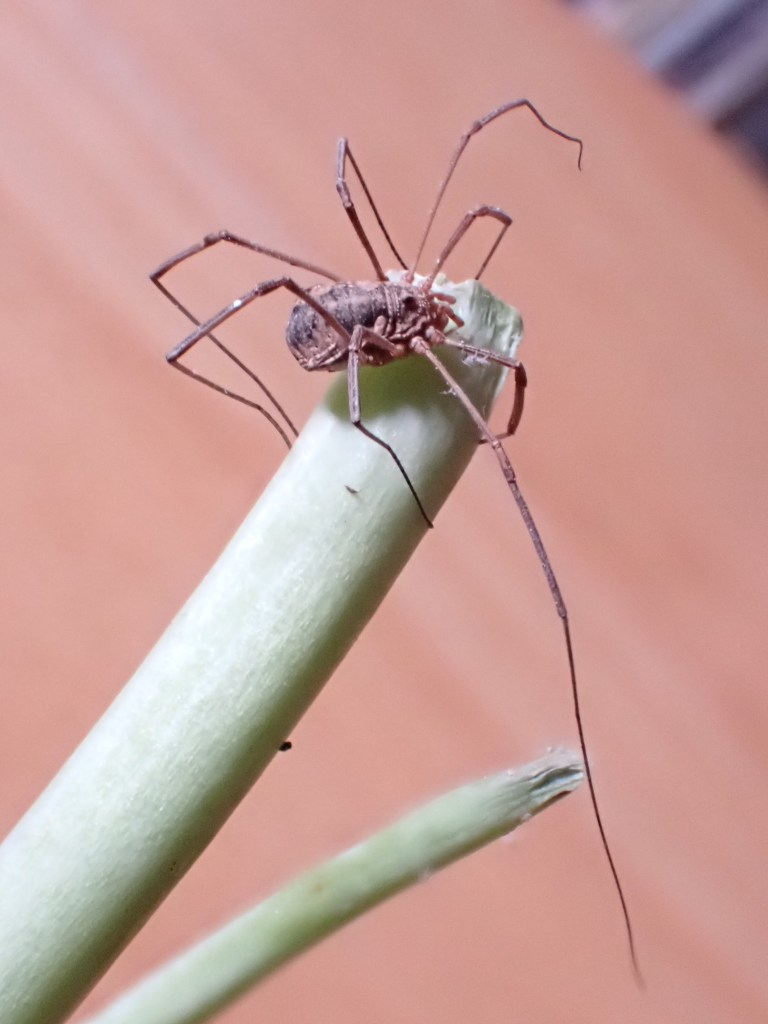
    Earlier this week, I met a Harvestman while making supper. It had stowed away on some kale from the garden, and was still walking about on it… even after a week or so in the refrigerator.

    The refrigerated Harvestman was promptly photographed and released in our garden’s cold frames.

    Harvestmen have a rather well-known urban legend. Perhaps you’ve heard people say that “they’re the most venomous spiders in the world, but are harmless to humans because their fangs are too small to puncture our skin.”This myth is mostly untrue. While Harvestmen are harmless to humans, they are NOT spiders – they’re closer kin to scorpions and mites. Additionally, they don’t have venom, though they do have some chemical weapons and chemical defenses. Some species, however, rely more on physical armor than chemicals.

    This Ecuadorian Harvestman sees no reason to limit itself:
    it has spiny armor and is putting chemicals on an arm, which it will then use as a whip!

    While many people call Harvestmen “Daddy-Long-Legs”, this common name is rather vague, and I try not to use it. It can also refer to Crane Flies and Cellar Spiders, and I prefer being specific. Incidentally, the harvestmen myth is equally untrue for those two organisms as well.

    Unlike most other arachnids, Harvestmen aren’t primarily hunters. Actually, many Harvestmen prefer to eat things that are already dead… They’re great scavengers, happy to eat dead vertebrates, dead invertebrates, and even droppings. One European species has been claimed to hang about bee hives, eating the dead worker bees that worker bees on the custodial shift are tossing out.

    Harvestmen are beneficial for our gardens though, because they can and do hunt small insect pests such as springtails. They use their tiny little pinchers and fancy chemical glue to catch their prey. If you’d like to see their feeding behavior yourself, I’d suggest waiting by a porchlight at night – I’ve found that they like to ambush and eat little moths. If you’re a bit more hands-on, Harvestmen are easy to keep in captivity, and could make a great science project (drop me an email if interested in more details).

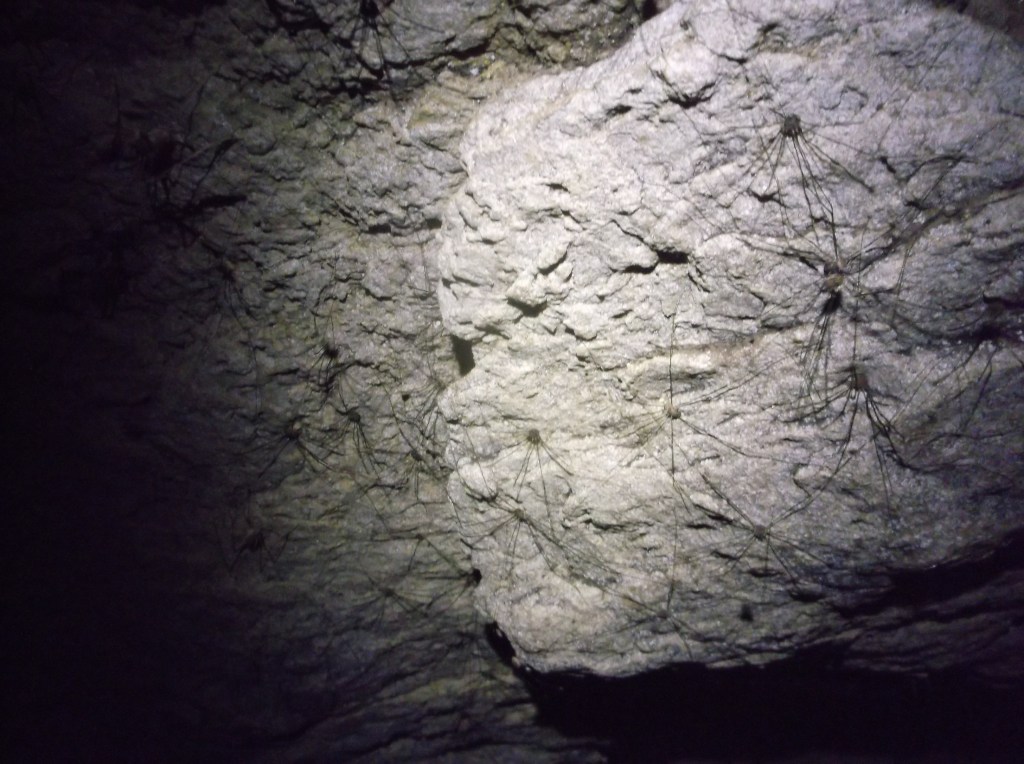
    As for why my Harvestmen was still alive in the refrigerator, these invertebrates tend to be Cold-Tolerant and Freeze-Avoidant. They’d prefer to be warm, increasing their odds of survival, so in autumn one can find large aggregations of Harvestmen. Sharing warmth, sheltering from the elements, and trying to survive the winter. This overwintering behavior frequently happens in caves, though in eastern North America, Harvestmen also overwinter in leaf litter.

    A disturbed aggregation of overwintering Harvestmen from a cave in Northern Tennessee.

    What have you observed Harvestmen doing?
    Hunting? Mating? Overwintering?