Trego's Mountain Ear

"Serving North Lincoln County"

Tag: Montana

  • 75th Annual Meeting of Lincoln Electric Coop

    75th Annual Meeting of Lincoln Electric Coop

    Like last year, the meeting took place at Lincoln County High School, and could be attended by car. Unlike last year, in person attendance was also possible. Voting for trustees had already been done (Exclusively by mail), though the results were announced at the meeting.

    In a somewhat novel experience, there were (for one district) more candidates than vacancies, so the election had the possibility of making a difference. All three incumbents were reelected, including Tina Taurman (District 7). Taurman ran unopposed, with 335 votes.

    With coffee, breakfast (Four Corners) and 75th Anniversary cake (Second Chance Bakery) available outside the auditorium (and a video stream of the stage), it was a very comfortable meeting. Attendees could choose between the easy to get out of chairs outside the auditorium (but no back support) or the chairs inside the auditorium that offered back support if perhaps a bit more difficulty in getting up. Of course, the food (and coffee) was outside the auditorium.

    Folks were evidently pleased by the opportunity to be around friends and neighbors. It had the sense of after church coffee hour, if after church coffee happened during the service. Talking stopped for the pledge, and things were a bit quieter during the doorprize drawings, and much quieter for the luck of the draw scholarships. This year, the gift cards included one to Trego Pub.

    I did try to get closer to the speakers, since the actual meeting content sounded interesting. Unfortunately, standing up gave neighboring tables a view of my service dog, and the whispering kept things just as hard to hear as when I had been seated.

    So, having cake and hearing the meeting did not combine well. That said, I do still have at least some details to share. Ryan Hall (whose article can be found in the recent issue of Rural Montana) spoke about the efforts that Montana Electric Cooperatives’ Association (MECA) made to combat a feasibility study of breaching the Lower Snake River Dams. Replacing the Lower Snake River Dams with other clean-energy options would be very expensive, and, at least in the case of solar, impractical.

    Dam breaching is proposed for environmental benefits, in this case restoring fisheries to benefit salmon is a major concern. The electric cooperatives consider the new proposed study to be part of a strategy by people that want the dams breached to keep ordering studies until one meets their needs. Members attending the meeting were encouraged to fill out postcards to be sent to the governor, supporting MECA’s aims with regards to the Lower Snake River Dams.

  • TFS: Free Community Internet and Public Phone

    TFS: Free Community Internet and Public Phone

    We have an update from the community hall– as follows:

    Trego, Fortine, Stryker Community Hall (TFS Community Hall)

    Announcing Free Community Internet Access and Public Phone

    Trego— March 12, 2022 As of today, free Wi-Fi is available at the TFS Community Hall for our community and visitors.  This area is void of cellular service and having accessible Wi-Fi coverage and phone will benefit the community by allowing communication where there previously was none.  With generous support and guidance from InterBel in Eureka, this service is now available to anyone in the Trego area.

    Safety and Convenience

    There is very little cellular service in the Trego, Fortine, and Stryker area and this means that travelers through the area are on their own if they need to reach family and friends, get directions or have an emergency and need services.  By having a publicly available land line and wi-fi that enables wi-fi calling on cell phones, the Hall is providing a valuable service to the community. There is a sign at the hall near the phone that outlines how to connect to Wi-Fi and enable wi-fi calling.    Once this is done, users can reach friends and neighbors, contact emergency services or 1-800 numbers.  No long-distance calling is permitted.  In addition, users will be able to access the internet for directions or any other purpose from the TFS Hall Parking lots.

    Product/Program Availability

    The phone will be located in the alcove at the front of the TFS Community Hall and is free for use for those without mobile phones or who cannot enable wi-fi calling.  It is available 24/7.  The wi-fi password is TheHall1947 and is available to anyone wanting to connect to the internet. 

    The TFS Community Hall hosts many community programs and with the support of InterBel, having access to phone and internet during these programs makes them far more efficient and enjoyable.  Currently the TFS Community Hall is available for rent for fundraisers and private events, they host a weekly Kids Play Day on Wednesdays at 10:30am, and distribute food on Fridays at 10:30 to over 150 families a week, and host a monthly community dinner.  All of these programs are free to the community.  The TFS Community Hall is exploring other programs and uses for the building.  If you would like to host an event or learn more you can contact them through Facebook or any board member.

    Annual Meeting

    The Annual meeting for the TFS Community Hall is March 25th at 5:30pm, free dinner will be provided by the TFS Community Hall and it is open to anyone who owns property in School District 53.

  • A Spy on Pinkham Creek

    Well, maybe we should call him an undercover agent.  In my youth, the term would have been narc.  Still, this story, from the old Forest Supervisor, C.S. Webb, is the closest to an official story of a Forest Service spy, working from the Supervisor’s office, monitoring the Pinkham Creek residents.  His whole story is at npshistory.com.

    In 1933, we were allotted 4 CC camps, and in 1931 the 4 CC camps returned and sufficient Dev-Nira and Imp-Nira funds were allotted to hire 200 men all season. In these two years, we built many miles of low-standard road, new towers and houses on dozens of lookouts, and telephone lines to serve them. A good start was made on a topographic map of the forest, and we built all the ranger stations as they stand today, except the Libby Station and the residence structures at Sylvanite, Warland and Rexford. The latter three were remodeled. The airfields at Troy and Libby were also constructed during those years. Times were hard, men plentiful, and the local populace was very appreciative of the employment provided by the Forest Service.

    It was in 1932 that Charlie Powell, ranger at Rexford, overheard a conversation at a trail camp between two Pinkham Ridgers, indicating that the Ridge-runners planned some incendiarism. He promptly reported this to me. The Ridge-runners were a rather canny clan who migrated from the mountains of West Virginia and Kentucky years earlier and took homesteads on Pinkham Creek and Pinkham Ridge. Their chief pursuits were stealing tie timber and moonshining, but occasionally they would set a few fires, “just for the hell of it – to bother the ‘Govment’ men,” and also to provide a few days’ work. A bad epidemic of these fires was experienced in 1922.

    Their planning in 1932 was to make lots of work. Bill Nagel, supervisor of the Blackfeet, and I hired an undercover man to go to Eureka to loiter and fish and get in with the Ridgers. He took an old Ford, rambled around the country, got acquainted with all of them, and finally joined their planning discussions after being accepted into their confidence. They completed their plans and set a date (August 22) for setting a string of fires from Edna Creek on the Blackfeet clear through to Sutton Creek on the Kootenai. A man was appointed to go into each drainage and the approximate spot was prescribed where he would set his fire. The complete plan, which was pretty thorough, was reported by our man directly to Nagel at Kalispell. This man was always around Eureka in the daytime, and whenever he had anything to report he drove into Kalispell during the night and was back before morning. We never phoned or wrote to him, nor did he to us. He was an ex-forest officer known to Nagel and me as a fully reliable man.

    The day before the scheduled setting of the fires, we had two or three men in the vicinity of where each fire was to be started and quite a few others at anticipated places of travel by the Ridgers in or out of the woods. Our men met several of the Ridgers, who appeared very surprised to see someone. Our fellows saw others they did not meet, and likely our men were seen, too. We had hoped to catch at least one or two Ridgers in the act, but not a fire was set. Our undercover man was out on the fire-setting expedition with one of the Ridgers and joined in their talks after they returned to Eureka. They had tumbled immediately to the fact that we had gotten wind of their plans, since everywhere they went they encountered someone. But, they never suspected our undercover man, and to this day, old timers there are wondering how we got next to their plan. I have never heard since of any attempts at incendiaries in that area. Previously, there had been several outbreaks, and one man served time in Deer Lodge for setting a fire on Pinkham Ridge.”

  • Homesteading and Risk

    Homesteading and Risk

    I saw a vague statistic the other day – an estimate that between 46 million and 93 million Americans are descended from homesteaders.  The number seems low – but my work experience is in the West . . . I have received a few paychecks from Minnesota, but most of my working life has been in Montana, Colorado, and South Dakota.  I suspect that, at least in Montana and South Dakota, the majority of my coworkers had homesteader grandparents and great-grandparents.

    My maternal great-grandparents had a story about Sitting Bull and his two wives stopping by their homestead right after my grandmother was born.  The dates of her birth and his death make the story possible, but don’t verify.  At the least, she was born in the same area and time where Sitting Bull was for the last year of his life.  My maternal great-grandparents were homesteaders,  My grandfather homesteaded in North Dakota, then finished proving up on two homesteads (which he bought) in Trego.  There is a special place for the legislation that authorized both homesteading and the land grant colleges – they were passed at a time when most of the Democrat legislators were in Richmond, not Washington.

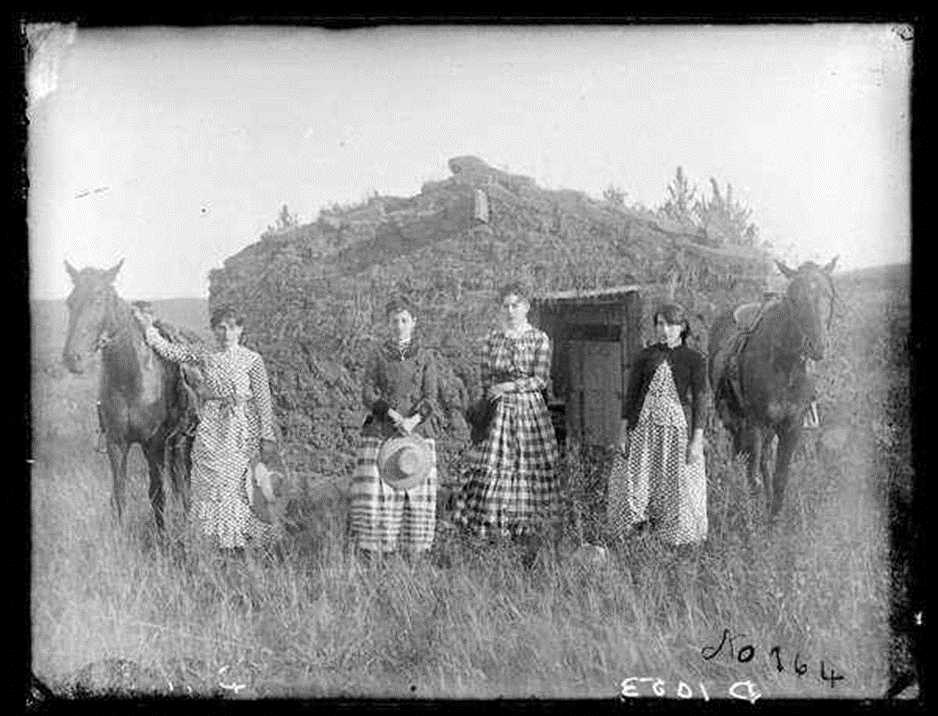
    The Homestead Act granted free land – but the homesteader had to live on that tract, raise a crop and build a house.  I’ve seen the log cabins and soddies that were their initial homes, and realize how limited the toolbox on the homestead was.  Yet the risks and hardships associated with the homesteading movement are the basis real estate investment for about a tenth of the land in the United States.  Not a tenth of the private land – a tenth of the total land mass. 

    Checking the records in South Dakota, I learned that the majority of female homesteaders near my home were Indian women – not all tribes received reservations, and these Indian women didn’t wait until 1924 for the rights of US citizenship – they were recognized as citizens upon proving up their homesteads.  Single women, white or Indian, former slaves, immigrants, all could qualify for homesteads.

    Not all succeeded.  Along the Milk River, that reliable water source also brought disease – typhus if memory serves correctly.  Homesteads were being claimed when Custer was still on active duty.  Risks from all sources were high.  Yet the Homestead Act gave Americans of all backgrounds the opportunity to risk it all for the chance to become landowners.

    Some died.  Some gave up, sold the homestead and found a job in town.  Some became landowners – property owners.  The Homestead Act provided a framework for upward mobility in rural America.  That opportunity to choose risk and hard work as a way to property doesn’t exist in today’s risk averse society.

    I think we’ve lost that link with the homesteaders – when my grandparents moved to Trego, their neighbors were people like them, homesteading to become property owners and eking out a living until the land became their own.  My last link with that generation went with the passing of Loretta Todd – I doubt if she ever realized that her comments on “Fahlgren’s Pond” were my last touch with a grandfather who died before my fifth birthday.

  • Trego’s 99-Year Lease

    Trego’s 99-Year Lease

    Part of Trego School’s playground was leased to the school in 1960 in return for water.  It makes a lot more sense if we go back in time and figure out what was going on in the fifties.

    Electricity was new, and the closest telephone was at Osler Brothers sawmill, just north of Mud Creek.  The general land price at the time was $30 per acre . . . less if you weren’t looking at the more desirable downtown Trego locations.

    From the documents, it looks like the school got electricity, drilled a well, added wiring and plumbing to the school, and then thought “a bigger playground would be nice.” The neighbors to the north, Bill and Madeline Opelt thought “Water would be nice.”  So a trade was made – in return for a 99 year lease for an acre of playground – relatively flat – the school would provide water for 99 years to the Opelt family, their heirs and assigns. 

    Trego School is on a 4.64 acre (rectangular) parcel. The area the school leases (highlighted yellow) is about .9 acres. The playground is located behind the school and includes swings, a slide, monkey-bars and several large tires, painted and partially buried

    Originally, the water went to the horse trough, not the house.  Bill had three elderly work horses that he called appaloosas – while they had the spots, they were definitely draft horses, and I didn’t realize the history that they represented for years – until I took a job at Chinook, near the Bear’s Paw Battlefield, and learned of the glorious military efforts of the Montana State militia at that location.  As near as I recall the story, the militia was tasked with running off the Nez Perce horse herd . . . and once they got them moving, drove them southeast to Billings or some such location, and sent them through the auction.  The Nez Perce mares were crossed with draft stallions, and provided work horses across Montana.  Bill may not have known the whole story, but he was right – his horses were descendents of the Nez Perce Appaloosas.

    I could end the story there – Bill wasn’t interested in putting the water indoors.  He explained how he had a deep hole under his outhouse, with even deeper poles under each corner, and nobody could tip it over.  It wasn’t an argument that I would have used – but I was raised around flush toilets and kind of bigoted.  Bill later lost his vision – as I recall he took a fall after cataract surgery.  He was one of our last veterans of World War I.

    It looks to me that on January 22, 2059, much of the school’s playground will go back to the assigns of the Opelts. 

  • Stahl Peak Snowpack in March

    Stahl Peak Snowpack in March

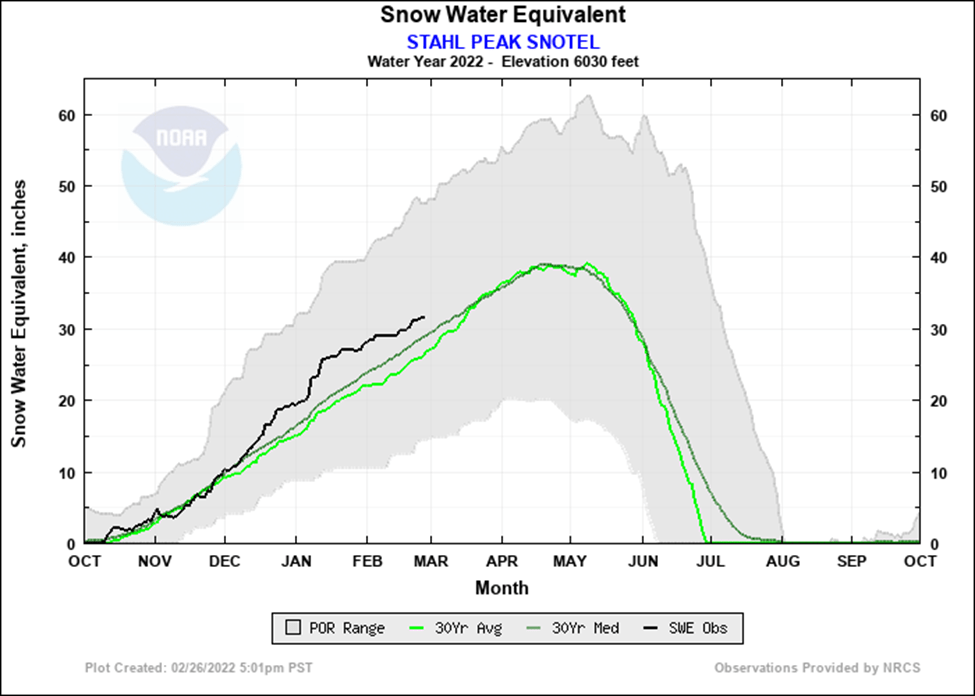
    Stahl Peak’s snow pillow continues to report that the snowpack is above the long-term average:

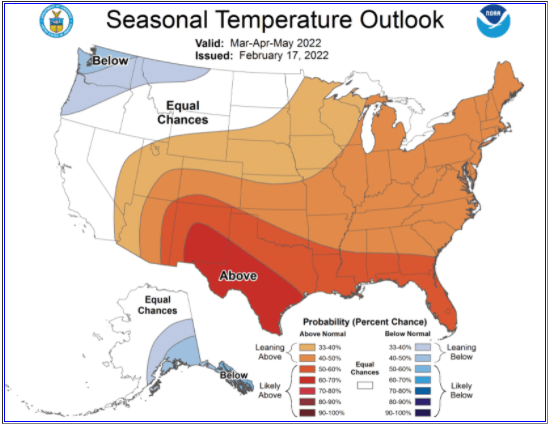
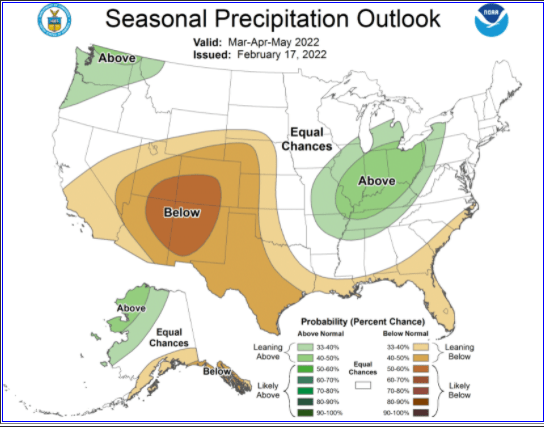
    The three month outlook (March/April/May) has temperatures leaning below normal and precipitation leaning above. Looking at further predictions, the forecast for the longer term has temperatures above average and precipitation below. In other words, starting out wetter and colder than usual, and being hotter and dryer by the June/July/August forecast.

    Temperature is leaning below normal
    Precipitation is leaning above normal