Trego's Mountain Ear

"Serving North Lincoln County"

Tag: nature

  • The Christmas Goats

    The things I don’t know about goats would fill books. But it has been great watching my community spontaneously move into action, small group by small group to do something about two shaggy goats that moved onto the Ant Flat Ranger Station just in time for the Christmas season.
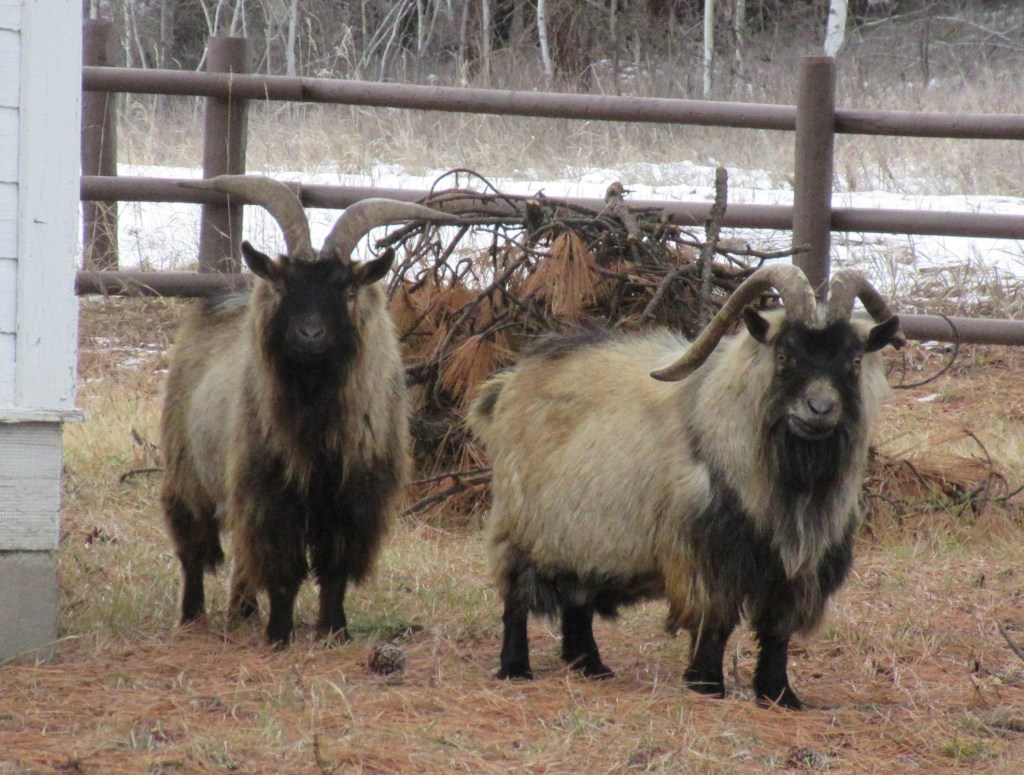
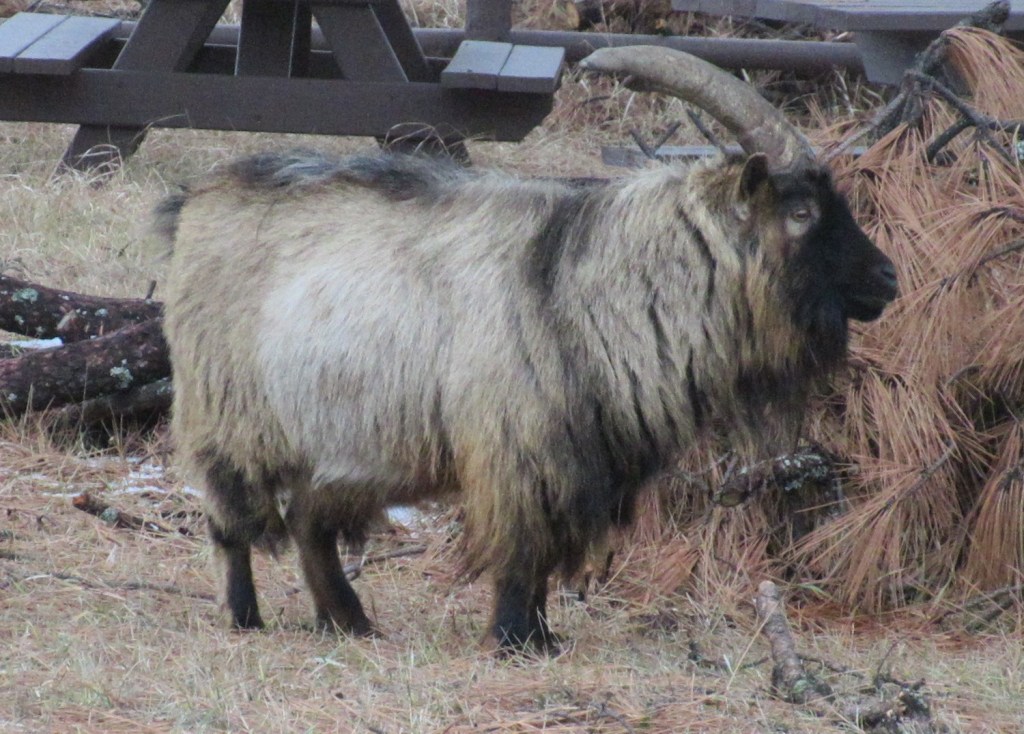
    In some ways their rescue was a bit of a comedy – first the challenge was finding the owner who had lost them, then the assumption was that they had been abandoned. Then the explanation – they had been wandering on their own for most of the year. Renata and I drove down to see them – the long, shaggy coats testified that they had been on their own for a long while. When I stepped out of the car and walked toward them, they ran around the building – but when I turned back to the car, they followed. However long they’ve been on their own, the pair remembered that humans are good creatures.

    And I watched the informal organization on the Trego, Fortine, Stryker Facebook page. First it was folks searching for an owner, folks bringing goat snacks to the old Ranger Station. Then the annoyance at animals being abandoned – and finally the individuals coming forward with determination, a pickup and horse trailer to rescue the goats.

    The rescue didn’t go smoothly – one goat was captured and hauled to a safe place – which left the other alone. Some of the folks who had been following the goats started to chime in on the errors. Now I wasn’t part of the rescue – or of the critics of the rescuers – but there is a little that I do know about goats:

    First, goats are herd animals. A lone goat is not a happy goat. Same as cows and horses, they are social animals. Second, goats are easier to catch when you let them catch themselves. Third, a goat’s pupils are different than ours – they’re kind of like horizontal rectangles. It makes for absolutely fantastic peripheral vision. The book tells me that, without moving their heads, they can see in 340 of a circle’s 360 degrees. A cat’s vertical pupils help the cat to succeed as an ambush predator. The goat’s horizontal pupils make them downright difficult to ambush or sneak up on.

    Facebook reads like the second goat was captured by a couple of women who brought their own goat along – demonstrating to him that they are trustworthy. The photo shared on Facebook showed some pretty respectable ropes around him after he had been caught.

    But the story isn’t about the goats – the story is about the high quality of our neighbors. These are people who will go the extra mile because a couple of goats don’t have a home. These are the same people who will rescue kittens and elderly dogs – in spades. I live in a good neighborhood with good neighbors. I didn’t see anyone calling on the government to fix the problem – I saw people who observed animals in distress, chose to act, and by the time they were done, two goats have a home for new year. They may have been homeless at Christmas – but my hat’s off to the neighbors who took the initiative to get the goats a home for their future.
  • The January Run

    It’s the week before Christmas. Fifty years ago, I was on a Ski-doo Alpine, making the January Run. It was a partial run – mostly for the purpose of rewinding the clockwork recorders that measured the height of the antifreeze solution as deeper snows compressed the snow pillows (a snow pillow is a rubber bladder, filled with antifreeze – I measured a lot of them, but rarely saw one).

    It’s a different world now – instead of pushing twin tracked snowmobiles up Grave Creek to sample Weasel Divide, then sample Stahl Peak and rewind the pillow, I can download the measurements from my armchair. Today, the only need for snow surveyors is to visit the site, and provide the measurements that allow the correlations with the (longer established) snow course. The real iron men of snow surveys were the generation before me – they did it all on skis and snowshoes.

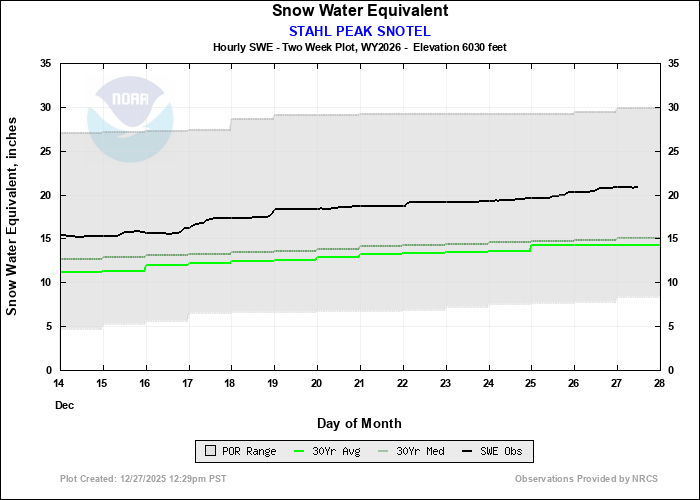
    So, in memory of the job that once brought me envy (“You really get paid to ride snowmobiles?”) Here’s what the data recorder has to say about Stahl Peak today:

    I like the chart – and the long-term data (for the last 30 years – it really does make me feel old to see that my measurements from 50 years ago, are so far in the past that they’re not included. But even a half century ago, I had learned that climate, like weather, changes – it’s just slower to change).

    6 Hour
    SWE Change
    (inches)
    12 Hour
    SWE Change
    (inches)
    24 Hour
    SWE Change
    (inches)
    48 Hour
    SWE Change
    (inches)
    1 Week
    SWE Change
    (inches)
    0.000.000.501.202.40
     Daily Statistics
    Latest Observation is 20.90 inches which is 147 % of average
     Note: The Median/Average is based upon the 30 year period 1991 to 2020.
    The Min/Max is based upon the Period Of Record (POR).

    So, at this time, the snowpack on Stahl is about 150% o the average. If you click on the NCRS site, you’ll see where the Kootenai basin sits:

    Basin
      Site Name
    Elev
    (ft)
    Snow Water EquivalentWater Year-to-Date Precipitation
    Current
    (in)
    Median
    (in)
    Pct of
    Median
    Current
    (in)
    Median
    (in)
    Pct of
    Median
    KOOTENAI RIVER BASIN
      Banfield Mountain55806.8   6.2   110   19.5   10.3   189   
      Bear Mountain546016.8   18.8   89   47.4   31.8   149   
      Garver Creek42503.3   4.7   70   15.2   9.0(24)169   
      Grave Creek43503.0   5.2   58   28.8   14.3   201   
      Hand Creek50303.6   3.9   92   11.6   7.2   161   
      Hawkins Lake646014.3   9.8   146   25.8   15.2   170   
      Poorman Creek50508.8   11.4(22)77   46.1   25.9(22)178   
      Stahl Peak604020.9   14.2   147   27.1   18.2   149   
    Basin Index (%)104   168

    The percentages are impressive – but there is a lot of winter yet to come. I don’t have data based on the Bouyoucos blocks we once measured to show how much moisture is stored in the soil at the sites – but I’d bet the soil moisture is at 100% capacity too.

    It’s a pleasant thing that the data is so readily available anymore.

  • Time Was

    Time was when I would catch a cold and work my way through it – a certain amount of misery, but no lost productivity. That time seems to be gone. As I recover from this last plague and contagion, I recall the words of Leon Trotsky: “One of the most surprising things in life is the sudden realization that one has become old.” I’ve reached that epiphany – though not with a life so much on the margin as his. My favorite variant of his quote is: “Old age is the most unexpected of all things that happen to a man.” Somehow, I have found old age, it is unexpected every morning, and each task I undertake that reveals a new, or a slightly greater infirmity that is as unexpected to me as it was to Trotsky.

    Today I noticed a Facebook post from an Idahoan who decided to contrast the long-term precipitation records on Bear Mountain and Rattle Creek with the recent events that led to floods on Keeler Creek and Rattle Creek. When I reviewed the records he shared, I found that he didn’t go back far enough to show the year when Jay and I had to go past Bear Mountain, and down Rattle Creek to get the snow measurements for Idaho – access was no longer possible from the west.

    I was nervous about Rattle Creek – my avalanche safety class at Snow Survey Training was taught by a guy who had made his reputation in an avalanche trap called Rattle Creek – and, having heard his warnings, I wasn’t really at ease about the opportunity. Getting in through Keeler Creek was a challenge – shovel the snowbank down to a spot where we could ford the creek, park the snowmobile in shallow water, shovel a new ramp up through a five or six foot snowbank as quickly as possible, and repeat about a dozen times until we left the washed out road and arrived at the Bear Mountain snow course. From there, follow the map over the mountain, and proceed down to Rattle Creek snow course. It was a cake walk – I should have realized that, since we regularly sampled Bear, all of the Rattle Creek hazards were below that snow course. The security of that part of the trip was unexpected.

    When we returned to the road that Keeler Creek had washed out, we encountered a half-dozen recreational snowmobilers – the trails we had shoveled up the snowbanks were good enough for our twin-track Alpines – but the lighter machines had a rougher time. Funny to realize that the data from one of my tougher runs is now ancient history, and doesn’t show up on the readily accessed records.

    The trip taught me that, while the snowfall and precipitation around Troy and Libby is every bit as intense as what we see on Stahl Peak, we’re lucky that our valleys are a bit higher, our mountains are a little higher, and Fortine and Grave Creeks do not share the same peak runoff times. They have it rough when winter floods hit the low country in south Lincoln County. Libby Dam has definitely served it’s flood protection purpose this past few days. But I never expected to be around when my snow measurements became ancient history.

  • Weather Changes – And Climate Does Too

    I’m looking at the ten day forecast – basically rain and above freezing. The precipitation side matches the NOAA long-term outlook, while the temperatures do not. Still, the national outlook suggests that the lines on NOAA’s map just wound up a few miles off. Weather forecasting is a science where errors are not uncommon – and climate is not constant. If it were, there would be glaciers north of Eureka covering the drumlins.

    One of the consistencies is the adiabatic lapse rate – the decrease in temperature as a chunk of moist air rises. It’s not a perfect way of modifying a weather prediction for Eureka – but if I guesstimate that, because of the 3,100 feet elevation at Trego (opposed to 2,700 feet at Eureka) the temperatures will be 2 degrees (Fahrenheit) cooler than Eureka, it winds up fairly close. Right now, with lows around the freezing mark, I figure most of the snow will be gone before it gets cold again – and the pond will be full before it freezes a second time. The predictions call for daytime thaws until the solstice – and after the solstice, the days begin to get longer.

    Ten thousand years ago the area went into an interglacial – a time when the glaciers went away. Technically, so long as we have polar (and Greenland) ice sheets, we’re in an ice age. Still, at the least, more melting can lead to a longer interglacial. This interglacial was the time when most (an argument could be made for all) of our food crops were developed. Warming may give us a longer growing season – but if our local precipitation stays the same, water, not growing degrees becomes the limiting factor.

    But the management choices are the same – my hay needs to include water tolerant, drought tolerant, and salt tolerant species. As I can get out with the chainsaw, the timber needs to be thinned for better growth, for a return to grazing and for fire control. Climate, like weather, changes.

  • Winter Thoughts

    As I look at the trees, I see bending from the snow loads. Some have snapped, while others have gone over at the roots. It isn’t a complex decision – I’m about to re-block and re-level the sawmill, and the stuff that is too small to make a log will make next winter’s firewood. Douglas Fir tends to roll over as the roots fail, while the tap roots of the Ponderosa Pine leave them susceptible to snapping. Western larch seems to be (at my elevation) immune to the snow loads.

    The midge spread diseases show a lot fewer whitetail deer browsing on the downed Fir trees. Last winter, if I started a chainsaw, a dozen or more deer would show up for the potential buffet. Now, many fewer deer. I suspect that the increased number of coyotes will likely also have problems by the time Spring rolls around again.

    The ponds are frozen – our next influx of waterfowl will be in the Spring – yet the decrease in feral cats has led to a great increase in the little squirrels. At the house, my aging dog is almost totally deaf. She seems to be compensating for not hearing by barking more. I’m not sure how that works out.

    As I look at the downed trees, I recall the idea that a properly thinned forest will produce the maximum timber and 80% of the grazing. My challenge is to get the cleanup and salvage moving along – not for me, but for the next generation. I have always planted fruit trees where i lived – someone will harvest the fruit, just as I have harvested the fruit from trees that landowners before me have planted.

    It is winter – but soon Spring will return, with the fawns, the ducklings and the goslings. And I will putter indoors until Spring comes north again.

  • Chesterton’s Fence

    As I move toward my 76th year, I have a fence to remove – mostly because I’m the last one left who knows why it was built about sixty years ago. It still has the original barbed wire, all the wooden posts have been replaced, and it’s not in a place where a fence should be.

    https://theknowledge.io/chestertons-fence-explained/ tells of Chesterton’s paradox on fences: “He once wrote: “There exists in such a case a certain institution or law; let us say, for the sake of simplicity, a fence or gate erected across a road. The more modern type of reformer goes gaily up to it and says, ‘I don’t see the use of this; let us clear it away.’ To which the more intelligent type of reformer will do well to answer: ‘If you don’t see the use of it, I certainly won’t let you clear it away. Go away and think. Then, when you can come back and tell me that you do see the use of it, I may allow you to destroy it.’”

    In other words, don’t be so quick to tear down things you don’t understand. That fence may have been put up for a very good reason, even if that reason is not immediately obvious. To ignore that reality risks unintended and potentially negative consequences.”

    That’s why I need to remove the fence. I know that it was put in when a cat skidder ran a line in to separate the ranchland from the trailer park – basically to solve a temporary problem. A problem of no more than five years duration. And if I leave it, my grandkids will be looking at Chesterton’s paradox – looking for the reason the fence was built. It’s in a spot where it’s downright inconvenient to maintain. It makes several acres of forest virtually impossible to keep thinned out and use. And, as the last person around when it was built, I owe it to the future generation to remove the dilemma. It briefly provided a solution to a small problem, was maintained to provide that solution when the problem no longer existed, and once it’s gone, the old cat line can provide a good firebreak for the next half-century.

    I don’t find any enjoyment in taking down a fence, rolling up barbed wire, pulling the metal posts and clearing things out. It’s an unpleasant task fraught with barbed wire knicks on my body. But it needs done – and Chesterton’s paradox reminds me that the work needs done in my lifetime – mostly because I know it was a bad solution installed because Walsh/Groves had a cost plus contract for the tunnel, and they made a profit whether the fence was put in a good place or a terrible one. And I don’t want the toddler to grow up and have to face Chesterton’s paradox without the necessary information.